
When Your PDA, Autistic Child Can't Separate and You Just Want a Break

**You can also listen to this in audio format only on The Regulated Mother Podcast on Apple or Spotify. Look for Episode #57
Why co-regulation becomes so hard with a child who can't leave your side | Part 1 of a three-part series
When They Need You Every Single Minute
Do you have a high needs child or teen who just needs so much of you, and finds it so hard to separate from you?
Maybe they're PDA or autistic, or maybe they're just highly anxious and sensitive, and they have this constant need for co-regulation and for your undivided attention. So they won't let you go to the bathroom by yourself. They follow you from room to room. They hear the toilet flush and call you right back to them. You can't cook dinner without them needing you every few minutes, even when the dinner is for them.
And what you want, most days, is just a little bit of space. A little reprieve. A few minutes where nobody needs anything from you.
And then for some of you, you decide to take that space, and then you pay for it afterwards. The rest of the day is harder, or the next three days are. So eventually you stop taking the space at all, and now you feel trapped.
For some of you, there's nowhere to take that space from in the first place, except maybe those last ten minutes at midnight, right before sleep.
And for most of you, there's guilt sitting on top of all of it. Guilt for even wanting to just get a break from your child.
So here's what I want to say today.
This kind of co-regulation is real labour. It costs real energy, and you are not weak, or a bad parent, for finding it heavy.
But what I've learned is that there's a whole other layer underneath it that makes this so much harder and more exhausting than it needs to be. Seven things, actually. And every single one of them can be worked with. Because when you work with these seven things, it actually begins to lessen the stress load you carry in this kind of parenting.
This is part one of a three-part series. Today I want to show you what's actually happening in your nervous system when your child cannot leave your side and needs you all the time, so that you can start to see what's happening in you.
Next week we'll go into the seven moves that help your nervous system feel less exhausted and more free. And in part three, we'll look at the question that so many of you carry. Am I giving too much? How will they ever learn? And how can I help my child to be able to separate from me and be okay without me?
So this is for you, whether your child is young or well into their teens.
Let's begin.
The Day I Drove Away
I was starting work again after a few months of being with my son daily, after he went into burnout.
I remember this moment. I was sitting on the floor by the front door with my son, and he was begging me not to go.
I gave him love. I stayed connected. I didn't rush him. And I tried to help him focus on the next point of connection. I said, I look forward to seeing you at 5pm, and we'll snuggle on the couch, and I'll give you a hundred kisses, and I'll bring you home some yummy food from your grandma's — which is where I was going to work.
And then I went out to the car, and he chased me.
So I paused several times along the way, trying to give him space to adjust and regulate. And then I got into the driver's seat, and he ran to the door and wouldn't let me close it. So I allowed some time right there as well, just to give him more autonomy in it, and to pace it gently for him.
But he kept panicking, and he started to really spiral. He was screaming and banging the car.
And then finally I really had to go. So I gently shut the door, and then he panicked even more. I told him to go onto the sidewalk, and I called his dad out to help.
He tried desperately to get into the car. He kicked, and he screamed.
And I was on the verge of tears. I felt horrible for leaving him like that. My guilt was so heavy at that time, and there was also this surge of fear in me, because I was leaving him after we had been together every single day for months.
And finally my husband was able to pull him away so that I could drive off.
And I cried the whole way to my mother's house, wondering — why is this so hard? And why was he acting like he was dying? And why did it also feel, inside me, like I was dying?
Let Me Tell You How We Got There
Because I want to give you some background here that I think is important.
I've always been the strongest co-regulator for my son. And at the same time, I've also had a nervous system that was so challenged by how intense his needs are, that I could reach a threshold and blow at times, or become disconnected at times.
Since my son was a baby, right up until now at 18 years old, separating from me has been so hard for him.
He had birth trauma. He was taken away from me at birth, and he was in the NICU for four days. And I know deep in my being that this left a traumatic imprint in his nervous system.
And then he went into burnout around the age of nine, and he stopped going to school, and his need for me became so much more intense than it had ever been.
It was like he was little again. Like he was a baby or a toddler. And that's genuinely what it felt like — a nine year old who needed me the way he needed me when he was a baby, or a two year old.
He wanted to come to the bathroom with me all the time now. If I turned my attention to the kitchen, even to make his food, I would watch him get more and more anxious, and then he'd start to escalate. Even if what I was doing was for him.
Just moving my attention onto anything else made his nervous system activate and pursue me, until he had all of my attention again.
And if I tried to work in our home office upstairs, it wouldn't be long before he came up and interrupted me. And if he was really dysregulated, he'd bang on the locked door, or he would find a way to come right in — sometimes while I was in a session with a client. And that was such an incredibly uncomfortable place to be.
Now, because I knew so much about attachment and trauma at that time, and about his neurotype and what he needed, I often felt so guilty. And I felt fear too. Like I wasn't giving him enough of me, and that if I just gave him more of me, then his attachment system and his nervous system could feel safer and do better in life.
So I would feel this pressure to be his everything, and to override my needs to give him more of what he needed.
And then I'd swing all the way the other way and just want space. Just wanting a break, and some quiet, and a few minutes where nobody needed anything from me.
I have had so many moments where I'm sitting with him and my body is just automatically leaning away from him, or my legs start to twitch, wanting to just run. These were automatic flight responses that just came, and I had to hold them in.
But then came the guilt. I felt like this is not how a parent, and especially a mother, is supposed to feel.
It was a really impossible, no-win, no good solution situation. And I often felt trapped in this reality that I could not change.
So there was a period of time where I took some time off work after he went into burnout, so I could give him more undivided attention. And I gave it my all. But over time, I became more exhausted and more unhappy.
And then one day I decided to go back part-time. I really needed it. I loved my work, and I felt that I was a better mother to my son when I could work. But we also needed the money, and that was our reality.
So I couldn't work at home now, because of the interruptions. So I decided to use my mother's home office, which wasn't being used.
And that morning at the front door, which is the story I just told you, was the first day I was going to work there.
Why It Felt Like I Was Dying Too
I want to come back to this, because it felt so intense inside. These moments where he was in so much distress, and he was having such a hard time separating from me, and then I would have all this fear and terror getting triggered inside of me, and feel like I was going to die too.
That's the question that really stayed with me from that drive. Why was this so hard for me too?
You would think I would be happy to be leaving and getting a break. I'd wanted a break for months. And instead I felt like I was breaking down too.
And later, as I explored this, I realised how much of me being okay depended on my son being okay. And how much me choosing me felt like I was abandoning him.
And how much my own inner child — who felt emotionally abandoned and alone earlier in life — was getting triggered right there in the car, and in that whole experience.
So I want you to take that in for a moment, because I think there is so much loaded into these situations with our kids. So much more than what's just happening on the surface.
And there was something else that was true for me the whole way through, until I learned to change these patterns and feel safer inside all of this. I was the one who could settle him when nobody else could. And I was also the one quietly running on empty, and sometimes blowing, or shutting down and disconnecting, when it all became too much.
Both of those were true at the same time. And for a long time I thought that was just me. That other parents were somehow managing this better, and that something about me was making it harder than it needed to be.
The Bind Every Parent Describes to Me
But this is what I've heard from so many parents since. And it's almost always the same shape.
We have these instincts as a parent to meet our child's needs. Every parent has this. It's wired in.
But then we learn about attachment and co-regulation, and we realise how much we didn't get as kids ourselves. And then our own younger hurt parts drive us even further to make sure we meet our children's needs, just so that we don't have to feel our own past pain getting triggered.
So there is always something from your past getting triggered in this parenting experience.
And then the next layer is that you throw in the neurodivergence of our kids, and they have a highly sensitive system, and their system doesn't always receive the secure attachment cues that we're sending to them.
So then what happens? We are driven to try harder. Because we're not getting that reciprocal feedback from our kids that helps to settle our own nervous systems too.
And then we become exhausted. Because it's never enough for our child. And because we just need a break too, since we are human, and all nervous systems need breaks. Even from other humans. Even from co-regulation.
And here's something else I want to name, because I don't think it gets talked about.
Co-regulation, in theory, is supposed to feed you back. It's supposed to fill you up too. That's how it's meant to work between two nervous systems.
But it doesn't always work that way with neurodivergent kids, who don't reciprocate the cues that what we're doing for them is landing, and working to calm them and develop their systems.
So that feedback loop isn't there for us. We don't get that oxytocin hit, or that dopamine hit — those chemicals that fill us up, that make us feel good, that make us want to keep doing this.
And it takes so much longer for us to see results in our child, to see those reciprocal cues in them. Years, even.
So we spend years feeling like we are giving at the expense of ourselves, without ever getting to fill our own cups from seeing the fruits of our labour on a daily basis.
This is why it's so hard, my friends. This is genuinely why it's so hard.
And then we are often met with this deep internal bind. This was my bind:
To give my child what he needs means I lose myself. And to give myself what I need means my child doesn't get what he needs.
So just take that in for a moment, and notice if you feel that too. Because this often goes unnamed.
As parents, we choose the child every time. And I'd argue that this is even more often true for mothers, just because of the way a mother's system is wired to feel her child and nurture them. But this happens for dads too, for sure.
And this makes so much sense to me now. Of course we do that. That's not a flaw in you. That's part of the design of being a parent.
The Messages I Get Every Week
I get these messages almost every week. And what always gets me is that they arrive in almost identical words. So see if you hear yourself in this.
I can never get a break.
If I take space, it gets worse, so I just stay.
I've given up so much I don't recognise my own life anymore.
I feel trapped.
It's never enough. No matter how much I give, they always want more.
And then some of them tell me something that's harder to say out loud. That it doesn't feel like connection anymore. That it feels like a job they clock into every morning. That co-regulating their child has become one more thing on a list of heavy responsibilities.
And then some of them tell me this one, usually with a lot of shame. I hear them coming down the hall, and my whole body tightens before they've even said anything.
And then there's another one that comes up all the time, and it's a different kind of worry. Am I giving them too much? Don't they need to learn to be okay without me? If I keep doing this, if I keep accommodating, if I keep giving them so much attention, will they ever learn?
That one deserves a whole episode, and it's getting one. That's coming in part three.
And then underneath all of those, there's this other belief and feeling. I must be doing something wrong. Or, I'm not doing enough. That it's not landing in them, so I'm not doing enough.
And finally: I feel so guilty for even feeling this way. That I want to get away from my child. That I want a break. That I feel all of these things about this experience.
The Seven Things Draining You
So let's get into the seven things that drain you, that I discovered in this experience.
It's really about understanding what's actually happening in your nervous system. Because when I understood this, it changed how I related to myself in it — and honestly, that's what changed first. And this did help the situation significantly for me and my son too.
And I want to say this before I get into it. None of this is you failing. This is the survival system doing exactly its job, in a situation it feels like it cannot solve. A situation that feels like there are no good choices.
So let's start with the simplest truth here. Co-regulation takes energy. It just does, hands down.
And to do this much of it — which we need to do for our kids — without ending up in exhaustion and stress load, you need three things.
You need to feel like you have some choice. Some autonomy. Including the autonomy to meet your own needs.
You need energy and capacity to handle all that is in front of you.
And you need capacity and tolerance for their distress, and for your own distress getting triggered inside of you.
And what happens in this kind of parenting is that all three of those get eroded.
So let me show you how. Because there are five things that happen in the nervous system, and then they pile up into two more, making it seven.
1. Blocked flight energy.
When we're co-regulating, our nervous system will naturally want a break from it. This is part of the nervous system design. You connect, you take a break, you connect again.
But we don't get this break with kids who need our attention constantly.
So then our systems mount these impulses or urges to get away. That's the flight response of the sympathetic fight-flight nervous system. But we cannot follow those impulses. So we unconsciously block or thwart them instead. We can't just run away from our child — although sometimes we try to. Go into another room or something.
You want reprieve. You want space. You want five minutes where nobody needs anything from you.
For my system, when I first learned how to tune into this, I noticed my body would start to lean away automatically, or my legs would twitch, wanting to run, while I sat there with my son for hours.
Those are flight responses, trying to get you back to feeling safe, in a body that isn't going anywhere.
And when that impulse never gets to move anywhere, it doesn't disappear. It stays in your body as unfinished activation. And then later it comes out. Sometimes as a fight response, where you snap at somebody who didn't deserve it, like a sibling or your partner. And sometimes it comes out as shutdown, or exhaustion, and that flat hopeless feeling at the end of the day.
So when you explode, you're not exploding because you're a bad parent. You're exploding because activation that never got to move is finally moving and getting out of your system.
And there's always a meaning here too. Remember, we have the nervous system body response, and then there's always this meaning underneath that's bound up in these impulses.
And with the flight response, the meaning is often: I can't take a break. They won't be okay without me. It'll get worse if I do take a break. And I can't tolerate their distress if I followed my own impulses for what my body needs.
2. Blocked fight energy.
This is the NO that you feel like you cannot say.
You're on an accommodation protocol. You're accommodating your child more, because that's what they need. So then you feel like you can't say no. You can't have boundaries.
You have this impulse to push back, or to say no, or to say that's enough, or you want to have a boundary — and you hold it in, over and over, all day long.
This is the same mechanism as the flight energy. It's the same sympathetic fight-flight system, just the other direction. It's a survival response that again cannot complete, because we don't fight our children and we don't express that no. So it stays in the system.
And then when you find yourself feeling resentment towards your child for how hard this is — that's the blocked fight energy.
It's not a character problem, and it's not evidence that you don't love them. It's fight energy that had nowhere to go, and so it ends up ruminating in your system as resentment.
And the meaning bound up in this reaction is often: I can't say no or it'll get worse. It isn't safe to say no. They need this much accommodation from me, and they need fewer demands, not more.
3. Guilt and self-criticism.
We often feel so guilty, and even ashamed, for feeling the resentment. Or for having this feeling of just wanting to run away from our kids and have space. And then perhaps we even feel that it's selfish to feel that way.
Or we feel this rage welling up and just want to scream and yell at them to back off — and then we feel bad for that too.
So there's this guilt and self-criticism layered on top. Even though these are natural nervous system reactions to this kind of situation, where we are giving so much of ourselves and overriding our needs.
This is the load we add on top of an already loaded system. Guilt, and self-criticism, or self-judgment, for having these feelings, impulses and needs.
And it's another place where a feeling of no choice gets triggered. It feels like allowing ourselves to feel that fight or flight, or even completing it, is not a good choice. So the only option becomes to turn that fight energy inwards towards ourselves, as self-judgment and self-criticism.
And then on top of this, the second guilt we feel is the guilt for our kids' suffering. That it's so hard for them, and I feel so terrible for my child. So we feel even more bad for having these inner reactions, because they're the ones who are suffering so much.
So see if that happens within you. Just notice.
4. The fear and the pressure about their future.
This is a big one for us parents of high needs kids. This future fear gets triggered constantly.
It's the fear that if I don't constantly accommodate their needs now, and be this way with them right now, then they won't be able to meet their basic needs, or develop the skills that they need, or develop a safer nervous system, or be more functional in their life.
So every break you take doesn't just feel like a break. It feels like a withdrawal from their future.
And that's a very heavy thing to carry into a decision about whether you can take some space, or even just have a shower.
I'm laughing about that, because you know how many times I said, I'm not going to take a shower now — even though I desperately wanted to — and I stayed dirty just to accommodate my child.
And the meaning underneath that is often: I have no choice but to keep doing this. And if I don't give enough now, I will be harming their future.
That's a big load to carry.
5. Grief.
Then there is grief. So much grief in this parenting experience.
Grief for the autonomy you feel like you don't have. Grief for the loss of work, of friendships, of the person you used to be. Grief for the life you thought you'd be living by now. Grief for the sibling who suffers as a result of the high needs child and all that they need.
And grief for your child too. For how hard their life is, and how much they suffer, and that you can't take any of that away from them.
And there's a particular kind of grief in here that I want to name on its own, because I hear it constantly and I lived it. It's the grief of feeling so unsupported.
It's having to give up all of your needs and having no help. It's doing this without enough hands, without enough money, without a partner who sees it, or without family nearby who understand it, or without anyone — even friends — who actually understand what your day looks like.
And it's that feeling of being completely alone inside this kind of parenting. Alone in a way where you look around and realise there's nobody coming.
And when grief doesn't move, it tends to come out sideways. It keeps the nervous system stuck in resentment — because grief is hard to sit in, so we sit in resentment and that fight energy instead. Or we go into that fight energy of trying to control and fix our child. Or we become depressed.
And the meaning underneath this is often: this isn't the life I wanted, and I have no choice about any of it. No choice to meet my own needs. No choice to change my child. And they have to suffer like this forever.
So there's that no choice again. And that feeling like a victim — for yourself, and for your child.
And Then It All Piles Up
Now I want you to notice something about all five of those things.
Every single one of them has no choice sitting inside of it.
No choice to fight or say no. No choice to flee or get some space. No choice to even feel any of these things, so the fight turns back on yourself with self-criticism and self-judgment. No choice but to keep giving, because of their future. And no choice about the losses, or about your child's suffering.
So that's an enormous pile of no choice. And it doesn't stay as five separate things. It piles up, and it culminates into two more things that happen in the nervous system.
And I want to mention here that choice is a necessity for the nervous system to feel safe.
So can you imagine how much we feel like we have no choice in this parenting experience? No wonder our nervous systems don't feel safe.
6. Your system goes into feeling trapped.
When your system doesn't feel like it has choice, and doesn't feel like it can fight or flee, it drops into a place of no choice. And that's when the trapped feeling gets triggered.
Trapped isn't just a feeling, though. It's also a nervous system state. It's a freeze or shutdown state, where all of that fight and flight energy gets bottled up and held in. And holding it in actually burns a lot of energy, which is a big part of why you're so exhausted.
But this is your child. So you keep functioning. You keep getting up. You keep going to them when they call. And underneath all of that, this load is just building and building, and nobody can see it — including you, a lot of the time. Until perhaps it reaches burnout.
And the meaning underneath is often: there are no good choices here, and there's no way out, because this is my child. So yes, it feels like this trapped feeling is forever.
7. Your child slowly becomes a cue of danger to your nervous system.
And this is where it ends up. This one is different from the others, so let's understand it.
The first six happen in a moment, or in many moments. This one builds over months, and even years.
Here's the mechanism. If you cannot fight them, and you cannot flee them — and you can't, because they're your child — then all of that survival energy has nowhere to go.
And then your brain's meaning-making centres start doing what they're designed to do. They look for the source of danger. And over time, your child gets wired into your amygdala as a felt sense that they are the source of the danger that you feel.
So it's not a conscious thought. You wouldn't often consciously think that. It's below thought. It's below the level of conscious awareness. It's an association that gets built one blocked impulse at a time.
And that's what this tightening in our system is. That's what's happening when you hear them coming down the hall, and your shoulders come up before they've said a single word.
It's not a sign that you don't love them. It's a sign that your survival system has had nowhere to put any of this fight or flight energy for a very long time — or these intense, deeper emotions that get triggered.
And here's the part of this that might be the most important thing I say today.
Once your brain has flagged your child as a cue of danger, it stops letting you take in the good moments.
That's negativity bias. Your brain is built to hold onto threat and let the good stuff slide right off.
So you get moments of real goodness with your child. We all do. They may be small and fleeting — maybe there's a snuggle, maybe there's a laugh, maybe there's a little thing they said or did that lit them up. And you can't see it. They don't land in your system. They don't register. And that means they don't nourish you.
And we need that nourishment to fill us up. We need to see those signs of goodness within them.
Which means you're being starved of exactly the cues of safety that could buffer all of this stress of giving so much.
What This Produces
So here's where this leaves you.
Co-regulation stops feeling like connection and starts feeling like labour. Like a job. Like one more thing you have to do that you're already behind on.
And you don't get filled up from it. You give and give, and none of it comes back to you, because your system can't take in the good parts anymore. Or maybe it's only searching for the big good things, and it misses all the little good things, because of that negativity bias.
So sit with that one for a moment, because I think it explains so much about why parents in this situation feel like nothing helps.
Where These Meanings Come From
So let's understand the meanings a little bit more, and where they come from. Because I've been naming the meaning underneath each of these nervous system reactions.
And if you put them all together, they collapse into five beliefs. These are the ones we walk around holding as though they're simply true. And these are the ones that need to change.
They won't be okay without me.
So then we don't separate from them, and we don't take our breaks.
If I don't give enough now, I'll harm their future.
My needs make me a bad parent.
I've lost myself, and I'm alone in it.
And the deepest one that many of us carry: if you're not okay, then I'm not okay.
So take a moment and just notice which of those is loudest in you. Because that's the one to work with. Not all five at once. Just work with the loudest one first.
And I want to say something about where these come from. Because they didn't start with your child.
We think that everything starts with our child, and that our child is the one who has caused our nervous system to become this way. But most of these came from what we learned growing up.
The ways in which we learned how we stay safe in this world. How we stay lovable. How we belong. How we stay successful in this world, and with our own caregivers.
And the meanings we formed back then get carried straight into our parenting. And in this kind of parenting — this constant, high demand, high need parenting — it presses on them harder than anything else in life ever will.
So when you notice one of those meanings running, it's worth asking: how old is this? Where does it come from? Because it's often much older than this experience with your child.
The One Pattern That Makes This the Most Exhausting
Now I want to help you understand one pattern in particular that makes this the most exhausting. This was in my nervous system, and I see it in many parents.
It gets exacerbated in this kind of parenting more than any other, and it's the thing that makes co-regulation the most exhausting.
And this pattern is: I'm not okay unless you're okay.
Take that in for a moment. This is huge.
So how does it show up? It shows up in two ways, and I want you to know the difference. And both of these sit under the umbrella of what's called a functional freeze state.
One is called appeasing, or people-pleasing. That's the active version. It's more sympathetic, fight driven — but there's freeze in there too. And it's: I work really hard to make sure you're okay, so that I can feel safe. So I stay ahead of it. I anticipate everything. I manage it. I control it.
So just notice if that's you at times. This is a nervous system pattern that formed a long time ago.
The other pattern, which is related but a little bit different, is called fawning. This is the more passive version. It's more dorsal dominant driven. And it's this feeling of: I give in. I comply. I lose myself.
So it's a kind of giving up. It's a kind of, I will lose myself, and I will become whatever you need, so that you don't leave or reject me. So that you can be okay, so that I can feel okay.
Both of these patterns got embedded early on in life. And both of them are what block your NO, and block your ability to even take a break. Because then you cannot tolerate your child's distress, since their distress makes your nervous system feel so unsafe.
Because underneath this kind of pattern, there can be a lot of deep terror. Deep terror at the disconnection we felt from our caregivers growing up. Or the danger we felt from our caregivers not being okay growing up.
And this is one of the hardest patterns to identify. Because a lot of us don't feel like we're people-pleasing with our children.
But when we really look at it, and we really start to notice — I'm not okay unless you're okay, so then I anticipate everything, I manage, I control it. Or, I'm not okay until you're okay, so then I'll give up everything and I'll lose myself so that you can be okay, so that I can feel okay.
When we start to notice that, we go — oh my God, this is in me. And where did this come from?
This is a deep state of feeling unsafe when other people aren't okay. It's needing everyone around you to be okay in order for you to feel safe in your own life.
And that's not a habit. It's a survival state. And it burns an enormous amount of energy, all day, in the background, while you also parent a child who is frequently not okay.
So remember what I told you I found underneath that drive to my mother's house? How much of me being okay depended on my son being okay.
That's this exact same pattern. And I had it long before I had him. That's why it was so intense, and why it felt like I was going to die too.
So here's what I want you to really take in.
We need to be okay regardless of whether they are okay or not.
That's what we want to build capacity for in our nervous systems. To feel like — I'm okay even if you're not. And I've got this, even if you are having the biggest meltdown ever.
And it's not because their distress doesn't matter. It's because when you can be okay while they are not okay, they slowly learn that they can be okay in their own distress too.
So they take that in from your nervous system. Nervous system to nervous system, no words needed. Because you feel their distress, and you feel your own, and you have capacity to be with it, to tolerate it, to know that this is not you, to regulate it, to feel safe enough within it. And then their nervous system feels that from your nervous system.
So this doesn't mean that we stop accommodating, or stop offering extra co-regulation when they need it. We will do that all the time, because that's what our kids need.
But it does mean not accommodating from guilt. Not doing it from fear. Not from pressure. And not from that place of — I'm not okay unless you're okay, so I will do absolutely anything to make sure you are okay.
So that's the difference. And it's the whole difference.
And here's the good news, and I mean this. This can be repatterned. It can be rewired. It is not who you truly are.
We Can't Change What We're Not Aware Of — Awareness Comes First
So that's the seven things, and I know that's a lot to take in.
But I want to be really clear about something before we finish, and I'll give you a little practice to do here, because I don't want you sitting with all of that and nothing to do with it.
Every single one of those seven things is workable.
This is what I worked on in my own system. And this is what I help parents to work on in their systems, so that they can build more capacity to make co-regulation less exhausting — and also help their child to not be so afraid of separating from them.
I know this works because I've done it. Working with these made co-regulating my son — a child who needed me every minute, who couldn't let me out of his sight — so much easier on my system.
Not because he necessarily needed less of me. He didn't, not for a long time. But because I stopped bleeding energy into all the things that were happening underneath it. All these patterns getting exacerbated within it.
And that's exactly where we're going to go next week. So stay tuned for part two, where we really walk through the seven moves of how to work with this.
But for this week, there's a first step. And I want to name it explicitly, because many people skip past it. They want to know, what do I do? What do I do?
But the first thing is really — how do you be with this? How do you have awareness for this first?
We can't change what we're not aware of. So awareness comes first, and the being with comes along with that, so that you can develop tolerance to be with what's here.
So the first step is simply becoming aware of your own nervous system patterns, and of the beliefs and meanings that come with them. The body patterns, and the meanings underneath, that most of us have been carrying since long before we had children.
That's the practice I'm inviting you into this week. Just noticing, and becoming aware of your patterns first.
What to Notice
The next time you're with your child, see if you can catch these as they come up.
Notice the flight response that gets blocked. Maybe the urge to get away, the wanting out, the wanting five minutes, the wanting space.
Or notice the fight response that gets blocked. The NO that you didn't say. The boundary you wanted to set that stays held inside of you.
Or notice the guilt that arrives right after either one of those.
Or notice the fear and pressure about the future, and how it shows up in small decisions — like whether you can have a shower, or even take five minutes to close your eyes.
Then notice the grief, and how alone or unsupported you feel in it.
Or notice the trapped feeling, and what it feels like in your body.
And notice whether your system sees your child as a cue of danger now, and the good moments go unnoticed and don't actually land in you.
So see if you can notice some of these. Become aware.
And see if you can catch the meanings too, that your mind makes. The I can't take a break, they won't be okay. The I can't say no. The a good parent wouldn't feel this. The if I don't give enough now, I'll harm their future. The I've lost myself and I'm all alone in this.
And Then Be the Curious Observer of It, and Allow It to Be There
So become aware first. And then become the curious observer of it, and just allow it to be there.
Once you notice something, can you first just notice it as the curious observer, or the watcher of it? Oh, there's the agitation again. Oh, there's the leaning away, the flight response. Oh, there's the guilt showing up right on cue.
See if you can notice it as a nervous system reaction that is not you — not your true self. But as a pattern that formed in your system, that has been exacerbated by this kind of parenting, but not caused by your child.
The circumstances of parenting a high needs child drove something deeper that was already there. That's true for all of us in this. Every single one of us.
So first you notice it. You become the curious observer of it, and the watcher of it, as a pattern. This is a pattern in your system.
Then you allow it to be there, just as it is. Without judging it. Without trying to fix it. Without fighting it. Without criticising it. Without making it mean something about you as a parent.
Just allow it to be there as it is. And perhaps even bring in some self-compassion where you need it, because some of what you're going to notice is going to be tender. And self-compassion is a must in this kind of parenting.
And notice that you're not alone in it. This is so common. I hear it every week from parents who all think that they're the only one. And you're not. You're really not.
And then if judgment comes up while you're doing this, or the urge to fix it immediately, see if you can just allow that to be there too.
We're just letting go of the fight with all that's here, and being the watcher of it, and allowing it to be here as it is. And that in itself can create safety.
So what you're really doing here is learning about your own nervous system first. You're learning about its patterns. You're learning about its conditioning and its wiring.
And that alone can be so freeing for a lot of you. I hear that all the time. Just to know that this is a pattern — it is not the truth of who you are. And patterns can be changed, with awareness, with safety, and with love.
So that's where I invite you to start. And I'll see you next week, where we go into more of the concrete tools on how to make co-regulation easier with a child who just needs so much of you.
Before You Go
If this helped you in any way, I'd love to hear it. And if you know another parent who needs this, please send it to them. So many of us are sitting inside this alone when we really don't have to be.
And if you want somewhere to start with this nervous system work, I have three free guides that will help you begin working with your own nervous system inside this kind of parenting. You can find all three here: illuminateu.ca/free-guides
Here's what each one is for, so you can pick the one that fits where you are right now.
3 Shifts to Make During Your Child's Meltdown
When your child melts down, there are three common patterns most parents get pulled into without realising, and they make things escalate. This guide shows you what those patterns are, and how to regulate your own nervous system and shift them, so meltdowns start to settle instead of spiral.
7 Truths About Why You React to Your Child (Even When You Know Better)
This is for the parent who has read the books and done the inner work and still reacts. It shows you what's actually running the show when you react — the conditioning, the automatic nervous system states, the hidden beliefs and pushed-down emotions, and the deeper patterns and meanings that keep you stuck in survival mode.
If today's episode landed for you, this is probably the one to start with, because it goes further into the meanings and patterns we talked about.
When You've Given Everything to Your High Needs Child and Lost Yourself: 5 Shifts Back to Meaning, Purpose and Feeling Like Yourself Again
This one is for the grief that nobody names. The life you thought you'd have, and the version of you that feels lost inside it.
And if the grief section of today's episode was the part that got you, that's the one I'd point you toward.
See you next week.
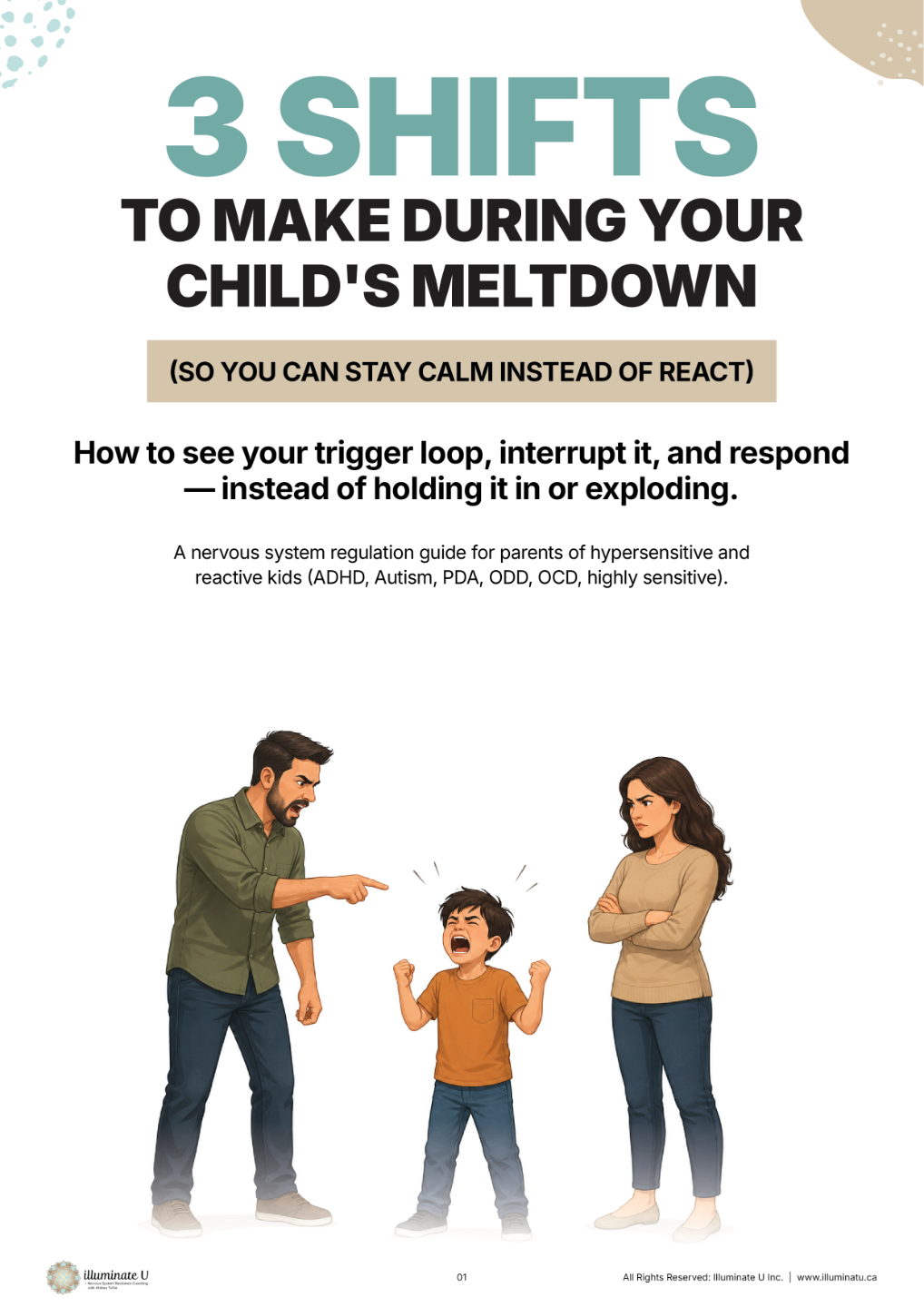
Free: The 3 Shifts Guide
The trigger loop and 3 patterns you get stuck in during meltdowns — and how to shift them so you can stay calm instead of react.
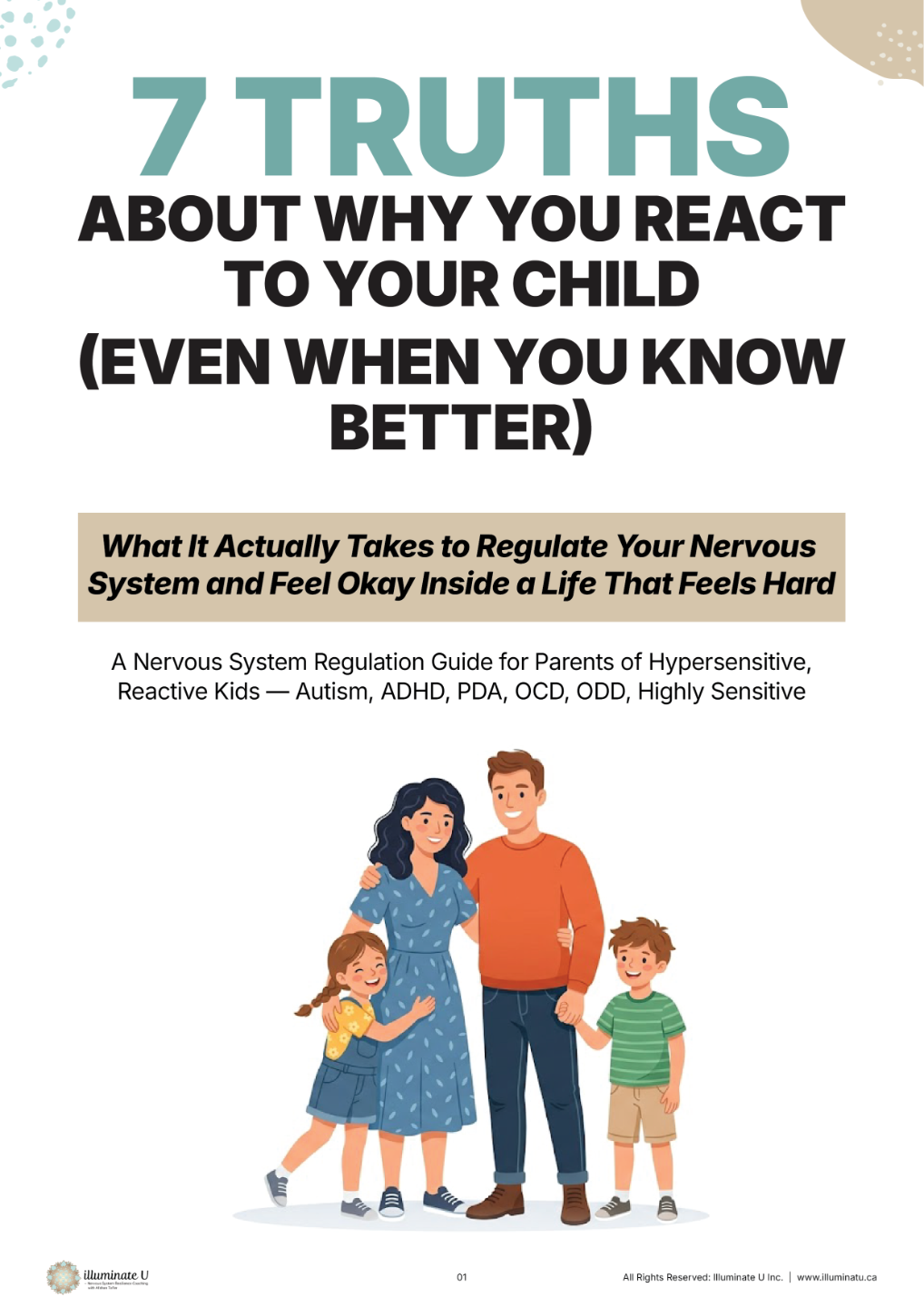
Free: 7 Truths About Why You React to Your Child Guide
Why you react even when you know better — the conditioning, nervous system states, hidden beliefs and patterns, and buried emotions running the show.

