
The 7 Moves That Make Co-Regulating Your PDA, Autistic Child Who Can't Leave Your Side So Much Easier
Part 2 of a three-part series
How to work with what gets triggered in you — in the moment.
When Giving Everything Still Isn't Enough
Do you give and give and give to your child all day, and then snap at them at the end of it, and then feel horrible about yourself?
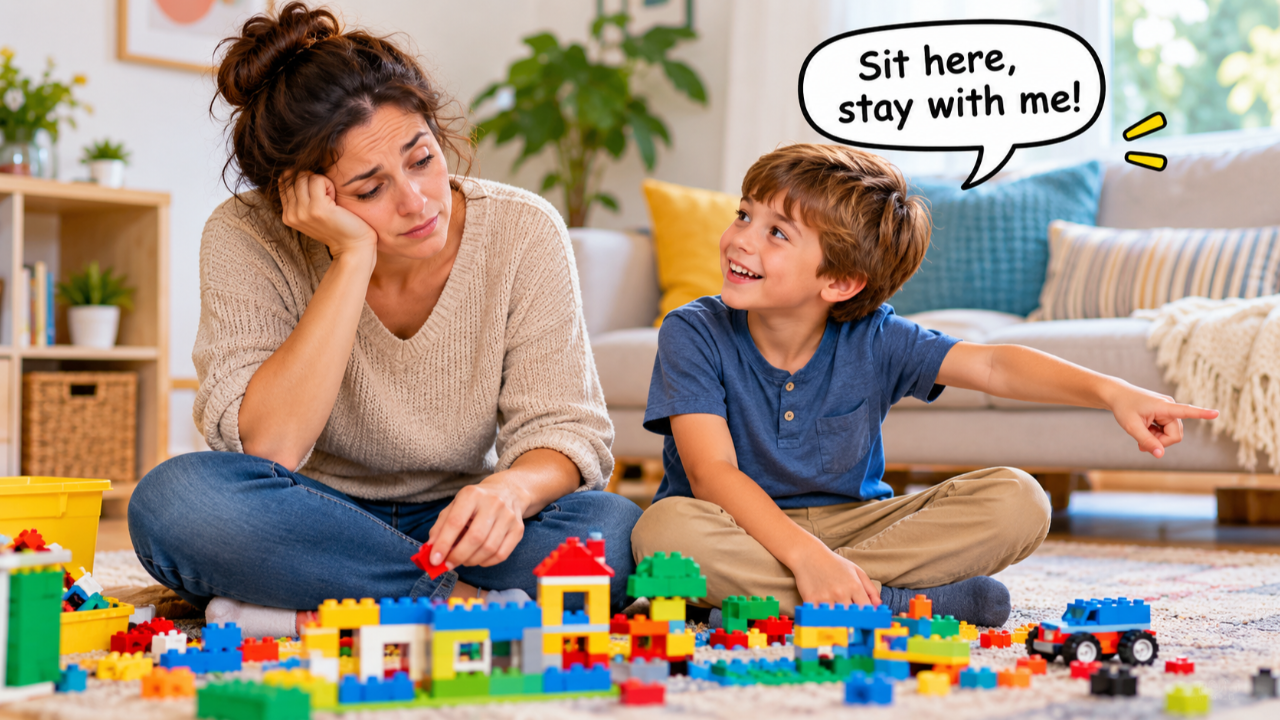
You're co-regulating a child who can't be away from you. Maybe they're PDA or autistic, or maybe they're just highly anxious and sensitive. And you're the one holding it all day. The demands, the questions, the needing you to look at them, the needing you to stay right there and not move.
And you're okay with it for a while. And then you're not.
Something in you runs out, and then you snap, or you go cold, or you unleash over something small that isn't even about them. And then comes the guilt, and the shame, and the promise to yourself that you won't do it again.
And then you go right back to giving everything, because that's what they need.
I want you to hear something about that cycle. It's not a patience problem. It's not a discipline problem. And it's not a you-being-a-bad-parent problem either.
There are seven specific things happening in your nervous system that are draining you inside this kind of parenting. And every single one of them can be worked with.
I know this because I did it. And when I did, co-regulating my son — a child who needed me every single minute — stopped costing me what it used to.
So today I'm going to give you seven moves. One for each of those seven things.
This is part two of a three-part series. In part one, I walked you through those seven things themselves, and why co-regulating a child who can't leave your side becomes so exhausting.
And I asked you to just notice them that week. Not fix them. Just notice. That was the first practice.
So today I want to show you what to do with them. But before that, I want to tell you about the night I understood what was actually happening to me.
Let's begin.
The Night I Sat on the Bathroom Floor
It was almost bedtime, and I was sitting on the bathroom floor crying.
Have you ever been there? I'm sure you have.
I was so exhausted, and so ashamed. Because I had just gotten angry at my son. Again.
And this was after a full day of co-regulating him. A full day of meeting his need for constant attention, following his demands, giving him autonomy over where I sat, and what I did, and when I could get up, and where my eyes went.
And there I was, yet again at the end of it, repeating the same pattern.
Give, give, give, until it became too much.
And then I would finally unleash. Sometimes at him. Sometimes at the spoon I dropped on the floor — which would then escalate him, which would then cause me to unleash even more anger at him.
And then I would drop. Drop into feeling helpless and hopeless about ever changing any of it.
I can't change my son, and I can't change me, so this is a hopeless cause.
Those were the thoughts I heard on repeat. And for the longest time, I actually believed them, because I could not find another way out. I just could not find another solution.
Why I Couldn't Just Give Less
Here I was with a child who needed so much. And I saw what happened when I didn't give him all of me.
He ate less. He was more anxious. He didn't sleep well. He couldn't function as well in life.
He needed me, and he genuinely did better when I was there. Even when I wasn't fully regulated. Even when I was performing what I now call pretend calm — which is really functional freeze, where my brain knew how to recruit all the social and co-regulation behaviors on the outside, while on the inside I was numb to everything that was happening in me.
So I was stuck in this cycle.
He needs me this much.
I have to do this, otherwise he can't even meet his basic needs.
I have to give up all of myself for him.
And underneath all of it, this constant feeling of — it's either him or me. Both of us cannot exist together with both of our needs actually being met.
I felt like that could never happen. And it felt like truth. It didn't feel like just a thought. It felt like truth.
So the cycle repeated itself. Give, give, give. No capacity left. Anger and agitation. Then guilt and shame and the feeling of failing. And then grief.
And then back to giving, because what else was there?
What I Learned Later
What I learned later, as I really began to understand the nervous system and the early life patterns we carry, is that there were certain patterns in me that were getting exacerbated in this situation.
They weren't caused by my son. They were already there. And this kind of parenting just pressed on them harder than anything else in my life ever has.
And what I found was that if I could work on changing those patterns, and the way my nervous system was reacting inside all of this, then I could actually feel more capacity. Capacity to handle co-regulation without it becoming so draining, and without feeling so trapped inside of it, like it was a never-ending, no-win situation.
So that's what changed things for me. Not my son needing less of me, necessarily — at least not right away. That took a while. And not finding some perfect strategy either.
It was working with the patterns underneath.
And I Know I'm Not Alone in This
I know I'm not alone in this, because I hear it constantly.
This is such a common experience for parents who have high needs kids who need them so much. And it becomes especially common when we learn about accommodation.
Especially for those of us who begin to understand PDA, and how much our children need accommodation, and need to feel a lot of autonomy and control.
Because we learn that accommodating helps our child's nervous system. And it does. That's real.
But then we carry all of our own survival patterns into that accommodation. Into giving up our own autonomy so that they can feel their autonomy.
And those patterns exacerbate our survival system even more, accumulating more and more stress load in our systems.
So much of the time, we are doing this whole co-regulation thing from a low-grade survival state that we just think is us. That we think is just our personality, or how we are.
But it isn't us. It's a deeply wired pattern in our system to override ourselves.
This is what we learned culturally, and in our families, if our families taught this to us. And especially, I feel, as women — though not only women. Men too.
And this is where so many parents end up. Feeling like this is a soul-crushing experience of completely losing themselves.
If that's where you are, I want you to know I'm not speaking about this from the outside.
A Quick Recap of the Seven Things
Let me briefly recap what we covered in part one, because today builds directly on it.
In part one we talked about the seven things that get triggered in your nervous system in this kind of parenting.
1Blocked flight energy.
Your nervous system naturally needs a break from co-regulating. That's how it's designed. You connect, you take a break, you connect again.
But you don't get that break in this kind of parenting. So the urge to get away mounts stress load, because you can't follow it. It gets blocked, and it stays in your system as blocked flight energy.
2Blocked fight energy.
When we're accommodating and giving more autonomy, we hold in our no's. We don't say the boundary we want to say. We don't push back.
But those impulses are still getting triggered inside of us, over and over, all day long. And every one of them adds to the stress load.
3Guilt and self-criticism.
As parents, we feel ashamed that we even have these urges. The urge to fight our child and push them away, or to run away from them. That we want to get away from our own child.
How bad do we feel about that?
And then the guilt comes on top of that. And then the fight energy turns inward on ourselves as self-criticism.
4The fear and the pressure about their future.
This is the feeling that if we don't do this for them now, they won't be able to function in their life. And that if that happens, it will be because we have failed them.
5Grief.
The grief of feeling unsupported in all of this. Feeling alone in this. And feeling like you have to give yourself up entirely just to meet your child's needs.
There is a lot of loss in here too. The loss of what we thought this parenting experience was going to be. And the grief we feel for our child suffering, too.
6The trapped feeling.
All of that no choice. No choice to fight. No choice to flee. No choice to say no. No choice to even feel any of the grief.
It piles up, and it results in your system dropping into — I'm trapped.
7Your child becomes a cue of danger.
Negativity bias takes over. Your child gets wired into your system as the source of the danger that your nervous system feels.
And then you stop taking in the good moments when they come, so you're not being nourished by any of this co-regulation experience.
If you haven't listened to part one, go back to it, because I go into all seven in depth — along with all of the meanings underneath them that our system makes, and where those meanings actually came from. That episode will make today land more deeply in your system.
But here's the thing I want you to understand about those seven things.
When you work with them, you are not just managing your day. You are working on the deeper patterns your system has been holding for a very long time. The ones that this kind of parenting experience keeps pressing on, over and over again, mounting more and more stress load.
And when I worked on these seven things, co-regulation stopped being so draining. It was honestly incredible.
What We're Actually Aiming For
Before we go into the seven moves, I want you to understand what we're aiming for. Because I don't want you to hear this as a list of tricks to get through the day.
So much of what's out there is, I just want a quick trick. A quick hack.
No. This is about deeply rewiring your nervous system.
So here's the honest part. Co-regulating a child who needs this much of you does take real energy. And there is, on many days, an energy cost to this — because you're holding a dysregulated nervous system all day long. Your child's nervous system.
And some days you're going to need to override yourself more than others, and that can feel like a lot on your system.
So that part is real, and I'm not going to pretend it away.
But it can be significantly less draining than it is right now. And that is the part I really want you to hear. Because it can also become more fulfilling, and it can nourish you.
Let's Talk About Capacity
The word I want to put at the center of all of this is capacity.
What you're trying to do here is build capacity. Capacity to be with everything that's getting triggered in yourself, and with all of your child's needs, without going into survival.
Because right now, there's an enormous amount of energy going into survival. And all of your capacity is being directed toward holding that survival energy down. Holding it all in, instead of learning to work with it.
And that's the piece I want you to really take in.
It's all of this holding back. The holding in. The blocking, the thwarting, the pushing down of our own survival reactions — because we think that's what a good parent should do. Hold it together.
But this is what costs an enormous amount of energy. To hold all of that in.
It's like survival on top of survival, clamping down on it.
And these survival patterns are so natural to get triggered when you override your own true impulses to say no, or to take a break. That's not a flaw in you. That's what a nervous system does when natural impulses get blocked.
And then on top of that, there are the older patterns. Deeply wired survival patterns, the ones you were carrying long before your child was here, that this kind of parenting triggers and presses on harder than anything else.
So here's what we're aiming for.
When we are truly present in co-regulation — coming from our own authenticity, from a place of I'm okay even if this is hard, and I'm okay even if you're not okay — then we free up a lot of energy.
We get to co-regulate from presence instead of survival. And survival burns so much more energy than presence does, because presence is more flow. The energy is flowing.
And as a result, we have more capacity in our system. Capacity for the next challenge, and the one after that.
The Three Things We're Repatterning Toward
Before we get into the seven moves, I want to name three things specifically that we want your nervous system to be able to feel, so that co-regulation can start to nourish you back and feed you back, instead of only taking from you.
1A felt sense of choice — instead of trapped.
I talked last week about how those seven things that drain you culminate in you feeling trapped.
So your system needs to feel that you have some choice. Choice is imperative for the nervous system to feel safe.
You need to feel like you have some autonomy in this too. Not this feeling of, I have to do this, otherwise there's no other choice here, my child will suffer, and so I have to do this.
You need to feel like you have choice even in situations you can't change. Even if you feel like you cannot change your child and their high needs.
Because without it, everything drops into that trapped state we talked about last week.
2A felt sense of support — instead of alone, depleted, and like nobody cares.
Because when you're giving and giving, it presses on the wound of I'm all alone. I'm unsupported.
Your system needs to feel like you're not carrying this entirely by yourself. And it needs that felt sense of support in order to be nourished.
Some of this support will come from the outside, and we'll talk more about that next week. That looks like allowing your partner to co-regulate them more while you take a break, or bringing in a caregiver from the outside.
But a lot of this is something you can learn to bring to yourself as well. This is what I teach all of my students in my course.
You can learn how to help yourself feel supported and not so alone inside this — even on the days when nobody else is there to do it for you.
3Taking in nourishment.
This one gets missed the most.
Because so much of regulation is about being able to sense that survival is here, and that safety is here too. Both of them, at the same time.
Right now your system is probably only registering the survival part. So this is about helping your system also sense what's good here, and finding ways to nourish yourself inside this experience rather than only being drained by it.
What is this experience giving you too? And what are the ways you can see nourishment, and allow that to fill you up?
I'll be honest with you, because this one does take real work. It takes actively helping your brain see what's here, and update the way it has been reading this whole situation.
We're going to come back to exactly how to do that in move number seven.
And One Pattern to Keep Watching
There's one pattern I want you to keep watching, which I mentioned last week, because it runs underneath all three of those things we're repatterning.
I'm not okay unless you're okay.
This is the pattern that has us over-giving when we don't actually need to at times. Because sometimes we need to discern that maybe we don't need to over-give quite so much.
And it comes from this feeling of I'm not okay unless you're okay, and from not being able to tolerate our children's distress.
So it has us accommodating out of fear rather than out of the actual need. Fear that our child won't be able to meet their needs, or won't be able to access their skills, or won't be okay in the future.
And here's the thing. Our kids sense that anyway. I know my son did. He feels the fear that's inside this kind of giving.
So then the giving doesn't actually land in his system, because there's the fear he's sensing behind it too. He can't fully take in the safety of the giving, because it's coming from fear, and he's also sensing that fear.
There's a dissonance that happens.
So as we go through these seven moves, keep that pattern in the back of your mind. Because a lot of what these moves are doing is helping us feel okay in the face of our child's distress, and hold this kind of calm confidence when their distress comes up.
The 7 Moves
These follow the same order as the seven things I mentioned last week — the seven things that get triggered and drain you. So if one of them stood out to you when you were noticing, you can go straight to that one.
1When the urge to get away comes — let it move.
2When the NO is stuck — let that move too.
3When the guilt and self-criticism arise — meet them with compassion instead.
4When the fear about their future grips — let them be distressed for a little while, and repair afterward.
5When the grief is there — make room for it.
6When you feel trapped — give yourself choice.
7Take in nourishment — however small.
1When the urge to get away comes — let it move.
This is the blocked flight energy that comes up. And what we tend to do is block it.
The way I used to feel it was this. My legs would start to twitch. My body would start to lean away. I'd start to feel like I just need a break. My eyes wanted to just close. It's that wanting-out feeling.
So the move is to let that impulse complete in small ways, instead of stopping it at the surface.
And the first part of the move is to become aware of it. Some of us are not even aware of it. Because our system blocks and thwarts it automatically, even below our conscious awareness.
So we want to be able to notice that impulse, feel it, and let it move.
For me, that looked like this. I'd be sitting with my son, and I would start to pedal my feet on the floor. And then I would imagine running to a beautiful beach location. And then I would get to that beach, and I would stop, and I would just exhale and let myself actually feel the freedom of that beach moment in my body.
That last part is what most people skip, and it matters. The pause afterward.
So you do the impulse — pedaling your feet, getting that flight energy out — and then you pause afterward, and you let your system take in that finished movement and the down-regulating that comes from it.
2When the NO is stuck — let that move too.
This is the blocked fight energy. That impulse that comes to push back, to say no, to put a boundary in place, that you feel like you cannot.
So the same principle applies. Let it move somewhere safe. Not onto your child.
I used to put my hands against the wall and push, like a push-up, and then I'd imagine in my mind saying NO while pushing away. And then I would stop, and settle, and notice the settling. And that helped some of that energy discharge.
Then over time, I would start practicing some small, real no's with him. Not the big ones. The tiny ones, where the stakes were lower.
Because your system needs some evidence that a no can happen, and that everybody can survive it. And that you can still repair and reconnect afterward.
3When the guilt and self-criticism arise — meet them with compassion instead.
This is the loop that costs so much energy, and it's the one that's so important to work with.
That urge to get up and get away comes. Then the shame arrives for having the urge. Then you override yourself and give more. And then the urge gets bigger, because you just added to the load.
So the move is to meet that urge with compassion instead of judgment.
First, allow it to be there. Normalize it. This is a normal part of being human. You're going to have these urges, even if this is your child.
The urge to get away is not a betrayal of your child. It's a system asking for something it needs.
And remember, there are two kinds of guilt that get triggered here.
The part that hurts for your child, because they're suffering and it's so hard for them — that comes from love. That's what it actually is. It is love. So can you let that be love?
And then there's the part that turns on you. The guilt that becomes self-criticism for having those urges. That's the part that needs compassion.
I think self-compassion is something that can hugely regulate you, and hugely replenish your energy.
4When the fear about their future grips — let them be distressed for a little while, and repair afterward.
This is a big one, because all of us have so much fear about our children's future. Fear that if we don't accommodate right now, they won't develop, and their future will be harder.
So the move is to allow some brief distress when you genuinely need to separate — even just to use the bathroom by yourself — and then to reconnect and repair when you come back.
This is about working with your own fear of them being distressed. That feeling of I'm not okay unless you're okay, which triggers that fear.
And I want to name what this fear actually is underneath. Yes, it's about the future fears that come up. But a lot of it is fear of your child being in distress, and what that means for their future. And fear of how their distress is going to dysregulate them further, which then makes everything harder for you across the day.
So a lot of us fear their distress because it makes everything harder. And then we try to avoid, and preempt, and control, and make sure they don't go into distress.
But that's survival too.
So the real work here is you being able to feel safe enough with your own fear of that distress.
Because when you can be okay while they're not okay, something happens for them. Slowly, they learn that it's okay to have this distress, and that they will recover from it.
There is a confidence and a calm that go together in this, and that's what we're modeling to our kids. Not that distress won't happen. That it's survivable.
And when you feel confident and calm enough with their distress, safe enough with their distress, they learn it's survivable. And that helps their nervous system expand their window of tolerance.
And I want to be clear that this is not about hardening your system. It's not about learning not to care. You care. It's about building more capacity. It's widening that window of tolerance so you can hold the fear and hold safety at the same time.
I'm going to go deeper into this next week, into the question so many of you are carrying — am I giving too much, and how will they ever learn?
5When the grief is there — make room for it.
I want to name this one properly, because the word that belongs here, and the understanding that belongs here, is loss.
There is grief for the loss of your own autonomy. For the loss of your work, perhaps, that you had to leave to stay home with your child. Your friendships. The person you used to be. The loss of the life you thought you'd be living by now.
And the loss of being able to meet your own true impulses and needs. Which, for a lot of us, touches something much older.
Because this isn't the first time in our lives that our needs have gone unmet, or that we've had to override them to keep things okay for somebody else. This can trigger childhood wounds around exactly that.
And it's worth knowing that. Because when you understand why the grief sometimes feels so much bigger than the situation in front of you, it helps you see what's getting triggered from the past here.
So the move is to bring self-compassion to your grief. To notice it. To recognize it. To allow it to be there. To give yourself time and space to actually be with the grief, and to witness it rather than pushing past it.
I used to do weekly grief dumps around this. Sometimes on a walk in nature, on a path where there weren't many people. Sometimes sitting in my parked car, putting on a sad song.
And then I would notice the meanings that come with the grief. What does this loss mean to me? What is the loss being triggered here? What is the meaning coming up with this grief?
And then allow it to be there, and let it process.
It's important to recognize the meanings, because some of this comes from the past — and over time you want to change those meanings, so that the grief doesn't keep cycling on repeat.
But for now, it's important to be with the grief and allow it to move.
6When you feel trapped — give yourself choice.
This move is about creating more choice in your system. Even if it doesn't feel like you have one. Even if it feels like all the choices are bad ones.
The move is to name the choice inside yourself, either way.
If I was staying and not leaving to take a break, I would say something like — I'm choosing to stay right now, because this is what he needs.
And if I was going — I'm choosing to separate. I'm okay with him being distressed for a short time, and I will repair afterward.
And I want to say more about the staying side of that, because that's the one most of you are living.
You can choose to accommodate. You can choose not to say the no. You can choose not to take a break right now. Those are all still choices.
And then you can offer yourself compassion for the grief that comes with that choice. The grief that you can't say that no, or can't take that break right now. Offering yourself compassion there helps build that felt sense of support in your system.
Because choosing between one awful option and another awful option doesn't feel good. I know that feeling very well. Choosing the least bad of the bad options is not a great experience.
But it is still choice. So can you feel that? Can you feel that it is still you making that choice?
Instead of saying, I'm trapped, there's no other way, I have no choice.
How many times do we say that to ourselves? I have no choice. I have no choice but to do this.
But the reality is, we do have choice. It just feels like if we choose not to do it, then we're choosing the hard consequences of that — which is our child getting more dysregulated.
So can you learn to feel okay with the grief of the hard choice?
Because then you're still standing in a place of choice, rather than dropping into powerless. And from there, you can also choose to support the grief that comes with those hard choices.
I think there's real power in that. I feel empowerment in that. Not power over the situation, but power inside yourself. Inside a situation you can't change, there is still power to support yourself and bring in that felt sense of support.
7Take in nourishment — however small.
This one is different from all the others. Every other move is about letting something move out. This one is about letting something in.
Remember from last week — once your brain has flagged your child as a cue of danger, it stops letting you take in the good moments. That's negativity bias. Your brain holds onto the threat and lets the good stuff slide right off. And sometimes it's only looking for the big good things, so it misses the small ones.
So there are two parts to this move.
Part one: meeting your needs in little ways — and letting them count
The first part is meeting your needs in little ways, and letting those little ways actually count. Not bypassing them.
Staying in the bathroom for one or two more minutes. Can you let that nourish you? I'm choosing to stay in the bathroom for one or two more minutes, and I'm going to let it nourish me, and just feel the quietness. Nobody in your space. A bit of that space.
Or sipping your coffee or your tea while you're sitting there with your child. Can you let that nourish you?
Or noticing the sunlight coming through the window, or any other glimmer. A little moment of goodness. Anything you can appreciate, or that comforts you, while you're with them.
Let that nourish you. And feel it in your body, not just notice it in your mind.
These matter enormously, because there will be days when there are no moments of connection with your child. And on those days, you still need something coming in.
Part two: actively taking in the connection that is there
The second part is actively taking in the moments of connection you do have with your child. Really allowing yourself to see those little moments, and the ways in which your child is trying to connect with you.
For those of you who are lucky and your child can be more snuggly — take in those moments.
But for some of you, it's about reframing. Actively helping your brain see how your child is connecting with you in their own unique way, and showing you love in their own unique way.
My son info dumps. He talks and talks and talks. And it used to make me so tired to listen to everything he had to say, so my brain would automatically tune things out.
But now I see it as a way that he is showing me his love and wanting to connect with me.
Before, it felt like — oh, it's all about him, and none of it is about me. Now what I feel is the warmth. That he wants to connect with me, and this is how he shows me his love. So I let that nourish me, and I take it in.
Or when he wants me beside him. That used to register in me as him being so needy. And now I help my nervous system take it in differently. Not as neediness, but as a gesture of love and connection. And I feel that love and connection of us being together.
And when I do that, I feel that connection nourish me so much more.
These are cues of safety, and your nervous system needs them. They nourish you. They bring in the oxytocin and dopamine that your system has been starved of inside all of this giving.
And here's what I noticed when I could actually do this.
My son felt it. He filled up more. And I found myself being able to take more space — longer bathroom breaks, longer kitchen breaks — without him escalating. Because he actually filled up, because I was filling up, and he was feeling that.
My state mattered a lot. Because I wasn't co-regulating from functional freeze anymore. It was true presence. And I was actively finding ways to help my brain notice the nourishment that was there too, and feel the safety in this whole experience. And over time, my son felt that too.
This is how your child slowly stops being wired into your system as a source of danger. Not by telling yourself they're not dangerous, but by giving your body new evidence, over and over, through a felt sense.
Because your amygdala — that's your threat center in your brain — its only language is the felt sense. So it actually believes you, and it starts to change the meaning-making inside of you.
The Deeper Pattern I Was Actually Working With
I want to name the deeper pattern I was actually working with here, because I talked about it in part one as the appeasing, or people-pleasing, or fawning pattern.
That feeling of I'm not okay unless you're okay. And this is where it actually showed up for me, in co-regulation, getting triggered over and over again.
Underneath all of my giving, there was this deeper pattern and this deeper meaning in my system. That I should give up all of my needs.
And this wasn't the truth. It just felt like it. Because this is what I learned growing up.
And then along with it came another belief. That it's not okay to upset other people. And so I should accommodate and give up myself so that other people are okay.
I learned both of those from my own upbringing, and from the culture I grew up in, which taught me very clearly that women should override their needs for others.
That's where it came from. Not from my son. It just got exacerbated with my son.
But then underneath all of that, this other voice would always come up.
What about me? What about me? Why can't it be about me? Why can't I meet my needs? Why don't I matter in this?
So what I actually learned to do was to meet my needs in little ways while I was still with my son. Knowing that I had choice. Knowing I could say no, and choosing not to. Finding small ways to fill up inside the experience. And finding small ways to let my flight response move, and to take little breaks when I needed them — like extending a bathroom trip by a couple of minutes.
That's what I did while my son slowly built the capacity to separate from me without his basic needs being so affected.
And then eventually it became about something more. It became about being okay with his distress when I left — knowing that he had other safe caregivers, his dad and a caregiver we eventually hired, and knowing that I could always repair when I came back.
So I could separate without fear. And that mattered more than I understood at the time.
Because for him, so much of how he reads a situation is based on how my husband and I are both reading it. His nervous system is the barometer for ours.
So over time, I started taking my space. And he did learn to be okay. He learned to be happy with other people too.
And then I would come back to him with more capacity in my system. And he loved that too.
What Changes When You Do This
I want to be honest about what this did and didn't do for me.
It did not make my son need me less. Not at first. That took longer. It took years, and it took a lot of other things that I'm going to talk about next week.
What it did was change what those days cost me.
At the end of the day, my body was still tired. Especially if it had been a day of doing a lot of things for him. That aspect didn't disappear.
But my mind was more balanced. And I could feel tired, and also feel fulfilled and connected at the same time. Which I had never been able to do before.
My body wasn't as tight or as tense. I could fall asleep more easily, and I could sleep more deeply. Because I wasn't holding all of that survival energy in anymore.
And each time I did these moves, it helped to rewire those survival patterns a little more. Over time.
That's how this works. It's not a dramatic shift. It's in the repetition that this gets rewired, and things start to change.
So I stopped ending up on the bathroom floor. That cycle of give, give, give until I unleashed, or until I dropped — it started to break, because the energy had somewhere to go before it got to that point.
And I was more present with my son. Which I could feel, and he could feel. Because he could always feel it, even when I thought I was covering it up well.
So if you take one thing from today, take this.
You do not have to wait for your child to change before this gets easier on you. There is a whole layer of this that is yours to work with, starting now.
What You Can Do This Week
Pick one of these moves. Not all seven at once. Pick one.
Choose whichever of those seven things you noticed most in yourself last week, and just try the move that goes with it. A few times. And see what happens in your body.
And keep doing the allowing we talked about last week. Being the curious observer of what comes up, letting it be there without judging it or trying to fix it. That's the ground all of this sits on.
Next week is part three, and we're going into the question I know so many of you are holding. Am I giving too much? How will they ever learn to be okay without me?
And how do you actually help your child build the capacity to separate over time — including when they're older, and when there's trauma and anxiety in the picture.
I'll see you there.
Before You Go
If this helped you in any way, please comment, and please share it with other parents.
If you missed it, part one is here.
And I have three free guides that I'll link below and in the show notes.
One is on the three patterns most parents get pulled into during a meltdown, and how to shift them. That's the 3 Shifts guide.
One is on why you react even when you know better. That's the 7 Truths guide.
And one is for the grief that nobody names, and finding your way back to meaning and purpose and feeling like yourself again. That's the Meaning guide.
So pick whichever one fits where you are right now.
Thank you for being here. I'll see you next week.
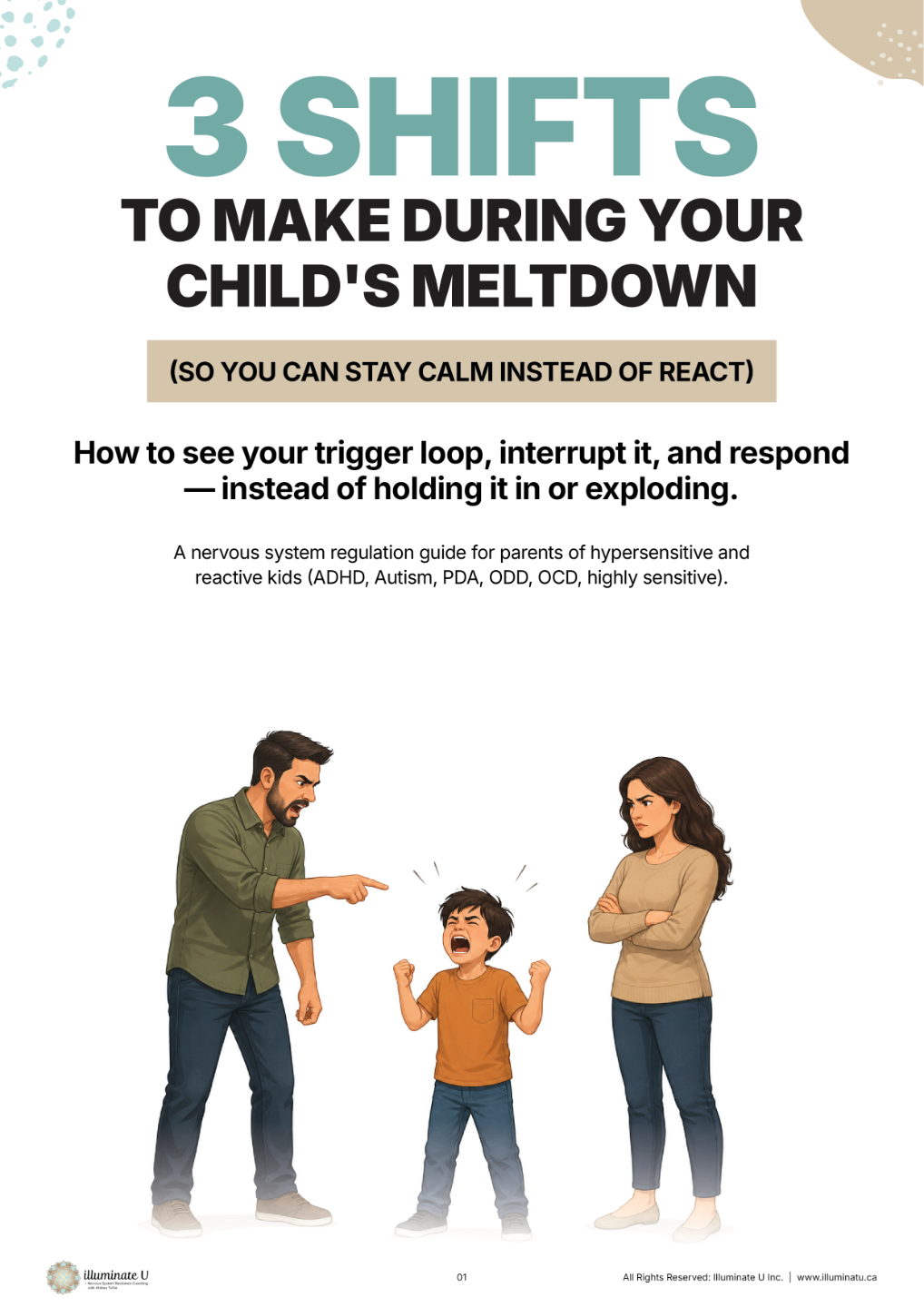
Free: The 3 Shifts Guide
The trigger loop and 3 patterns you get stuck in during meltdowns — and how to shift them so you can stay calm instead of react.
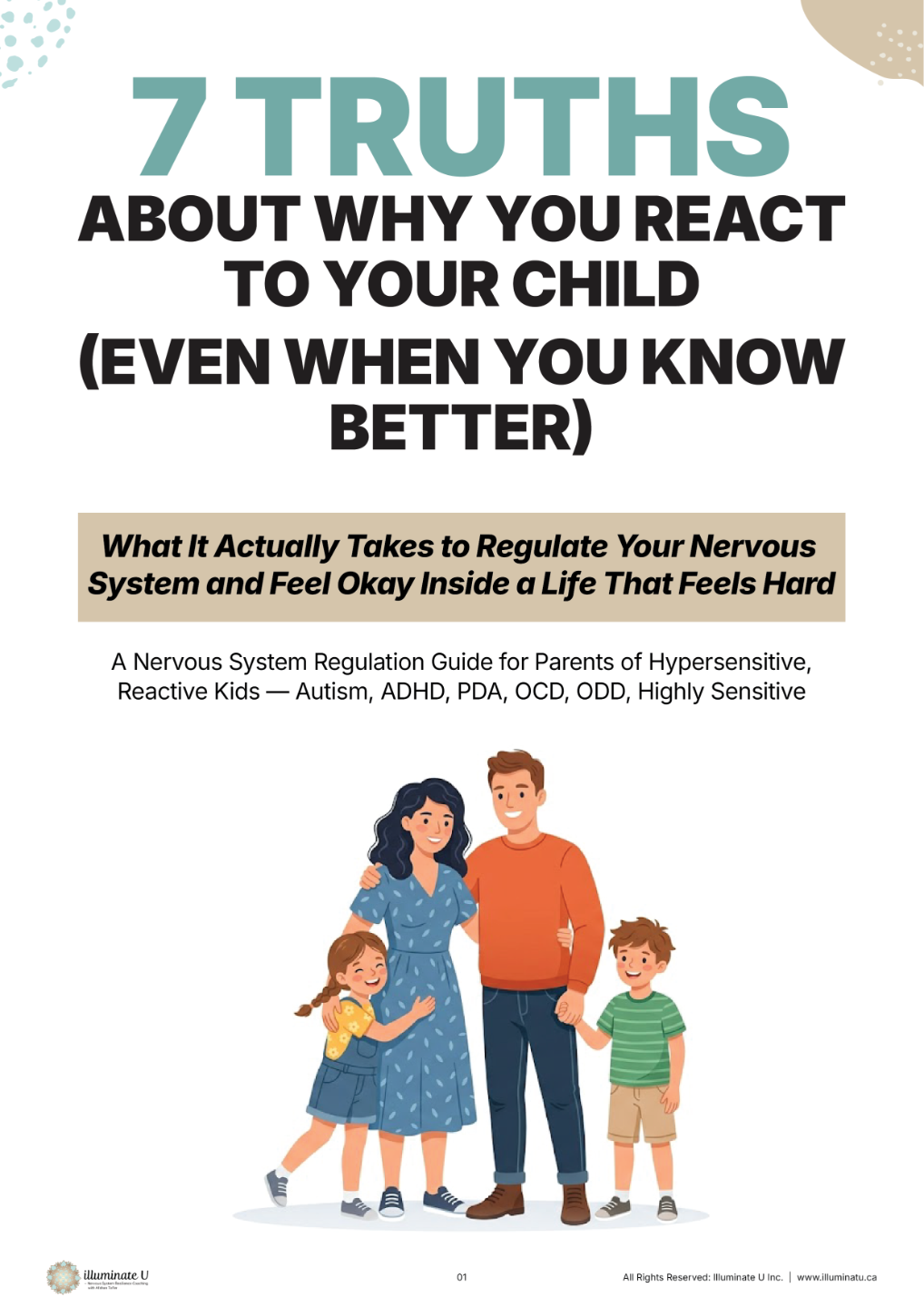
Free: 7 Truths About Why You React to Your Child Guide
Why you react even when you know better — the conditioning, nervous system states, hidden beliefs and patterns, and buried emotions running the show.

