
Watching Your Autistic, PDA Child Suffer: The Grief, Guilt, and Helplessness Parents Carry

**You can also listen to this in audio format only on The Regulated Mother Podcast on Apple or Spotify. Look for Episode #47
When You’re Watching Your Child Suffer and You Can’t Make It Better
Have you ever felt such immense pain in your heart watching how much your PDA, Autistic or high needs child suffers?
Maybe you've watched your child desperately want friends, connection, freedom, joy, independence… and then watched their nervous system completely block them from accessing it.
Heartbreaking, right?
Maybe you've watched them:
not eat,
not sleep,
hurt themselves,
become trapped in rituals and fear,
or apologize for who they are over and over again.
And maybe the hardest part is this:
You can see how much they are suffering internally… while the rest of the world only sees “challenging behavior.”
There is a kind of deep inner pain – this grief that comes with parenting a PDA, Autistic, or high-needs child that almost nobody talks about.
The helplessness.
The heartbreak.
The guilt.
The fear about the future.
The pain of watching someone you love suffer — while knowing you cannot simply fix it or take it away.
And over time, that grief doesn’t just stay emotional.
It lives in the nervous system.
In the body.
In your thoughts.
In your relationships.
In your ability to still feel alive inside yourself.
In today’s episode, I want to talk about this hidden grief that so many parents carry silently.
I want to help you understand:
why seeing your child suffer feels so overwhelming,
what gets triggered inside of us when we witness our child suffering,
why this grief is so painful and so complex,
and how to begin working with it without losing yourself inside it.
Because while you cannot take away your child’s pain…
you can learn how to hold your own heart while you witness theirs.
The Deep Pain Of Watching My Child Suffer
For years, I have watched my son suffer.
Since he left school seven years ago, his life became smaller and smaller. I watched him eat so little that every meal felt like a battle his body couldn't win. I watched him sleep so little that exhaustion and wired became his baseline. I watched him head bang — hitting himself so hard I feared he'd hurt himself permanently. I watched him destroy things he loved deeply, like his iPad, in moments when the overwhelm became too much to contain.
I watched how hard social connection was for him. He wants friends so badly. He wants relationships with his cousins. But he needs so much control over what others do and say that the threat response takes over, and people pull away. He wants to leave the house and go places. And although we're going for drives again after years of burnout and being housebound, there is still so much fear living in his body about being out in the world.
He is Autistic. He has PDA and OCD, which makes everything especially challenging because there are so many rituals that need to be completed just to get through daily life.
I watch him up all night, not getting enough sleep, searching for social opportunities online — only for people to be unkind to him on social apps. And I see how much he apologizes for himself. The deep shame he carries because of how his challenges affect him and our family.
All of this breaks my heart.
I want so badly to help him. To make things better for him. And I can't.
If I push at all, things just go backwards.
The pain I feel in my heart when he can't do healthy things for himself — or get himself to do the things he loves — is enormous. And it often feels like it's never ending.
It's so hard to watch your child suffer.
It's so hard to know what they could do to help themselves and watch how they just can't do it.
It's so hard to see the yearning and longing in their eyes to be out in the world, only to be taken over by the part of them that feels too scared and stops them in their tracks.
Why Watching Your Child Suffer Feels So Unbearable
Watching your child suffer is one of the hardest things parents of PDA, Autistic, or high-needs kids have to endure in this lifetime.
It's not just hard. It's primal pain.
It activates something in us that feels unbearable — something ancient, biological, impossible to override. It triggers the helplessness of being a parent who can't fix it. The powerlessness of watching someone you love more than life itself struggle — and knowing there's nothing you can do to take it away.
There is also a deep grief in realizing your child doesn't get to have the easier life that others seem to have. Things that come so easily for other children can feel impossibly hard for them. They have to work harder to accomplish things most people take for granted.
And often, nobody in the world truly sees how much they are suffering. They only see how challenging their behaviors are.
As parents, we absorb so much of our child's pain, hurt, fear, and grief. We feel our child's pain as if it is our own. We can become deeply enmeshed with them — especially mothers — because we are so connected to them intuitively, emotionally, and even biologically.
Their pain becomes our pain to bear.
And because of this, many of us never truly feel free to fully live our own lives in the way that we want.
I have often felt enormous guilt for wanting to take a vacation — which we haven't done in eight years. I crave going on a beach vacation. But I know my son wants that so badly and cannot get himself to do it. So the guilt stops me from going on my own.
I know deep down that I need to fulfill my needs and live my life too, but it's so easy to give up what I want because I don't want to hurt my son further and leave him feeling even more sad that he cannot go too.
The grief is enormous.
This Is the Grief No One Talks About
Today is really about this deep, often silent and hidden, grief that so many of us parents of Autistic, PDA or high needs kids carry.
The grief that comes with watching your child suffer.
The grief that has no closure, no ritual, no clear end.
The grief no one talks about.
I want to help you understand:
- what gets triggered in you when you witness your child's pain
- why you absorb their pain as your own
- why this grief feels so overwhelming and consuming
- how this grief is different from other kinds of grief
- and most importantly, how to work with this grief so it doesn't consume you
Because you cannot take away your child's suffering.
But you can learn to hold your own heart while you witness theirs.
The Specific Pain of Watching Your Child Suffer
Let's start by naming what you're witnessing. Because this isn't abstract. This is concrete, daily, lived suffering that you see in your child's body, behavior, nervous system, and eyes.
1. Physical Suffering
The first thing we witness is physical suffering that our child goes through.
Your child's body is trapped in survival mode.
You may watch them restrict eating, sleeping, or toileting because their nervous system experiences these basic needs as threat. You may watch them engage in self-harm — head banging, scratching, hitting themselves. You may watch them destroy things they love in moments of overwhelm. You may watch them live in a body that cannot access what it needs, even when they desperately want to.
Their nervous system gets stuck. And no amount of wanting it to be different makes it change.
You see them know what they need — sleep, food, calm, regulation — and yet watch their nervous system refuse to let them access it.
That is devastating to witness as a parent.
2. Social Suffering
The second thing we witness is their social suffering.
Your child wants connection desperately.
They want friends. They want to belong. They want relationships.
But their nervous system makes it incredibly hard.
You may watch them need so much control over others that friendships fall apart. You may watch them get hurt online, rejected, misunderstood. You may watch them apologize for themselves over and over. You may watch them carry shame about how their behavior affects others. You may watch them long for connection — and yet be unable to sustain it.
The loneliness is palpable.
You can see it in their eyes.
And you feel it in your own chest — the ache of watching someone you love be so alone.
3. The Shrinking Life
The third thing we witness is how much their life (and ours too) shrinks more and more.
Over time, your child's world can become smaller and smaller.
You may watch them become housebound for months or years. You may watch them burn out so deeply they can't engage in life. You may watch them lose access to things they used to be able to do. You may watch them desperately want to do things — and still be unable to get themselves to do them.
Life doesn't expand.
It contracts.
And you are watching it happen in real time.
4. The Inner Suffering You Can See in Their Eyes
The fourth thing is seeing the suffering in their eyes.
This is the part that breaks you.
The yearning to be out in the world.
The longing for ease, normalcy, friendship, and connection.
The part that wants to. And the part that can't. You see both at once.
And you know — in a way no one else does — how much they are suffering internally.
The world sees them as "challenging behavior."
You see pain.
You see a nervous system trapped in survival.
You see a child who desperately wants things they cannot access.
And being one of the only people who truly sees how much they are suffering makes the grief even heavier.
It’s not easy to watch your child suffer. It triggers so much inside of you.
What Gets Triggered in You When You Watch Your Child Suffer
This isn't just empathy.
This is nervous system activation.
And it touches multiple wounds at once.
1. Helplessness and Powerlessness
You can't fix it.
You can't make it better.
You can't take their pain away.
If you push, things go backwards. If you don't push, they stay stuck.
You feel trapped in your own inability to help the person you love most.
The is a core wound, that often comes from our own childhood, that gets activated and compounded when we feel like we cannot fix this situation and that is:
"I am powerless. I have no control."
This is one of the deepest wounds that can live inside the nervous system — and watching your child suffer presses directly on it.
Research on parents of children with complex care needs shows that chronic stress, ongoing caregiving demands, feelings of helplessness, grief, and prolonged survival mode can significantly contribute to parental burnout, emotional exhaustion, and depression.
You are not imagining this.
This experience is real.
And it is one of the hardest emotional experiences a human can endure.
2. The Primal Fear Every Parent Carries
Underneath everything is the question that haunts you:
"Will my child be okay?"
"What does their future look like?"
"Will they ever have ease, joy, connection, independence?"
"What happens when I'm not here anymore?"
This goes beyond worry.
This is existential fear.
And it lives in the body as constant low-level panic, dread, bracing, hypervigilance, and anticipatory fear.
You wake up with it.
You go to bed with it.
It hums in the background of everyday life.
And no amount of reassurance fully takes it away because you are living the reality that proves the fear is not irrational.
3. The Grief of Loss
You are grieving — actively and ongoing.
Every single day.
You are grieving:
- the loss of the life you thought they'd have
- the loss of ease — watching things that come easily to others be impossibly hard for them
- the loss of the experiences you imagined — school, friendships, activities, milestones
- the loss of the future you envisioned
- comparing their life to others and feeling the sharp edge of that difference
Researcher Pauline Boss calls this ambiguous loss — grief that has no closure because the person is still here, but what you hoped for them is not.
And ambiguous loss is one of the hardest kinds of grief to process because it has no clear beginning or end.
It just continues.
4. The Guilt and Self-Blame
Somewhere in the back of your mind, the questions loop:
"Did I cause this?"
"Should I have done something differently?"
"Am I making it worse?"
"If I were a better parent, could I help them more?"
Even when you know intellectually that this isn't your fault, the guilt still lives in your body.
Because when your child suffers, every part of you wants to believe there must be something you could do to change it.
And then there is another layer of guilt.
The guilt of living your own life.
"How can I go on vacation when they can't?"
"How can I enjoy something when they're suffering?"
"If I live my life fully, am I abandoning them?"
You start to shrink your own life to match theirs because anything else feels unbearable.
You give up experiences. You cancel plans. You stop dreaming about what you want.
Because how can you have what they can't have?
How can you feel joy when they are in pain?
So you carry their suffering as your own — and slowly stop fully living yourself.
5. The Enmeshment — Their Pain Becomes Your Pain
As parents — especially mothers — we are biologically and neurologically wired to attune to our child. But this can very much happen for fathers and adoptive parents too.
Research on empathy and parental bonding shows that when we witness our child suffering, our own nervous system responds as if the pain is happening to us. Mirror neurons in the brain fire when we see our child in distress, creating a visceral, embodied experience of their pain in our own body.
Over time, the boundary between our emotional state and theirs can become blurred.
This is enmeshment.
You absorb their emotions, their nervous system states, their pain.
When they suffer, you suffer.
When they can't do something, you feel it in your own body.
You lose the boundary between their experience and yours.
And over time, this becomes exhausting, depleting, and destabilizing.
It’s important to understand what can get triggered in you when watching your child suffer. When you have awareness and clarity, it can help you work with what’s getting triggered inside of you instead of being completely overtaken by it.
I know from my own experience that healing past childhood wounds through trauma reprocessing has helped immensely to decrease the pain I feel today around my child’s suffering. The past can often compound the present.
I’m not denying that what we feel is real and valid. I’m simply saying that it helps immensely to not become so flooded when you can reprocess past traumas that may be connected to and compounding the present triggering.
And the reality is that this experience truly does carry enormous grief.
So let’s understand this grief next, why it feels so complex, and how to work with it without losing yourself inside it.
Why This Grief Feels So Complex
It’s important to understand the different aspects of this grief because many parents don’t realize just how much they are carrying emotionally, mentally, physically, and neurologically. Naming these different experiences can help bring clarity and validation to why this feels so hard.
1. It's Ambiguous Grief
Your child is here, alive, with you — and you are grieving.
You're grieving what isn't.
What can't be.
What was lost.
Pauline Boss, who coined the term ambiguous loss, describes it as:
"A loss that occurs without closure or clear understanding."
It's grief without resolution.
There is no ritual for this.
No funeral.
No clear end point.
It just continues.
2. It's Disenfranchised Grief
Most people don't see it.
No one acknowledges it.
You can't talk about it openly without fear of judgment.
"But your child is alive — why are you grieving?"
Disenfranchised grief is grief that is not socially recognized or validated. And research shows this kind of grief is especially isolating because there is no collective understanding or support around it.
So many parents carry this grief silently and alone.
3. It's Layered Grief
You're not grieving one thing.
You're grieving many things at once.
Your child's suffering.
Your own life.
The loss of ease, belonging, freedom, normalcy.
The future you imagined.
The parent you thought you'd be.
The experiences you thought you'd share together.
Each layer adds weight.
And they don't resolve separately.
They all exist together.
4. It Comes in Waves
Sometimes you're functioning.
Sometimes you're hopeful.
Sometimes you're okay.
And then something happens.
A missed milestone.
A moment of suffering.
A comparison.
A reminder of how hard things are for them.
And the grief crashes over you again.
You never fully know when it will hit.
5. No One Truly Sees Their Suffering
The world sees our kids first and foremost as "challenging behavior."
Professionals may see "defiance," "rigidity," "anxiety," or "control."
Family members may see "difficult," "too much," or "spoiled."
But you see pain.
You see a nervous system trapped in survival.
You see the shame they carry.
You see the longing in their eyes.
You see how hard they are trying internally.
And being one of the only people who truly sees their suffering makes the grief even heavier because it can feel like no one fully understands what you are carrying.
As you can see, there are so many aspects to this grief and pain you feel when your child suffers, and this is why it’s so complex.
The Cost of Carrying This Grief Alone
But there is a cost to carrying this grief. If this grief has nowhere to go, it doesn't just sit quietly inside you…It moves into your body, your nervous system, your relationships, and your life.
What happens when grief stays trapped:
1. It lives in the body as tension, pain, exhaustion, and heaviness
Research on trauma and Somatic Experiencing shows that emotions that are not processed through the body often become stored in the nervous system and body.
This can show up as:
- chronic tension
- fatigue
- shutdown
- headaches
- body pain
- illness
- heaviness
The body carries what the heart cannot process alone.
2. It becomes numbness, depression, and shutdown
The nervous system cannot hold this much ongoing pain forever.
So eventually it starts protecting you by shutting down.
You stop feeling fully.
You become emotionally numb, disconnected, and flat.
You move through life on autopilot.
3. It turns into resentment
Toward your child.
Toward your partner.
Toward yourself.
Toward the world.
Not because you want to feel this way — but because grief with nowhere to go often hardens into bitterness and resentment.
4. It keeps you trapped in enmeshment
You can't separate your pain from theirs.
So both nervous systems stay stuck.
You absorb their suffering.
They feel your suffering.
And everyone stays trapped in survival together.
5. It fuels self-abandonment
You stop living your own life because it feels wrong to have anything they can't have.
You shrink yourself.
Your needs.
Your dreams.
Your aliveness.
And over time, you disappear inside the caregiving.
6. It makes it harder to access presence, joy, and hope
The grief becomes so heavy that it blocks access to moments of connection, safety, joy, or hope.
You are physically present.
But emotionally and internally, you are drowning.
How to Work With the Grief Without Letting It Consume You
Grief is one of the hardest emotions to be with. It’s heavy and it can often feel like it will never end. But if we don’t work with it, the nervous system stays stuck in survival.
Processing grief is not about "getting over it." It's not about bypassing the pain. And it's not about pretending things are okay when they aren't.
It's about learning how to be WITH the grief. How to hold it without collapsing inside it. How to feel it without losing yourself.
1. Name the Grief and Let Yourself Feel It
Say it out loud:
"I am grieving."
Not failing. Not weak. Not dramatic.
Grieving.
There is power in naming what this actually is. Because until you name it, it stays shapeless and consuming.
Research on emotional processing shows that naming emotions helps regulate the nervous system and creates more space around overwhelming experiences.
And grief needs to move through the body. It cannot stay trapped forever. But that doesn't mean you have to feel all of it at once.
This is where titration becomes important — a concept from Somatic Experiencing developed by Dr. Peter Levine.
Titration means:
feel a little, then come back to safety.
Feel a little more, then come back again to safety in the present moment.
You don't dive into the grief and stay there until you drown.
You touch it. Allow it. Then resource yourself again.
Orient to the room. Breathe. Ground. Feel your feet. Look for safety.
And let the body process the grief in small doses.
Sometimes I put on a sad song that I love to support me to process the grief. I allow myself a song or two to feel the grief and support myself with self compassion, and then I come back to the present and connect to something I appreciate in the room around me. Then I walk around to come out of it and then move forward with my day.
Processing grief can look different for everyone. Sometimes grief needs:
- tears
- Holding and self containment
- Movement (walking in nature or rocking while processing grief helps me a lot)
- screaming into a pillow or making sounds to let out the agony
- letting anger out in safe ways – anger and tears at the same time
- Resting and holding yourself with self compassion
The body needs somewhere for the grief to go. The important thing is to stay present and be with the grief instead of totally consumed by it.
2. Separate Your Pain From Your Child's Pain
Your child's suffering is real. And it is theirs. It is part of their human experience on this Earth. Just as our experience is our own.
You can witness it. Support it. Hold space for it. But you cannot carry it for them.
And absorbing it doesn't help them — it only depletes you.
This is differentiation: the ability to stay deeply connected to someone while still maintaining the boundary between their experience and yours.
Practice reminding yourself:
"This is their pain. I can care without becoming consumed by it."
"I can love them without absorbing all of their suffering into my body."
"I can witness their struggle without losing myself inside it."
This doesn't mean you stop caring. It means you stop drowning.
And for some of us, we may need to do some boundary work that connects to early childhood attachment wounds to help us to be able to do this – this is something I had to do to help me feel separate from my own child, so that I could bring my strength and compassion to him to support him.
3. Work With the Guilt Without Letting It Define Your Life
The guilt is real and it will come up again and again.
But ask yourself:
"Does my suffering help my child?"
"Does shrinking my life to match theirs actually support them?"
Or does it teach:
- that life stops when things are hard
- that joy is not allowed when someone you love is struggling
- that your needs don't matter
- that aliveness must be sacrificed
What if one of the most powerful things your child could witness is someone who can hold grief AND still choose life?
Someone who can still laugh, connect, travel, rest, experience joy, pursue meaning, and stay alive inside themselves.
Your aliveness does not take away from them.
In many ways, it may help show them that life can still be lived even in the middle of struggle.
4. Don't Carry the Grief Alone
This kind of grief needs witnesses.
You need people who:
- see what you see
- understand this kind of parenting
- don't minimize it
- don't try to fix it
- don't judge your grief
Research on grief recovery shows that one of the most healing experiences for human beings is being witnessed in pain.
Not rescued.
Witnessed.
You need people who can say:
"I see you."
"This is incredibly hard."
"You're not crazy for feeling this way."
"You're not alone."
And it can also help to create rituals for grief because grief needs somewhere to go.
Write. Journal. Cry. Light a candle. Sit in nature. Write letters you never send. Move your body.
Create moments where the grief has permission to exist instead of constantly being pushed away.
5. Hold Both Grief AND Love
This is the paradox of parenting a child who suffers a lot:
You can grieve deeply and still feel immense love.
You can ache for what your child struggles with and still see the beauty of who they are.
You can carry sorrow and still experience moments of joy, connection, laughter, and meaning.
Both can exist together.
This is not either/or.
It is both/and.
You do not have to wait for the grief to disappear before allowing yourself to feel anything else.
6. Redefine What It Means to Help and Trust the Unfolding
You cannot fix your child's suffering.
But you CAN:
- hold space without absorbing
- stay more regulated so they have safety near them
- witness without constantly trying to change
- love them exactly as they are
- trust they have their own timeline and path
- remain present even when you cannot make things better
Sometimes the most healing thing a parent can do is stop trying to rescue and simply BE with their child.
Not fixing doesn't mean giving up.
It means understanding that your presence matters deeply.
And while you cannot fully control the future, you also cannot fully predict it.
You do not know what healing, growth, maturity, support, insight, or change may unfold over time.
Trust does not mean:
"Everything will be okay."
Trust means:
"I can hold uncertainty without letting it destroy me."
"I can stay present without needing to control the ending."
"I can continue showing up even when I don't know what comes next."
Holding Your Heart While You Hold Theirs
I truly believe that this journey of parenting a child who suffers so much is so much better supported when we can connect to a bigger meaning or purpose to it all. And often that purpose centers around learning and growth, because I don’t believe all this pain is for nothing and we are just victims of circumstance.
What if this grief — as painful as it is — is also changing you?
Not because your child needed to suffer for you to grow.
But because being asked to love someone through this level of suffering transforms a person.
Maybe this grief is:
- cracking you open to a depth of love you didn't know existed
- teaching you surrender, presence, and acceptance
- breaking down old ideas of success, control, productivity, and normalcy
- connecting you to other parents in profound ways
- revealing your own resilience and capacity to hold hard things
This doesn't make the pain "worth it."
But it does mean this experience is shaping you deeply and it does have meaning.
You are being asked to:
- love without fixing
- witness without controlling
- grieve without collapsing
- stay alive while carrying pain
- hold sorrow and hope at the same time
That is sacred work.
And it is some of the hardest work a human being can do.
You cannot take away your child's suffering.
But you can learn to hold your own heart while you witness theirs.
You can grieve without being consumed by it.
You can feel the heartbreak without letting it define every moment of your life.
You can slowly create space for your own needs, your own aliveness, your own life too.
Not because their suffering doesn't matter.
But because you matter too.
Watching your child suffer is one of the hardest things you will ever do.
And you do not have to do it perfectly.
You do not have to carry it alone.
You do not have to have all the answers.
Some days, just continuing to show up with love is enough.
Some days, simply holding your own heart while you hold theirs is the bravest thing you can do.
And that is more than enough.
The Regulation Rebuild course
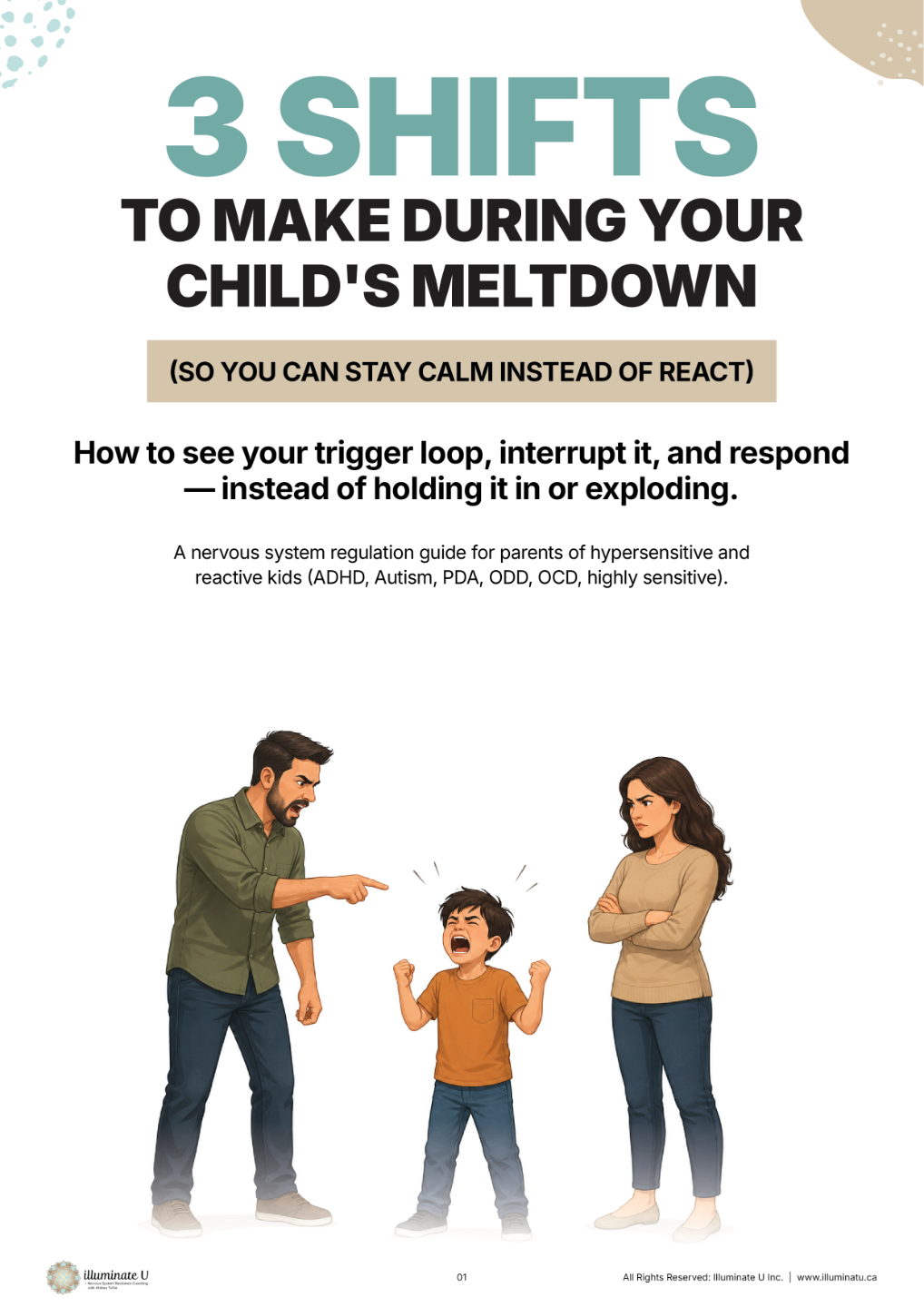
Free: The 3 Shifts Guide
The trigger loop and 3 patterns you get stuck in during meltdowns — and how to shift them so you can stay calm instead of react.
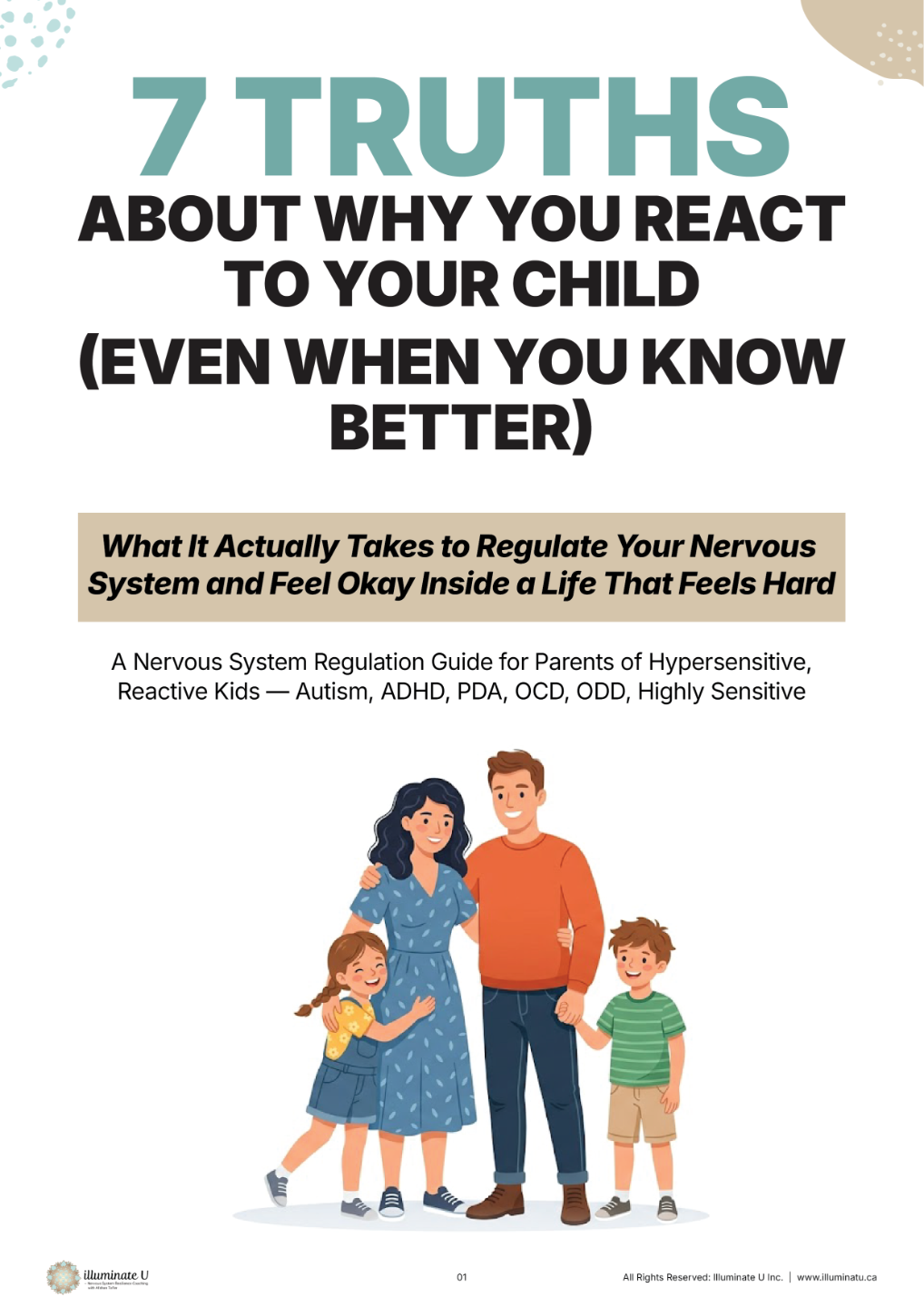
Free: 7 Truths About Why You React to Your Child Guide
Why you react even when you know better — the conditioning, nervous system states, hidden beliefs and patterns, and buried emotions running the show.

