
Why 8 Core Childhood Wounds Make Parenting a PDA/Autistic or Hypersensitive Child Feel So Personal

**You can also listen to this in audio format only on The Regulated Mother Podcast on Apple or Spotify. Look for Episode #44
If This Feels Personal… There’s a Reason
Is it hard to not take it personally when your child triggers you?
Because when you’re parenting a PDA, autistic, or hypersensitive child…
it can feel like everywhere you turn, there’s another moment waiting to set something off inside of you.
Within a single week—sometimes even a single day—
your child might be have violent aggressions towards you, or hurling mean words at you…
you might feel unsafe, rejected, pushed away, or completely overwhelmed by their dysregulation…
and then on top of that, you’re dealing with doctors or therapists who don’t fully get it…
who may even subtly gaslight or blame you or question what you’re doing…
and then there’s friends, family, or your community—
who just don’t understand how hard this actually is.
So week after week…it can start to feel like a constant buildup of:
feeling alone…unsupported…like you and your child don’t belong…
feeling like you’re doing everything wrong…
feeling like you’re failing…
and like somehow…you’re just not a good enough parent.
And the hardest part?
It all feels so personal.
But what if I told you…that what you’re feeling right now is not actually about who you are today?
What if it’s connected to something much deeper—
to eight core wounds that were wired into your system in childhood…
and the meanings you took on about yourself back then?
And what if…
by understanding those wounds,
and slowly changing those meanings…
this parenting experience could shift…
from feeling like one long, overwhelming, triggering cycle…
into something that, while still hard at times…
becomes way less triggering and even deeply meaningful and fulfilling?
What if I told you that working with these 8 core wounds…
can completely change how you see your child…
how you experience your life…
and more than anything…
how you see and value yourself.
So stay with me.
Because today, we’re going to shine a light on the eight core childhood wounds that get activated every single day when parenting a hypersensitive, PDA, or autistic child…
so that you can finally understand what’s happening inside of you—
and begin to feel a sense of clarity, relief and dare I say it – even freedom!
When Parenting Felt Like One Big Failing Experience
There was a time during my most intense parenting challenges with my PDA, autistic, OCD child when I felt like I was being triggered a hundred times a day.
I had no reprieve.
There were violent outbursts. I could not eat when I needed to. I could not go to the bathroom when I needed to. I could not sleep when I wanted to, or get the amount of sleep I desperately needed to be even somewhat functional.
My nervous system never got a break.
And it wasn’t just that life was hard. It was that everything felt like it was pressing on the deepest, most vulnerable places inside of me.
The doctors and therapists I worked with often, even if unintentionally, gaslit or blamed me for the challenges. I was somehow being too permissive, not hard enough, not pushing enough. At the same time, all the training and research I had done on attachment parenting made me feel like I was somehow doing it all wrong and failing my child because he wasn’t responding to those approaches the way I thought he should.
My husband and I were at total odds, competing for who had it worse and whose needs got to be met more. I was so exhausted and depleted that I had no time or energy for friends, and all the girlfriends I had worked so diligently to build community with slowly fell away. We had to stop going out, and my son stopped going to school because of the severity of the outbursts he was having.
My life became smaller and smaller.
And inside me, something deeper was happening.
I felt unsafe in my own home with my own child. I felt like I could be harmed. I felt like my friends didn’t love me anymore because I was so unavailable and they didn’t understand how hard it was. I felt so alone. I felt like the doctors and therapists didn’t get it and were not actually able to help, so I felt unsupported. I felt like I didn’t belong in a world that I already often felt I didn’t belong in.
We were different.
And somehow, in the deeper layers of my nervous system, that difference started to feel like it meant something about me. About us.
Like we were bad. Wrong. Failing. Unlovable. Unsuccessful.
And this is how so many parents in this kind of parenting come to me feeling.
Everything feels personal.
Not just difficult.
Not just exhausting.
Personal.
As if what your child does, how the world responds, what support you do or do not get, and how your life has changed all mean something painful and condemning about who you are.
And that is what I want to talk about here.
Because when we understand why this kind of parenting feels so personal, we can begin to stop fighting ourselves so much. We can start to see what is actually being activated. And from there, we can begin to create real freedom.
Not because the challenges magically disappear.
But because we are no longer living only from the old wounds and meanings that those challenges keep activating.
Why This Kind of Parenting Feels So Personal
When you are parenting a high-needs, PDA, or autistic child, it doesn’t just challenge your parenting skills.
It challenges your entire nervous system.
It touches your sense of safety, your identity, your belonging, your worth, your ability to cope, your hope for the future, and your deepest beliefs about yourself. The day-to-day realities of this kind of parenting are not neutral. They hit places in us that were already vulnerable long before our child was born.
Most of us think our child’s behavior is what is causing us to react so intensely. And yes, of course the behavior matters. Of course the circumstances are hard. But often what makes our reactions feel so overwhelming is not only the present situation. It is that the present situation is activating unresolved wounds from the past.
Our children are often showing us what still feels threatened, unhealed, or unfinished in our own systems.
That does not mean our child is doing something wrong by having needs, struggles, meltdowns, or nervous system challenges. It means their behavior and the life situation surrounding it can press directly on the meanings we made about ourselves in childhood.
And once those meanings are activated, we do not just have thoughts.
We have body memories.
Emotional flashbacks.
Protective reactions.
Survival responses.
This is why the awareness of our programming can become so liberating. Because so many parents feel trapped and stuck parenting in this kind of context. They feel like they have no control over their child, no control over their future, and no control over their own chronic reactions to them and to the life situation itself.
But when we get clear on what is being triggered, where we learned it, and what meaning we took on about ourselves long ago, we move into a very different place. We move into clarity. And from clarity, we can begin to shift.
This is where freedom begins.
The 8 Core Wounds That Get Activated
On a foundational level, we all need certain developmental experiences in order to build a solid internal sense of self.
We need to feel safe.
We need to feel loved.
We need to feel wanted.
We need to feel that our needs matter.
We need to feel supported.
We need to feel like we belong.
We need to feel that who we are is enough.
According to attachment experts, the core developmental self-states that create secure attachment are: I am loved, I am wanted, and my needs are important (I matter). And so much of healing our nervous systems is really about learning to meet and repair unfulfilled attachment needs that never got fully met in childhood. We can think of these as core needs that create a void in our nervous systems and crave to be filled by our adult Self today.
In a sense, we are reparenting ourselves now. We are changing the experience on a felt-sense level and slowly shifting the meanings our brain took on about being unloved, unwanted, unsupported, unprotected, or not enough. We are building something new back into our systems from the body up.
When those developmental needs are not met consistently enough, we adapt. We form beliefs and meanings about who we are and what we need to do in order to stay safe, connected, accepted, or valued. And then those beliefs become the lens through which we experience life.
Especially parenting.
Here are the eight core wounds that, in my experience, get activated again and again in this kind of parenting.
1. I Am Not Safe
This wound forms when no one protected you, when caregivers were unsafe or harmful, when there was chaos, unpredictability, fear, emotional volatility, or a chronic sense that the world was not secure.
When this is the wound that gets activated, your child’s violent outbursts, aggression, intensity, or unpredictability can feel like real danger. Not just “hard behavior.” Not just a difficult moment. Real danger.
Your body may brace, freeze, panic, rage, or become hypervigilant because it is not only responding to what is happening now. It is also responding to everything that has ever felt like this before.
And if you were not protected in your childhood, or if one of your own caregivers or family members harmed you, then your child’s dysregulation can unconsciously press on that exact place and trigger this wound. It can feel like it is happening all over again. On some very old level, the younger parts of you can experience your child as the one bringing back that old feeling of being unsafe and unprotected.
2. I Am Not Loved (For Who I Truly Am)
This wound forms when love felt conditional. When you had to be a certain way to be accepted. When your real feelings, needs, personality, or sensitivity were too much, not enough, inconvenient, or unacceptable.
Then you learn: I am not loved just as I am. I must shape myself in order to receive love.
So when your child rejects you, says mean things, pushes you away, or seems unable to receive your care in a warm and reciprocal way, it can hit something very old. It can feel like proof that you are not lovable. Not because that is true, but because that is the old meaning your system already knows how to reach for.
When others don’t accept or understand your child and their challenges and judge them and you, this can make you feel like your child is not accepted or loved for who they truly are, which feels painful to you – but not only because they are your child, but also because it is triggering your own wound.
3. I Am All Alone
This is the wound of emotional isolation.
It is not just about being physically by yourself. It is about the feeling that no one sees you, no one understands you, no one is truly with you in what you are going through. And you’re left all alone, with these big emotions and sensations with no one there to help you with them.
This is such a common wound in this kind of parenting. Friends fall away because you cannot be there the same way anymore. Your life becomes hard to explain. Other parents do not understand. Family may not understand. Even if people care, you can still feel profoundly alone in your actual lived reality.
And this wound gets activated again and again because this parenting can actually create very real isolation. It is not “all in your head.” The experience of being more alone is often real. Which is why this work has to hold both truths: the outer reality and the inner wound.
4. I Am Not Supported (My Needs Don’t Matter)
This wound comes from having needs that were not met, seen, prioritized, or protected. It comes from learning that there is no one to lean on, no one to truly hold you, no one to meet you where you are.
Over time, this can become the belief: My needs do not matter. I have to handle everything myself. If I want support, I have to over-function, over-give, over-explain, or over-carry.
Then parenting a high-needs child presses directly on this wound. You are carrying so much. Holding so much. Doing so much. And often it really does feel like there is no one there in the way you need. Professionals may miss the mark. Your partner may not understand. Family may minimize. The support you long for may simply not be there.
So of course this wound gets activated.
5. I Am Not Enough
This wound is about conditional worth. It is the belief that who you are, what you are doing, and what you can offer is somehow not enough.
Not good enough.
Not smart enough.
Not capable enough.
Not good looking or slim enough.
Not calm enough.
Not strong enough.
Parenting a child whose needs are intense, shifting, complex, and often not responsive to standard approaches can light this wound up constantly. You can do everything you know to do and still feel like you are coming up short. You can compare yourself to other parents, compare your child to other children, compare your life to what you thought it would be, and arrive over and over again at the same painful conclusion: I am not enough.
6. I Am Bad, Wrong, or Failing
This is a shame wound. It goes beyond inadequacy and into identity.
Not just: I didn’t do well.
But: There is something wrong with me.
This gets activated when doctors, therapists, family members, teachers, or even strangers imply that you are somehow doing it wrong. It gets activated when nothing seems to “work,” when the approaches you believed in don’t seem to help, when you lose your temper, when your child is struggling, and when the world reflects back some version of: you should be handling this better.
Then the old shame floods in.
I am bad.
I am wrong.
I am failing.
7. I Don’t Belong
This wound is about being outside the circle. Outside what is accepted, welcomed, mirrored, or normalized.
This one can become very loud in parenting a PDA/autistic or hypersensitive child because your family may simply not fit into many of the spaces and rhythms that other families move through more easily. You may stop going places. You may not be able to invite people over. Outings may become impossible. School may not work. Community may feel inaccessible.
And if you already carried a wound of not belonging, this can intensify it tremendously. You may feel like there is no place for you in the world as you are living it. No place for your child. No place for your family.
8. I Am Powerless (I Have No Control)
This is the wound of having no choice, no say, no agency, no real control over what is happening to you. It can come from childhood experiences where you were trapped, overpowered, ignored, or forced to endure what you could not change.
Then parenting a high-needs child activates it constantly. You cannot control your child’s nervous system. You cannot force regulation. You cannot predict every outburst. You cannot control whether professionals will understand. You cannot control whether the world will accommodate your child. You cannot control how your life has changed.
And this can feel unbearable to a nervous system that learned to rely on control to feel safe.
This is why rage, shutdown, panic, and resentment can build. Because underneath them is often a very old wound of powerlessness.
The Protective Patterns That Grow Out of These Wounds
Once these wounds get wired in, we do what human beings always do.
We protect ourselves.
We develop patterns, habits, and survival strategies to help us not feel those wounds so directly. We do everything possible to feel safe, loved, supported, accepted, and enough.
So if the wound is safety, we may become overly cautious, hypervigilant, controlling, prepared for every possible outcome, constantly scanning for danger.
If the wound is love, we may become people pleasers, overly compliant, self-abandoning, shape-shifting in order to feel accepted.
If the wound is aloneness, we may keep ourselves busy, keep ourselves surrounded by people, or overextend toward relationships so we do not have to feel the emptiness underneath.
If the wound is lack of support, we may over-give, over-support others, make ourselves indispensable, or become the strong one who never needs anything.
If the wound is not enough, we may overwork, overlearn, over-focus on productivity, appearance, achievement, knowledge, image, or performance in order to feel worthy.
These patterns make sense.
They are not random.
They are intelligent adaptations.
But this kind of parenting has a way of exposing them all, because our usual ways of protecting ourselves often stop working the way they used to.
Where This Shows Up in Your Everyday Life
This is where everything starts to come together.
Because it’s not just that these wounds exist inside of you, and it’s not just that your child’s behavior can trigger one of them at a time. It’s that this kind of parenting environment has a way of activating multiple wounds at once, over and over again, often many times a day.
And when that happens, it doesn’t feel like one clear emotion. It feels like everything.
When your child has violent outbursts, aggressive behavior, or intense dysregulation, your body can go into a full threat response. This isn’t just a stressful parenting moment—it can feel like your safety is at risk. You may feel like you could be harmed, like you can’t relax in your own home, like you are constantly bracing for what might happen next.
And if you have a history of not being protected, this can go even deeper. Your system may not fully register that this is your struggling child in front of you. Instead, it pulls from a much older place that simply knows the feeling: this isn’t safe.
At the very same time, there can be another layer running underneath it—a sense of powerlessness. Because you can’t control when it happens, you can’t always stop it, and you can’t predict it.
So now it’s not just fear. It’s fear mixed with helplessness.
Then there are the moments outside your home.
When your child is severely dysregulated in public, when meltdowns happen in front of others, when people stare, judge, dismiss, misunderstand, or even subtly shun you or your child, something else begins to stack on top. You may start to feel like you’re doing it all wrong, like you should be able to handle this better, like other parents don’t struggle like this.
And even if no one says anything directly, your system fills in the gaps.
You feel exposed.
You feel judged.
You feel like you and your child are not accepted as you are.
And suddenly, it’s not just about the moment. It’s about what that moment feels like it means about you.
And those meanings don’t come out of nowhere. They come from beliefs that were formed much earlier in your life.
For many parents, this is also where interactions with doctors, therapists, or professionals become incredibly activating.
You go to them for help—for guidance, for support—but instead, you may leave feeling blamed, misunderstood, or subtly criticized. Maybe you’re told you’re too permissive, or not firm enough, or not doing enough, or doing too much.
And even if it’s not said directly, the implication can land hard.
Because it connects to something old—experiences where you were blamed, misunderstood, or not supported in the way you needed.
That feeling of being wrong.
Of being judged.
Of not being supported in the way you actually need.
So now, it’s not just about your child. It’s about feeling like there is no one truly in your corner.
Then there is the slow, often painful shift in your relationships.
Friends who used to be close may drift away—not always because they don’t care, but because your capacity to show up has changed. Your life has changed. The things you can do, the places you can go, the way you can connect—it’s all different now.
And over time, that creates a very real sense of isolation.
You may find yourself thinking:
No one really understands this.
No one sees how hard this is.
I’m carrying this on my own.
Even if there are people around you, you can still feel completely alone in your actual experience. And if aloneness was something you felt earlier in your life, this can bring that feeling back very quickly.
Within your own home, the dynamics can become just as complex.
When your child says mean things, rejects you, or pushes you away, it can hit deeply—not just because the words hurt, but because of what they seem to say about your relationship.
And if your partner questions your approach, disagrees with how you’re handling things, or places blame on you, that can add another layer. Now it’s not just your child’s behavior—it’s the meaning your system is making about it all.
I am unsupported.
I am all alone.
I am not enough.
I am bad, wrong, and failing.
I am not loved.
I do not belong.
And all of that can happen in seconds.
Because your system is not just reacting to what’s being said now—it’s reacting to what those words have meant to you before.
And underneath so many of these moments is a quiet but persistent sense of not belonging.
You may not be able to participate in the same activities as other families. You may stop going places. You may avoid gatherings. School may not be working. Outings may feel impossible.
Your life starts to look different.
And if you already carried a wound around belonging, this can amplify it in a very real way.
It can feel like:
There’s no place for us here.
We don’t fit anywhere.
And running through all of it is the thread of powerlessness.
You cannot control your child’s nervous system. You cannot control how others respond. You cannot control how quickly things change. You cannot control whether support shows up in the way you need.
And for a system that learned early on that control creates safety, this can feel overwhelming.
Sometimes it comes out as rage.
Sometimes as shutdown.
Sometimes as exhaustion, numbness or burnout.
But underneath it is often the same feeling:
There is no way out of this moment.
A feeling your system may have learned long before this parenting experience ever began.
So what happens is this:
Your child’s behavior, your life circumstances, your relationships, and the lack of understanding from others all come together to activate multiple wounds at once.
And when that happens, your system doesn’t experience it as separate pieces.
It experiences it as one overwhelming state.
What’s important to understand is this:
None of these reactions are random.
They are your nervous system connecting the present moment to meanings that were formed in the past. And when those meanings get activated over and over again, it doesn’t just feel like stress. It feels like something is wrong with you.
It’s not just that these wounds are being activated. It’s that this kind of parenting often strips away many of the strategies you once used to feel okay. The ways you used to cope, regulate, or find relief don’t always work in the same way anymore.
So it is not just that you are being “too sensitive.” It is that your system is responding exactly as it was wired to.
This is why the reactions can feel so big. This is why the emotions can feel so intense. This is why the experience can feel relentless. And this is why it feels so personal.
Because in the middle of all of this, your brain is doing what it is designed to do.
It is trying to make meaning.
It is trying to answer the question:
What does this say about me?
And without awareness of these deeper wounds, the answers it gives you will almost always come from the past—old beliefs, old meanings, old conclusions your brain made about you a long time ago, but now it’s connecting this feeling to be all about the present circumstance – “your challenging child”.
But once you begin to see this clearly, something starts to shift. Because now, instead of being completely inside the experience, you are starting to understand it. And that understanding is what creates the first opening. The first bit of space. The first step toward doing something different with what gets activated inside of you.
Why It Feels So Personal — And Why That Makes Sense
This is such an important part to name, because so many parents already carry shame about how personally they take things.
They know, intellectually, that their child is struggling. They know their child is not trying to wound them on purpose. They know they “shouldn’t” take it so personally.
And yet they do.
Of course they do.
It makes complete sense that it feels personal.
Because in some ways, it is personal.
Not personal in terms of the truth of who you are today.
But personal in terms of what your nervous system has lived before.
Our brains are meaning-making organs. Under stress, they move quickly to interpret what is happening and what it means for us. Attachment wounds do the same thing. Early in life, we form deep assumptions around questions like: Am I safe? Am I loved? Do I matter? Will anyone help me? Do I belong here? And then later, when something in the present resembles those earlier emotional experiences, the brain reaches for the old meanings fast.
So when your child is dysregulated, rejecting, aggressive, out of control, or when the life situation around their needs is chaotic and overwhelming, your system does not only see the current event. It also starts searching for meaning.
What does this mean about me?
About my worth?
About my lovability?
About my adequacy?
About my goodness?
About my belonging?
About my future?
So yes, it feels personal. Because your present pain is linking to your past meanings.
But here is the reframe that matters so much:
What feels personal is not necessarily true in the present.
It is personal to the past.
It is personal to the old wound.
It is personal to the younger parts of you that learned painful meanings in order to survive.
But it is not the truth of who you are now.
Your child’s behavior is not a reflection of your worth. It is not proof that you are failing. It is not evidence that you are bad, unlovable, unsupported, or not enough. And if you continue to take everything personally in the present, you stay fused with those old meanings. You stay trapped inside the old wound.
This is why learning not to take things personally today is so important. Not because you are supposed to become detached, cold, or unaffected. And not because your feelings are wrong. But because freedom requires being able to separate what is being activated from what is actually true.
When you can begin to say, this feels personal because it is touching something old in me, but it is not defining me in this moment, you create space. And in that space, you create choice, and this is where your freedom lies.
Working With What Gets Triggered
The goal is not to never get triggered.
In this kind of parenting, you will get triggered.
The goal is to become more aware of what is happening inside of you so that you are not only living from the old wound every time it gets activated.
1. Awareness Comes First
In every triggering situation, the first step is to become aware that you are triggered.
That sounds simple, but it is profound.
Because once you recognize that you are activated, you are no longer fully fused with the experience. There is already a little bit of witnessing. A little bit of separation. A little bit of space.
2. Do the U-Turn
Instead of only focusing on your child, turn back toward yourself.
Go inside.
Ask:
What am I believing about myself in this situation?
What am I afraid will happen here that is making me react this way?
What meaning am I making about myself right now?
And see if it connects to one of the core wounds.
Am I feeling unsafe?
Unlovable?
Alone?
Unsupported?
Not enough?
Bad or failing?
Outside of belonging?
Powerless?
This is where so much clarity can start to emerge.
3. Investigate Further
Once you notice the wound or the belief, gently ask:
Where did I learn this?
Where did I take in this meaning?
Then WAIT – let it come to you without thinking about it.
Sometimes the answer will come as words.
Sometimes as an image.
Sometimes as a memory.
Sometimes as a felt sense in the body.
That all counts.
Because some meanings can get wired in before the age of three, before we had language. So sometimes what is stored is not a clear story. It is a body feeling, an emotion, an energetic imprint. But over time that felt sense becomes a word-based meaning we live inside of every day.
4. Validate and Give Context
This part matters so much.
Of course this makes sense.
Of course this is here.
Of course I react this way.
This was taken on by a younger version of me who had very little choice and had to make sense of what was happening somehow.
And now, as an adult, when you understand the who, what, where, when, why of your triggering, the brain gets context. The nervous system gets context. And context creates safety.
Suddenly you are not just drowning in a reaction.
You are understanding it.
And understanding is liberating.
5. Choose What You Would Rather Believe
Once there is awareness and clarity, you are no longer only inside the old programming. You are in a place of choice.
Then you can ask:
What would I rather believe about myself?
What would support me?
What would be more life-affirming?
What would help me today with my child?
Usually it is some form of:
I am safe.
I can protect myself.
I am loved.
I am enough and worthy.
I am supported.
I can support myself.
My needs matter.
I belong.
I have power.
I have choice.
I can be who I truly am.
I can express myself authentically.
I can love myself for who I am.
This is where real change begins.
6. Work With the Body, Not Just the Mind
This is so important because this work cannot be done through the mind alone.
Yes, some of us can shift a lot with awareness and thought. But for many of us, the body also has to feel something different. These wounds were not only made through ideas. They were made through lived experience, nervous system states and blocked fight/flight responses, repeated emotions, and the felt sense of not being safe, loved, held, or enough.
So the body has to be included.
This is why body-based regulation, somatic work, orienting, grounding, movement, touch, breath, and all the work of helping the body feel safer matter so much.
We are not just changing thoughts.
We are changing the felt sense experience in the body too.
Rebuilding New Meanings in the Body
Showing up truly regulated and actually feeling okay with this life and with our child requires more than just understanding these wounds. It requires slowly building new meanings back into our systems and truly feeling them in our bodies.
Insight is not enough on its own.
The nervous system changes through felt sense experience.
These old wounds were built through repeated experiences that seemed to confirm painful beliefs. So healing requires repeated experiences that begin to confirm something different.
Here are the eight meanings we want to build in now, as adults:
Safety → I am safe
Love → I am loved
Support → I am supported, My needs matter
Alone vs Connection → I am connected
Worth → I am enough
Shame Repair → I am a good person and parent
Competence → I am capable, I am successful
Belonging → I belong
Agency → I have power and choice
These are not just affirmations to say mechanically. They are experiences to build, feel, and reinforce over time.
Using Havening to Build New Meanings
This is one of the reasons I love Havening so much. It’s a psychosensory, mind-body modality of using moving touch on the hands, arms and face to help create more safety in the body while opening space for new meanings to be received more deeply in the brain.
One gentle way to work with Havening is through “What if…” prompts.
What if I am safe right now?
What if I am supported?
What if my needs matter too?
What if I am loved, just as I am?
What if I am enough?
What if I belong?
What if I have more power and choice than I feel in this moment?
Notice we are not forcing anything.
We are not arguing with the nervous system and the past meanings that the brain says is your truth.
We are opening the door to possibility and allowing the body to begin to experience something new.
A Simple Daily Practice to Help the Brain Update
Along with more structured practices, there is something very simple you can begin doing every day.
Help your brain notice when you are safe.
Help your brain notice when you feel enough and worthy. Notice when you feel loved. Notice when you feel supported. Notice when you feel like you have done a good job. Notice when you feel successful in some way, even if it is something small.
These moments matter.
A moment of connection or love with your child (I am loved and connected).
Getting through something hard (I am capable, successful, good enough).
A feeling of pride (I am enough as I am).
A feeling of steadiness or a moment you feel capable (I am capable).
A moment where you advocate for yourself (My needs matter, I can support myself).
When you notice one of these moments, pause.
And feel it.
For at least 30 seconds.
Let it land.
Let your body take it in.
This helps update your brain that you are having new experiences now, experiences that validate taking on this new belief. And when you do this daily, over time your brain starts to self-fulfill these beliefs more naturally. It begins to notice more evidence for them. It begins to organize around them. It begins to expect them more.
This is how neuroplasticity works in a lived, embodied way.
Not by force.
But by repetition, attention, and letting good experiences actually register.
The Gift Hidden Inside the Triggering
When we do this work, something starts to change.
The same challenges may still be there. The same life may still be hard in many ways. But they do not land in the same way inside of us.
There is more awareness.
More context.
More space.
More choice.
Less automatic personalization.
Less shame.
Less fusion with old meanings.
And over time, something beautiful begins to emerge.
We begin to realize that our child is not creating these wounds. They are revealing them. They are showing us where the past is still living in the present. They are showing us what still needs tenderness, care, regulation, truth, and healing inside of us.
That does not make the path easy.
But it does make it meaningful…by turning loss into gain.
Because when we keep doing this work, we begin to feel something many parents have not felt in a very long time:
I’m okay.
Nothing is wrong with me.
Nothing is wrong with my child.
I belong here.
And from that place, our child starts to become something more than just the source of our triggering. They become an unexpected guide. A mirror. A catalyst. A gift in the deepest sense.
Not because the struggle itself is a gift.
But because what it reveals and makes possible can be.
This path can help us live more free from old wounds. More free from old meanings. More free from the identities we built around being unsafe, unloved, unsupported, not enough, bad, not belonging, or powerless.
It can bring us into greater clarity, greater self-awareness, greater compassion, and greater truth.
And that is real freedom.
Not perfection.
Not never getting triggered again.
Not controlling everything.
But freedom from living inside meanings that were never the full truth of who we are.
And when that happens, we do not just parent differently.
We live differently.
We see ourselves differently.
We experience our child differently.
We experience this life differently.
And that changes everything.
The Regulation Rebuild course
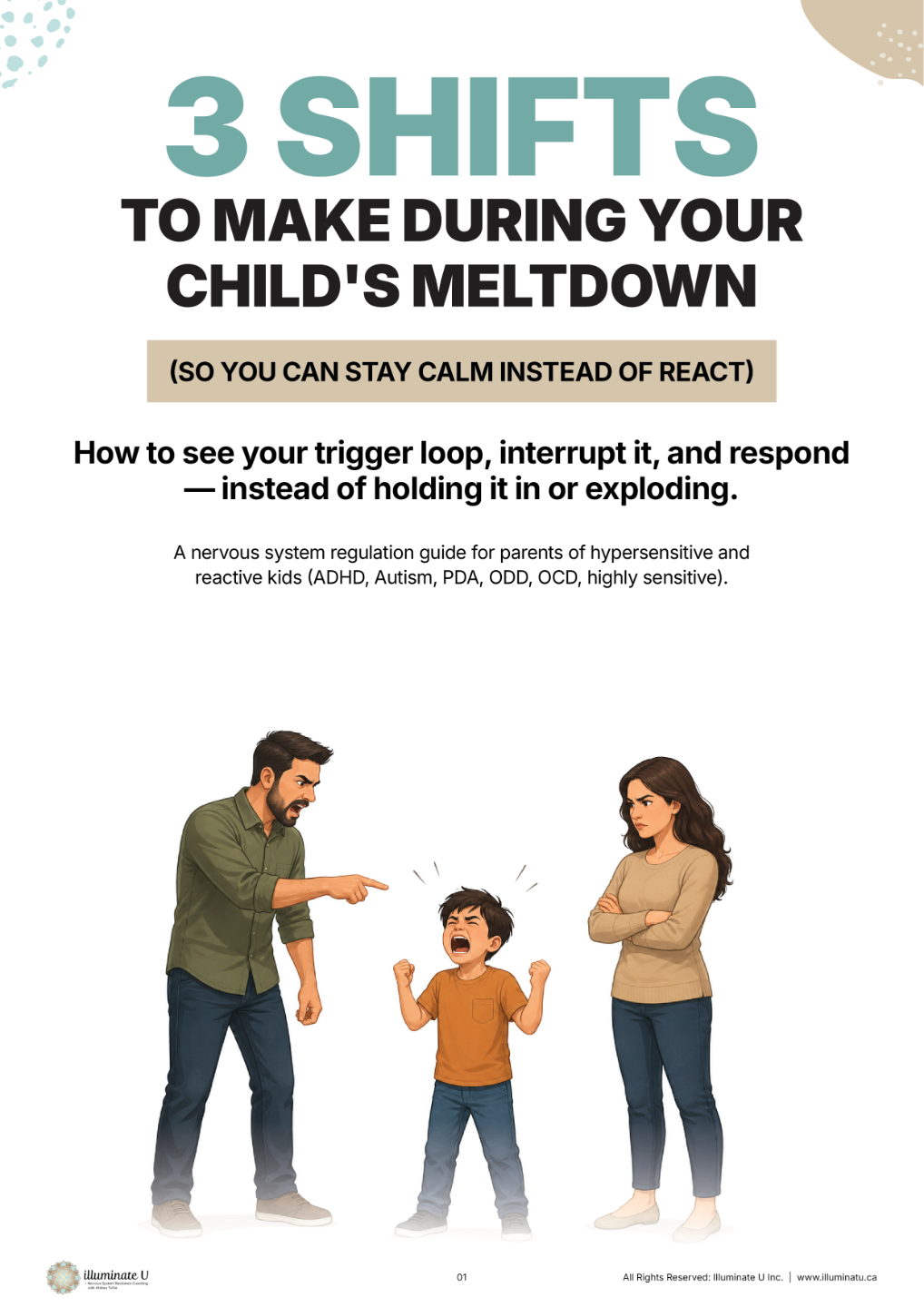
Free: The 3 Shifts Guide
The trigger loop and 3 patterns you get stuck in during meltdowns — and how to shift them so you can stay calm instead of react.
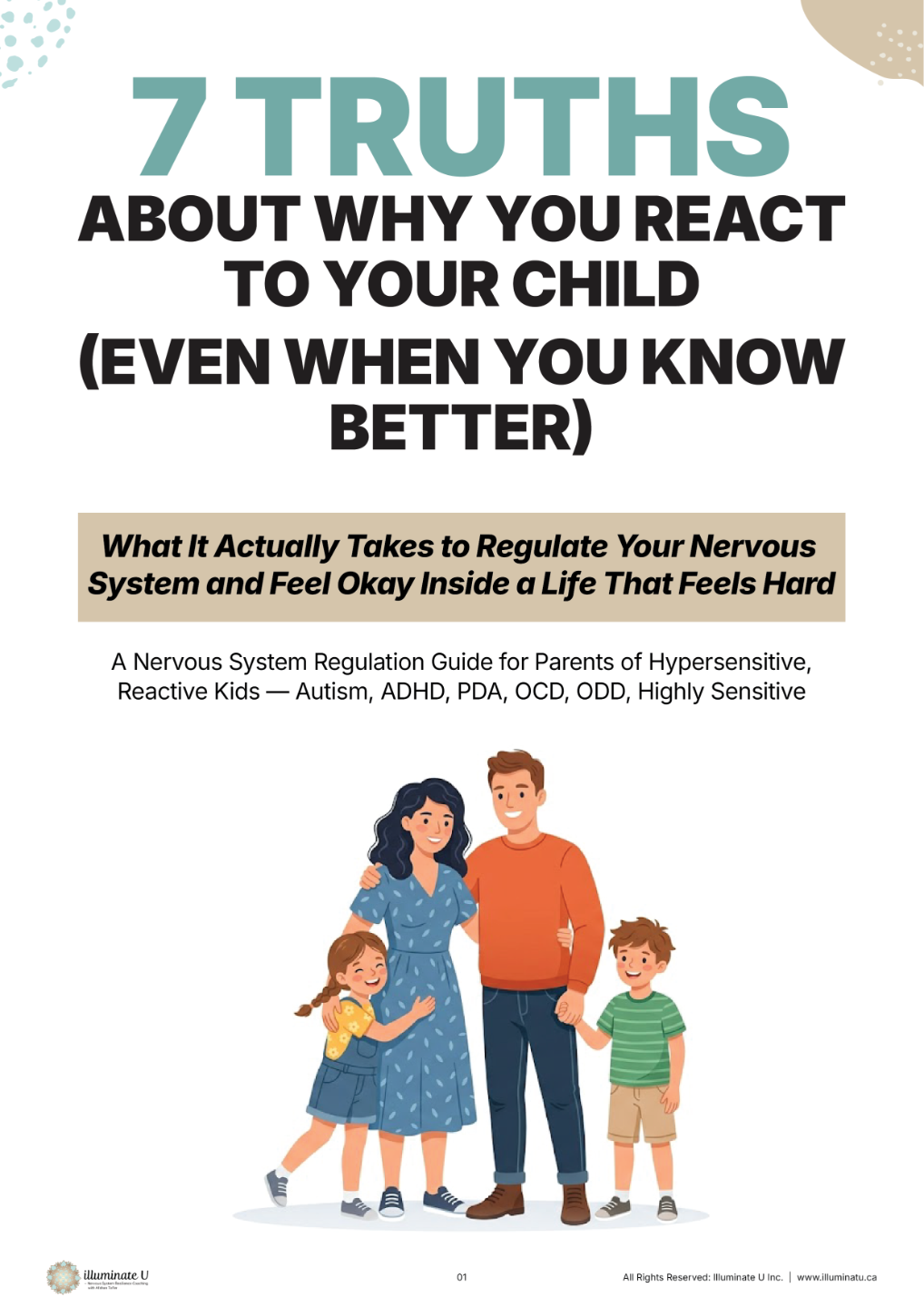
Free: 7 Truths About Why You React to Your Child Guide
Why you react even when you know better — the conditioning, nervous system states, hidden beliefs and patterns, and buried emotions running the show.

