
Will They Ever Learn to Be Okay Without Me? How to Help Your PDA, Autistic Child Separate From You

Part 3 of a four-part series
What's happening in your child, why accommodation on its own may still leave them stuck, and how to help them build the capacity to be okay without you.
If your PDA, autistic child can’t separate from you, this is what’s happening inside them — a lower threat threshold, monotropism, a sticky predictive brain — why the co-regulation and accommodation you’re giving are genuinely needed, why on their own they may still leave your child stuck, and exactly what I did with my son.
Am I Giving Too Much to My PDA, Autistic Child?
Am I giving too much to my child?
Will they ever learn?
Don't I need to be teaching them to be okay without me, and to do things on their own?
If you're parenting a PDA, autistic or high-needs child who can't leave your side, and who needs so much co-regulation, undivided attention and accommodation from you, I know you're carrying these questions.
Because we hear it so much from others who judge our parenting. And it's also wired into our own programming and conditioning.
But then there's the guilt we feel for even thinking that way, because this is a child with real challenges who needs a lot of help.
So let me say where I think a lot of us actually are.
We learn about accommodation, and co-regulation, and our kids borrowing our nervous system for safety. And it's right. Our kids do need it, because their systems are so often in threat mode.
So we give it. We accommodate, we co-regulate, we stay close, and we give them everything we have.
Because all of us want the same thing here. We want to help our child learn, and grow, and do better in their life.
But what happens next isn't the same for all of us.
For some of us, it is enough. Our child's capacity grows, and we see them doing better, and the only real struggle left is the people telling us that we're coddling them.
And for some of us, it has gone the other way. No amount of accommodation seems to be helping them function better in life, and it feels like it's getting worse.
And for some of us, the accommodation and the co-regulation are helping in some ways, but our child is still stuck in many others, and it may not be the whole picture of what they need. Your child may be calmer with you, and settled when you're right there beside them, and still not able to do very much at all without you.
So today I want to show you what's actually happening in your child, and why the co-regulation and the accommodation are needed and really do help them, and also why on their own they may still leave your child stuck.
And then how you hold both of those things together, without pushing your child, and without losing any of the safety you have built.
And then exactly what I did with my son to help him be able to separate from me. The real version of it, with the real timeline.
This is part three of a four-part series.
In part one we went through what happens when your child can't separate from you. What gets triggered in you, and what's happening in them.
In part two I took you through how to work with what's getting triggered in you, so that all of this co-regulating and accommodating doesn't feel so draining on you.
So let me take you right back to when I was in the thick of this with my son.
When My Son Couldn't Let Me Out of the Room
I want to take you back to when my son was in the middle of his burnout.
He had stopped going to school. He had stopped leaving the house. He wasn't going places anymore, and after a while he didn't even want to spend time outside. A neighbour would look at him the wrong way on the street and he would bark at them.
And every day, for hours at a time, I was sitting with him in our family room.
I want you to picture what that actually looked like, and I'm sure some of you can, because it isn't what most people imagine when they hear the word co-regulation.
I'm sitting beside him. The TV is on and it's his show, but I'm not watching it. I'm not closing my eyes. I'm not moving much. And if I tried to do any kind of breathing to settle myself down, I was trying to do it so quietly that he couldn't hear me.
Because every time I moved, or closed my eyes, or breathed louder, he would turn to me straight away. He was watching me out of the side of his eye the whole time.
If I went to get him food, he had to be the one to say when, and he would call me back very quickly. If my attention or my energy moved away from him at all, he would sense it. And then I would sense his anxiety rise, and he would be right in my face, trying to direct me and tell me what to do and get all of my attention back.
And then when I needed the bathroom, I would wait. I'd give him some autonomy in it and wait until he was okay with me going. And I would sit there holding it in, sometimes for so long that I could feel the frustration building in me.
And then every so often I would just get angry, and I would stand up and say, "I'm going now. You can't control me."
And I would go. And he would escalate. He would bang on the bathroom door and try to break it down.
We still have holes in our doors from that time. I have not fixed them yet.
So let me tell you how we got there. And you may recognize yourself in this, because I hear it from parents all the time.
My son had masked for years, and he was coming out of that during this period of burnout. His PDA had been much more internalized before, and it was becoming a lot more externalized now. He was more aggressive, more irritable, crabby most of the day. Everything irritated him. And he was under so much stress that he could barely meet his basic needs. He wasn't eating properly, his sleep was so affected, and his toileting as well.
We were also starting to see signs of OCD, and he has anxiety. But the doctors kept telling us that the OCD was not really OCD, that it was just a part of autism.
At the time we were learning about PDA, and it made so much sense to us. We were like, oh, this is him. This is what he needs. This makes so much sense now. So we really wanted to give the approaches for PDA a real chance.
So what did we do? We gave him more. More co-regulation, more undivided attention, more attunement, and more control over what happened around him.
And at first that control was about the things we could understand. Accommodating his sensory needs, and his need to control the sensory environment. He couldn't tolerate us drinking tea in front of him, it would make him nauseous. Or eating in front of him, or moving too much. He couldn't tolerate us watching the show that he was watching.
So some of this was sensory related and some of it not so much. There was the need for us to give him our full attention, and that was a real need too.
But then his need for control and autonomy moved onto our own basic needs. Us parents, our basic needs. Where we ate. When we ate. Whether I could go to the bathroom, or even go to sleep.
So his need for autonomy and control had stopped being about what he got to do. It became about what we were allowed to do. And I hear this a lot. It's quite common with our kids, and I went deeper into it in why a PDA child's need for control feels so dysregulating for parents.
Some of giving him this kind of autonomy over us worked. He needed some of that. On the days when I could sit there and tolerate it and stay regulated enough, he did eat better. He met his basic needs better. He even had moments of joy, and he laughed, in the middle of a burnout where he didn't feel good most days of the week.
And on the days when I was holding something in, when I was uncomfortable, or feeling trapped, or my frustration was building and I was trying so hard to hide it, it didn't work. He wouldn't eat. He wouldn't settle. He could feel all of it, no matter how well I thought I was covering it up. And then he would try to control me even more.
But this was also not totally consistent. And when we really did have to meet our own needs, the escalations were enormous. Two hours, sometimes more, before he could settle. There was aggression, things breaking in the house.
And all through this we were talking to doctors, and they were telling us that we were being too permissive. That we shouldn't give in. That he was getting used to these patterns of us accommodating him, and that we were solidifying these behaviours in him. That's the behavioural model, and that's the lens they were seeing it through.
They didn't understand PDA, though, and we did. We were really beginning to understand it, and we could see it. And what we saw was that when we did not accommodate my son's need for control over us, his escalations were even more extreme. They would go on for hours, and then his basic needs could not be met at all. Sometimes only a few bites of food in a day, on the days we would not accommodate him.
So we knew there had to be some accommodation for autonomy and control here. It couldn't be none at all, which is what they were telling us to do.
But I also couldn't tell myself that they were completely wrong, because he was becoming more and more afraid of me leaving, or of doing anything without me. His capacity wasn't growing and generalizing into situations that didn't include me. And sometimes it looked like it was going the other way.
And then later, when we understood more about the OCD, we looked at something like ERP, which is exposure and response prevention, the standard treatment for OCD. And we could not see how we would ever do that with him. I would read it and I would cringe, and I thought, there's no way we could do this.
And at the same time, we knew he had to learn to be okay when he didn't have all the control. There was a voice in the back of my head saying, he has to learn. And my husband was saying that as well.
So we were stuck in this bind. On the one end, I would accommodate and accommodate and hold and hold and hold everything in. And on the other end I would think, forget it, he has to learn. And I would just go and do whatever I needed to do and deal with whatever came after, but often end up getting very angry at him.
And then I would sit in a pile of shame and grief afterwards. Why can't I figure this out? What am I supposed to be doing here?
I contacted maybe three to five different people in the world who had any real understanding of autism, PDA and OCD together, and none of them had a good answer for me either.
So I was searching high and low for an expert who could just tell me what to do. And meanwhile my fear was growing, my exhaustion was getting deeper, and my bouts of rage, just to feel some semblance of control, were coming more and more often.
For a long time I thought that bind was just me. And then I started hearing from other parents, from you, the same bind in different houses with different children.
So if that's where you've been sitting, you're not the only one.
What's Going On in a Child Who Can't Separate From You
There are two things happening in our high-needs kids at the same time.
One of them is why they need so much co-regulation and accommodation and support from us. And the other is why, for some of our kids, they may also need us to challenge them a little bit inside the container of a safe and trusted relationship with us. Not challenge in the way that we usually know it.
And when you can see both of them, you'll understand why it can be so hard to know when to accommodate and when to challenge.
This is not a one-size-fits-all approach. We want it to be that way, but it really isn't. This is about tuning into your kid, who they are, what their patterns are, what they need, and tuning into your own instincts.
But I want to be clear about one thing first. It is never about when not to co-regulate. Because co-regulation and support, in the way that our child can really take it in and receive it, is always the foundation, and it doesn't go anywhere. So when I talk about accommodation here, I'm not talking about letting go of co-regulation and support, and I'm not talking about challenging co-regulation and support. That is the foundation.
Why Your PDA, Autistic Child Needs This Much From You
We covered some of this in Part 1 of this series, but I'll name the reasons again here, and I'm going to add a few more to them.
These are the reasons our kids need so much co-regulation, support and accommodation from us, and why it makes so much sense that we give so much more to them than anybody would give to a more neurotypical child.
1Their threat threshold is lower.
2They don't absorb the co-regulation the way we expect.
3Developmentally, they're younger than their age.
4Their attention runs like a tunnel.
5Autonomy is a survival need.
6They often can't read or tell us what's happening inside them.
7Their capacity fluctuates a lot.
1Their threat threshold is lower.
Our kids sense threat more easily. They have heightened neuroception, which is our threat detection system that runs below the level of conscious awareness. And they have a narrower window of tolerance, which means they can handle less stress before they drop into a survival state.
They don't have a lot of tolerance for stress. They go into a survival state more easily. They go into threat faster, and from a lot less input.
So when you leave the room or you go upstairs, their system registers it as, my safety resource is gone, and now I'm sensing danger.
2They don't absorb the co-regulation the way we expect.
Their system is often stuck in survival states, either defence or numbing. So the safety cues can't fully land, which means they come back for more and more. They always need more co-regulation from us, because they may not be able to fully fill up.
And this is why we end up giving more.
3Developmentally, they're usually younger than their age.
From a developmental perspective, not an age perspective, younger children need physical proximity to feel safe. Because at that stage, it's the only channel they have.
Gordon Neufeld, the child development and attachment psychologist, describes attachment as deepening through stages. It starts with the senses, with your child needing you physically close in order to feel connected to you. And as it deepens, eventually they become able to hold you in their heart when you're not there. That's where we want our kids to get to.
But it starts first with the senses and physical closeness. And hypersensitivity, anxiety and trauma can keep a system at that early developmental stage long past what their actual age is.
4Their attention runs like a tunnel.
This is monotropism, attention that's deep and narrow rather than spread across many things at once. And shifting out of that tunnel is genuinely costly.
So when you are their tunnel, your leaving is what pulls them out of that tunnel of safety they were in with you. And monotropism can also be connected to why transitions are so hard for our kids.
5Autonomy is a survival need.
It's not a nice-to-have. Every nervous system needs autonomy and choice. But for a demand-avoidant nervous system, having control over what happens to them is how the system keeps itself out of threat. So it's an even stronger need for them. A survival need.
Which means a challenge that gets handed to them lands completely differently than a challenge they have a say in, or are also co-regulated through. If they have choice and feel supported by borrowing your nervous system, then they can more often feel like they can get through that challenge.
So this is where we need to give more again.
6They often can't read or tell us what's happening inside them.
This is interoception, that sense of what's going on in your own body, and it can work differently in our kids. Hunger, thirst, needing the bathroom, the early building of distress in their bodies. They often can't feel or read these cues at all. Or at the other extreme, they can get completely flooded by them.
So they go from fine to flooded with very little warning, including for them. And a lot of our kids can't put it into words even when they do feel it, which means somebody has to be reading it for them. Most of the time that somebody is you, through attuning to them.
And always making sure they're meeting their basic needs. Could they be hungry? Could they be thirsty? A lot of us are preempting, making sure all of that's in place so they don't have low blood sugar and then a huge meltdown.
This is a lot of labour for us. We're giving more.
7Their capacity fluctuates a lot.
Their capacity fluctuates a lot based on cumulative nervous system threat. And this means that what they can do one day doesn't always translate into what they can do the next day.
So they have a harder time showing consistent progress. It fluctuates depending on their level of stress and how much capacity they have that day. As parents, we are always having to tune into that and factor it in. And that isn't easy, because we often don't know what internal stress their body and mind are carrying today, and they can't always tell us.
So it often leaves us guessing. What is their capacity today? Can they handle this challenge today, or do I need to not challenge them today?
So again, we're giving more.
So co-regulation, attunement, accommodation and scaffolding are always part of this picture with our kids, and often for many years, even into adult age. This is what helps them build more regulation skills over time, and more capacity to actually use those skills in their life.
Why the Research Says You Are Not Coddling Your Child
There's research behind this, and I want to give it to you, because I know so many of you are being told, whether it's by family members or doctors or other therapists, that you're coddling your child.
In attachment research, the word for what we're doing with our kids is sensitivity. And it doesn't mean being gentle, or being soft, or giving more. It means reading your child's signals accurately and responding in a way that fits what you're reading.
Researchers pooled seven studies of autistic children and their mothers. And at first they found what you'd expect to find with any child. The more accurately a mother was reading her child and responding to what she was reading, the more likely that child was to be securely attached.
In children who aren't autistic, how attuned a mother is accounts for only part of whether that child is securely attached. Only a part of it. It sits alongside many other things that also contribute.
But in these autistic children, the link was about twice as strong as what researchers usually find in children in general. Which means a mother's attunement accounted for much more of the difference between the children who were securely attached and the ones who weren't.
Now, these studies were all done with mothers, but I'd say the same holds for whichever parent is doing the attuning.
So the very thing you're being told is too much appears to matter more for our kids than it does for anybody else's.
I want you to take that in, please, because it's so important. This co-regulation, and attuning to our kids' true needs. And we're all doing so much of that, and it's arguably even more important for autistic kids in order for them to become securely attached.
So if you struggle with how much attention and attunement you give your child, or you're being criticized for it, and you feel bad when other people question you, take this in. I'm handing you this gift. Take it in. You are doing the right thing for your child. We can let go of feeling bad about that now. Let that be your permission.
Researchers pooled seven studies of autistic children and their mothers.
The more accurately a mother read her child and responded to what she was reading, the more likely that child was to be securely attached.
In these autistic children, that link was about twice as strong as what researchers usually find in children in general.
So the very thing you are being told is too much appears to matter more for our kids than it does for anybody else's.
Three Things That Can Keep Your Child Stuck Even When You Accommodate
There's no question in my mind that our kids need the extra co-regulation and accommodation, and that it helps them a lot. That we're really tuning into them and what they need.
But for some of our kids, it doesn't always generalize into them being able to do more in their life. Like even being able to separate from you. And this is the struggle a lot of you are having. Your child sticks to you like glue and doesn't even let you go to the bathroom, or anywhere.
In my experience, having a child with anxiety, OCD, who is also autistic and PDA, it really requires two approaches that can feel completely contrary to each other. One is accommodation. And the other is gently challenging them so that they don't get stuck.
But first I want to mention that there are different forms of accommodation, and they are not all the same thing. I've also written about how to accommodate without fear, burnout or losing yourself.
I'm not talking about reducing co-regulation. Co-regulation stays. It's the foundation, and it does not move.
What I'm talking about is accommodating their need for control and autonomy all of the time. Because them not being able to separate from you can have a lot to do with them needing to have a lot of control over you, and I hear this from parents all of the time. And if we're doing that a lot, it can hinder some of our kids.
So here are the three things that may be going on in our kids that can cause them to get stuck, even if you're doing everything you can to support them. See if you can recognize whether this is your child, and then you can start to learn the kind of approach that might be best for them, and tune into your own instincts for that.
1Anxiety. About 40% of autistic children meet criteria for an anxiety disorder, and avoiding brings relief, which teaches the system to avoid more.
2OCD. About 17% of autistic children also have OCD, and the more a family accommodates it, the more severe it tends to be.
3The predictive brain. Their brain predicts what this moment means from all the other times, not from today.
1Anxiety.
Some of our kids have anxiety. It's very common. About 40% of autistic children meet criteria for an anxiety disorder.*
And anxiety has a particular shape to it. Avoiding the thing brings the anxiety down right away. And that relief teaches the system that avoiding worked. So the avoiding gets stronger, and the world they feel able to move around in gets smaller and smaller. So the more we don't work with the anxiety and we accommodate it, the more their world can shrink.
It can look like this. They stop going to one place, and then they stop going to another place, and then a whole version of the day gets built around not going anywhere anymore.
It can also look like it did for my son, which is what it did look like. Underneath it all, his system learned, I am only safe when my mom is here with me. And once that was in place, he avoided anything that meant being away from me, and had panic and meltdowns when I wasn't there.
So these kinds of mental models, these more anxious mental models, get built below the level of conscious awareness, and they're sticky.
2OCD.
Obsessive compulsive disorder can show up alongside autism far more than we realize. About 17% of autistic children also have OCD,* and it's genuinely hard to tell the two apart.
This is what made it so hard for us to get an OCD diagnosis for my son, especially because he had "just right" OCD, which often looks like it is a part of autism.
But the more a family accommodates OCD, the more severe the OCD tends to be.** So we spent years accommodating while unintentionally feeding the OCD, and things just spiralled out of control for us, making the meltdowns so much more intense.
So if OCD is present, you still need co-regulation and attunement. But the levels of accommodation and autonomy may need to be balanced with some challenge, otherwise the OCD can take over and grow like wildfire. And that was our experience.
But I want to name how tricky this can get with our kids, especially when they have PDA. It's super tricky. It's not easy to decipher which approach to use and when, and it's a real dance between accommodating and then not accommodating. So I will do another podcast, and even offer a live class, on OCD and PDA together at some point, because it's so complex.
3The predictive brain.
Peter Vermeulen writes about this,*** and I feel like it's one of the most useful lenses I have for what I see in my son and in our kids who are autistic.
The idea is that our brain doesn't simply take in what's in front of it and see it as it actually is. Our brain is predictive, which means it is constantly predicting what something means. Not what it actually means. It's predicting what something means based on the mental models and the sensory information already loaded into your brain from past experience.
So what's in front of you is being seen through a filter that was wired in long before you got to this moment.
And the argument for autistic people is that these predictions can be held more absolutely. They're sticky. They don't update as easily from the situation. So if the situation changes and their safety is on board there, their brain won't update as easily. It can take a lot longer.
So here's an example. If every separation your child has had so far has ended in panic, then the prediction gets set. Mom or dad leaving means danger. And now you pick up your keys, and their system is already in threat before you've gone anywhere and before anything has actually happened.
Because their brain isn't making its prediction from today. It's making it from all the other times.
And then maybe one day you have a calm goodbye, and things went well, and it doesn't soften this prediction the way it would for another child, because the context isn't updating the model. At least not right away. It can take a lot longer.
So I call this a sticky brain. It sticks to what it believes the situation means. So even though your child has had experiences of being safe and happy without you there, their brain still believes they're in danger when you leave.
This is a theory in progress, and most of the research is in autistic adults rather than children. But it describes what I see better than anything else I've found, and it helped me understand how my son has this sticky brain, and how it's going to take him longer to update its models that it's safe when I leave the room.
How to Know If This Is Your Child
If you put those three things together, you get the thing that many of you are describing to me.
You're accommodating, and you're constantly co-regulating and attuning, and you're giving your child more and more of you and more autonomy and control. But for those of you whose kids may have these other factors at play, you may not be seeing your child getting better.
Perhaps they're able to access their basic needs better, and perhaps not. And perhaps you're seeing your child melt down even more, or get even more stuck, not going anywhere and not expanding their capacity to do more in their life.
So take in everything I'm sharing with you here with discernment, and ask yourself three things.
Is this my child? These three mechanisms I just described.
Am I seeing the benefits of co-regulation and attunement and giving more of my nervous system to them? And if I am, what are the benefits I'm seeing?
And are there ways I'm seeing them get worse, or more stuck, the more I accommodate their need for autonomy and control? And if so, could anxiety, or OCD, or a sticky predictive brain that can't update its mental models very easily, be at play here?
And if what you're seeing is that you've accommodated and it helped, and you've given it real time and real autonomy, and they still want to do less rather than more, then it may be that what's needed next isn't more of the same. It may be that they need opportunities, which is a nicer word for challenges. Not demands, but opportunities. Gentle challenges inside safety, inside co-regulation, and inside your relationship with them.
So always use your own intuition here for what you're seeing in your own child. And try to observe them from a regulated place, where you have some perspective and you're able to step back and look at the whole picture.
So if we want to help our kids who get stuck to learn and grow, and to help their brain build new mental models of what they're actually capable of, we still need all of it. The co-regulation. The attunement. The secure relationship with enough trust in it that your child can feel like, my parent understands me, they can handle me, they love and accept me no matter what, and they support me when I'm having a hard time. None of that goes anywhere.
But if we need to create opportunities to challenge them to grow, then we also need something else alongside it. We need to work with our own capacity to be with their dysregulation and distress as we challenge them. And that's not always easy.
But when we do, that's what allows us to stay with them inside something hard, instead of backing away from it and either giving in, or on the other side, pushing them through it.
And it comes down to being able to feel in your own body that I'm okay even if you're not okay, and I can handle this. No matter how big your distress is, I can handle this.
And that's not an easy state to embody, because so many of us have not learned this through our own caregivers mirroring it to us, which would have been the easiest way for us to learn it. Nervous system to nervous system. So we have this deeper conditioning and programming that often gets in the way.
And when it does, here's what it can look like around challenging our kids.
A parent hears that they need to challenge their child, and what they actually end up doing is pushing them. They just leave, and they call that building capacity and tolerance in my child. They make their child do the thing while their own body is braced and their jaw is tight, and they call it staying steady.
So this isn't challenge in the way that could actually work better for your child. It's more like pushing with a kinder word on it. And it's one of the two patterns I'm going to take you through in Part 4 of this series, so that you can see the difference.
Because your child feels that difference right away. They're not reading what you're doing. They're reading what's happening in you, in your nervous system, while you're doing it.
The Dance Between Accommodating and Gently Challenging
Here's what I feel we're aiming for when we're parenting our high-needs kids in these kinds of situations. It's about doing this dance between accommodating and gently challenging them.
The main thing is that we want to parent from regulation. From our truth, from our own inner wisdom about what's best for our child, because we have attuned to them and we understand them deeply. Not from our fear, and not from our programming of how we learned this is supposed to look.
And this often involves what I think of as a dance, and not just doing one thing all the time. We are so wired to think that there's one thing, the one thing that will change this. But it's never the one thing all the time, not for our kids. It's the one thing this day, and then it's the other thing the next day. It's a dance. It's using your creativity, which can only come from a regulated place.
So the dance is giving, accommodating, co-regulating, staying attuned and connected on the one end. And then inside that, it can also be challenging our kids in gentle ways so that they can learn and grow.
So what does that actually involve on an ordinary day? It involves these five things.
1You get regulated enough yourself.
2You tune in and read what your child needs right now.
3You give them that. Co-regulation, accommodation, staying close.
4Once that's on board, you support them to step out of their comfort zone.
5When there is rupture, you repair.
1It starts with you being regulated enough.
Because from inside survival, we can't read our child accurately and we can't hear our own intuition.
2Then you tune into your child in this moment and read what they need right now.
Rather than applying the same rule every day. Because what they need today, they may not need tomorrow, depending on their capacity and how much cumulative nervous system load they're carrying that day.
3And then you give them that.
The co-regulation. The accommodation. Staying close. It's also how trust gets built, over hundreds of small moments of attuning to their needs.
4And once that's really on board, you can also support them to step out of their comfort zone.
Gently, with you right there with them, with them having some autonomy and choice inside of it, and on a day when they have enough capacity to handle it.
5And when there is rupture, you repair.
Because inevitably there will be rupture at times, and you can always repair. They may not like it. They may have a threat response to you doing something to challenge them, because it's different from what they're used to. They may get activated. You may get activated too in the process. And can that be okay? Can you see that the important thing is to repair after?
So if you're working on helping your child be able to separate from you, or sleep without you, or try something new, or do one small thing on their own, then all of that comes after that foundation is in place. And especially when the challenge is about changing that physical closeness and proximity to you.
And I think that's where a lot of us get stuck, because we end up reaching for challenging them without the foundation underneath it. And then it doesn't hold. And then we conclude that our child just can't do this.
Where to Start, and What It Looked Like for Us
So that's what we're aiming for. And now I want to show you what it can actually look like in my house on a real day, and how I did this, because I know all of this can sound lovely and still feel impossible to picture.
Eventually I had to make a decision. For my own sanity and for my own nervous system health, I had to start working with him on space. Because a happy mom is better for him than a mom who is there all the time. I had to work through that one.
And the first thing I had to work out was where to start. Because when you are in deep patterns with your child controlling every one of your basic needs, like the bathroom, sleeping, eating, even moving around your own house, you can't work on all of it at once. You would overwhelm your child, and you would overwhelm yourself.
So you make a list of what matters most to you, and then you pick one thing.
And the ones to start with are your own basic needs, in my opinion. I know that can also be the hardest place to start, because we believe we should be accommodating our child in this way. But it is the one thing that makes the biggest difference in you. I know it did in me, because being able to meet your needs helps you stay more regulated. And it also gives you back some autonomy and control in your life, so that you don't feel as trapped as you may feel.
So look at your own basic needs and what your child is controlling or needing control over, and pick the one you want to work on. Then decide which ones you're going to let go of for now and come back to later, and which ones are the most important to work on.
1You can't work on all of it at once. You would overwhelm your child, and you would overwhelm yourself.
2Make a list of what matters most to you, and then pick one thing.
3Start with your own basic needs. It is the hardest place to start, and it makes the biggest difference in you.
4Decide which ones you are letting go of for now, and which ones you will come back to later.
The First Thing I Worked On Was the Bathroom
Remember, it didn't start with my son first. It started with me first. Because I had to be able to be with his dysregulation without getting pulled into an extreme response myself. I had to actually feel safe enough in it, and then I could mirror that safe enough feeling back to him.
And then the first thing I worked on with him was me going to the washroom.
And I didn't just start doing it. I talked to him about it in advance. I strewed it, which just means I kind of threw it out there here and there and left it lying around for him. So I had puppets act out me and him, and me going to the bathroom, so that it wasn't as personalized. And I had him watch that and see how he would react.
And I asked him that if I were to go to the bathroom, which one would he want me to use. So we would talk about the hypothetical situation. "So if I go to the bathroom, which one do you want me to use, the main floor or the bedroom upstairs?" So then he would think about that, and he would have choice in it.
And sometimes those conversations dysregulated him a little, but I was right there. We were connected. I wasn't going anywhere. We were just talking about it at first. And I did this for a couple of weeks, to give him time to process.
Then when I actually started going to the bathroom, first I would connect with him and co-regulate with him. Then sometimes my husband would come in and co-regulate him too. Or if my husband wasn't there, I'd put a little stuffy beside him, or suggest he watch a YouTube video. And then I would leave and get up to go upstairs.
And sometimes there was distress. So I allowed it, and I waited a few minutes and let him work through it.
Then I'd go and stand at the entrance to the room, or I'd go and stand at the stairs. So slowly, little by little, so that he could see I wanted to go up and I was going to go, but I was giving him time and space to process, and I was also giving him some autonomy and control.
And at the start, sometimes I would wait up to fifteen minutes at the bottom of the stairs. But I still gave him some autonomy and control in it. I'd take a few steps up, and then I'd wait, and he'd work through it. And eventually he would say to me, "Okay, Mommy, go up." Because he could see that I was going, but he could also see that I was waiting for him to give his okay.
And if he got so dysregulated that he couldn't handle it, because at the beginning this happened, I didn't come running back down. Because me going upstairs for a few minutes to use the washroom was my basic need. So if he was not letting me go up, I would just keep going. A few steps at a time, waiting a few minutes. A few steps at a time, waiting a few minutes. And then I would just go, even if he didn't say to go.
And sometimes he would get dysregulated and come after me. But I worked through it, and in my mind I was thinking, this is expected. This is okay. I'm okay with him being dysregulated. And then I'd do my thing in the washroom. He would bang on the door if he was dysregulated, and I would stay in there for a few minutes.
But over time he learned that I come out of the washroom calm, that I reconnect with him, and that he's okay. Sometimes I would come out and he would escalate for a bit, but I would show him I was not in fear. I would show him, I'm okay that you're distressed. This makes sense. I understand. I would stay more silent, and I would just work through it with him.
I worked on my own capacity first, so I could be with his distress without getting pulled under.
I talked about it in advance for a couple of weeks, and strewed it with puppets.
I gave him a choice: which bathroom would he want me to use.
On the day, I connected and co-regulated first, and so did my husband.
I allowed the distress and waited a few minutes.
I stood at the stairs so he could see I was going, and waited there, at the start for up to fifteen minutes.
A few steps up, then wait. A few steps up, then wait. And then I went, even if he hadn't said to go.
I came out calm and reconnected with him.
So I want you to hear how slow this was. We repeated it over and over, and eventually the waiting at the stairs came down from fifteen minutes to two to five minutes, and then I could go faster and faster. And you're giving some autonomy along the way, but not full autonomy, especially when it's your own basic needs.
And Then Leaving the House
And then we worked with leaving the house. Going for a walk. I wanted to go for a walk.
And I didn't decide how that would go at first. I worked it out with him. What it could look like, what he would like to do, how many minutes he'd like me to be gone, what him and his dad would do together. We'd talk about it when we were connected and regulated.
And again, sometimes he would get dysregulated in the conversation itself, and that was okay. Because every time, I was showing him, I'm okay with what's happening in you. And it's okay for me to take these breaks and go. And it's okay for you to not like it.
And the key here was that I wasn't in fear of his reactions anymore like I was in the past, and I wasn't attached to how it would go, or needing him to be calm while I did it.
And then he would come up with ideas that are better than anything I would suggest. He decided that we would give each other things when we would separate. He'd give me something to take with me, and I'd bring him back something to be excited about. He decided I'd take his iPad and record a video for him while I was out. He would also pick the amount of time that I would walk around the block for.
So this gave him some control, and it made the whole process feel safer to him. And I just had to be steady enough to let him.
And I want you to notice what was happening underneath all of it. Every single time, his brain got a piece of evidence it didn't have before. That Mommy goes, and Mommy comes back. I was scared and sad, but I was okay.
And over time, because remember, this can take time for those mental models to update because of the sticky predictive brain, he learned to be okay with others taking care of him too. Like his dad as well. He learned to be okay first with me separating, and then with others taking care of him. And then eventually we hired a caregiver, and it took eight months before he was comfortable being alone with her.
So that is a long time. Most people would probably give up. I nearly did too. But it took eight months, and he got there.
And he learned that it's okay for me to go. And when I felt safe enough in it too, eventually he could feel safe enough in it too.
And I don't want to underestimate that. Because me feeling safe enough in it, and not having that fear, meant he wasn't reading any of that anymore. So his whole felt sense and his mental models could update without the fear there. With safety on board. I was safe enough, so then he was starting to feel safe enough with that change. I don't want to underestimate that, because I think that was huge, and my husband and I talk about it to this day.
And to this day, he's 18, and he still gives me something when I leave, and I still bring something back for him. I still take videos and I text them to him now, because he has his own phone.
So we never stopped doing all those little accommodations. It just stopped being so hard.
Being Okay With Their Distress While You Challenge Them
So it's really about being okay with their distress while you challenge them.
There's a parent program called the SPACE program, which stands for Supportive Parenting for Anxious Childhood Emotions. They have an OCD program too. And I did the training for parents. The whole idea of it is that you reduce the accommodation while you increase the support. Both at the same time. And increasing the support means acknowledging their distress, and letting them know that you believe they can handle it.
And I would say for us, it wasn't about the words. It depends on your child. They might need the words. For us it wasn't about the words, it was how we felt inside and how we were mirroring that to him. That I can support you, I can handle this, I'm okay if you're distressed, and we're going to work through this. And I'm going to stay connected with you, even if I don't like that you're escalating and hitting me or throwing things or breaking things.
So every challenge we worked on with my son involved us being okay with his distress, no matter how big it got, and at the same time allowing him some autonomy along the way.
So it was a real dance. A real dance. And it only works well when you're coming from your own intuition of knowing, when do I push a little and go, when do I back up a little. When do I get to the point where they no longer have capacity and they're banging their head against the wall. It's a real dance.
The Small Things I Did Every Time
There were three things I did every time for the separation to make it better, and one bigger thing underneath them.
Before I would leave, I would give him something concrete. Not necessarily reassurance, like, oh, it's okay, you're okay, I'll be back, because he hated that. But I would give him the actual time, because he's very attached to time. And I would give him the actual thing we would do together. I would help him orient to the future point of connection, so that instead of his brain thinking about the separation, I'd help him orient to that next point of connection.
So I would say, I look forward to seeing you at 5:00pm, and I can't wait to snuggle on the couch with you. So we'll snuggle on the couch, and I'll bring home some food from your grandma, because at that time I was going to work at his grandma's place. And I'd tell him the exciting thing I would bring back for him.
And then when I came back, I reconnected before anything else. Before the bags, the mail, anything. I'd walk in the door, he was right there, and it was just all about connecting with him.
And then I told him about it later on, as we were sitting together and connected. I would say, oh, so I was gone, and you had such a nice time with Daddy, or with the caregiver. I went away and I came back, just like I said I would, because Mommy always comes back. Mommy always comes back. And, oh, I thought of you when I was gone. I was sending love to you when I was gone. Did you feel that in your heart?
Before I went: "I look forward to seeing you at 5:00pm, and I can't wait to snuggle on the couch with you. And I'll bring home some food from your grandma."
After I came back, once we were connected again: "I went away and I came back, just like I said I would. Because Mommy always comes back. And I thought of you when I was gone. I was sending love to you. Did you feel that in your heart?"
And: "I'm holding you in my heart. Can you hold me in your heart too? Can you feel that Mommy's in your heart?"
And then there's one more thing that I take from all of it. There was a fear underneath this that I had to work with first.
This fear I had for a long time that I'm the only one who can co-regulate him. And this happens for a lot of us mothers, and sometimes fathers too, when we become the primary parent for that child. That we feel like nobody else can do it. I'm the only one.
I really had to work with that twice. Once with my husband, and letting go of some control and letting him find his way with our son, and trusting that he could find that way, which was never going to be my way of doing things and co-regulating. They had to develop their own way. And then also with the caregiver.
So I want to say this. If you can get help, if you have the money or you can get funding or respite available to you, then I highly recommend taking it. And I know this can be really hard, and it can take a long time, and I also know it's not available to everyone. But if it is available, then take the support. We don't live in a village anymore, and we don't have all that support around us. So where you can, take it. For me, I had to hire a caregiver. That was the only way.
How Long Is This Going to Last?
I want to get into the question that's the hardest for us to be with. The one that brings up the most fear and the most grief.
How long is this going to go on? Is this going to be my life when they're an adult?
And underneath that question there is fear. That if I keep accommodating my child and keep giving this much, they're always going to be like this.
So I'm not going to give you a timeline, because I don't have one, and neither does anyone else who's being straight with you. All we can do is our best, and then see what our child's system is capable of over time.
And what I can tell you is that for some of you, it can take many years.
For my son, I accommodated his teeth brushing for years. And it's only now that I'm seeing what Gordon Neufeld calls emergence. That's when a child isn't as preoccupied with closeness to you anymore, and they start wanting to do things on their own.
My son had regressions on one of his medications, which likely slowed everything down. So I had to give him a lot more time. But inside all of that time, there was also gentle challenge.
And now he's seeing how much more capable he is than he ever thought. And I mirror that to him all the time. I smile and I show him, in ways that he will accept it, how happy I am that he's so happy brushing his teeth on his own.
And he even helps me sometimes too. His OCD will take everything out of the cupboards every morning. He removes all the dishes from the cupboards and puts them on the counter. And then I come down every morning and I have to put it all away. But now I can ask him to help me. And I say, oh, your OCD can have a new OCD to put things back in the cupboard, and I start laughing. And then he laughs too, and he sits down and starts putting things back in the cupboards with me, all the bottles he's pulled out. And we do it together.
And he still does struggle separating from me. He still gets sad. But he can tolerate it so much more now, and I hear him coaching himself through it too, talking to himself, reminding himself that Daddy's here, I'm going to do fun stuff with Daddy. And his caregiver is here and he's going to have fun with her today, and he thinks about the things they're going to do together.
So he coaches himself through it. And this took years for us to get here.
I have a lot of parents contacting me telling me their child is 15 and they still cannot separate from them. And what I want to say to those parents is to really take in what we've talked about today. Notice where you can challenge a little bit inside a safe relationship. And also be really patient, because it depends so much on your child's background and the traumas they carry.
And can it be okay that both of you are on your own timeline? That it doesn't have to look like everybody else's.
And for our kids who are in burnout, this is different in every single child. For some of our kids, depending on how long they have masked for and how much cumulative nervous system stress they have, burnout can last for months to years before they finally come out of it and show some ability to separate, and show that emergence of wanting to do things on their own.
And of course, what often comes up when things take a long time is grief. Our brain keeps measuring it against the life trajectory everyone else seems to be on, and then we feel this loss that our life is so much different from other people's, and we don't get to live that kind of life.
So part of what gives you capacity for the long haul is acknowledging that grief, working with it, and also changing the meaning-making underneath that grief. It's a huge part of having a more regulated nervous system and being able to build capacity for this kind of challenge. To really work on changing the meaning underneath that grief, so that it doesn't keep getting triggered. So that we can also feel like there is goodness in this life too, and in this experience.
And so that is the work. It's intense, but that is what gave me the capacity I have now.
And it did get easier for us. Partly because he does have more people, he can attach to his dad more and to the caregiver. But mostly because I'm not adding my own fear into every goodbye anymore. And I'm okay with meeting my needs now, and it doesn't feel like I have to meet my needs at the expense of his.
He could feel all of that before, inside me, because we're so deeply connected, me and my son. So he was separating from me while also absorbing everything I was feeling about it. But that's gone now, and that was a big piece of what made it so hard for us.
I'm not going to give you a timeline, because I don't have one, and neither does anyone else who is being straight with you.
For some of you it can take many years. It took years for us.
Inside all of that time, there was also gentle challenge.
And both of you are allowed to be on your own timeline.
You Are Not Giving Too Much
So let me come back to where we started before we end.
Am I giving too much, and will they ever learn?
I want to say that most of us are not giving too much. And our children can build capacity too. Not from being pushed into it, but from having enough safety and enough connection that their system isn't working so hard to hold onto us anymore, and it can start growing instead.
And then inside that, from small experiences that they have a say in, where they get to find out that they're okay. That they can be challenged and they can be okay, inside the container of a connected relationship.
So it's both of those things. Always both. That's the dance. We give, we accommodate, and then we challenge.
And nobody can tell you the exact steps of it, because this is your child. It's your house, your family, and it's both of your own nervous systems.
Now, there's one more piece to all of this, and it's the hardest one. Because knowing what to do and being able to do it are two different things. And most of us are trying to do this dance while doubting every decision we make inside of it, and then going looking for somebody else to tell us whether we're getting it right.
So that's what Part 4 of this four-part series is about. Why you can't hear your own deeper intuition and knowing, and where the doubt got put into you in the first place. And how you can come back to your own intuition and your own instincts. Because in the end, that's the thing that will tell you what your child actually needs.
You have your own wisdom inside of you. You just need to tune into it, and you can do that once we help you clear all the noise.
So before we do that, I want you to take this in.
You are not failing, my friend, and you are not doing anything wrong.
You are trying to find a model for how to help your child, and your own nervous system was never given that model to begin with. So it makes sense that you feel confused and overwhelmed, and that you often don't know what to do.
But you are also a parent who loves your child so much and is trying so hard. So please don't discount that. Value that.
And your child knows and feels your love. That is worth a lot.
So go easier on yourself, because you deserve it.
Questions Parents Ask
Am I accommodating my PDA, autistic child too much?
Most of us are not giving too much. Our kids genuinely need more co-regulation, attunement and accommodation than other children, and attachment research suggests a parent's attunement matters more for autistic children, not less. The question worth asking isn't whether you're giving too much, it's whether anxiety, OCD or a sticky predictive brain is also in the picture.
Why won't my autistic child let me go to the bathroom?
For a demand-avoidant nervous system, having control over what happens is how the system stays out of threat, so that need for control can move onto your basic needs. It's also about proximity. If your child is developmentally younger than their age, physical closeness may be the only channel they have for feeling safe.
Should I challenge my PDA child or keep accommodating?
It's rarely one or the other, and it's never a question of reducing co-regulation. Co-regulation is the foundation and it doesn't move. What can be balanced with gentle challenge is accommodating their need for control all of the time, especially if you're seeing your child get more stuck the more you accommodate.
How long does it take for an autistic child to be able to separate?
There's no timeline, and anyone who gives you one isn't being straight with you. For us it took years, and eight months alone before my son was comfortable with a caregiver. For kids in burnout it can be months to years before they come out of it. Both of you are allowed to be on your own timeline.
What's the difference between challenging my child and pushing them?
Your child reads what's happening in your nervous system, not what you're doing. If you leave while your body is braced and your jaw is tight, that's pushing with a kinder word on it. Real challenge happens when you can feel in your own body, I'm okay even if you're not okay, and I can handle this.
Sources
*van Steensel, Bögels and Perrin, Anxiety Disorders in Children and Adolescents with Autistic Spectrum Disorders: A Meta-Analysis. Clinical Child and Family Psychology Review, 2011. 31 studies: 39.6% met criteria for at least one anxiety disorder, 17.4% for OCD.
**Wu, McGuire, Martino, Phares, Selles and Storch, A Meta-Analysis of Family Accommodation and OCD Symptom Severity. Clinical Psychology Review, 2016. 41 studies, pooled correlation about .42. This is an association, not evidence that accommodation causes OCD to worsen.
***Peter Vermeulen, Autism and the Predictive Brain. Routledge, 2023.
The attachment research is The association between maternal sensitivity/availability and attachment in children with autism spectrum disorder: a systematic review and meta-analysis. Current Psychology, 2021.
SPACE (Supportive Parenting for Anxious Childhood Emotions) was developed by Eli Lebowitz at the Yale Child Study Center.
Before You Go
If this helped you in any way, please comment, and please share it with other parents.
If you missed them, part one is here and part two is here.
And I have three free guides that I'll link below and in the show notes.
One is on the three patterns most parents get pulled into during a meltdown, and how to shift them. That's the 3 Shifts guide.
One is on why you react even when you know better. That's the 7 Truths guide.
And one is for the grief that nobody names, and finding your way back to meaning and purpose and feeling like yourself again. That's the Meaning guide.
So pick whichever one fits where you are right now.
Thank you for being here. I'll see you next week.
About the author: Afshan Tafler is a Nervous System Resilience Coach, host of The Regulated Parent podcast, and a parent raising a PDA autistic teen with high anxiety and OCD. She is trained in Internal Family Systems (Level 3), Havening, polyvagal-informed practice and EFT, and is completing her Somatic Experiencing training. She has guided hundreds of parents of ADHD, autistic and PDA kids from burnout and barely coping to steadier, more connected and more alive, within the life they are actually living.
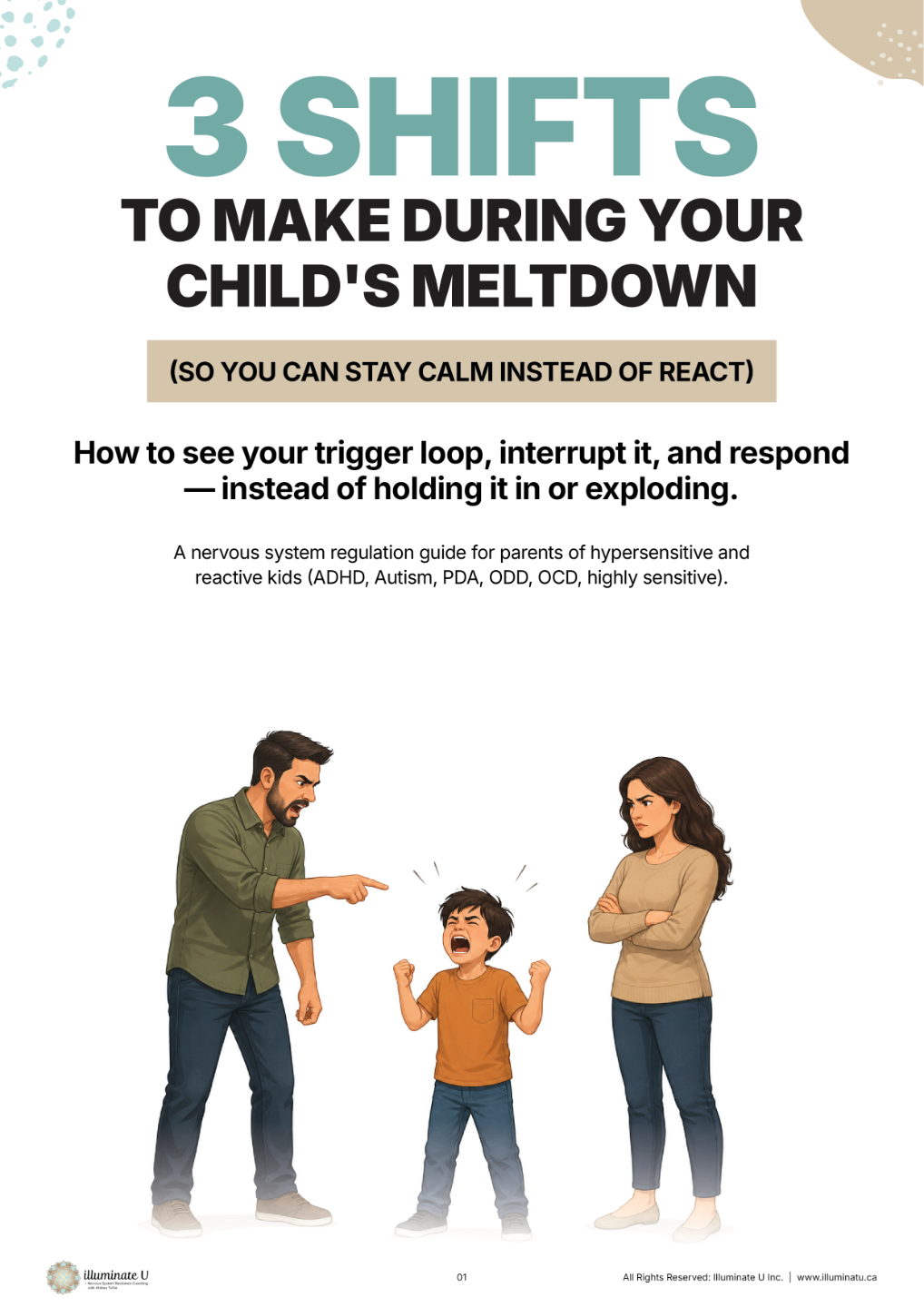
Free: The 3 Shifts Guide
The trigger loop and 3 patterns you get stuck in during meltdowns — and how to shift them so you can stay calm instead of react.
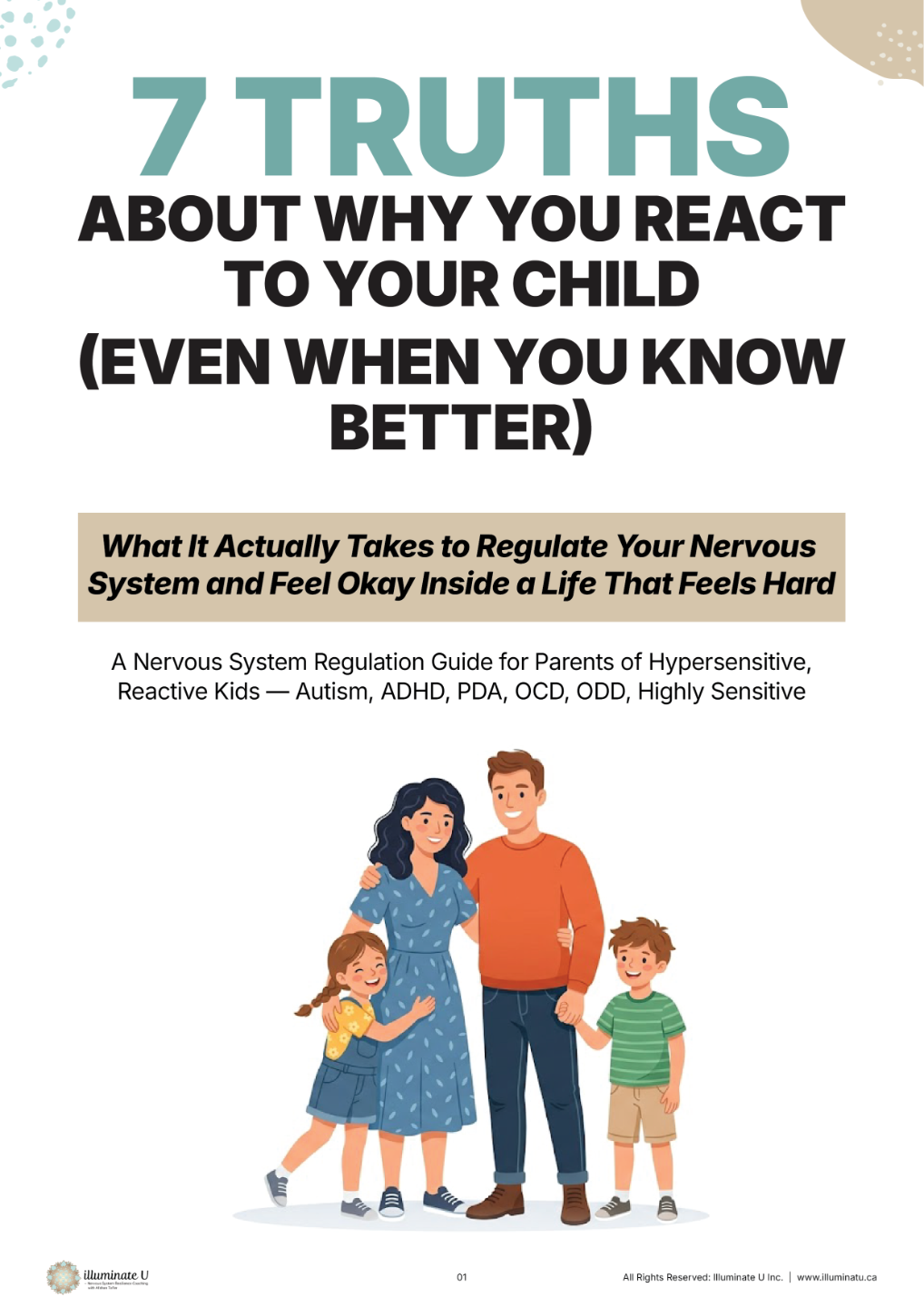
Free: 7 Truths About Why You React to Your Child Guide
Why you react even when you know better — the conditioning, nervous system states, hidden beliefs and patterns, and buried emotions running the show.

