
The Movements That Rewired Her Sons' Brains — and Kept Her Alive
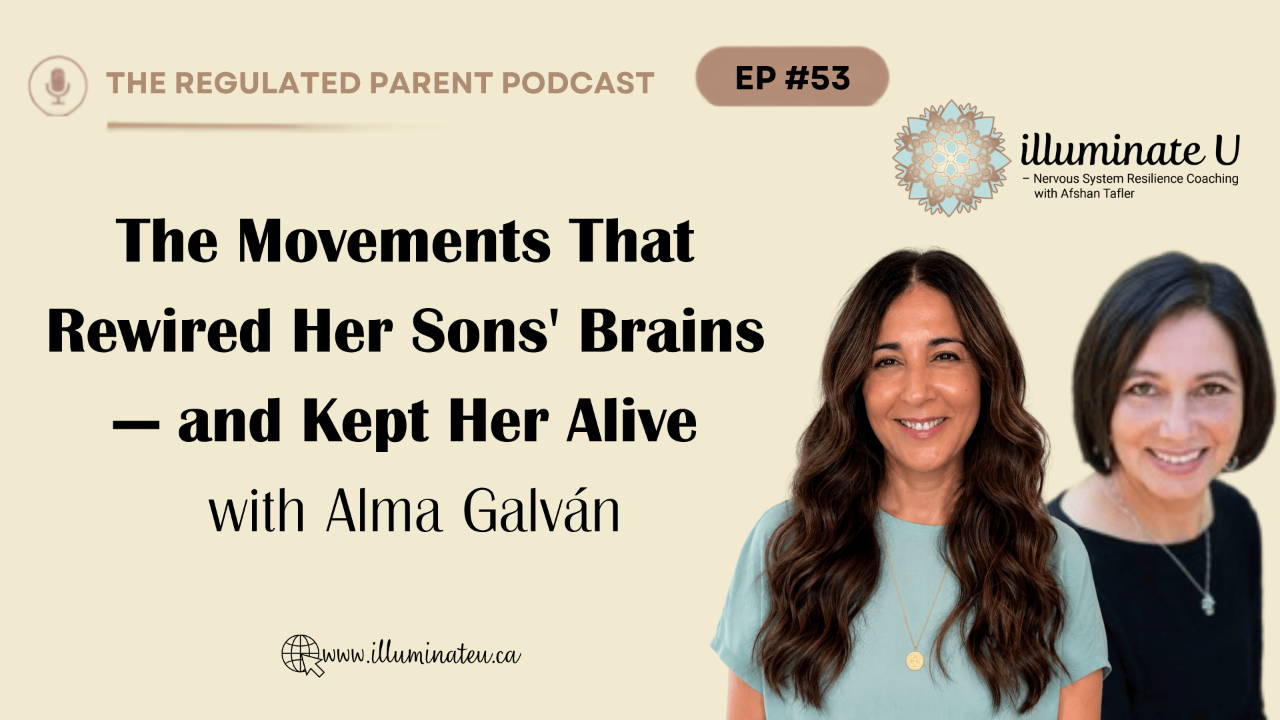
**You can also listen to this in audio format only on The Regulated Mother Podcast on Apple or Spotify. Look for Episode #53
Who Alma Galván is, and why I wanted her on this show
My guest this week is someone I was just taken by when I first met her, and her name is Alma Galván. She's the founder of BrainWorx, and she is one of the very few people I've come across whose work speaks to both halves of what we carry as parents — what our kids need, and what we need.
Her story starts the way a lot of ours do. In 1996, both of her boys were diagnosed with severe autism, ADHD, and sensory disorder, and a doctor looked at her and told her to put her oldest son in an institution and move on with her life. She didn't. And then she spent seven years searching for something, anything, that would actually help — which is a stretch of time I think a lot of you will recognize in your own bones.
What she eventually found was movement. Specific, gentle, tiny movements that develop the lower centers of the brain — the pons and the midbrain, the parts responsible for automatic functions most of us would never even think about, like regulating fight or flight and filtering out distraction. When those connections don't fully form, a child ends up living in a near-constant state of survival, and everything we see on the outside — the meltdowns, the overwhelm, the sensory storms — is actually downstream of that.
When Alma started using these movements with her boys, they improved more in a few months than in all seven years combined. Other parents noticed and started asking her to work with their children, and that's how BrainWorx was born. She's spent more than two decades with it since, working with thousands of families, educators, and professionals around the world.
And here's the part of her story that made me want her on this show even more.
On December 9th, 2024, Alma had an aneurysm. She was sedated for two days and spent twenty-one days in the ICU. And while she was unconscious — with no conscious mind available to her at all — her body kept doing the movements. Reflexively. Instinctively. As though they had been woven into the fabric of who she is. Her neurosurgeon and doctors confirmed it. She believes wholeheartedly that the practices she'd done daily for years played a vital role in her survival and her recovery.
I cannot stop thinking about that. Because so much of what we do as parents is reaching — mid-meltdown, phone in hand, googling what do I do, what do I do right now. And Alma's story says something completely different, something I believe with my whole heart: that what carries you through the hardest moments isn't what you grab for in a crisis. It's what's already woven in by the time the crisis arrives.
Since her recovery, Alma has also built something new — Alma Integration, an integrative coaching practice focused on helping people return to what she calls their original blueprint, the calm, connected, wise essence that's still there underneath the survival patterns and the noise.
So her two bodies of work now hold both directions at once. BrainWorx for the child's nervous system, and Alma Integration for yours. Which is exactly why I asked her to come on — because I don't want you to have to choose between getting help for your child and getting help for yourself. Ha! As if we have the energy for both.
But that's the thing. Alma's whole life is the proof that they're not two separate projects. They're the same one.
Seven years of "I know something is wrong" and nobody believing her
Alma's story starts the way a lot of ours do, and I want to spend a minute here because I think many of you are living in this exact stretch right now.
In 1996, both of her boys were diagnosed with severe autism, ADHD, and sensory disorder. And it wasn't one doctor who told her to institutionalize her oldest son and move on with her life — it was two. Two different doctors. Two separate conversations where a professional looked at her and told her that her child's life was essentially over before it had started.
But before that, there was the pediatrician. She kept bringing her son in. She kept saying, "I can't pinpoint anything, I can't tell you anything, but I feel like there's something off." And he kept assuring her that everything was fine. By the third visit, he told her, "Alma, you're neurotic. You're too stuck on that. Nothing's wrong with your son." When she pushed back that his language wasn't coming in, he said, "Boys speak later than girls. Let it go."
She said, "Okay." And she went home.
I asked her what those seven years of searching were actually like, and she didn't reach for a nice word. She said: "They were hell. Absolute hell."
By then she had two boys with significant challenges, and meltdowns in her home could run up to two hours. Two hours. As a common, ordinary occurrence.
And here's the moment that broke it open. She was up at one o'clock in the morning, having bawled her eyes out, and the thought that came was, "This isn't life. This can't be life. It just can't."
And then a different thought arrived — and she describes it as coming from somewhere other than her, a divine energy, and I'll let her language be her language here. The thought was: wait, they're not yours. They came through you.
She said, "They're my sons, yes they are. But I didn't have a single decision on where the eyes went, where the mouth was, where their lungs were, where their heart was. So there's a different blueprint that somebody else has, this divine energy has, that I didn't know about."
And so her next thought was: then there's got to be a way. You have the blueprint. Show me.
That's what lit the fuse. Not hope, exactly. Something more stubborn than hope. And I want to name it for you, because I think it lives in you too — it's the thing that has you reading this right now, at whatever hour it is, still looking. That is not nothing. That is the whole engine.
What she found at year seven, and what actually changed first
This was the nineties. No Google. No internet. So Alma — whose brain, in her words, is fundamentally a researcher's brain — just talked to everybody she could find. And all the programs that existed for kids with challenges weren't doing a thing for her kids.
Then somebody said, "Call this teacher. She's doing something and she may have an insight." The teacher wasn't even in her district. Alma figured, well, she could just hang up on me.
The teacher started working with Adrian, her second son, and she started doing Brain Gym movements, plus some others.
Within a week and a half, Alma said, "I felt like the edge had been taken off of our home."
A week and a half. After seven years.
But here's the part I made her slow down on, because it is the actual mechanism and almost everybody misses it.
Two things had to be true for it to work.
The first was play. Anything Alma did with her kids, she had to do through play. So the teacher would show her a movement, and then Alma would have to get creative — how do I turn this into a game? How do I get them to want in? Which meant she had to let go of "this is how the movement goes, you have to do it this way." And she was very honest that this went against her nature. Do it right. Do it correctly. That was her instinct.
What she learned instead: "If we want to do something truly correctly, it has to do with connection. If we can connect with our child in a loving, playful way, they will follow us much more."
The second was that she was doing the movements too.
Her kids were doing them, yes. But so was she. And she said, "It was really my nervous system that started settling down. It's the first time that I felt like I could breathe in years."
Now. If you've been around here for a while, you know this is exactly what I teach — that you cannot regulate your child from a dysregulated place, that co-regulation isn't a technique you apply but a state you transmit. But here's what usually happens when parents hear that. They go still. They stop talking. They stay quiet and stiff and they call it regulation, and underneath it there's still this pushing energy, this expectation, this agenda. And our kids — especially our PDA kids, especially our demand-avoidant kids — read that instantly. They don't read our words. They read our state.
So parents get exasperated and think, "I can't bring in another therapy or modality, my child won't do it."
But listen to what Alma actually built. The parent does the movement. The parent is in the play. The movement regulates the parent. And then the child feels that regulation, and then there's a real chance they lean in and join.
The intervention for the child runs through the parent. It's not a workaround. It's the design.
Microchimerism, or: why working on yourself is not selfish
Alma brought up something I've written about before and love — microchimerism. In utero, cells pass between parent and baby in both directions. Their cells travel into us, up into our brains. Our cells stay in them. And those cells don't die. They stay.
Alma thinks in pictures, so here's how she put it: "If I'm working on myself and I'm calming myself, I'm attuning myself to the frequency of kindness, of calm, of love, and my cells are starting to vibrate like a tuning fork. And then that sends the message to the cells that are my cells that I gifted my child when they were in utero. So anything I do to me, I'm doing to the cells that they gifted me."
You can take that literally or you can take it as a beautiful metaphor. I honestly don't think it matters which. Because the felt truth underneath it is the same one my whole body of work rests on: there is no version of this where you help your child and skip yourself. Your regulation is not the thing you get to after everyone else is sorted. It's the delivery system.
Or as Alma said, with a lot more joy than I'm managing here: "I get excited that we have so much more power as a parent to grow our capacity to be that strongest, loving, calmest energy."
Why movement reaches what reasoning can't
Okay. Let's get into the brain, because this is where it clicked for me.
Alma's frame is that movement is our first language. Before words, before thought, before anything — cells move, grow, duplicate. And development happens in a sequence. Each stage builds on the one underneath it.
Which means if that sequence gets interrupted — and for Adrian, it kept getting interrupted, because he was under enormous stress from the very beginning — then the foundation that later development is supposed to stand on simply isn't there. And it compounds. He was born without the ability to move well, which meant movement wasn't available to him as the engine to keep developing, which meant more gaps.
Now here's the piece I want you to really take in.
The pons is the survival part of the brain. It's the part that tells you, truthfully, am I in a life-and-death situation, or have we been here before and we've got this?
And one of the primary things that develops the pons is creeping. Tummy time. Being on the belly.
Adrian got very little tummy time.
Which means, in Alma's words: "Any little thing and he would be going off to the races in the panic mode that oh my gosh, the sky is falling. Didn't matter what it was, because his brain kept getting the signal: you're in a threatening situation, this is life and death, this is life and death."
He didn't have the foundational awareness that says oh, no — this isn't actually life and death. That equipment hadn't been built.
And then she said the line that I keep turning over:
"To a human, Afshan, there is nothing greater than survival. So if I'm getting this message of survival, nothing else matters. Not learning, not fun. Nothing matters. It trumps everything."
That's it. That's the whole thing. That's why the reward chart doesn't work. That's why the reasoning doesn't land. That's why the beautifully-worded explanation you spent twenty minutes crafting evaporates on contact. You are talking to a brain that has been told the building is on fire. Nothing gets in. Nothing is supposed to get in — that's the pons doing its job with bad information.
You cannot talk someone out of a survival signal. But you can build the part of the brain that generates a more accurate one.
About three months into the Brain Gym movements, Alma hit a wall. She went back to the teacher and said, "I think there's more, isn't there? Because if we don't do these movements, I revert back." And the teacher pointed her toward Doman and Delacato's research — they had simulated the movements a baby would have done in that first year of life, with brain-injured children, and those children started doing things they were not supposed to be able to do.
That research is one of the first places anyone really saw the brain's plasticity in action. And it's the foundation of what Alma has been building for twenty-five years: go back, fill in the gaps, and as you do the movements, you acquire the functions.
"If my brain keeps getting the message that I'm under threat, I can't think. But if I grow that part of me, if I fill that in, then my nervous system doesn't have to jump into fight or flight constantly."
The part where she discovered it was rewiring her too
Alma didn't set out to work on herself. She didn't think she had anything going on.
She'd done okay in school. And she had this thing she was actually kind of proud of — she thought it was a character strength. "Oh, no, I have a great work ethic. I could outwork anyone."
Except. She could outwork anyone because she had to. She was working significantly harder than everyone around her to achieve what others got to with far less effort.
Read that again if you need to, because I suspect some of you just recognized yourself. The thing you've been carrying as a virtue may be a compensation. The brain is astonishing at building workarounds, and then we build an identity on top of the workaround and call it discipline.
Here's how she found out. She had to do the movements too — the tummy time, the creeping, the crawling, all of it, in a fun way. And one day she was reading an article, and she got all the way through it, and it was effortless.
Before that, she'd read for ten or fifteen minutes and her brain would wander off — what am I having for dinner? — and she'd get to the bottom of the page with no idea what she'd just read. Because her eyes didn't team.
That's midbrain. That's crawling.
And crawling, it turns out, brings in an enormous amount of what we call executive function: auditory processing, auditory discrimination, visual imagery, visual closure, shifting gears. We're all out here hunting for tools and apps and planners to prop up executive function, and Alma's point is that a lot of that function is developmental, and it can be built rather than propped.
Now — before you go lie down on your kitchen floor — she was very clear that she does not send grown adults off to crawl. We have kneecaps. We have aches and pains. Ha! Adult bodies are not baby bodies. Her whole twenty-five-year body of work is figuring out how to do these movements gently, adaptively, a little at a time.
"That's fight or flight, my friends"
This exchange was my favourite part of the whole conversation, and it's about how you do any of this.
I told her what I see constantly — that we embark on a new strategy with our child, or with ourselves, in this harsh, jaw-set, push-through way. We have to do this. We have to get through it. It's the conditioning. Hurry up. Get it done. Work harder.
And then it doesn't work. And we decide the thing doesn't work, or worse, that we don't work.
Alma's response: "That stresses the brain. And if you're doing any kind of work in that state, you're not learning. You're not growing."
The safety of the movement never lands. You did the practice, but you did it in a state that guaranteed the practice couldn't take.
Then she gave the example that made both of us laugh in recognition. She learned her times tables under enormous stress. And years later, someone asks her "what's seven times six?" and — nothing. She can't retrieve it. Because, as she put it: when my brain is in a comfortable state, I can't retrieve what I learned in a stressed-out state.
I told her the same is true for me. I could memorize anything as a kid. And now? Gone. I never really took it in, because I never learned it from a place of calm, relaxed, alert presence. I learned it from a place of survival, and survival doesn't file things where you can find them later.
This is why the play matters so much. That playful, connected zone isn't the nice-to-have wrapper around the real work. It's the state that makes the real work possible at all.
And Alma gave a beautiful, simple compass for reading whether you're in it:
Are they leaning in, or are they pulling away?
If they're leaning in, you're good. Keep going. If they're pulling away, pushing back, getting uncomfortable, even slightly — don't push harder. Ask: what's going on here, and how can I make this energy lighter?
She called it tropism — a cell moves toward what's nourishing and away from what isn't. Our kids are doing that constantly, and they're telling us the truth about our own state whether we want to hear it or not.
So can it be a dance instead of an agenda? I think it can.
And if you take one thing from this whole section: connection first, relationship first, then challenge. If your child is struggling with a task and you pause the task to connect with them instead — you have not failed at the task. You have done the more valuable thing.
Where her sons are now
I asked, because I know you want to know. And because Alma said something I loved: "I wish I would've had somebody that would've said, hey, look — this is possible."
Both of her boys were non-verbal until after six years old.
They started talking. They started making eye contact. She started being able to take them out into nature — she'd been homebound for years — and being able to live a little, in her words, was huge.
They're now 33 and 31. They both have jobs. They live with her, and they pay rent, and they do their own food and their own laundry, and they're largely independent. She described them as her roommates and then immediately said she doesn't love that word.
And this is the part that got me: "They are my most magnificent teachers, and I adore being around them. And the cool part is that they adore being around me." When her office door opens, she said, they come buzzing over like little bees — hey, can I talk to you?
We got into it a bit here, because I feel like we've lost the whole village. So much of our anguish comes from a script we absorbed about what should happen — that your child should be independent, get the job, live alone, have the relationship, do all of it, on the standard timeline. That isn't the path for all of our kids. And can it be okay that some of our kids stay part of the village longer? They have their own journey and their own timeline.
Alma grew up in a village where everybody worked together. And when the challenges showed up, her first thought was, they're not going to be able to be independent, they're not going to be able to — and then she caught herself. "Wait a minute. Let's not go into what the world says they should be doing. Let's look at what path of life would actually be ideal for them, and for us as a family."
That's a very big conversation to have with yourself. It's also, I think, where a lot of the suffering actually lives — not in our kids, but in the gap between them and a script none of us consented to.
December 9th, 2024
She calls it a day she blesses. Massively. Which — I mean.
It was a Monday morning. Normally she'd be alone in her office. That day, she happened to be with friends. She's convinced that's not coincidence, and if she'd been home alone, the outcome would have been different.
Triple aneurysm, upper left side, near the corpus callosum. Paramedics didn't expect her to reach the hospital. The surgeon didn't expect her to survive the operation, and expected serious cognitive damage if she did. Induced coma for two days. Twenty-one days in the ICU.
Then, about a week and a half in, one of the surgeons came in and said: "We're not sure why, but your brain is recovering really fast, so we're going to go ahead and take out the coil." They'd inserted a coil on the right side to monitor brain activity. She said, "We don't know why it's recovering the way that it's recovering."
And Alma's husband took out his phone, pulled up the BrainWorx website, and said: "Do you think this might have something to do with it?"
The surgeon looked at the phone. She said, "This is what you do? This is the work that you do?"
Alma said, "Mm-hmm."
And the surgeon said: "Well, that makes sense."
There are certain movements Alma does every single day — the ones that settle the heart and the nervous system. And those were the ones her body was doing while she was unconscious. Her husband watched it. He told her afterward, "It was so interesting, Alma. You just go right into that." The staff were asking whether she was okay, because her body was moving with no conscious driver at the wheel.
No higher thinking brain involved. No decision. Just instinct — reaching for what it knew, because it had been wired in so deeply that it had become part of the fabric of who she is.
She was released on New Year's Eve. She came home into 2025.
When she went back to have the staples removed, the neurosurgeon walked in and didn't even say hello. He just said, "You are so lucky. You have no idea how lucky you are." She said, "Well, I know I'm lucky, but you tell me why you think I'm lucky." And he said: "If I'd seen your scans and known that you're over 50, I would have said no way. No way can she recover — not 100%."
One of her clients took one look at her when she came back to work and renamed her.
Alma 2.0.
Alma Integration: the blueprint underneath
Here's what I find so moving about what came next. Alma Integration wasn't a new idea. It was her very first company name, from way back, and it came circling back around to her.
Alma means soul.
Soul integration.
She said, simply: "My name is Alma, and I help people integrate."
After the aneurysm, she needed her brain to come back online gently, so she pulled way back from BrainWorx. She had enormous plans for 2025, and — her words — absolutely none of them happened. "Sometimes we think that we're going a certain way, and there's a big detour that happens that goes: no, you're not going that way."
So she started writing. She'd ask herself: what do I need? What do I want to hear? And she'd write it, and record it, and lay gentle music underneath it — and that's what she'd wake up to every single morning.
She calls them thought streams. They're meditations, essentially, but the framing matters: they're not instructions. They're a stream of words that invites your body to soften.
And then she started writing songs. She writes the lyrics herself and uses an AI generator to build the music around them. And the songs, she says, are little mini-lessons — layered, so the concept goes in gently while you're not braced against it.
Which brings me to my favourite thing she said in the entire conversation.
Her sons started hearing the songs. And then they started coming to her office with their thumb drives — can I have that song?
She wasn't pushing anything on them. They came to her.
And then she said: "Anything I want to say to my kid, I can put in a song now, and he'll listen to me."
I actually gasped. Because if you have a PDA child, you already know: everything has to be indirect. My son's brain shuts down the second something is aimed straight at him. So we go sideways. I've been making social stories and graphics with ChatGPT for exactly this reason. But music? Music walks right past the guard at the door.
(And I'll confess — the song about gratitude on her YouTube channel has become a genuine hit in our house. My son adores it. We play it on repeat.)
She's now starting to offer this to parents directly, and the prompt she uses is going to sit in my chest for a while. She asks people to write: what would you have wanted to say to your child in utero? What do you truly want to convey to them, from your heart to their soul?
And then it gets set to music. And even if it's playing quietly in the background — frequency is felt. They pick it up.
Two practices you can start today
I asked Alma for one practice for us and one for our kids. Here's both.
For you: Soothing Heart
Put both hands over your heart — one hand, then the other on top, and keep them toward the middle of your chest. That placement matters, and I'll tell you why in a second.
Set an intention. The one Alma recommends for parents starting out:
"I show up, I do my best, and I release the rest."
Breathe in while you say it (out loud or in your mind). Then exhale through your mouth, and as you exhale, gently press on your heart. Alma likes to say hug your heart, and I like that better too.
Do three rounds. Switch which hand is on top partway through if that feels good; leave it if it doesn't.
That's it. Under three minutes.
Now here's why it's not as simple as it looks:
You're crossing the midline. One hand is on one side of your body and one is on the other, which means both hemispheres are engaged at once. And crossing the midline, Alma explained, opens access to the subconscious — which is why the intention isn't just a nice thought. In that state, it's writing.
You're activating your receptors. Every joint has receptors — Alma calls them little buttons. When you press, you're not just pressing your hands. You're activating your wrists, your elbows, your shoulders, your spine. When I did it sitting down I could feel it all the way to my hips. Standing, all the way to my legs.
And all those little buttons are sending one message up to your brain: "There I am. There I am."
The brain relaxes, because it knows where all the body parts are. That's the whole trick. Any time we push or pull on those receptors, they make us more aware and calmer at the same time, which is the exact combination we're always chasing.
There's research behind the heart piece too — the HeartMath Institute has found that connecting with the heart for three minutes with a sense of gratitude gives your immune system a boost that lasts up to six hours.
When to do it: first thing when you wake up, still in bed, before the day has its hands on you. And again right before you fall asleep, so it integrates overnight. Those are the two greatest windows for rewiring.
And the intention can be tiny. "I'm able to rest tonight." "I can let go of today's challenges and go into reset." It genuinely doesn't matter what it is. It's the pairing of the intention with the movement that does the work.
Little and often. Three minutes a day. That's how the nervous system rewires — not in one heroic session, but as a seed you keep putting in the ground.
For your child: Pinch and Uncurl
Model it first. Always. You do it, they watch, they get curious.
Take your thumb and index finger — your pincher fingers — and start where your ear connects to your head. Give it a gentle little pinch, then uncurl. Work your way around the outer edge of the ear, pinching and uncurling as you go, all the way down to the earlobe.
When you get to the bottom of the earlobe: wiggle, wiggle, wiggle, wiggle. Alma is very firm that you have to be silly about this part. Then go back to the top and do it again.
Three times through.
With little ones, she just goes pinch, pinch, pinch — because you're giving them something to do.
And here's what's actually happening, because it sounds far too simple to matter:
When we're in fight or flight, the first and second vertebrae lock. Our eyes go into tunnel vision — nothing exists but the threat. And our ears stop hearing everything except threatening sounds.
The ear massage activates acupressure points that let those vertebrae start to unlock. Which restores peripheral vision. And restores hearing.
So — if you want your child to hear you better, you don't repeat yourself louder. You get them to massage their ears. As Alma says to the kids: let's turn on our listening ears.
And think about what else this does for our kids specifically. Mine is exquisitely sensitive to every small noise; his threat system is just permanently switched on. This helps him stop being so hypervigilant to the sounds around him — which means less getting jangled by a sibling, less snapping at nothing.
Both of you can do it. Together. In about thirty seconds.
The thing about layers (because you're going to need this one)
Before we get to her closing message, I want to include something Alma said that I say to the parents in my course constantly, because it will save you at some point.
She told me it took her a long time to figure this out: she'd work through some emotion or some trigger, and then months later the same thing would come around again and she'd think, but I already dealt with that. I already took care of that. I already learned that.
And what she learned is that we grow in a spiral.
Say something snags you with the feeling of I'm not heard. You work with it. And then you keep growing, around and around, and eventually you arrive at a spot that feels like the same spot — something gets triggered that feels like I'm not heard again.
But it isn't the same spot. It's the next turn of the spiral. And now you have the chance to deepen that awareness from a different angle, a different place, more profoundly.
So when you get triggered again and the voice says I thought this was better, and it's back, so nothing worked — no. That's not what happened. It worked. And then the next layer showed up. And now there's a new layer to work with, to deepen that felt sense of the belief you actually want to live inside.
That's not failure. That's the design. And honestly, if we can stay curious about it — oh, what's coming up this time? — it becomes the interesting part instead of the crushing part.
"You're not alone"
I asked Alma what she'd want every parent listening to remember. The one who's exhausted. The one who's tried everything. The one who isn't sure they have it in them to do one more thing.
She said: "You're not alone."
And then she said, "I know it may sound like — oh, come on. No. You really are not alone."
And this: "There's a lot of ways I can explain why you are doing the best you can. And when we're struggling, it's really hard to see that I really am doing the best I can. You really are. I hope you hear it in my voice — I want to reach in and give you a hug. Because truly, when you have a child who's having such difficulties, we want to do everything in our power to make those difficulties go away."
"And yes, you're going to keep doing it. Because you know what? You're stronger than you think. Stronger than you know."
Then she said the thing that landed hardest for me.
She looks at her sons now — 33 and 31, buzzing into her office to talk to her — and she says one of the things she knows for sure is that their job in this world was to wake her up.
"Still is. He continues to be my number one Zen master. Always showing me where I'm not aligned, and bringing me back into alignment."
My greatest gift. Best teacher ever.
And I said it back to her, and I'll say it to you: as haaaarrrrd as it is — and it is so hard, I'm not going to pretend otherwise — your child is teaching you a better way. That pain can become purpose, and growth, and learning.
Not because the pain was good. But because you were always more than what the pain could take from you.
Where to find Alma
BrainWorx — her work with children, families, and educators: rewiring the brain through movement. 👉 brainworxinc.com
Alma Integration — her integrative coaching practice, the thought streams, and the work of returning to your original blueprint. 👉 almaintegration.com
Alma Integration on YouTube — her songs. Start with the gratitude one. 👉 Alma Integration by Alma Galván on YouTube
And two free summits she's hosting — I'm speaking at both
The ADHD Toolbox Summit — August 4th. This is the BrainWorx side: helping you understand your child's brain and learn new ways to support them. Live on the first day, with pre-recorded speakers on the second. I'll be sharing a talk in this one. 👉 Register here.
The Alma Integration Summit — "Finding Calm in a Chaotic World" — August 25th. This one is for you. Different energy entirely, a different way of sharing — how do we help our own hearts find calm in a chaotic world? I'll be speaking at this one too, and it will be a completely different conversation from the first. A deeper one. 👉 [Register here:link coming]
Both are free. If you're on my email list, you'll get the details.
When Alma and I first met, we clicked immediately — soul friends, the kind of people who just get each other because they've both been through the hard thing and come out the other side understanding that there was a bigger meaning underneath it.
That's my hope for you too. That you find your bigger meaning and your deeper purpose in all of this.
And in the meantime — three minutes. Hands on your heart. I show up, I do my best, and I release the rest.
Little and often. That's how it gets woven in.
With so much love, Afshan 💛
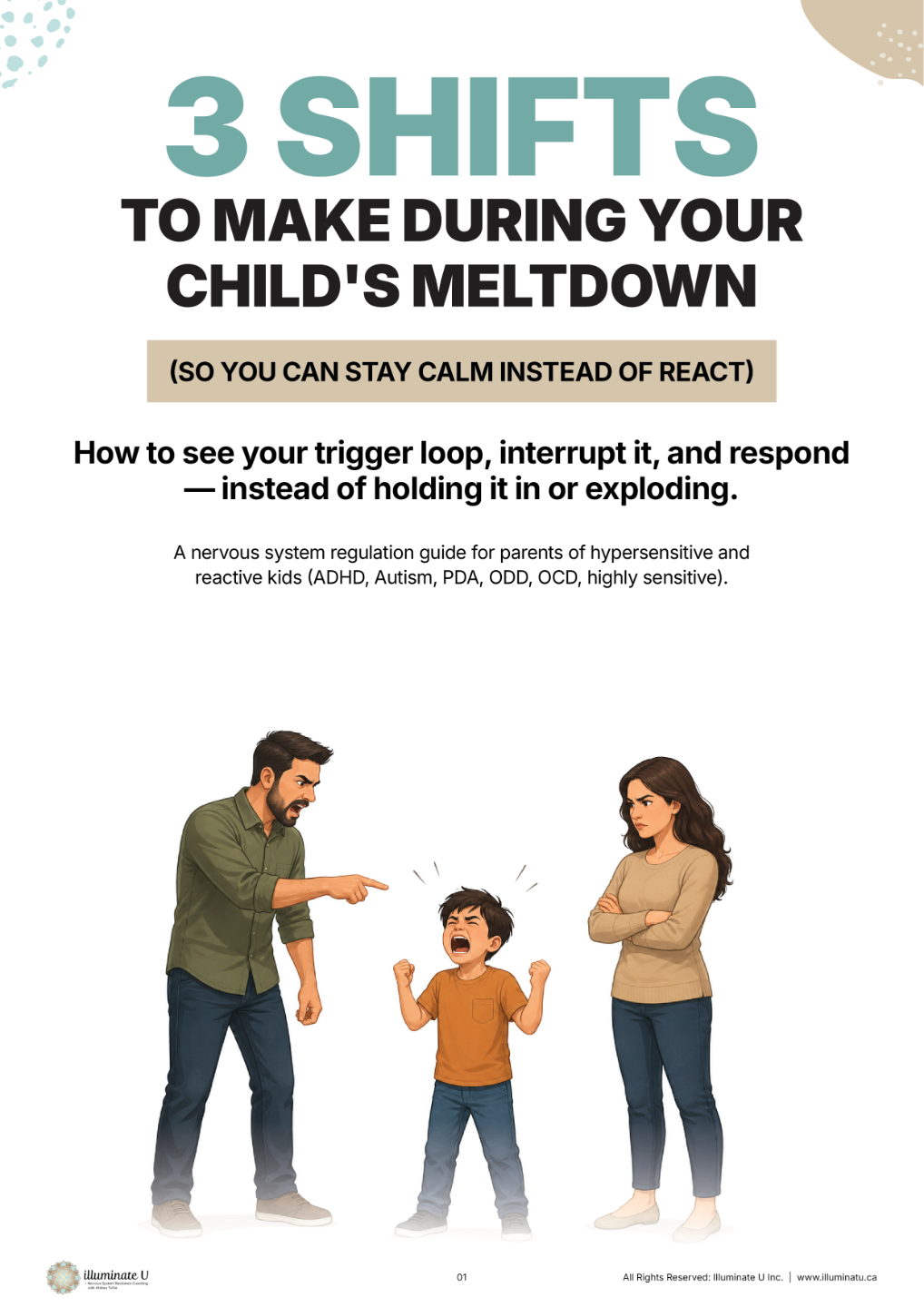
Free: The 3 Shifts Guide
The trigger loop and 3 patterns you get stuck in during meltdowns — and how to shift them so you can stay calm instead of react.
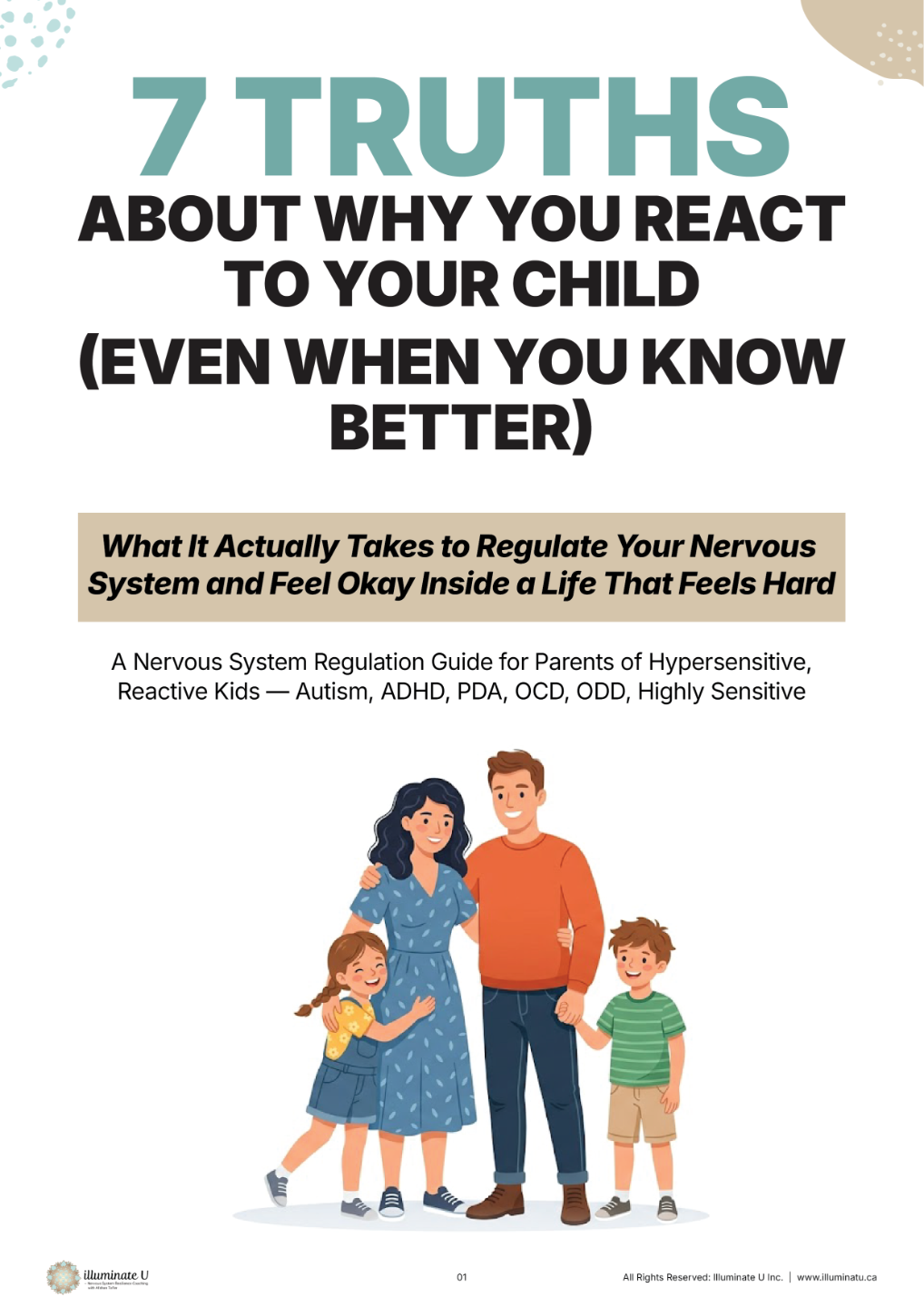
Free: 7 Truths About Why You React to Your Child Guide
Why you react even when you know better — the conditioning, nervous system states, hidden beliefs and patterns, and buried emotions running the show.

