
Why Real Regulation Can Often Look Messy With Your PDA, Autistic Child

For years I carried the pressure to be the perfect calm parent for my PDA, autistic son. This post explains why regulation isn't about staying calm all the time, how "pretend calm" leads to burnout, and why children learn more from watching us work with big feelings safely than from perfect calm. Messy does not mean damaging.
You can also listen to this in audio format only on The Regulated Parent Podcast on Apple or Spotify. Look for Episode #37
When the Pressure to Stay Calm Feels Impossible
Parenting a PDA, Autistic child can put an enormous amount of pressure on parents to stay calm all the time.
We have learned that our nervous system regulates our child’s nervous system — and that message is true. But many parents walk away from that idea believing that regulation means being calm and perfectly composed no matter what.
And when we can’t do that — which is often — we feel like we’re failing.
But what if real regulation doesn’t actually look calm? What if real regulation sometimes looks messy?
What if regulation isn’t about being perfectly calm, but about being able to feel and work with the big, intense sensations and emotions moving through your body — something that often doesn’t look calm or composed at all?
What if some of the most powerful moments of regulation our children learn from are the moments when they see us navigating those big feelings in real time?
In this episode, I want to talk about the enormous pressure many parents of PDA, autistic, and hypersensitive children feel to be perfectly calm — and why real regulation in parenting often looks much messier than we expect.
And why we may need to give ourselves permission to let it be messy.
Why Being a Regulated Parent Isn’t About Staying Calm All the Time
For years, I carried an invisible pressure inside me: the pressure to be the perfect calm parent.
When my son was younger, I was learning everything I could about attachment, trauma-informed parenting, nervous system regulation, co-regulation, and peaceful parenting. And with every new thing I learned, I felt the stakes rising. Because the message I absorbed, even though it came from thoughtful and well-intentioned places, sounded something like this: your child’s nervous system learns safety through your nervous system.
And for a child like mine — hypersensitive, deeply reactive, and later identified as having PDA and OCD — that message felt enormous.
It felt like his future depended on me getting this right.
If I could stay calm, then maybe he would feel safe. If I could stay regulated, then maybe he would learn to regulate himself. If I could be the steady, grounded nervous system he needed, then maybe he would be okay.
But there was another side to this belief that I didn’t fully understand at the time. Because if his ability to feel safe depended on my nervous system, then every moment I wasn’t calm felt like failure.
Every time I lost patience. Every time I raised my voice. Every time panic, rage, frustration, grief, or overwhelm rose up in my body. I felt like I was damaging my child.
So I tried harder. I tried to be calm through every storm. I tried to hold it all in. I tried to be that parent — the one who stays composed, gentle, and “regulated” no matter what is happening.
But the harder I tried to be that parent, the more pressure I felt inside. And over time I began to realize something really important:
I had misunderstood what regulation actually is.
The Myth That’s Hurting So Many Parents
Many parents, especially parents of high-needs children, begin to believe that regulation means staying calm all the time.
It starts innocently enough. We hear that our children need our calm. We hear that co-regulation matters. We hear that our child’s nervous system is deeply affected by ours. We hear that our reactions shape the emotional tone of the home. All of that is true.
But many of us unconsciously turn those truths into pressure.
We start believing that being a regulated parent means:
- staying calm all the time
- hiding our big emotions
- never reacting
- always responding wisely
- keeping it together no matter what
And when we cannot do that — which is often, especially when parenting a PDA or highly sensitive child — we think, I’m failing. I’m doing damage. I’m not regulated enough. I’m not a good enough parent.
This pressure is especially intense for parents of PDA Autistic children because so much truly does rest on the parent’s ability to adapt, understand, and respond differently. We know our child’s nervous system is sensitive. We know accommodations matter. We know co-regulation matters. We know our child can escalate quickly when they sense pressure, control, or threat.
So we try even harder to stay calm.
But this is where many parents get into trouble.
Because instead of regulating, they often start suppressing.
What Many Parents Accidentally Do Instead
When you believe you must be calm all the time, you often begin clamping down on your natural nervous system responses. You push down anger, fear, frustration, panic, sadness, helplessness. You recruit social engagement behaviors to appear calm on the outside. You try to sound steady. You try to look reasonable. You try to keep the lid on.
And from the outside, it may even look like regulation.
But inside your body, your nervous system can still be flooded with activation.
The fight-or-flight energy has not disappeared. It has simply been pushed down or clamped down on. This is what is called functional freeze, or what I often call “pretend calm.” You appear to be functioning fine on the surface, but underneath there is a lot of activation that you either cannot feel or are overriding.
This is one of the biggest misunderstandings I see in parents who are trying very hard to do this well — especially parents who are moving toward a more accommodations-based, trauma-informed, connected way of parenting. They put enormous pressure on themselves to stay calm, believing this is what their child needs. And in doing so, they inadvertently suppress their own nervous system responses over and over and over again.
When this happens repeatedly — especially in homes where there is chronic intensity, repeated triggering, and very little recovery time — that buried activation accumulates.
Eventually it shows up as burnout, emotional shutdown, resentment, collapse, depression, explosive reactions, or deep shame.
That is why so many parents say things like:
“I tried so hard to stay calm until I suddenly exploded,”
or
“I stay pretty calm and hold it together, but I feel so exhausted and drained all the time.”
Not because they failed.
But because their nervous system was never allowed to process what it was carrying.
The challenge is that many of us assume this is what regulation is supposed to look like. We assume that people who are “good at regulating” are simply better at holding it all in. We think trauma-informed parenting means suppressing our reactions and appearing calm no matter what is happening inside.
Because this is the only model many of us have ever seen of “being calm in the storm.”
But that isn’t actually regulation.
Real regulation does not come from clamping down on what is happening inside you.
It comes from learning how to work with what is activated in your body and gradually bring safety and settling to it.
The Shift We Need to Make
This is the shift I want parents to understand:
Real regulation is not about being perfectly calm all the time. It is about working with what gets activated inside you and bringing enough safety, space, and support to it that you do not have to dump it on your child. And sometimes that looks messy.
That is very different from perfection.
Sometimes regulation does look calm. Sometimes you feel the frustration rise, but you have enough capacity that you can settle it fairly quickly and stay connected. Of course that is wonderful when it happens. But many parents, especially parents of high-needs children, assume that this should be the norm all the time. It often is not.
When you live with chronic activation, frequent triggering, little downtime, accumulated stress, and your own unresolved trauma history being activated again and again, regulation may look much messier than that.
It may look like tears in your eyes while you are trying to stay present.
It may look like feeling rage move through your body while you breathe, stomp your feet, push against the wall, or make a deep sound to help the activation move.
It may look like saying to your child, “This is a big feeling in my body right now. It’s not your fault. I’m working with it.”
It may look like asking your spouse for support or to take over because you are right on the edge.
It may look like feeling panicky, overwhelmed, or flooded, but still trying to bring safety on board and not act from that activation in a harmful way.
In other words, regulation is not the absence of activation. It is the presence of activation plus the presence of enough safety, awareness, support, and containment to be with and work with the activation rather than acting it out on others.
That is a very different standard than “be calm all the time.”
And for many parents, it is a much more human and truthful one.
Why Calm Isn’t the Goal — Capacity Is
One of the most important things to understand about nervous system healing is that the goal is not permanent calm. The goal is capacity.
Capacity means having enough space inside yourself to feel what you are feeling without immediately collapsing into despair, exploding into rage, or having to shut it all down and not feel. It means being able to tolerate strong sensations, emotions and intense energy for longer without being completely overtaken by them.
And this matters because, in parenting, especially PDA Autistic parenting, you are going to get activated. A lot.
It is not realistic to expect yourself to stay calm all the time while living with a child whose nervous system is so easily activated, whose distress may be intense and frequent, and whose needs may require enormous flexibility, accommodation, and emotional labor from you.
Trying to be calm all the time is not realistic.
Trying to build more capacity to work with what arises is.
Capacity means that when something huge gets activated inside you, you can begin to recognize: this is activation. This is big. This is real. And I can work with it.
Maybe not perfectly. Maybe not neatly. Maybe not calmly.
But you can work with it.
And that is regulation.
Why Children Learn More From Real Regulation Than Perfect Calm
This is the part I especially want parents to understand.
Many parents think it is better for their child never to see their big feelings. They think the ideal is for the child to only ever see calm. They worry that if their child sees their fear, overwhelm, rage, tears, or shakiness, then they are harming them.
But children do not learn regulation from being around robots.
They learn regulation by being around humans who know how to work with their humanity safely.
They learn through mirror neurons, through felt experience, through watching and sensing what we do when big feelings arise. They learn when they see that activation can exist and safety can also come on board. They learn when they feel that emotions do not have to be denied, hidden, or explosively discharged. They learn that intensity can be contained, worked with, moved through, and eventually settled.
That is such a different lesson than the lesson of perfect calm.
A perfectly calm parent may look ideal in theory. But in real life, children benefit far more from seeing an adult feel something real and then work with it in a way that is safe enough, honest, embodied, and reparative.
They learn:
- big feelings are survivable
- activation does not automatically mean danger
- emotions can move through the body
- a person can get dysregulated and come back
- connection can be repaired
- safety can coexist with intensity
That is nervous system learning.
And that is far more useful to a child than the performance of constant calm.
What This Can Look Like in Real Life
A few weeks ago, I had a moment that brought all of this into focus for me.
I had been working hard for weeks and was already exhausted. There were deadlines, pressure, and many things that needed to get done. At the same time, I was trying to be present with my son. And inside me, something was getting triggered.
Eventually I realized what it was.
The pressure I was feeling was activating an old trauma pattern in my nervous system, something encoded very early in my life. My body started interpreting the pressure as danger. I could feel panic rising. All I needed in that moment was five minutes to sit and breathe, but my son could not tolerate that. Then my husband, without meaning to, added another layer of pressure, and suddenly I felt myself tipping.
My son felt it too. He started escalating. Everything began to spiral.
In the past, moments like this often ended in rage, collapse, or shame. I would have tormented myself afterward, convinced that I had just damaged my child. But this time something different happened.
Even though I felt panicky and overwhelmed, I realized what I needed. I asked my husband to sit on the floor with his back against the wall so I could lean against him and feel the support of his body behind me.
And something shifted.
Instead of us working against each other, we became a team. My son watched this happen. He saw co-regulation. He saw my husband supporting me. He saw that even though I was overwhelmed, I was not dumping it on everyone around me. I was working with what was happening inside me and I was asking for support.
Slowly, he began to calm down. He came closer. Eventually we were all sitting together, regulating as a family.
It was not calm. It was not neat. It was not pretty. But it was deeply healing.
And what struck me afterward was this: so many parents would look at a moment like that and think it was wrong because it was intense. They would think, My child saw too much. My child felt too much. I was too dysregulated. I failed.
But that is not what I saw in my son afterward.
I did not see trauma. I saw relief. I saw connection. I saw safety. He was happy. He ate well. He felt good.
Why?
Because what he experienced was not me being perfectly calm. What he experienced was us bringing safety, support, and co-regulation into a moment of intensity. He saw that hard things can happen and we can still come back together.
That is a powerful nervous system lesson.
Understanding Why It Gets So Big
Part of why parenting can feel so messy is that what gets activated with our children is often not just about the present moment.
So much of what gets triggered in us is connected to our own past.
When something in the present resembles an earlier experience of pressure, danger, helplessness, shame, engulfment, rejection, or overwhelm, the nervous system can react as if the past is happening again. The sensations can feel enormous, not because the present moment objectively warrants that level of alarm, but because the nervous system is also responding to old material.
This is why context matters so much.
If, in the middle of activation, you can begin to remind yourself, oh, this is the past getting stirred up inside me, that can help create a little more space. You can say to yourself: This makes sense. This is real. But it is not all about what is happening right now. I do not have to believe this feeling means I am in present danger.
That kind of context helps the brain orient. It helps the system come back toward the present. It helps build capacity.
You can begin to say: This is big. But I know what this is. I can hold space for it. I can work with it. I can bring safety to it.
And often, that is enough to shift you out of total overwhelm and into some form of messy but meaningful regulation.
What Working With Activation Can Actually Look Like
Working with activation does not always look quiet. Sometimes it does. Sometimes it looks like slowing your breath, grounding your feet, softening your jaw, orienting to the room, or asking for a hug.
Other times it looks much more physical.
When rage rises in my body, for example, I might make a deep VOOO sound, roar, stomp my feet, shake, do lion’s breath, or push against the wall. These are ways of helping the energy move rather than clamp down or explode outward.
At first my son sometimes found this confusing or even a little scary, especially because he had earlier experiences of my anger that did not feel safe to him. But over time, he began to sense the difference.
He began to see that I could feel big energy in my body and still work with it safely. That I could contain it. Redirect it. Release it. And return to presence.
That is such an important lesson for children.
Not that adults never feel rage or panic or overwhelm.
But that adults can learn how to work with those intense states and help them.
Why This Matters So Much for Burnout
I think one of the biggest hidden costs of misunderstanding regulation is the toll it takes on parents.
When parents believe they must stay calm all the time, they suppress fight energy, flight energy, tears, fear, and frustration. They hold in what their body is trying to process. They clamp down because they think that is what good parenting requires.
But those responses are meant to move.
And when they do not move, when they are repeatedly suppressed day after day, especially in the chronic intensity of parenting a high-needs child, the nervous system starts to break down under the weight of what it is carrying.
That is why so many parents end up chronically stressed, burnt out, shut down, resentful, depressed, or physically depleted.
Not because they are weak.
But because they have been carrying too much survival energy for too long without enough support, discharge, expression, repair, or regulation.
What many parents do not understand is that sensations and emotions can move through the body without being acted out destructively. They can be allowed. Contained. Worked with. Released. Supported.
And as I learned to do this more and more, I came out of burnout. I had more energy. I felt more alive. I could see more clearly how much I had been suppressing for years in the name of trying to be calm.
What Children Actually Need From Us
Children do not need perfectly calm parents.
They need real parents.
They need parents who can show them that big emotions do not have to destroy connection. They need parents who can show them that dysregulation is not the end of the story. They need parents who can model that it is possible to get activated, to work with what is happening, to seek support, to bring safety on board, and to come back to connection again and again.
They need to see that being human is allowed.
They need to feel that there is room for intensity, repair, and return.
They need to know, through experience, that regulation is not perfection. Regulation is what happens when we meet what is real with enough safety and support.
Can We Give Ourselves Permission to Let It Be Messy?
This is the question I keep coming back to:
Can we let go of the idea that regulation means being calm all the time?
Can we let go of seeing messiness as bad?
Can we stop measuring ourselves against an impossible standard that no nervous system, especially not one living under chronic stress, could meet consistently?
Can we allow ourselves to be human?
Because parenting a PDA Autistic child is activating. Parenting high-needs children is activating. It is not realistic to expect calm all the time in a life filled with this much intensity.
What matters more is not that you never get activated.
What matters more is that your child sees how you work with activation. How you come back to yourself. How you find support. How you repair. How you reconnect. How you return to your connected self over and over again.
That is the lesson.
That is the model.
That is regulation.
A Final Thought for the Parent Who Is So Hard on Themselves
If you are parenting a hypersensitive, high-needs, or PDA child, you are carrying more than most people realize. You are learning, adapting, repairing, and showing up in situations that stretch your nervous system to its limits.
You do not have to be perfect.
You do not have to be calm all the time.
You do not have to hide every big feeling in order to be a safe enough parent.
Your child does not need a perfectly calm parent.
They need a parent who is willing to work with what gets activated inside them and bring safety, support, honesty, and repair to it.
And yes, sometimes that will look messy.
But messy does not mean bad.
Messy does not mean damaging.
Messy may simply mean that something real got activated — and instead of hiding it, suppressing it, or dumping it out, you worked with it.
And that may be one of the most powerful things your child can learn from you.
Questions Parents Ask
Does being a regulated parent mean staying calm all the time?
Real regulation is not about being perfectly calm all the time. It is about working with what gets activated inside you and bringing enough safety, space and support to it that you do not have to dump it on your child. And sometimes that looks messy. The goal is not permanent calm. The goal is capacity.
Why do I stay calm with my PDA child and then suddenly explode?
When you believe you must be calm all the time, you often begin clamping down on your natural nervous system responses. The fight-or-flight energy has not disappeared, it has simply been pushed down. This is what is called functional freeze, or what I often call "pretend calm." When this happens repeatedly, that buried activation accumulates and can show up as burnout, shutdown or explosive reactions.
Is it harmful for my child to see my big emotions?
Children do not learn regulation from being around robots. They learn regulation by being around humans who know how to work with their humanity safely. When they see an adult feel something real and then work with it in a way that is safe enough, they learn that big feelings are survivable, a person can get dysregulated and come back, and connection can be repaired.
What does working with activation look like when I'm parenting a PDA child?
Sometimes it looks like slowing your breath, grounding your feet, orienting to the room or asking for a hug. Other times it is more physical. When rage rises in my body, I might make a deep VOOO sound, stomp my feet, shake or push against the wall. It may also look like saying to your child, "This is a big feeling in my body right now. It's not your fault. I'm working with it."
Why do my reactions to my child feel so much bigger than the moment?
So much of what gets triggered in us is connected to our own past. When something in the present resembles an earlier experience of pressure, danger or overwhelm, the nervous system can react as if the past is happening again. Reminding yourself "this is the past getting stirred up inside me" can help create a little more space and build capacity.
Why "Holding It Together" Is Burning You Out
how pretend calm leads to parent burnout
Why It Feels So Hard to Stay Calm When Your PDA Child Is Melting Down
what happens in you during meltdowns
Rupture Isn't Failure: It's the Path to Healing
why repair matters more than getting it right
Does Regulating Your Own Nervous System Really Help Your Child?
how your regulation affects your child
The Hidden Patterns That Prime You To Easily React To Your Child
how your past shapes your reactions today
I have three free guides for parents of PDA, autistic and high-needs kids: the 3 Shifts guide for meltdowns, the 7 Truths guide on why you react even when you know better, and the Meaning guide for finding your way back to yourself. Pick whichever one fits where you are right now.
And if you want to go deeper with me, the Regulation Rebuild is my course for parents who want to rebuild their own nervous system capacity, step by step. Join the waitlist to hear first when the next round opens.
About the author: Afshan Tafler is a Nervous System Resilience Coach, host of The Regulated Parent podcast, and a parent raising a PDA autistic teen with high anxiety and OCD. She is trained in Internal Family Systems (Level 3), Havening, polyvagal-informed practice and EFT, and is completing her Somatic Experiencing training. She has guided hundreds of parents of ADHD, autistic and PDA kids from burnout and barely coping to steadier, more connected and more alive, within the life they are actually living.
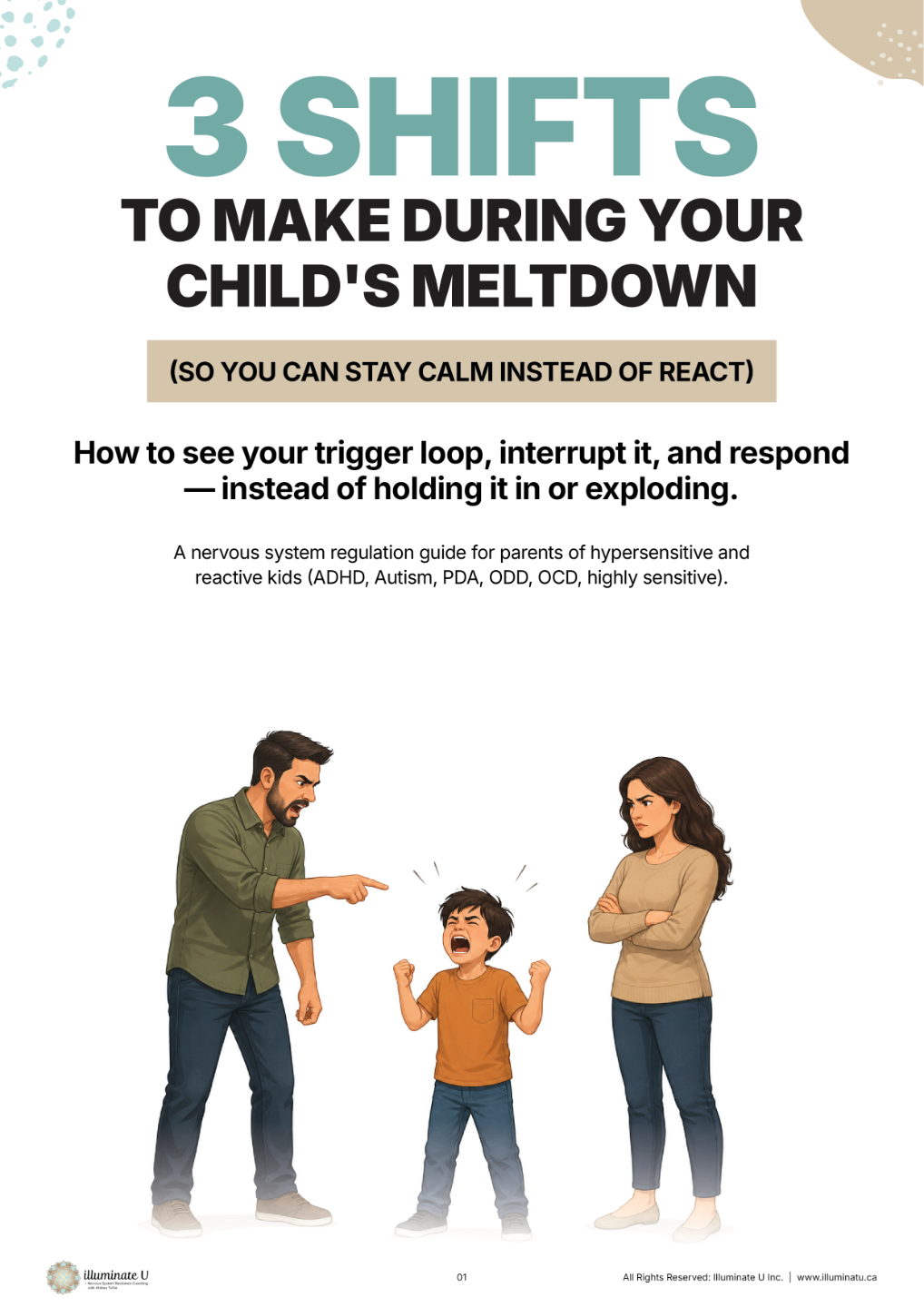
Free: The 3 Shifts Guide
The trigger loop and 3 patterns you get stuck in during meltdowns — and how to shift them so you can stay calm instead of react.
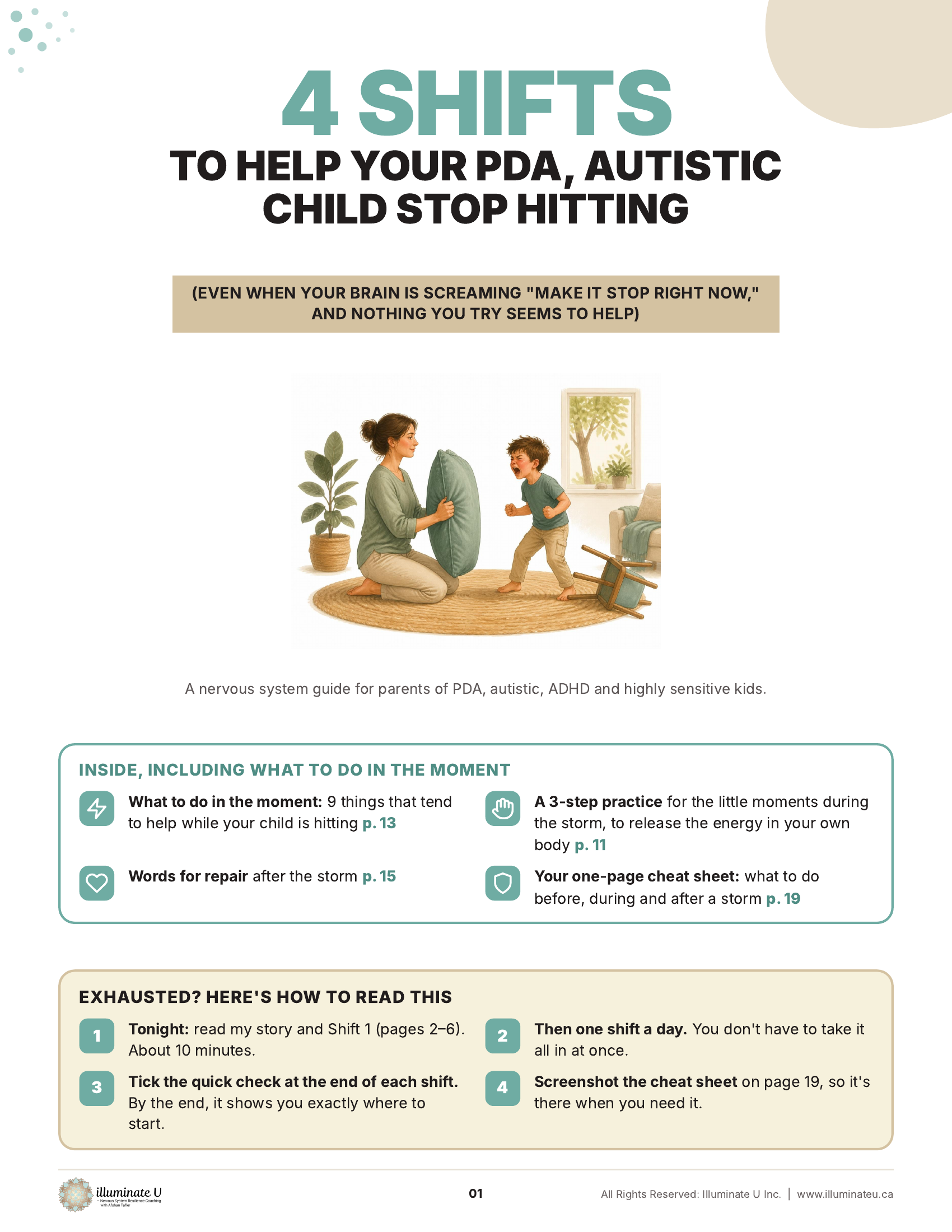
Free: 4 Shifts to Help Your PDA, Autistic Child Stop Hitting
What to do in the moment your child is hitting you, a one-page cheat sheet to keep on your phone, and the 4 shifts that changed things in our home.
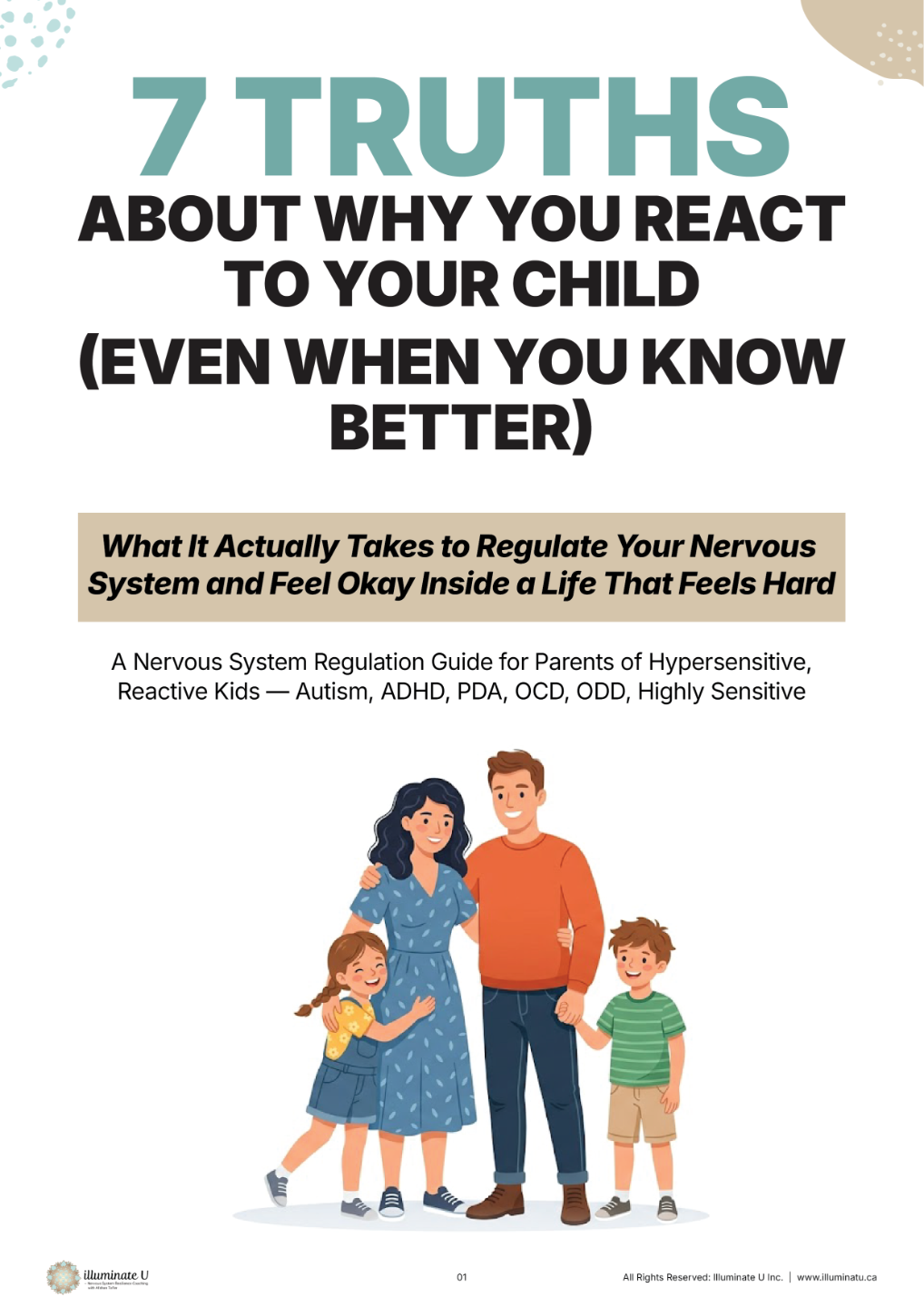
Free: 7 Truths About Why You React to Your Child Guide
Why you react even when you know better — the conditioning, nervous system states, hidden beliefs and patterns, and buried emotions running the show.
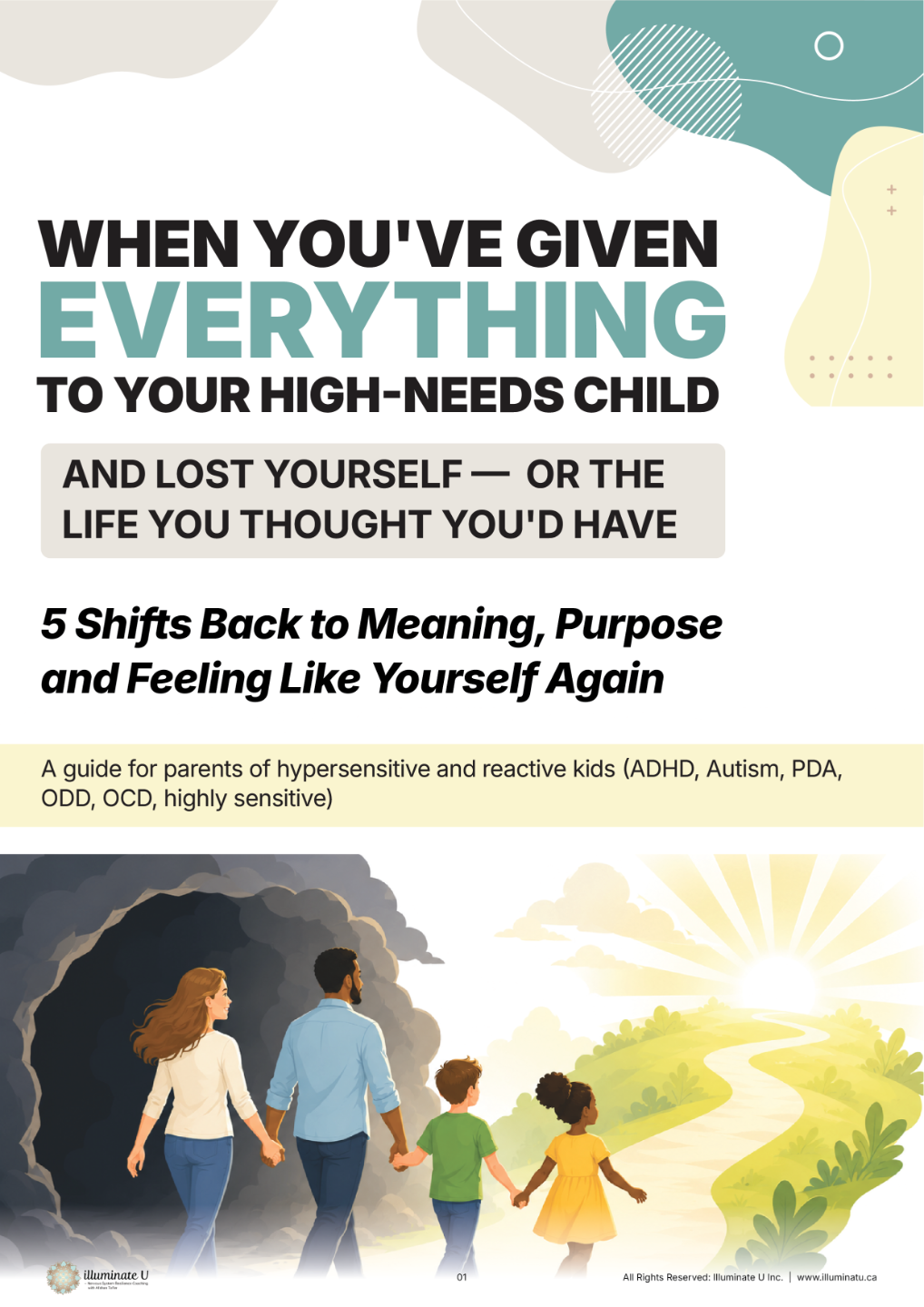
Free: 5 Shifts Back to Meaning Guide
For when you've given everything to your high-needs child and lost yourself — 5 shifts back to meaning, purpose and feeling like you again.

