
The #1 Regulation Tool That Cut My Autistic, PDA Child's Meltdowns by 95%
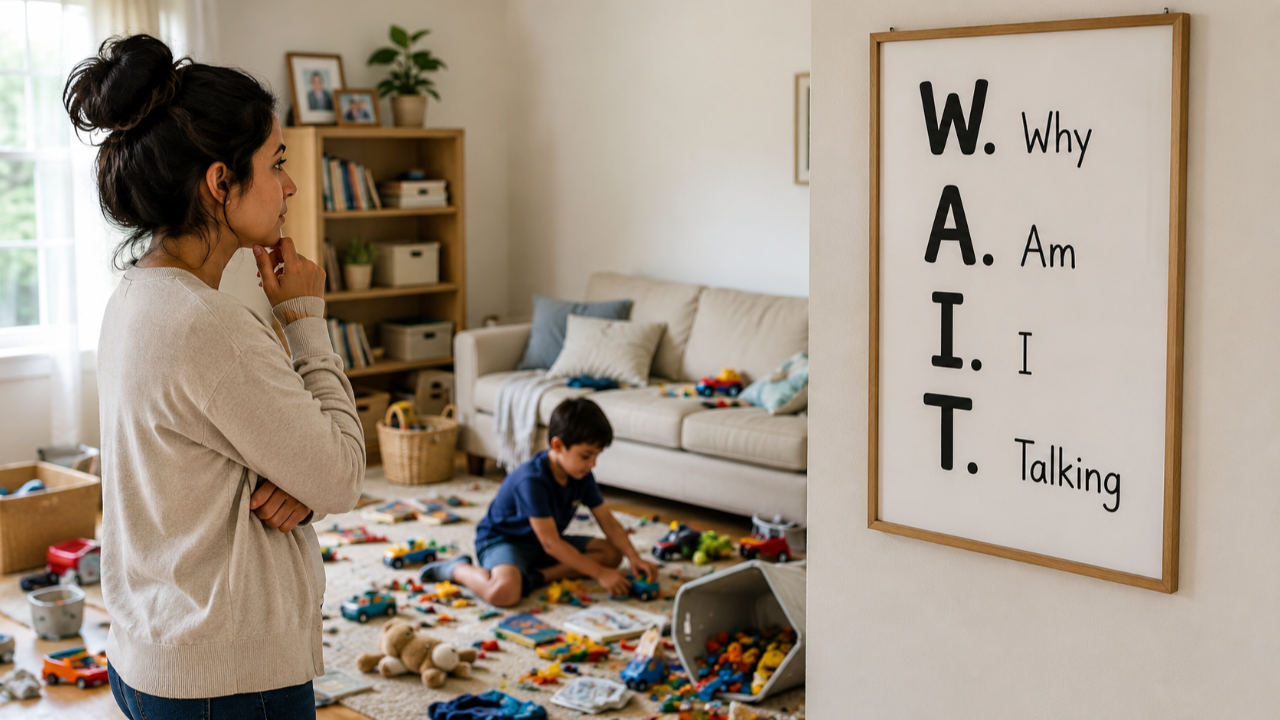
When your PDA, autistic child is melting down, the most powerful thing you can do may be to stop talking. W.A.I.T., Why Am I Talking, took my son from five hours of daily meltdowns to less than 30 minutes a few times a week. Here's why it works, and the five steps.
You can also listen to this in audio format only on The Regulated Parent Podcast on Apple or Spotify. Look for Episode #52
The Tool That Shocked Our Doctors
If I could offer you one tool — one tool that took my PDA, autistic son's aggressive behaviors from five hours of daily meltdowns and destruction to less than 30 minutes a few times a week — would you want it?
It's four letters. W.A.I.T. It stands for Why Am I Talking.
Here's what I didn't understand for years: I thought regulation was about saying the right thing. Finding the right words to calm him down, to reason with him, to fix what was happening.
It's not.
So much of regulation isn't words at all. It's energy. It's nervous system cues. And the second you open your mouth to try to manage a meltdown, there's a good chance you've already left the one thing that actually helps.
So today, I want to show you what I mean, and why waiting, not talking, became the single most powerful tool we ever used with my son.
Let's begin.
The Bathroom Meltdown
I want to take you back to the thick of it, when my son was in the middle of his burnout, and the aggressive episodes were happening regularly, sometimes for hours a day.
There's one example that captures this so well, and it's something that will probably sound familiar to a lot of you.
Back then, my son would get incredibly upset by things that had nothing to do with him directly, and one of the biggest ones was my husband. He needed to control my husband's basic needs of toileting. If my husband did something as simple as go to the bathroom, my son would feel like he had lost control of the situation, and he would come running to find me, wherever I was, even if I was right in the middle of work, and he would explode. He'd start banging on the walls, desperate for me to go and change his dad, constantly pulling at me, trying to get me to go make his dad stop going to the bathroom, or stop doing whatever it was that had set him off.
Two Kinds of Talking That Both Backfired
Here's what I want to walk you through, because I think this is where so many of us get stuck, and it's where I got stuck for a long time too.
I had two ways I would respond to him in that moment, and I used to think one of them was the "good" version and the other was the "not so good" version. But it turns out neither of them worked, and understanding why really took me years.
The first kind of talking came straight from fight or flight. I would jump in and try to explain things to him. "You're safe, it's okay for daddy to go to the bathroom." I would try to reason with him, I would try to teach him in the moment, and say things like, "Well, it's his body, it's his choice, just like it's your body and your choice." And every single time — poof — it would explode even more.
So then I'd think, okay, let me try to be calmer about this. Let me say something softer, and acknowledge him, validate him. Because I do coaching, so I'm good at validating people. So I would say things like, "Seems like this is really hard for you." Or, "I'm so sorry you're not feeling good right now."
And I want you to notice something in those sentences, because it took me a long time to catch it myself: the word you was all over them. And even though it sounded calm on the surface, it still exploded him just as much.
I remember feeling so exasperated in those moments, thinking, here I am, I'm trying to be calm, I'm trying to say the right things, I'm trying to co-regulate him and be the parent who validates him, and say these nice, gentle things — so why the heck isn't it working?
Fight or Flight, Dressed as Connection - The New Insight
What I understood much later was that both of those kinds of talking, the reasoning one and the soft one, were coming from the same place. They were both scripted attempts to regulate him with words, while I myself was not regulated inside. And underneath both of them was the same agenda, whether I wanted to admit it or not — that agenda was for him to change, so that I could stop dealing with what was happening inside of me. All the activation and triggering that was happening inside of me.
That's very common. It's the first place we go — fight or flight, sympathetic, trying to control, fix. I must fix everyone outside of us so that I don't have to feel this inside.
I eventually realized that the more I opened my mouth, the more I moved toward him, even the more I simply looked directly at him when he was already escalated, the more he would explode. And what I came to understand was that these were social engagement strategies. You look at your child, you try to move toward them to help them — these are the kinds of things we're wired to reach for. Eye contact, gentle words, closeness. But they weren't coming from an embodied state of safety in me, or a true understanding of my son's nervous system and what he actually needed in those moments. They were coming from my own fight or flight, just dressed up as connection.
And this is what often happens — it's kind of like a functional freeze state. We have all this activation, we clamp down on it, we recruit social engagement behaviors, and we seem like we're being calm and social, but inside, we have all this fight-flight energy going on. And our kids read that.
From Five Hours to Thirty Minutes
Over time, as we really came to understand my son's profile and how his brain was processing all of this, we started implementing the WAIT strategy for real.
What that meant for us was really regulating ourselves first. We would stop talking, look away and slightly down instead of at him, and stay in proximity so he still knew we hadn't left him. And then we would keep our hearts open and our body language soft, without a single word.
This became, hands down, the number one strategy that helped de-escalate my son. And as it became our consistent pattern, something remarkable happened. He eventually learned to regulate himself, and to come back to a regulated state on his own. No words needed.
This is a big statistic, my friends. When I tell doctors and professionals about this, they're shocked — because no other intervention worked. We went from five hours of daily rages, full-on destruction in our house (we still have holes in our walls we haven't fixed yet — I'm getting around to those), to a few minutes, maybe 30 minutes at most, of escalation every few days.
And here's the part that still gets me: the moment we would falter, the moment we'd lose our own footing and start talking again, he would escalate. Boom. Big one. And the moment we stopped talking and stayed with just our presence, regulating ourselves, he would regulate. It was remarkable to watch, over and over.
I want to be honest with you here, though, because people are probably thinking, "That doesn't work for me — I don't talk, and my child escalates even more," or "it doesn't calm them down." I want you to understand this: it did not happen overnight. When a child is stuck in those kinds of dysregulation patterns, it can take time, it can take trust, it takes a lot of consistency from the parents. It took the better part of a year for us to become consistent with this, and that was after a few years of real trauma that had built up in us before we got there.
But we did it. And to this day, when professionals or doctors ask us what interventions helped him the most, this is what I say. This, and my husband and I becoming more of a team, doing this together, consistently.
The Deeper Pattern: Why We Default to Talking
Let's talk about the deeper pattern, and why we default to talking. I see this pattern in almost every parent I work with, because I lived it for years before I could name it.
When our kids are activated, our own nervous system goes into gear too. We're designed to ping with our child's nervous system, to feel their activation — and then our own stuff gets triggered, and we don't want to feel our own stuff, so we go into gear. For most of us that shows up as fight or flight — sometimes a mild fight or flight, so mild you don't even notice it. There's a pull to control, to fix, to manage the situation, and talking is often the fastest expression of that pull. It feels like we're doing something useful. It feels like it's helping.
But talking in that moment is usually coming from our sympathetic fight-flight activation system, not from a place of calm, grounded presence. So we're not actually offering regulation. We're offering our own fight or flight, dressed up as guidance.
And here's the caveat, because I want to be clear about this: if there's a true safety concern — your child is harming themselves or is in danger — you intervene. If you have to yell "stop" to get them to freeze in place and scare the daylights out of their nervous system so they don't run into the street, you gotta do what you gotta do.
But that's not what this is about. Most of the time, in the thick of a meltdown, there's no safety issue — especially if you catch it earlier, while they're just starting to escalate. There's just our own survival system screaming that it needs to do something.
And here's the part that took me the longest to see: the very act of chasing "what do I do, what do I do," searching for the right script, the right strategy, the right words, is already a sign that you've left regulation. That you're in that fight-flight system. It's not neutral, and it's not just being a responsible parent. It's your own sympathetic system looking for something to do — because doing feels safer than just being, and tolerating everything that's getting triggered inside of you.
Take that in for a moment. Doing feels so much easier and safer to be with than just being.
So the question itself is the tell. If you're deep in "what do I do, what do I do," you're not regulated, my friends. You're activated, and you're looking for an exit — a way to get your child to change. And it backfires almost every time, because what we're actually doing is adding our own activated state on top of theirs.
From Doing and Talking To Holding Space
I want to get specific here, because this pattern usually shows up in one of two ways, and I think a lot of you will recognize both of them — just like in my example.
The first is the obvious one. It's the reasoning, the explaining, the in-the-moment teaching. "You're safe." "Here's why this is happening." "Let me explain it to you." This one is pretty easy to spot as low-grade fight or flight, once you know what to look for, because it's so clearly trying to manage the situation. Now, sometimes those words can come from true regulation, if that's what your child needs to hear, and if you're truly regulated, it can work. But when they're really escalated, it often doesn't — and then it's coming from your fight-flight system, which can fuel their fire even more.
The second one is sneakier. It's the one that trips up so many of the parents I work with, and myself, for a long time. It's the softer talking — saying things like, "Seems like this is hard for you." "I'm so sorry you're not feeling good." It sounds regulated. We've often been taught, in gentle parenting and attachment-focused learning, that this is how you talk to your child, how you validate them. It sounds exactly like the gentle, attuned language we're taught to reach for. But if we're honest with ourselves in the moment, it's often just as scripted, and it's coming from a nervous system that isn't actually settled either — it's just quieter about it. And underneath, it's often the same agenda as the reasoning version: I need you to calm down now, so I can stop feeling this.
There's even something small but worth naming in the language itself. Notice how often that softer talking is built around the word you. "This is hard for you." "You're not feeling good." Even gentle language, when it's aimed at them rather than just being with them, can land as pressure — especially for our PDA and autistic kiddos. It's one more thing being directed at them from the outside, instead of space being held around them.
Regulation in yourself, emanating out of you, and just holding space. That's really what this is about. Moving from "wait, why am I talking?" to just regulating yourself and holding space of safety — this energy in the air of safety.
Why This Actually Works: The Nervous System Science
I want to go into a little bit of the nervous system science, for both our kids and ourselves, because there are two layers here.
First — what's happening in them.
When a child is activated, especially if they're PDA, autistic, or highly sensitive, their brain is prioritizing survival, not speech. Verbal processing is expensive. It takes prefrontal cortex resources that, in the moment, are being redirected toward managing the threat response. That's why kids can also lose their words entirely in a meltdown or shutdown. We want them to use their words, but they lose their words. It's not defiance, it's not a choice — the language system has quite literally been taken offline to protect the more urgent stuff.
So when we add a verbal demand — a question, a request to explain themselves, or even a gentle "let's talk about this" — we're asking a system that's already overloaded to do the one thing it has the least capacity for. It doesn't calm them down. It adds pressure. And added pressure on an already-overwhelmed nervous system prolongs the very state we're trying to help them out of. It adds fuel to the fire.
Second — what's happening between us.
This is from polyvagal theory, the science of safety and the nervous system, founded by Dr. Stephen Porges — specifically a term he coined, neuroception, which is your nervous system always reading for cues of safety or danger from the people around you, faster than conscious thought, below the level of conscious awareness. Our nervous system is always giving cues, and we're always reading those cues from other people — tone of voice, posture, facial expression, body language, energy, all of it.
When we're activated and talking, even if our words are gentle, our body is often broadcasting fight or flight. And their nervous system picks that up. Two dysregulated systems in the same room, feeding each other.
But when we regulate ourselves quietly, without words, we become a cue of safety their nervous system can borrow. Co-regulation isn't something you do for your child. It's something your calm offers, and their body reads. It's being. It's not doing. Co-regulation is how you're being — and then their nervous system reads that.
From "What Do I Do" to "How Do I Be"
So the big shift here is the strategy: W.A.I.T. May it become your best friend. Why Am I Talking. It isn't really a question about them. It's a question about you.
Most of us come into these moments asking, "What do I do? What do I do?" Every parent comes to me with that question. And like we just named, that question itself is a sign we've left regulation. So the shift isn't a better answer to "what do I do." It's a different question altogether. Not what do I do — but how do I be.
Because most of the time, when we're talking in the middle of our child's activation, we're not actually regulating them. We're trying to regulate ourselves. Sit with that for a moment. When you're talking to your child, you're really trying to regulate yourself, through control, through fixing, through explaining. Because if only you could get them to change, then you could feel okay. We're using our words the way they might use a stim. It's our coping strategy in that moment. We just don't usually see it that way.
Once you can see that, the whole strategy flips. Unless there's a genuine safety concern, the most powerful thing you can do isn't to find better words. It's to stop talking, and turn the doing back onto yourself. Regulate your own body. Work with your own fight-or-flight energy. And trust — actually trust — that as you come back to yourself, you're creating the conditions for them to come back to themselves too. No fixing, no managing. Just allowing what is, in you and in them. And this brings on regulation.
What This Gave My Son
Here's what this gave my son, once we got it right. It gave him room — actual room — to use the regulation tools he already had, without our fight or flight adding fuel to his.
Verbal processing is hard for a lot of kids even on a calm day. Under activation, it's often the hardest thing we could ask of them. Every question, every "let's talk about it," every attempt to reason is one more demand on a system that has nothing left to give.
When we stopped talking, we stopped adding that demand. And what we saw, over and over, was him starting to talk to himself — actually talking himself through things, using strategies that were already his, that he couldn't access a moment before when we were pushing words at him. He wasn't being managed back to calm. He was finding his own way there, feeling our regulation, which allowed him to start regulating and using his own strategies. And then, in his own time, he'd come back to connect with us — and we were right there, waiting for him.
That's the part I want you to sit with. Regulation that comes from inside them, instead of being imposed from outside, is regulation that actually sticks.
The Five Steps of WAIT
Here's how to actually do this in the moment, because I know the pull to talk is strong — it was for us too, for years.
Step one: catch yourself talking. Awareness is the first step. That's it. Just notice. Become aware. "Oh, I'm talking." No judgment of yourself here, just awareness.
Step two: stop. Mid-sentence if you have to. Just stop.
Step three: turn the doing onto yourself. If there's fight-or-flight energy stuck in your body, we don't want to hold it in — give it something to do. This is the part people skip, and it's the part that matters most. Your survival system, when it's in fight or flight, wants to do something, so give it something to do that isn't aimed at your child. Aim it at yourself. Do a shake-off. Let the energy discharge — hands, arms, whatever kind of movement helps discharge that fight-or-flight energy in your own body. Move, breathe, help yourself fully come down.
Step four: come back to presence. Not hovering, not staring them down, just being there. Being there in proximity, your heart open, maybe looking slightly away so it doesn't feel like pressure. Just being present.
Step five: allow what is. You can actually bring this step in earlier too, right at the beginning — allow that you're triggered, they're triggered, while you're regulating yourself. This is the piece I teach throughout my whole course: letting go of resistance to what is, and allowing it instead. You and them. Not fighting the moment, not trying to speed it up.
And then — trust. Trust that as you regulate, they will too. Maybe not instantly. That's the caveat, and it's an important one. This doesn't happen immediately. They need time to come down too, and they're reading your nervous system cues the whole way through.
I remember my son would be side-eyeing me, watching my nervous system, reading it like a hawk — literally side-eyeing me, waiting for me to explode. And I would just stay there with my heart open, and show him that as I was settling, I was giving him something to track and borrow from, gradually. It's not a switch — it's hard for us to switch too, and they're not going to just switch like that. It's a process, and it's often a slower one than our survival brain wants it to be. It could take some time for them to fully come down, so you just give it time — which is the last thing our survival system wants to do, but it's so important.
The Number One Tool We Used
Looking back now, I understand my son's nervous system so much more than I did in the thick of it. And the single biggest thing that helped him — not the strategies, not the scripts, not the things I said — it was not talking. It was learning to WAIT.
What's remarkable is that doing this consistently didn't just help him. It was probably the number one tool we ever used to see a real decrease in his behaviors. Because every time we regulated instead of reacting, he got the chance to learn regulation through us. No words needed — just our nervous system settling, over and over, until his learned it could settle too.
So if you take one thing from today, let it be this. Next time you feel the pull to talk, just pause and ask yourself: Why am I talking?
Then wait. And trust what happens next.
Questions Parents Ask
What should I do when my PDA, autistic child is having a meltdown?
Unless there's a true safety concern, stop talking and regulate yourself first. Look away and slightly down instead of at them, stay in proximity so they know you haven't left, and keep your heart open and your body language soft, without a single word.
Why does talking make my child's meltdown worse?
When a child is activated, their brain is prioritizing survival, not speech. Verbal processing takes resources that are being redirected toward the threat response, so every question or explanation is one more demand on a system that's already overloaded. It adds pressure, and it adds fuel to the fire.
Why doesn't validating my child's feelings calm them down?
Gentle lines like “this is hard for you” can still come from a nervous system that isn't settled, with the same agenda underneath: I need you to calm down so I can stop feeling this. For PDA and autistic kids, language aimed at them can land as one more pressure from the outside.
What does W.A.I.T. stand for?
Why Am I Talking. It isn't really a question about your child. It's a question about you: when you're talking in the middle of your child's activation, you're usually trying to regulate yourself, through control, through fixing, through explaining.
How long does it take for W.A.I.T. to work?
It doesn't happen overnight. It took us the better part of a year to become consistent with it. And in each moment, your child needs time to come down too. It's not a switch, it's a process, and often a slower one than our survival brain wants.
Does Regulating Your Own Nervous System Really Help Your Child?
pretend calm, and what your child actually reads in you
Why “Holding It Together” Is Burning You Out
the functional freeze underneath staying calm
Why a PDA Child’s Need for Control Can Feel So Dysregulating
when your child needs to control the bathroom, and everything else
Why You Can’t Stay Calm When Your PDA or Autistic Child Is Hitting You
what happens in you when your child gets aggressive
If this helped you in any way, I'd love to hear it. And if you know another parent who needs this message, please share it with them. So many of us are figuring this out alone when we don't have to be.
I have three free guides for parents of PDA, autistic and high-needs kids: the 3 Shifts guide for meltdowns, the 7 Truths guide on why you react even when you know better, and the Meaning guide for finding your way back to yourself. Pick whichever one fits where you are right now.
And if you want to go deeper with me, the Regulation Rebuild is my course for parents who want to rebuild their own nervous system capacity, step by step. Join the waitlist to hear first when the next round opens.
About the author: Afshan Tafler is a Nervous System Resilience Coach, host of The Regulated Parent podcast, and a parent raising a PDA autistic teen with high anxiety and OCD. She is trained in Internal Family Systems (Level 3), Havening, polyvagal-informed practice and EFT, and is completing her Somatic Experiencing training. She has guided hundreds of parents of ADHD, autistic and PDA kids from burnout and barely coping to steadier, more connected and more alive, within the life they are actually living.
Free: The 3 Shifts Guide
The trigger loop and 3 patterns you get stuck in during meltdowns — and how to shift them so you can stay calm instead of react.
Free: 7 Truths About Why You React to Your Child Guide
Why you react even when you know better — the conditioning, nervous system states, hidden beliefs and patterns, and buried emotions running the show.

