
Shouldn't I Be Teaching My Child That Hitting Is Wrong? (Part 3)
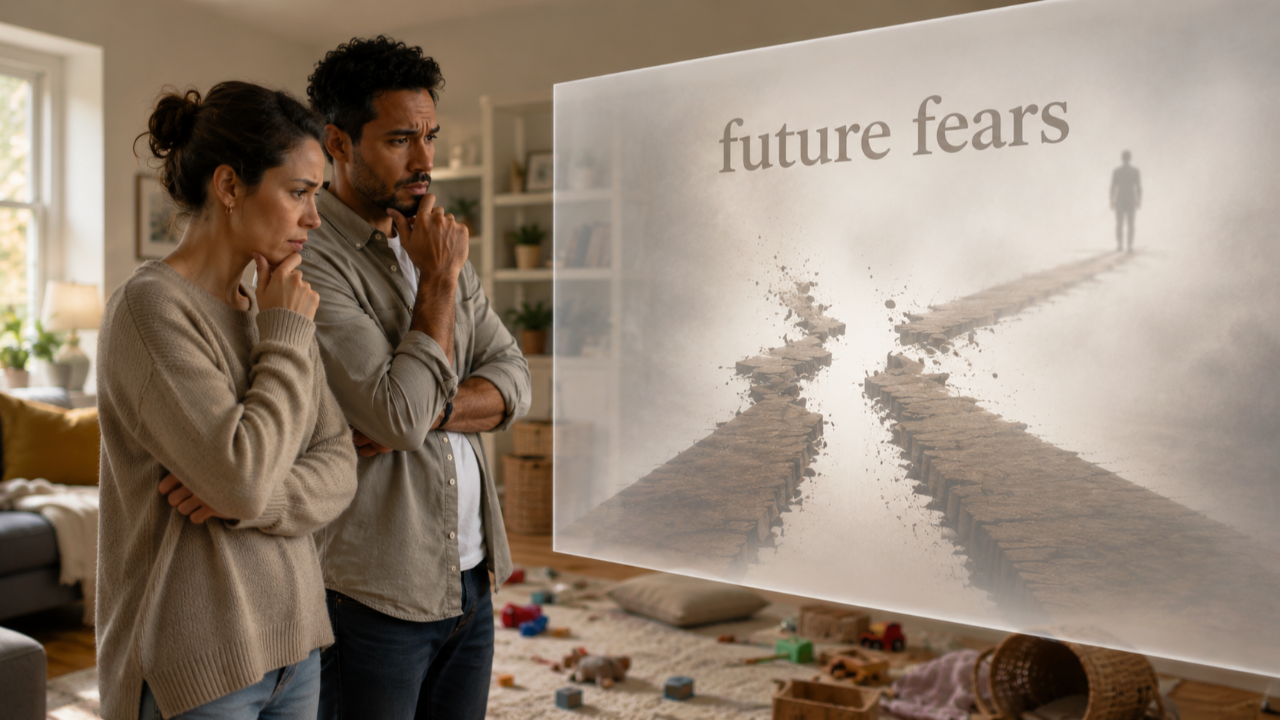
If you're afraid that not correcting the hitting means your child will never learn, or will grow into someone who hurts people, this is for you. Stopping the behaviour and building the capacity underneath it are two different jobs. Here's where the real teaching happens, and why it's one of the most protective things you can do.
You can also listen to this in audio format only on The Regulated Parent Podcast on Apple or Spotify. Look for Episode #56
How our kids actually learn — and how to build the capacity that changes the behaviour over time
Part 3 of a three-part series
(click here for Part 1 or Part 2)
The Question Underneath It All
"Shouldn't I be the one to teach my child that hitting is wrong? If I don't correct it now, how will they ever learn? And what will it mean for their future — who does a child who hits like this become?"
If some version of those questions keeps you up at night, this piece is for you. And I want to say something right away: these are the questions of a good, loving parent. You're not looking to punish your child — most of the parents I work with let go of that a long time ago. You're trying to do right by them, and you're scared. That fear is not a flaw. It's love, scanning the future for danger to the person you love most in the world.
And here's the thing about the fear: most of us absorbed a particular story long before we ever had children — from our own parents, our teachers, the world all around us — that a child who acts this way now will keep doing it, and grow into someone who hurts people, unless we make them learn, right now, that it's wrong.
That story runs deep. It feels like plain truth. So this piece is my attempt to gently question it with you — not to tell you you're wrong, but to ask: what if what we're seeing, and what actually helps a child learn, isn't quite what we were taught?
Because here's what I've found, in my own family and with the hundreds of parents I've walked alongside: the way our kids actually learn — and the way this behaviour actually changes — is almost never the way the fear tells us it will.
I lived inside these exact fears for years, certain my son was heading somewhere terrible. Today he is a deeply loving, caring kid — so gentle and tender with his little cousins, and full of care for the people he loves. It didn't become the way I feared.
And it started, as it always does in my work, not with the child, but with what shifts in us. Because it turned out that the question I kept asking myself — “shouldn't I be the one to teach my child that hitting is wrong?” — wasn't quite the right question. And the real one changed everything. So before we go anywhere else, let me take you back to when I was still living inside that fear — and then I'll show you what actually changed it.
My Story: The Years I Was Sure I Was Failing Him
My son has always been PDA, Autistic, with what's often called a pathological, though I prefer persistent, drive for autonomy. But for years it was more internalized. He had many meltdowns and hit here and there, but it wasn’t severe aggression. More so, it showed up as him not being able to meet his own basic needs. Then, around the age of nine, everything shifted. We had moved him to a new school, and after years of masking — holding himself together all day long — his stress began to mount. We had some health traumas in our home. He had a trauma at school. And his PDA became far more externalized. What followed was years of really intense, aggressive behaviour and OCD (Obsessive Compulsive Disorder).
I want to be honest about where I was inside all of it, because I know some of you are living there right now. As I threw myself into this nervous-system work, I was flooded with doubt. And with fear — enormous fears about the future. I would lie awake certain he would end up institutionalized one day. Or in jail. Or that he'd be badly hurt — beaten by someone who didn't understand him. Those fears didn't feel like fears. They felt like facts.
And here's the part that nearly made me want to give up. Every time I managed to change — to stay calmer for him, to not have the big reaction — I would watch him escalate more, at first. And that escalation would yank me right back into the fear, back into reacting, back into trying to force him to change. I'd decide it wasn't working, and I'd slip back into the old pattern. Over and over and over.
It took us a few years — years — to become truly consistent. To really understand his cues and what helped him. And, just as much, to work with our own fears, so we could stay regulated and feel safe-enough inside the storms instead of being swept away by them. And only after we became consistent with that did we start to see him change. Not before. That is the honest timeline, and everything I'm about to explain is why it had to be that way.
Where This Fits: This Is Part 3
A quick orientation before we go deeper, because everything today builds on what came before. This is Part 3 of a three-part series on aggression — your child hitting you, or lashing out at home. Part 1 was about what happens inside YOU in these moments: why you can't feel calm, and how to aim for "safe enough" instead. Part 2 was about what to do in the storm itself — how to meet it from that safe-enough place and keep everyone safe, without pouring fuel on the fire. And Part 3, this one, is about the question that quietly haunts so many of us underneath all of it: how will my child ever learn — and what will this behaviour mean for who they become? If you haven't heard Part 1 and Part 2, I'd start there; they're the foundation this is built on.
This Does Not Mean Letting Your Child Hit You
Now let me clear up the one misunderstanding I run into more than any other, because it trips up even the most thoughtful parents, and I suspect it's the fear hiding underneath a lot of the pushback I hear. It sounds like this: "If I'm not using consequences to stop the hitting, then you're telling me I just have to let my child hit me." No. That is not what any of this means. Nervous-system-informed parenting does not mean letting your child hit you.
You stop the behaviour. You keep bodies safe — yours, your child's, a sibling's. You block, you create distance, you hold a firm limit, you move someone out of harm's way. AND, at the very same time, you seek to understand what's driving it. Those two were never opposites. Safety does not require punishment. And understanding does not require permitting. You can do both — in fact, you have to do both.
So the real question was never "stop it or allow it." It's this: once everyone is safe, what actually helps my child learn to do this differently? And here's the "what if" I most want to offer you. We were taught that a child learns something is wrong by being made to stop it — by the correction, the consequence, the lesson delivered in the heat of the moment. But what if that isn't how learning actually works for a flooded, developing, neurodivergent brain? What if stopping the behaviour, on its own, teaches almost nothing — and the real learning happens somewhere else entirely? That question is what the rest of this piece is about.
So Where Does the Behaviour Even Come From?
To answer that, we have to look — briefly, because we went deep on this in Part 1 and Part 2 — at what the hitting actually is. Because it is not a strategy, and it is not a child choosing to be bad.
A nervous-system-informed lens asks us to consider aggressive behaviour as a possible expression of overwhelm, threat, distress, unmet needs, or not-yet-developed regulation capacity — not simply willful misconduct. The psychologist Mona Delahooke calls it "the tip of the iceberg." The educational neuroscientist Lori Desautels teaches that behaviour is a signal of the nervous system's state, and that the real work is with the adults. And in Somatic Experiencing — Dr. Peter Levine's body-based approach, brought to behaviour and schools by Maggie Kline — aggression is understood as survival energy that got mobilized and needs to move.
In plain language? The hitting isn't your child being bad, or trying to hurt you. It's their body doing the only thing it knows to do when it's completely overwhelmed — trying to get itself back to safety. That's really it.
And another aspect to hitting or aggressive behaviors is that often there can be something tender underneath it. Hitting is often a protector. Sometimes what gets triggered first in our kids is a more vulnerable feeling — like sadness, shame, feeling rejected or alone, or, especially for our PDA kids, a sense of losing their autonomy — and when a child's system can't tolerate that vulnerability, because it feels too painful or too much, the system moves into fight/flight to protect them from feeling it. It's even harder to be with vulnerability when too much lands at once, or they're running on too little sleep. So the "aggressive" behaviour is, so often, a frightened, overwhelmed child protecting themselves from a feeling that is simply too big and overwhelming to feel. This is also part of our nervous system design. We can have fight/flight reactions to our own inner vulnerable emotions too. Anxiety is a good example — it's often a fight-or-flight response to something softer underneath that feels too hard to sit with.
And our kids get overwhelmed more easily than most. Here's how I explain it to parents in my class: they take in far more of the world than the rest of us, and filter out far less, so they flood fast. The newer thinking here — the "predictive brain," an idea Dr. Peter Vermeulen captures beautifully in his book Autism and The Predictive Brain — adds that it's not only how much comes in; it's that these brains lean less on "I already know what's coming," so more of life arrives as new, surprising, and a lot to handle.
Here's what I mean. Most of our brains are quietly running predictions in the background all the time — oh, I know how this goes — and leaning on them, so the familiar feels familiar and safe. Our kids' brains lean on those built-up predictions far less, and rely more on exactly what's in front of them, right now. So the world stays newer, and less predictable, for them than it does for us — and even something they've done a hundred times can keep feeling uncertain, over and over.
I saw this so clearly with my son and his grandma, during a stretch when he was already really stressed. She had visited every week for years, and he adored her — but after she was away for a few months, he struggled to settle around her all over again, anxious before every visit, almost as if it were brand new. My husband and I kept thinking, "he's done this for years — why is it suddenly so hard for him?" But his brain just wasn't leaning on that old, familiar pattern the way ours would. The gap had made her visits feel unpredictable again — and to a nervous system like his, unpredictable can feel unsafe.
The overwhelm is real. And when you can see a survival response or understand the way in which their brain works instead of a bad behaviour, something in you shifts — you stop fighting your child and start helping them. That shift in you is where everything begins.
The Fear Isn't Only About What's Happening Right Now
Here's something I want you to notice, because I didn't see it for years. When your child hits you, you may think you're reacting to the hit. But often, your nervous system has already raced ten or twenty years into the future.
What if this never stops?
What if they get bigger and I can't keep everyone safe?
What if they hurt someone? What if they can't live on their own one day?
What if I've failed them because I didn't stop this now?
And suddenly you're not standing in your kitchen with your overwhelmed nine-year-old anymore. You're standing inside an imagined future your body believes is happening right now. Of course your nervous system drops into survival.
And here's what's powerful to notice: this isn't only about hitting. It's the same move underneath so many of our fears for these kids.
School refusal: “They'll never have a job.”
Food restriction: “They'll never be healthy.”
No friends: “They'll always be alone.”
Can't tolerate demands: “How will they ever function in the world?”
Aggression: “They'll become dangerous.”
Dependence: “What happens when I'm gone?”
Those fears look different on the surface. But underneath, the pattern is the same: a hard moment right now, and a nervous system that turns it into tomorrow's catastrophe.
And sometimes there's another layer underneath the fear about our child's future — one that's even harder to admit:
What does this mean about me? If my child is behaving this way, am I failing them? Should I have been able to stop this? Am I being too permissive? What will other people think of me? If my child struggles as an adult, will it mean I didn't do enough?
Because now we're not only afraid for our child — our own identity as a parent can feel like it's on the line. And that can create even more urgency to make the behaviour stop, because somewhere underneath it all, stopping the behaviour can start to feel like proof that we're doing this parenting thing right.
But your child's hardest moment is not a report card on your parenting.
Their behaviour can tell you something about what they're struggling with. It does not tell you who you are.
I'm not telling you those fears are silly, or that the future doesn't matter — some of what our kids face is real, and some of the questions we carry don't have easy answers. But fear about the future is not the same thing as truth about the present. So here's a simple practice you can come back to, right in these moments — three questions:
- What am I afraid this means about my child?
- What am I afraid this means about me?
- And then: what is actually true right now?
That little space — between the fear and the truth — is where something begins to change.
The Meaning You Attach Changes Everything
Here's a piece that sits underneath all of it — and it's some of the most important work I do with parents. It isn't only the hitting that hijacks us. It's the meaning we attach to it. Watch what happens inside a parent's nervous system, almost instantly, when a child hits:
The event: my child hits me.
The meaning: my child is becoming dangerous.
The projection: if I don't stop this now, they'll become an abusive adult.
The survival response: fear, fight, control.
My behaviour: punish, lecture, overpower, yell.
My child's nervous system: reads more threat.
The patterned loop: it strengthens.
Notice that the behaviour didn't set off that whole cascade. The meaning did. "My child is becoming dangerous" is the hinge the entire chain swings on. And this is the truth I keep coming back to, because it's the quiet centre of my work: the meaning we attach to our child's behaviour changes the state from which we respond to it. Change the meaning, and everything downstream begins to change too.
So a huge part of this is learning to catch the survival meaning, and to choose a present-moment truth in its place.
Survival meaning: “If I don't stop this now, my child will become someone dangerous.”
Present-moment truth: “My child is overwhelmed and doesn't yet have enough capacity to manage what's happening inside them safely. I need to protect everyone now — AND help that capacity develop over time.”
The survival meaning pulls you into fear and control. The present-moment truth lets you protect and help at the very same time. Both take the behaviour completely seriously. Only one of them actually lets you help the behavior change.
Why It Gets So Stuck — and Why “Just Stopping It” Doesn't Teach
So why won't the behavior just stop? Because the brain is a prediction machine — and in the neurodivergent brain, patterns get held especially tightly, because keeping things the same is how the system holds unbearable uncertainty at bay. That's not stubbornness. It's neurobiology. It's why these patterns are, as I say to parents, so sticky.
Here's the everyday version: their brain loves "same." Sameness feels safe. So once a pattern like "overwhelmed, then hit" gets carved in, their system holds onto it hard — not to be difficult, but because the familiar, even when it hurts, can feel safer to them than the unknown.
And here's the part most parents have never been told — the piece that reframes what "teaching" even means. When your child hits and you have a big emotional reaction — even a big, well-meaning corrective one — that charged moment gets stamped into memory more deeply. High-emotion moments consolidate far more strongly than calm ones; that's well-established memory science (the work of James McGaugh and Joseph LeDoux). So a big reaction, even in the name of teaching, can wire the pattern in harder. (I first learned to work with this in a modality I trained in called Havening.) Which is exactly why "just stopping it" with force, fear, or a big correction doesn't teach what we hope: the thinking brain is offline, so no lesson is landing — but the emotional charge very much is.
Let me say that as simply as I can: big, intense moments get "saved" in the brain far more strongly than calm ones. So when we react big in order to teach a lesson, the lesson itself doesn't land — but the big feeling does, and it presses the whole pattern in even deeper. For both of you.
Sit with what that means, because it's hope in disguise: the pattern isn't only in your child. It's a loop that got wired between the two of you. Which means you are not powerless inside it. When you change your half of the loop, you take away some of what holds it in place.
The Part Nobody Warns You About: It Gets Worse Before It Gets Better
But — and this is such an important thing to understand, and it's the answer to "I tried staying calm and it made it worse" — when you change your half of the loop, your child does not thank you and settle. At first, they do the opposite.
Here's one way to understand it. You change. You stay calm, you don't have the big reaction, you reach for a pillow instead of matching their storm. And for a while, things can actually get more unsettled, not less. One reason may be that a nervous system leans hard on predictability — and you've just changed something it counted on. For a moment, the unfamiliar can feel less safe than the familiar, even when the familiar was painful. So they may escalate, almost as if to pull the old, predictable response back out of you. And this is the exact moment so many of us lose heart, conclude it isn't working, and slip back into the old pattern — which convinces us that regulation doesn't work. I did this more times than I can count.
But an early increase in distress does not automatically mean the approach has failed. Sometimes it's a sign that a familiar pattern is being challenged — that the update is just beginning. So instead of concluding it's broken, you get curious: you keep watching your child, you keep safety first, and you give the new way real time and consistency before you judge it.
I also want to be honest here so you can hear all sides of this. When you change, and be a different way with your child and they escalate, it may also mean other things — including that a particular approach isn't the right fit for your particular child in that moment. So the important thing is to stay curious and willing to adjust. But you also don't abandon something good one day too early. Often, when you can hold steady through the unsettled patch — and it may take many, many repetitions — a child's system slowly discovers that the new way is safe too, and things begin to settle.
This is the hardest thing I ask parents to do: to stay consistent through the exact part where it looks like it might be failing, while staying honest enough to change course if something genuinely isn't right. This is about following your intuition and your inner wisdom, which so many of us have a hard time doing. But that capacity is buildable as you learn to regulate your nervous system more.
What I Actually Believe
So let me put my cards on the table, because this is the heart of everything I'm going to say. I don't believe that nervous-system-informed parenting means permitting unsafe behaviour. I believe we can protect bodies and stop behaviour without using fear, shame, or punishment as the mechanism a child learns from. And I believe that if we only focus on stopping the behaviour — without ever understanding what's driving it — we can suppress an expression without building the underlying capacity our child actually needs in order to do things differently.
Read (or listen to) that last part again, because it's the whole thing. Stopping a behaviour and building the capacity underneath it are two completely different projects. Stopping keeps everyone safe in the moment — and that matters, deeply. But it is not the same as teaching, and it is not the same as change. You can get a behaviour to stop and have built nothing underneath it. Or you can put most of your energy into the thing that actually grows — the capacity — and watch the behaviour slowly change as a result. This piece is about the second one. It's the lens I call nervous-system-informed parenting, and it's the ground for everything that follows.
Let me name the two paradigms as plainly as I can, because this is so much bigger than hitting. We inherited a model of parenting focused primarily on shaping behaviour — behaviour, then correction or consequence, then (we hope) learning, then better behaviour. I want to invite you into a different model: one focused on developing capacity. This does not mean behaviour doesn't matter. If your child is hurting someone, you stop it — safety always comes first. But stopping a behaviour, and developing the capacity that eventually makes that behaviour less necessary, are not the same job. A Regulated Parent learns to hold both.
The goal isn't to become better at controlling your child's behaviour. It's to become more capable of meeting what is actually happening — so you can create the conditions in which different behaviour becomes possible.
What I Mean by “The Regulated Parent”
I've built this whole series on hitting and aggression around a phrase I should finally define. A Regulated Parent is not a parent whose child never hits. And it is not a parent who stays perfectly calm when they do. A Regulated Parent is someone learning to recognize when their own survival system has taken over, to create enough safety inside themselves to come back online, and to see the child in front of them rather than the future their fear is predicting.
They protect without punishing from fear. They understand without permitting. They hold boundaries without making their child's behaviour mean they've failed. And when they lose themselves — as every parent sometimes will — they return, and they repair.
Regulated parenting isn't perfection. It's the practice of returning.
And here, in one breath, is the spine of everything that follows:
We don't ignore behaviour — we look underneath it. We don't abandon boundaries — we change the state we hold them from. We don't stop teaching — we reconsider where the real learning happens.
Here's Where the Real Teaching Happens: Building Capacity
So if forcing it to stop in the moment doesn't teach — where does the learning actually happen? Here's the shift that changes everything, and it's where most of your focus and most of your time is best spent. We pour so much energy into stopping the behaviour in the heated moment. But that is the smallest, hardest, least teachable place there is. The real teaching — the thing that actually helps your child grow the ability to move through these moments differently — happens everywhere else: in the ordinary, calm, connected hours outside the storms, where you build the underlying capacity, drop by drop. The behaviour settles as a byproduct of that capacity. Not as the target.
So here is the shift I most want for you:
From: "My main job is to make this behaviour stop now, so his future is safe." To: "In the heated moments, I do my best to keep everyone safe and bring calm — but that was never where the real change happens. Most of my focus, most of my energy, goes to everything outside those moments: tending the conditions that let my child slowly grow the capacity to do this differently."
There's a beautiful way to understand why, from the developmental psychologist Gordon Neufeld. In his model, the things we most want for our kids — self-control, patience, good judgment, a child who can stop themselves — are not behaviours you can teach or demand. They are fruits of maturation. And fruit doesn't ripen because you pull on it. It grows when the roots are healthy: secure attachment, emotional safety, and enough rest from the constant work of feeling safe and connected. The parent's job, he says, isn't to extract the fruit — it's to tend the conditions, and let the child mature into it, on their own timeline. (This is Neufeld's model — a lens, not settled neuroscience — but it lines up beautifully with what we do know about the brain maturing over many years.)
And here's the piece that reframes "he should know better and just stop" entirely. In Neufeld's model, genuine self-control comes from a specific developmental leap he calls integration — the moment a child becomes able to hold two feelings at once. "I'm furious AND I care about you." "I want to hit AND I don't want to hurt." Before that leap, a young child is run by a single feeling; there's only room for one at a time. Once a second, tempering feeling can come online alongside the impulse, the impulse can be felt without dictating the action. That is what self-control actually is. In typically developing children it tends to arrive somewhere around five to seven, as the brain matures — and later, and far more unevenly, for our sensitive and neurodivergent kids. So when we ask a flooded child to "know better and stop," we are often asking for a capacity their brain simply hasn't grown yet. That is not defiance. That is not your failure. It is developmental readiness.
So here's the real-life version: asking a flooded child to "just stop and know better" can be a little like asking them to reach a shelf their arms aren't quite long enough for yet. It isn't that they won't. It's that, right now, they can't — and one day, as they grow, they will.
And I love this, because it ties the whole series together. The very capacity your child is slowly growing toward — the ability to hold two feelings at once — is exactly what you practised in Part 2: holding your own survival AND your own safety, "I've got this, and I've got you."
There's a simple, well-known way to hold the in-the-moment order, too, from Dr. Bruce Perry: Regulate, Relate, Reason. You calm the body first, restore the connection second, and only then — much later, when they're regulated and truly ready — does any reasoning or "teaching" have a chance to land. Never the other way around. This is precisely why teaching in the heat of it fails: you cannot reason with a brain that isn't regulated. So in the moment, you regulate and relate. The reasoning comes later, if at all — and most of the time it isn't even needed, because the capacity grows from the safety, not the lecture.
So what actually builds that capacity? Here is what the research points to — and notice, almost none of it happens in the heated moment. It's the conditions you tend, over time:
Felt safety and connection. A calm, attuned adult and a secure bond — the soil everything else grows in. (Harvard's "serve and return"; Porges; Neufeld.)
Rest and lowered demands. Less threat to defend against — which matters enormously for our PDA kids — so there's capacity to spare. (PDA Society; the low-arousal approach.)
A resourced body. Sleep, food, sensory needs met, movement — and helping them notice what's happening inside their own body (interoception), which is where feeling and managing emotion actually begins. (Walker on sleep; Kelly Mahler; Delahooke.)
Co-regulation and repair. Your regulated nervous system, lent again and again, slowly becomes theirs — and every rupture repaired teaches that distress is survivable. (Harvard; Tronick; Siegel.)
Room to feel the hard feelings. The sadness and disappointment underneath the fight, instead of only stopping the fight. Feelings that are allowed to move don't have to come out sideways. (Neufeld.)
Play and joy. Not a break from the work — part of how the capacity actually grows. (Panksepp; Neufeld / MacNamara.)
Time, on their timeline. The capacity arrives when the brain is ready, and later for our kids. Slow is not failure. (The autism emotion-regulation research.)
Look at that list again and notice something: this is where your focus goes. Not the ten seconds of the hit — the thousand ordinary moments around it.
And there's one more piece, the one I build everything in my work around: you go first. The capacity I most help parents grow is the capacity to stay with challenge without acting from their own survival system — to feel the fear and the fury, and not be run by them. Because when you can do that, two things happen: your child has a genuinely regulated nervous system to borrow from, and they have a living model of the exact skill they're trying to grow. You cannot hand your child a capacity you don't yet have yourself. So we build yours first — and, as it turns out, a parent's own emotion regulation tends to be closely tied to their parenting and to how their children do — a large 2022 meta-analytic review (Zimmer-Gembeck and colleagues) pointed to exactly this.
Your regulation is not a nice-to-have. It may be the most powerful lever you have.
You Are Growing the Same Capacity
I said a moment ago that the capacity your child is growing toward — holding two feelings at once — is the very thing you practised in Part 2. I want to slow down on that, because it's where this work becomes something more than a parenting technique. You are not standing above your child, developing them. You are growing the same capacity, right alongside them.
Look at the symmetry. Your child is slowly learning to hold:
“I want to hit AND I don't want to hurt.”
And you are learning to hold:
“I'm scared AND I can handle this.”
“I need this behaviour to stop AND I can accept that it's happening right now.”
“I hate this AND I love my child.”
“I need to protect myself AND my child isn't bad.”
It's the same skill. The same developmental leap — integration — just happening in two nervous systems at once. You model it; they slowly grow it. Which means the hardest moments of your parenting are not only something to survive. They are, quietly, the very place your own capacity is being built. This is parenthood as a path of becoming — for both of you.
The Honest Part: What I Can't Promise You
Now I have to be honest with you, because I won't sell you a fantasy. Doing all of this does not come with a guarantee, and it does not come with a timeline. Every child's path is their own. For some, change comes in months; for others — like mine — it takes years. And if it is slow for your child, that is not proof you are failing. Their system has its own pace, shaped by so much that is outside your control. A slow timeline is not a verdict on you — and so much of the suffering I see in parents is the self-blame layered on top of the hard. You are allowed to set that down.
There may be a ceiling at times, too. Because these kids take in so much, and can stay so flooded, there can be moments when even your steadiest presence doesn't fully land — when their system may not be able to take it in just yet. That is not your failure either. You keep offering the safety anyway, because it's the offering, repeated over time, that tends to change things — far more than any single moment.
Let me give you my honest picture. It took years of doubt before I saw my son change. Today, he is an extraordinarily loving, gentle teenager. He has a friend online who is autistic and lives with BPD, and one day she texted him that she was in a BPD meltdown and couldn't talk — and he wrote back, simply, "Ok, I'm sending you love." To me, that is deep nervous-system learning. But it took years. And he still hits, sometimes. It's short now, and far less intense, and it tends to happen only when he hasn't slept, when we ourselves are dysregulated, when a necessary boundary lands hard, or when something touches that tender place of shame or rejection. This is real life, not a tidy before-and-after. And it is still, unmistakably, so much better.
Modalities That Can Help the Nervous System Build Capacity
I want to name something here, because parents ask me about it all the time. Alongside everything we've talked about, there are approaches that work more directly with the brain and nervous system to help them grow capacity — and some of them have helped my son. But I want to be really clear about why I'd ever offer them, because it matters. It is not to fix your child. It is not to change who they are. It's almost the opposite.
So many of our kids have a nervous system that gets stuck in survival loops. These kinds of tools can help that system soften, and open to new patterns — so your child gets the best possible chance to grow into their fullest, most regulated self. That's the whole intention: supporting development where it can get stuck, so they can be their best self — never trying to make them into someone they're not.
The one I reach for most is Unyte's Safe and Sound Protocol — a gentle, listening-based tool grounded in polyvagal theory that helps the nervous system learn cues of safety from the inside out. For my son, doing it in small bits, here and there, has helped — and Unyte's other listening technologies have too. It has also helped my own nervous system, which matters more than it might sound, because — as we keep coming back to — my regulation is part of his. In full transparency: my husband is the CEO of Unyte, and I am a provider of it, but I share it simply because it has genuinely helped us and I have read so many amazing stories and testimonies of people it has helped.
There's a second area I'll mention more quietly: approaches that help balance and develop the brain through movement — things like functional neurology (including the work of Dr. Robert Melillo and Dr. Brandon Crawford), Brain Gym, and simply lots of movement and play. I've watched my son do so much better when he moves — when he did gymnastics, when we did brain-balancing movements, when he does Brain Gym. But here's the important caveat, especially for our PDA kids: many of them won't tolerate the demands these things can involve. So none of it works as one more thing you impose. It only helps inside the safe relationship — offered, never forced, and always with your steady nervous system there for them to borrow from. The container comes first; the tool comes second.
I think of all of it as a both/and. Tools like these can help your child's nervous system find safety and grow capacity — and the work you do to become a safe, regulated presence helps it too. They support and strengthen each other. Neither one replaces the other.
So — Will My Child Become Someone Who Hurts People?
This is the fear underneath all the others, and I hear it constantly: so many of you have written to me, terrified that your child will grow up to be an abuser if you don't teach them — and stop this — now. I understand that fear in my bones, because I carried it about my own son for years.
So let me offer you something gentler, and truer. A child in the middle of a meltdown is not a person choosing to hurt someone. They are a flooded, overwhelmed nervous system with the thinking brain offline — no plan, no strategy, no power being sought. It is simply not the same thing as a grown adult who chooses to harm, and the one really doesn't tell us much about the other.
And here's what actually eases me, and I hope eases you: what your child does when they are completely overwhelmed today is not a prediction of who they will become as an adult. In fact, autistic people are at significantly increased risk of being victims of violence themselves. So rather than trying to frighten this behaviour out of our kids because we're terrified of their future, I want us to come back to what we can actually influence now: safety, connection, support, and helping them slowly build the capacity to handle what overwhelms them.
So here is what I want you to hold onto: one of the most protective things you can do — for who your child becomes, and for their future — is not to frighten the behaviour out of them now. It's to help their nervous system feel safe, build their capacity, and keep them connected to you. That's what actually helps lower the real risks. Reducing your child's stress isn't the permissive choice. It's a protective one.
What to Carry With You
So if you take nothing else from this, take these — because they're what let you put the future-fear down and parent the child in front of you. Each is a move from the old paradigm to a new one.
From "how do I make this stop right now?" → to "what capacity does my child need in order to do this differently — and what conditions help it grow?"
From "shouldn't I be teaching them it's wrong?" → to "I keep everyone safe now — and the real teaching is the safety and capacity I build, over time."
From "if I don't correct it, I'm permitting it" → to "stopping the behaviour and understanding it were never opposites — I do both."
From "it's getting worse, this isn't working" → to "a bumpier period doesn't automatically mean it's failing — I stay curious, consistent, and willing to adjust."
From "what if he becomes someone who hurts people?" → to "helping him feel safe and building his capacity is the most protective thing I can do."
And underneath all of them is the quiet reframe that changes a parent's whole nervous system: I don't have to force my child to learn this today. I have to build the conditions for the capacity to grow — over time. That is slower. It is harder. And it is the thing that actually lasts.
Where to Go From Here
Everything in this piece is the understanding. But here's the honest truth: you may understand every word I've written, and still find yourself yelling, freezing, grabbing, or panicking the next time your child hits you. Because understanding a new paradigm and having the nervous-system capacity to live it — when your own survival system is screaming danger — are two completely different things. That gap is exactly what my signature program was built to close.
It's called The Regulation Rebuild — twelve nervous system shifts for parents of high-needs, PDA, and autistic kids. Over 18 weeks, we don't simply teach you more about regulation — we systematically build the capacities that let you access what you already know, even when your survival system is activated. It's a rebuild, not just a reset, because these are capacities most of us were never taught in the first place — and that's what creates lasting change, not only for these storms but for your whole family. The doors open again in Spring 2027, so get on the priority list now at illuminateu.ca/regulation-rebuild-course-priority, and you'll be first through the door. And if you'd like somewhere to start today, for free, my guide The 3 Shifts To Make During Your Child's Meltdowns will get you going.
Your Child's Meltdown Is Not Their Destiny
So the next time the fear comes — the institution, the jail cell, the person your child might hurt someday — I want you to have something truer to reach for. What your child does while profoundly overwhelmed today does not give us a crystal ball into who they will become. What it tells us is what they need right now: an overwhelmed, deeply sensitive nervous system, doing its very best to survive, learning safety the only way any of us ever do — by borrowing it, over and over, from someone steady who refuses to give up on them, while their own capacity slowly, quietly grows.
That someone is you. Not the perfect, correcting, in-control version that the fear demands. The safe-enough one. The one who keeps coming back. It took me years to trust this, and I doubted it almost the whole way. And then, slowly, my son showed me it was true. Hold hope, my friend. It is not naive. It is the most clear-eyed thing you can do.
Questions Parents Ask
If I don't punish my child for hitting, how will they learn it's wrong?
Stopping a behaviour and building the capacity underneath it are two different projects. You keep everyone safe in the moment: you block, create distance and hold a firm limit. But the real teaching happens over time, in the conditions that build capacity: felt safety and connection, rest and lowered demands, a resourced body, co-regulation and repair, room for hard feelings, play, and time.
Will my aggressive child grow up to hurt people?
What your child does when they are completely overwhelmed today is not a prediction of who they will become as an adult. A child in a meltdown is a flooded nervous system with the thinking brain offline, not a person choosing to hurt someone. Helping them feel safe and building their capacity is one of the most protective things you can do for their future.
Why does my child's hitting get worse when I stay calm?
When you change your half of the loop, your child doesn't settle right away. At first things can get more unsettled, because a familiar pattern is being challenged. An early increase in distress does not automatically mean the approach has failed. Stay curious and consistent, and willing to adjust if something genuinely isn't right for your child.
Why can't my child just stop and know better?
In Gordon Neufeld's model, genuine self-control comes from integration, the developmental leap of being able to hold two feelings at once. Asking a flooded child to just stop and know better can be like asking them to reach a shelf their arms aren't quite long enough for yet. It isn't that they won't. Right now, they can't.
Is not punishing hitting the same as allowing it?
No. You stop the behaviour and keep bodies safe, yours, your child's and a sibling's. And at the very same time, you seek to understand what's driving it. Stopping the behaviour and understanding it were never opposites. We can protect bodies and stop behaviour without using fear or shame.
Part 1: Why You Can't Stay Calm When Your PDA or Autistic Child Is Hitting You
what happens inside you, and aiming for safe enough
Part 2: What to Do When Your PDA or Autistic Child Is Hitting You
what to do in the storm itself
The #1 Regulation Tool That Cut My Autistic, PDA Child's Meltdowns by 95%
W.A.I.T., and why less talking helps
When Your PDA Child Hurts a Sibling
parenting inside an impossible bind
When Your PDA Child Hits Burnout
and your fear about the future starts growing
Sources & Further Reading
A few of the people and studies behind the ideas in this piece, if you'd like to go deeper:
Gordon Neufeld — the maturation model (roots, rest, and integration): neufeldinstitute.org
Deborah MacNamara — Rest, Play, Grow (Neufeld's model, for parents): macnamara.ca
Dr. Bruce Perry — "Regulate, Relate, Reason" / the Neurosequential Model: neurosequential.com
Lori Desautels — Connections Over Compliance (behaviour as a nervous-system signal): revelationsineducation.com
Mona Delahooke — Beyond Behaviors ("the tip of the iceberg"): monadelahooke.com
Peter Levine & Maggie Kline — Somatic Experiencing / Trauma-Proofing: maggiekline.com
Peter Vermeulen — Autism and The Predictive Brain: routledge.com
James McGaugh — how emotional arousal strengthens memory: ncbi.nlm.nih.gov
Harvard Center on the Developing Child — Serve and Return (co-regulation): developingchild.harvard.edu
Rosanbalm & Murray — Co-Regulation From Birth Through Young Adulthood: acf.gov
Zimmer-Gembeck et al. (2022) — parents' emotion regulation and children's (meta-analysis): journals.sagepub.com
Trundle et al. (2023) — autistic people are far more often victims of violence: journals.sagepub.com
Studio 3 — the Low Arousal Approach (Prof. Andrew McDonnell): studio3.org
Unyte — the Safe and Sound Protocol: unyte.com
I have three free guides for parents of PDA, autistic and high-needs kids: the 3 Shifts guide for meltdowns, the 7 Truths guide on why you react even when you know better, and the Meaning guide for finding your way back to yourself. Pick whichever one fits where you are right now.
And if you want to go deeper with me, the Regulation Rebuild is my course for parents who want to rebuild their own nervous system capacity, step by step. Join the waitlist to hear first when the next round opens.
About the author: Afshan Tafler is a Nervous System Resilience Coach, host of The Regulated Parent podcast, and a parent raising a PDA autistic teen with high anxiety and OCD. She is trained in Internal Family Systems (Level 3), Havening, polyvagal-informed practice and EFT, and is completing her Somatic Experiencing training. She has guided hundreds of parents of ADHD, autistic and PDA kids from burnout and barely coping to steadier, more connected and more alive, within the life they are actually living.
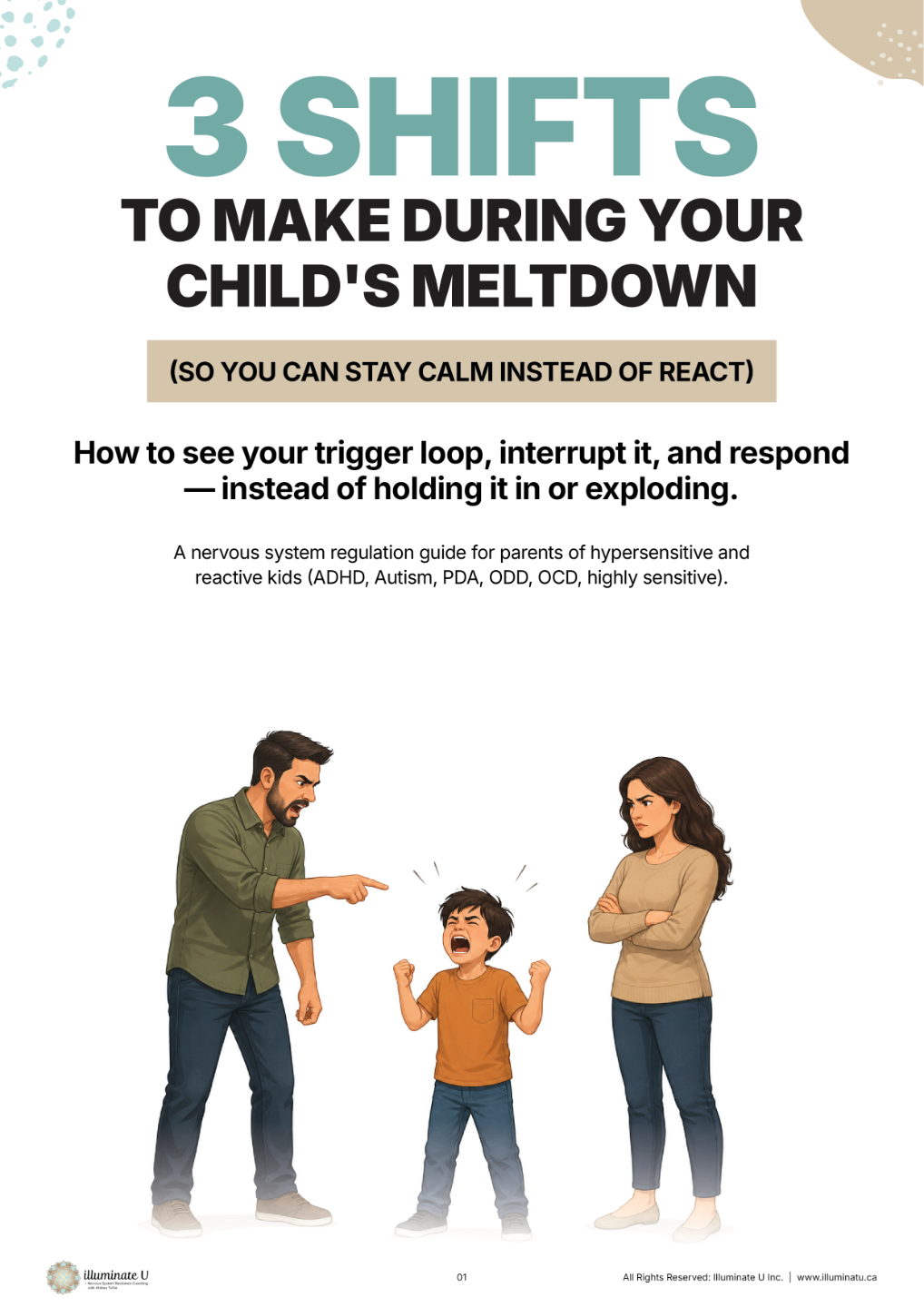
Free: The 3 Shifts Guide
The trigger loop and 3 patterns you get stuck in during meltdowns — and how to shift them so you can stay calm instead of react.
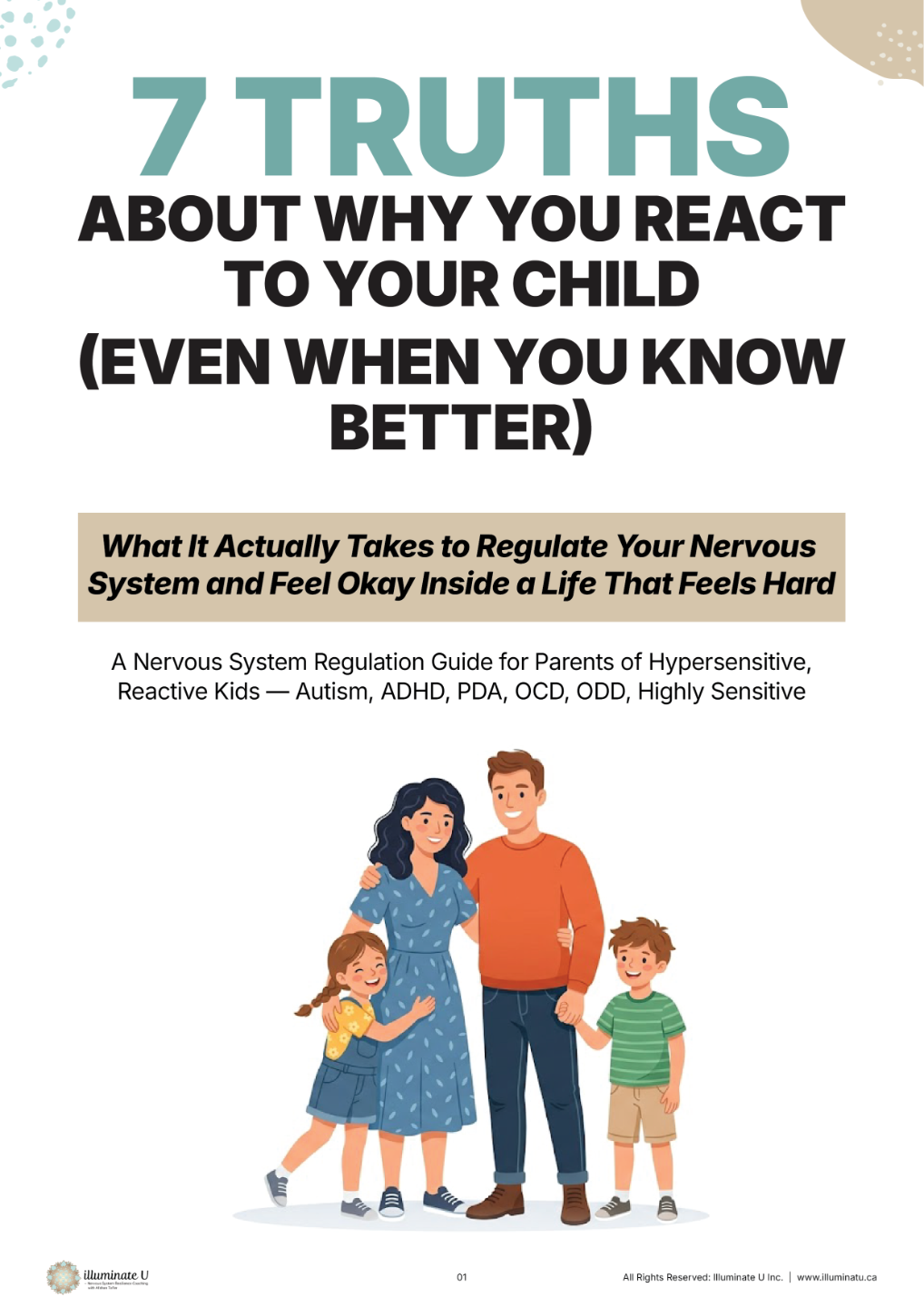
Free: 7 Truths About Why You React to Your Child Guide
Why you react even when you know better — the conditioning, nervous system states, hidden beliefs and patterns, and buried emotions running the show.

