
Why You Can't Stay Calm When Your PDA or Autistic Child Is Hitting You (Part 1)

**You can also listen to this in audio format only on The Regulated Mother Podcast on Apple or Spotify. Look for Episode #54
What's really happening inside you — and what to aim for instead
You're Not Supposed to Feel Calm
If you've ever been told to just stay calm while your child is screaming in your face, kicking the door, throwing things, or hitting you — and I'm talking about real aggression here — and then you've quietly hated yourself because you couldn't be the calm parent in that storm, I want to say something to you before we go one step further, because it's the thing I most wish someone had said to me.
You are not supposed to feel calm in those moments, my friend. It isn't possible. And chasing calm might actually be making these moments harder for you.
Take that in for a second, because I know how much weight you've been carrying trying to be the serene, gentle, unshakable parent while your child rages and destroys and gets aggressive — and how much you've beaten yourself up every time the anger rose up in you anyway.
This is for the parents whose kids don't melt down quietly. The PDA kids, the autistic kids, the ADHD, hypersensitive, high-needs kids, the ODD kids — whose big meltdowns are loud and physical and long. And here's what I didn't understand for years: there is a completely different thing we can aim for.
It's not perfectly calm.
And the day I finally understood what it actually was, everything started to change for me — and, as a bonus I never saw coming, it changed for my son too. So let's begin.
What This Two-Part Series Is (and Isn't)
Before we go any further: this is Part 1 of a two-part series on aggression — your child having aggression toward you, toward siblings, or in the house. And the question you probably came here with is the one I get asked more than any other: what do I actually do when my child is hitting me, or even when they're destroying something in the house?
It's hands down the hardest thing so many of us are living with. Being hit by your own child, or watching them go after a sibling — that is not easy. So I want you to know up front: we are going to get into what you can do when that aggression is aimed at you, some of it here in Part 1, and more of it in Part 2, because this is a big topic that deserves to be spoken about in depth.
So today, Part 1 — which is where I always start — is about gaining awareness of what happens in these moments inside YOU first. Because everything you try to do in these moments — every strategy, every response, every tool — either helps or backfires depending on the state you're in when you reach for it.
If it comes from panic, from your own fight-or-flight, even the so-called right move ends up pouring fuel on the fire of your child. And to be honest, the real change I saw with my son came when I learned to catch my own patterns and settle my nervous system first — and the science backs this up, which I'll get into.
So let's understand what's happening inside you when your child gets aggressive — because that inner shift is the ground that comes before everything you try to do for them. It's the most important part, and it's what makes all the strategies and tools we expand on in Part 2 actually work.
You can't do your way out of these moments until you've learned how to be in them. So we start with you.
Because the truth is, we've been chasing two wrong things, my friends. The first is calm — we think we should be calm, when what we actually need is to feel safe enough. Safe enough, even while we're still activated.
And the second thing we chase is: how do I make my child stop? That's the one we chase the most — when the real question is, how do I notice my own patterns and settle my own nervous system, so I stop fueling their fire, inadvertently, not on purpose.
Because as much as we think we're not adding to their fire — and I've coached hundreds of parents — I'd say we often are, on a daily basis, and we don't even realize it.
So I'll keep coming back to these two, because together they're the whole shift. It's the foundation behind everything. And this is exactly why the strategies we get into in Part 2 — the things you actually try with your child — work so much better when you can rewire this foundation we're going to talk about today.
My Story: When the Meltdowns Lasted Five Hours
So let me take you right back to when I was in the thick of this. When my son was younger, his meltdowns could last five hours — daily, for months on end. Not five minutes. Five hours.
And I don't mean crying in a room. I mean full-on raging.
He would move through the house banging and breaking things, try to hit us and throw things at us, and when he ran outside he'd bang on the garage doors of the neighbours. And I remember the specific feeling of this hot wave of fear that the neighbours would hate us or even call the police — and then the shame I'd feel on top of everything else for not being able to control my child.
It is not a small thing to be in these kinds of situations. And it is not a small thing to be hit, thrown at, or to watch someone you love aim for the exact spot on you or your partner that they know will land and hurt.
Our kids, when they're in it, can be so much stronger and so much more precise than people imagine — it can feel like they know exactly what they're doing and they're being strategic about it.
So what happens when you're experiencing all of this? Your body reads it as what it is — a threat — and it does what bodies automatically do when feeling threatened. It starts to mobilize fight-or-flight energy: to take action, to protect, to fix, to control, to do anything to get this stressful behaviour to stop so you can feel okay inside.
Now, for some of us it can go the opposite direction — into freeze or shutdown. So either we stand there frozen, not knowing what to do, or we drop into total exasperation and despair, that feeling of "I can't.
I just can't handle this. I can't take anymore."
And sometimes it's cycling between the two until the stress builds enough that you blow too, or take an aggressive action toward your child — like restraining them — and you land in a pit of guilt and shame later.
It always feels like a no-win, no-choice, no-good-options situation. And it makes sense that it feels that way.
So here's what I actually did for a long time, before I understood any of this. This was my pattern: I would clamp down. I'd go very still and very quiet and try to look like the calm, regulated parent I thought I was supposed to be — flat, neutral face, level voice, trying to say the right words — while inside I was a pressure cooker, feeling so much activation underneath.
And I could only do that for so long, because clamping down on that much activation takes an enormous amount of energy. Eventually the lid would come off, and I'd erupt. I'd rage right back at him, trying to scare the daylights out of him — anything to get him to stop.
And then I'd hate myself for it, and spiral into shame.
There were nights I'd lock myself in a room just to keep my own body safe, and he did not like that. He'd be on the other side of the door kicking it, and I'd be on my side, peeking out every little while to make sure he was safe, my own heart going a hundred miles an hour.
Sometimes I'd stay with him but hold pillows up in front of me. And sometimes I'd just ride it out and let him damage the home.
And underneath all of it, on the worst nights, was that thought so many of you know: nothing works. No matter what I do, nothing works, and I can't live like this.
I want to be honest about the timeline, because I don't believe in the overnight-miracle version of these stories. This did not turn around in a week. My husband and I both had to work on it. It took us a long time, a lot of trial and error, a lot of getting it wrong — and then finally understanding what we needed to do.
And what needed to happen was consistency: showing up in the same way over time, to re-pattern all of our mental models and nervous-system patterns, and then help my son step into that re-patterning as we did.
But there was a turn. And the turn didn't come from finding the perfect technique to make him stop. It came from something happening inside of me first — inside my husband first.
What I understood much later was this: I had been trying to control the storm. And the whole time, the thing that actually helped was learning how to be safe inside the storm — not calm, but safe enough.
The Survival Patterns We Fall Into Without Realizing
So how do we feel safe enough? First, we really have to gain awareness. Because before I could learn a new way, I had to see what I was already doing. And what I found was that when my son escalated, my nervous system had a handful of automatic moves — and almost every one of them came from a belief about what a good parent is supposed to do in that moment.
Let me name them, because I think you'll know some of these intimately. It's so important to gain awareness of the patterns our nervous systems automatically go into, so we can begin to change them — because all of them tend to fuel your child's fire even more, and a lot of the time we don't even recognize we're in them.
The Reasoner
This is the one where you keep talking. "Okay, but you can't hit me. Hitting hurts. Let's use our words. Remember what we said about hitting?" We use our words, we try to explain — often with an escalated or deepening tone of voice that signals danger to them — trying to reach the thinking part of a brain that has completely gone offline.
And every time — poof — it gets bigger. The belief underneath: if I can just explain it well enough, I can talk him down.
The Fixer
You jump in to make it stop. You move toward your child, you intervene, you manage, you control. Your whole body is oriented around one goal: end this now. The belief underneath: a good parent stops the meltdown.
And don't get me wrong — this is needed sometimes, when there are real safety concerns and other siblings involved. But it's often the energy and the safe-enough state behind our action that matters here.
The Performer of Calm
This is the one I lived in. On the outside you look calm — flat face, low monotone voice, saying all the right calm things — but you're not actually in your body. You've clamped down hard on everything you're feeling so you can function, recruiting social-engagement behaviours automatically, without conscious awareness, trying to act like you're okay and calm.
But it's not true regulation. It's a freeze response — functional freeze. Your system has put a numbing lid on all the activation underneath, so you don't have to feel it. And holding this much stress energy in burns a huge amount of energy — it either leaves you primed to explode out of nowhere, or later sends you into exhaustion, despair, and burnout.
And as much as we think we're being regulated, our children can feel this mismatch. I know my son does — he tells me when I think I'm being calm and I'm not. Their nervous systems read the tension underneath the calm mask, and it doesn't feel safe to them; it feels confusing.
Looking calm and being calm are not the same thing. And children read the truth underneath, not the performance layer on top.
And I want you to understand — this performance of calm isn't something you're consciously doing on purpose, so there's no shame here. Most of us aren't even aware it's happening. We're just so used to handling stressful moments this way — even out in public, or with people we don't know well — that level of functioning like you're okay when inside you're not.
And it gets exacerbated with our kids, because we think this is how we're supposed to show we're calm. So it's a deeply patterned response, and it can take a while to really feel into it.
The Peacekeeper
This is the over-explaining, over-apologizing, offering ten choices, giving in, trying to fix your child's feelings so the storm will stop. The belief underneath: if I can make him feel better fast enough, this will end and I'll finally feel safe and okay.
This is also a deeply patterned early-childhood response — you might recognize it as people-pleasing, or the fawning or appeasing response.
But this strategy often doesn't work either. It just teaches everyone that the storm is unbearable — it wires that pattern in for you, and it teaches your child that their storm is unbearable too. And then there are two more patterns — and these ones aren't really about what we believe makes us a good parent, but they're just as important to recognize.
The Collapser
This is when it's all too much and you drop — into that dorsal vagal shutdown, into "I can't, I just can't take anymore," into despair, or into that faraway, numb place where it feels like this will never end.
And I'll be honest: I had my own moments where my old trauma got triggered and I'd end up whimpering, crying, saying "I can't take anymore."
That's a real place a lot of us go, and there's no shame in it. It's a nervous system that feels like there's no choice, feels trapped, feels so overwhelmed by it all — and it's almost always fuelled by past trauma getting activated in the present.
The One Nobody Admits: Turning on Your Partner
Because you can't take that fight energy out on your child — your system says, this is my child, I can't fight my child — sometimes it swings sideways onto your partner. You start directing them, blaming them, controlling them, even trying to tell them what to do in the moment, because you think they're activating your child more and you just want them to stop so your child will stop.
This is the fight system looking for somewhere to put all that energy, and the partner is the safer target. So if you've done this, you're not a bad partner. We all do it. Your survival system was just looking for some semblance of control, anywhere it could find it.
The Belief Underneath Them All
The belief underneath almost all of these patterns is the same misconception, and I want to say it as plainly as I can: we believe we are supposed to feel calm. We believe a regulated parent is a calm parent.
So if the anger rises in us, if we want to fight back, if we feel that surge of "I can't let this happen," we feel like we've somehow failed — like we're not supposed to have this reaction, like we're doing it wrong, like we're the problem.
And that belief is quietly crushing us.
And there's a second one tucked right beside it. We believe there's a right thing to do — a perfect script, a magic move — and if we could just find it, we could make this all stop.
I laugh a little, not to make light of it, but because I was that for so long. That is a survival-system response right there.
I had a mother message me about exactly this. She said her son follows her when she walks away, and punches the door when she closes it — and then this line stayed with me. She said, "Speaking doesn't tend to help, but neither does staying quiet."
And I understood exactly what she meant, because I'd been there.
When you're hunting for the perfect action, you try one thing and it doesn't work, then you try the other and it doesn't work — talking, then silence — and both feel like failures, because neither one reliably stops the storm.
You're always looking for the magic tool to stop this storm right now.
But what if the goal was never to find the perfect action — or to feel calm — because neither of those was ever actually possible?
And here's what I most need you to take in about these patterns: they are part of what's fueling the fire. Every one of them springs from that same "what do I do to make this stop" place — which is really control in disguise, our own fight-or-flight looking for a way out.
So this is where the work begins: not forcing the patterns away, but noticing them, so you can help your own nervous system feel safe enough — instead of adding your storm to theirs — and take action from that steadier place, instead of from fear.
One Important Caveat: Real Danger Comes First
One important caveat here: real danger comes first. If your child's behaviour is truly dangerous — if someone is getting hurt — your first job is safety. Your nervous system is going to do what it does; ideally with enough safety on board that you can intervene and create more safety.
We'll go further into that in Part 2, in terms of the actual tools you can use in the moment.
So none of what I'm about to say is about standing there and taking blows from your child — this isn't condoning that. It's about what's happening inside of you while you keep everyone as safe as you can.
And when you do have to intervene for safety, you stay as safe as you can, do what you need to do, and then repair later.
What's Actually Happening: Your Nervous System in Three Layers
Now let's go into a little more detail, so you can understand what's really happening in your nervous system and your child's — and the layers underneath it. I'm going to take you under the hood for a few minutes, because understanding this is exactly what took the shame off me, and I think it might for you too.
I see it with the parents in my Regulation Rebuild course all the time: when they understand the nervous system, the shame lessens — and that itself helps your nervous system.
Here's why it matters practically: when you understand what's actually happening, you stop fighting your own body, you stop fighting your child's body, and you start working with both. There are three layers happening at once in these moments, and once you can see them, this stops feeling like something is wrong with you.
Layer One: What's Happening in Your Child's Body
When your child is fully melting down, they are not giving you a hard time — they are having a hard time, in the most literal, physical way. Most of us understand that at a higher-thinking level, but that understanding tends to go offline when we're triggered.
It's literally biological: there's too much energy in their system, more than their body can hold down, and that energy needs to move out.
And here's something we don't always see: our kids are also holding in and clamping down on their own fight-or-flight responses all day long, just like we do. But their systems are really sensitive — they feel threat more easily.
So think about how many times a day their survival system is getting triggered. They hold so much of it in. And then there's a tipping point where they can't hold it anymore — a trigger, a loss of autonomy, a wave of shame — and boom, all that held-in energy needs to come out.
They need to let it out, but they don't know how to do it in safe ways yet. They've become patterned to release it in ways that aren't good for them or anyone, because that's what their brain learned to do — and our brain is a predictive, pattern-making machine.
Once it does something that somehow worked, even if it's not functional, it does it again and again. So it's not easy to re-pattern these things — but it's possible. I've seen it with my son.
So in the moment, they cannot override it. The energy is like a volcano erupting — it needs to come out. Even when you try to help by doing instead of being, it doesn't work, because the thinking, reasoning, verbal part of their brain has gone offline.
Under threat, the brain shunts its resources away from language and logic toward the survival brain. That's why reasoning doesn't land — there's no one home in the reasoning department.
This is survival energy that needs to discharge, and a lot of the time the kindest, wisest thing is to let that wave rise and fall while keeping everyone safe. That's what I call riding the wave. It's not easy, but it will come down.
Sometimes it takes longer than you'd expect, and it's not because you're doing it wrong. Their body might have other things going on — a blood sugar crash sending adrenaline through them, low dopamine, other things we just can't see.
So we hold this loosely: their body is discharging something, and it will come down, even if we can't control exactly when. And it will come down faster over time, as we stay consistent with being safe enough and mirroring that to them.
Layer One, Continued: What's Happening in Your Body
Now here's the part I most want you to hear, because it's the thing that took the shame off me. When your child hits you, or throws something, or destroys something you love — your nervous system activates.
It floods with fight-or-flight energy. This is human. This is natural. You feel the surge to stop it, to push back, to protect — and that is not a character flaw. So can you stop beating yourself up over it?
I had to really work on that one.
This is not you being an angry or dysregulated person. This is a healthy nervous system doing exactly what it's built to do under threat.
Your anger in that moment is not a failure of regulation. It's a sign your system is working. You are being hit — of course it wants to fight back and protect you. This is part of the human design.
So if the goal isn't to make that activation go away — because we can't, and honestly we wouldn't want to switch off a system that's trying to protect us — then what is the goal? Here's the shift in the science, and it's everything.
We have a branch of the nervous system, the ventral vagal — our safety and social system — and its job is not to erase the fight energy. Its job is to hold it, to put an umbrella over it.
To build a felt sense of safety, so all that mobilized energy can stay as safe-enough sympathetic energy. Because there's danger sympathetic, and then there's safe-enough sympathetic — where you're activated, alert, energized, but not tipped over into blind defensive rage, and not collapsing down into shutdown.
Think of the difference between sprinting because you're playing, versus sprinting because something is chasing you. Same racing heart, same fast breath, same mobilized body — completely different felt sense inside. One has safety on board. One doesn't.
That's what we're going for. Not no activation — activation with safety wrapped around it, so your thinking brain can stay online and you can actually choose what you do next.
Layer Two: What Happens Between Your Nervous Systems
Your two nervous systems are not separate in these moments. They're talking to each other constantly, underneath words, through something called neuroception — the way our bodies read safety or danger in each other before we've thought a single thought.
It's below conscious awareness. Our bodies are designed to ping with each other: one pings, the other pings — and especially between you and your child, that's part of the design.
So your child's body is reading your body all the time — your tone of voice, your posture, the tension in your face, the energy coming off you. Through mirror neurons and that constant exchange, their system is asking: am I safe with all this that's going on inside me right now?
And is my parent showing me they feel safe with me, even when I feel out of control?
Their nervous system is constantly looking for cues that you feel safe enough and okay with their big reactions — so they can learn to feel safe and okay within their storm too. And over time, that's how their nervous system learns to regulate.
So when your safety system is holding your fight energy — when you're activated but okay, mobilized but not dangerous, not numbing it down — your child's body picks that up. It gets a message it desperately needs: it's safe to have big feelings here; the adult can handle my storm; I am not too much.
And that, over time, usually helps them feel safer within their own storm and come down faster — because their nervous system is learning from yours. This is how we teach regulation: they ping with us, feel our safe-enough on board, and their nervous system slowly starts to bring its own safe-enough on board too.
Regulating yourself is regulating your child. Your nervous system is the single biggest cue of safety they have.
Now, I know some of you are thinking: Afshan, this doesn't work for me — I stay regulated and my kid still escalates. I hear you, my friend, and I'm not going to pretend it's a magic switch.
I used to try it once or twice and think, "It didn't work." Sometimes it takes longer — especially if you've been in these patterns together for a long time — and you'll need to be more consistent, repeating this way of being many times, sometimes hundreds of times, before their nervous system can fully trust it and form new patterns with you.
I'll say more about that in Part 2. But stay with me — because the research on this is stronger than you'd expect.
Studio 3 & the Low Arousal Approach (UK)
There's a company out in the UK whose work I love — I found them when I was in a desperate state, and they helped me so much. They're called Studio 3, and they do the Low Arousal Approach.
Professor Andrew McDonnell and the Studio 3 team developed it over 30-plus years, for exactly these situations: managing aggression and crisis. And its central finding is striking: the most powerful lever in a crisis is not the child's behaviour — it's how the supporting adult behaves.
Their own arousal, their calm, their body language.
Take that in for a moment. This is the research. Their approach is built on reducing stress and arousal in both people — avoiding confrontation and demands, never using punishment. They point out that a huge portion of communication is non-verbal, so a caregiver's ability to bring calm, neutral, non-confrontational energy is treated as the actual intervention.
Your nervous system is the intervention.
And the outcomes back it up. One service in Nova Scotia that implemented this over five years saw around a 40% reduction in distress behaviours and a 69% reduction in staff injuries. And a 2024 study of families using the approach found parents reporting far fewer crises — one parent said, "We do not really get the crisis situations anymore" — and 15 of 17 families reported better relationships.
So managing your own arousal isn't the soft option. It's the evidence-based one.
I love this research because it says, in clinical language, the thing I learned on my kitchen floor: you are not the crisis manager standing outside the storm. You are inside it, and your own state is the intervention.
And here's the part I want you to hold onto, because it's your state, not a technique, that builds this change over time. When you bring your safe-enough presence consistently, even imperfectly, your child's nervous system slowly learns to trust yours and to borrow it, until it can learn that steadiness itself — which can take time to wire in, based on their development.
That's what makes the storms come less often and pass more quickly when they do — the aggression, even the hitting, easing over time. Not through perfect words. Through you, safe enough, again and again. This is exactly why I teach this in my Regulation Rebuild course — and why it's an 18-week course now — because it takes time to really develop this new way of being.
Layer Three: The Beliefs and Wiring Underneath It All
Now, Layer Three: the beliefs and wiring underneath it all — the engine beneath the biology, the one actually driving so much of the reaction. It's the meanings we carry. For a lot of us, our child's aggression doesn't just trigger a threat response — it triggers our history.
Maybe you grew up where anger meant danger, where you had to keep the peace to stay safe, where a raised voice meant something bad was coming. So when your child rages, it's not only today's threat your body is responding to — it's every time you ever felt unsafe and powerless in the past.
That's why these moments can feel so much bigger than the moment itself.
And then there are the beliefs about what makes a good child — a lovable child, a child who belongs, a child who'll be okay in the world. When we witness these behaviours, all the expectations our brain quietly holds get triggered too, whispering that our child will never fit in, never belong, never be loved, never be successful — according to the conditioned mental models we picked up along the way.
And then, underneath it all, those beliefs about ourselves we named earlier: that a good parent stays calm, that if I can't control this I'm failing, that my child's behaviour is somehow a report card on me. Those are the real fuel.
They're what turn a hard moment into one filled with fear or shame. And part of this work — the deep part — is meeting those beliefs and slowly rewiring a truer story into your nervous system: that your child's behaviour does not define them, or you.
It just means that right now, biologically speaking, their nervous system does not feel safe.
The Shift: From 'What Do I Do?' to 'How Do I Be?'
So here's the whole thing in one line. For years, I was asking the wrong question. I was asking, over and over, in the middle of the storm: what do I do? What do I do to make this stop, what's the right move, what's the technique?
And the shift — the thing that actually changed everything — was moving from "what do I do" to "how do I be."
The goal was never to be the calm, perfect parent. The goal is to be safe enough — regulated enough — inside myself that I can take action in a steady way and ride this wave without being swept under it.
Calm enough. Regulated enough. Safe enough. Not perfectly calm — that's a fantasy that only makes you feel like a failure. Safe enough on the inside that your thinking brain stays online, so you have choices, so you can send your child cues of safety even while a part of you hates every second of it.
That's the target. And it is so much more reachable than calm, because it's real. And it can also look messy. Safe enough isn't about looking calm, or even feeling calm. It's about working with this energy inside of you, helping it feel safe enough that it doesn't take you over into your own aggressive meltdown, or shut you down into total disconnection.
Your Takeaway: What to Do With This Now
So let me make this really concrete, because I know you're not here for just more ideas and concepts — you're here for what to actually do. Most of us have no mental model for these moments except the old, conditioned ones we grew up with, that cause us to react in ways we don't want to.
So let me give you some new ones, and show you how each one translates into something you can do, starting today.
1. Step into the reframes
There are three reframes — new mental models to reach for in the moment, in place of the old ones. And some of you are good at stepping into reframes; some of you will need to work with the body first, to shift your state enough to step into the reframe.
The first: it's not about being calm — it's about feeling safe enough to handle the storm and ride the wave until it's over. So in the moment, you stop trying to force yourself calm, and you aim for something actually reachable: just safe enough to stay in it, so your true self, your higher-thinking brain, stays online.
The second: "My activation is expected — and so is my child's. And can that be okay, right now?" This one is about stopping the fight with reality. Instead of "this shouldn't be happening," you allow what's here — because what you can allow, you can actually help.
If you're fighting it, you can't help it.
And the third: "My nervous system is the intervention." So the moment you feel yourself scrambling for what do I do, let that be your cue to stop reaching outward, and instead come back to yourself and help yourself first.
Because you, settling into safe enough, is the most powerful thing happening in that room — no words needed.
2. Safety first — the one caveat
If there's a real safety issue and someone is about to get hurt, your nervous system will step in fast to create safety — and it should. So here's what to do with that: let it be what it is.
Don't shame yourself for the fast, protective thing your body does. Help your brain accept that in that moment, this was what was needed — and then repair afterward. Because the reconnection that comes after always matters more than the rupture.
It teaches both your nervous systems that there is always a way back to connection.
3. Become the curious observer of your patterns
This is where the real change begins. When your child starts to escalate, get curious instead of hard on yourself. Start to catch yourself in the automatic patterns — the Reasoner, the Fixer, the Performer of Calm, the Peacekeeper, the Collapser, or turning your energy onto your partner — and simply name it: "That's survival mode.
There goes that pattern." No judgment, just awareness — because you can't shift a pattern you can't see.
And then, once you catch it, help yourself regulate — starting with your body, because you can't reframe your way out of a flooded body. When the energy is really mounting, give it somewhere to go: do a full-body shake-off to move it, then let yourself come all the way down, and find something around you that cues safety and take it in.
Over time, the more you interrupt and regulate these patterns, the less they take you over — and when they do, they won't be as extreme.
And if you want to be walked through some of these body tools step by step, that's exactly what my free guide is for — it's called The 3 Shifts To Make During Your Child's Meltdowns, and it's the perfect companion to this episode. And of course, there's my Regulation Rebuild — 12 Nervous System Shifts course, which is starting this September. I'll put the links in the show notes.
So — What Do I Do When My Child Is Hitting Me?
So, to the question you probably walked in with — what do I actually do when my child is hitting me? For right now, here's your honest answer: do the best you can to ride the wave, and keep yourself and everyone else safe.
Use some of the strategies I tried — it's a lot about trial and error, and it's not necessarily about stopping the storm, but about keeping it safe enough that nobody gets hurt.
And then always repair afterward. Let your child know, in whatever way they can receive it, that your relationship is stronger than any storm they bring. That alone changes so much.
But I want to be honest with you: lessening these hits over time is not a one-time hack or a single clever strategy. It's a foundation — and today is where that foundation starts. It starts with learning how to be: how to change your patterns so you're not adding fuel to the fire.
And in Part 2, we build on it together: what you can do more of in these moments, and — just as importantly — what you can do before the big storms even hit, so that over time they become less intense, less often, and hurt less.
Because that is how the hitting actually lessens: your nervous system, steady and consistent, slowly teaching theirs that it's safe.
So for now, just start here. The next time the storm hits, see if you can catch that fight-or-flight rising in you, and instead of judging it, just be with it — and tell yourself: I don't have to be calm.
I just have to be safe enough, with what's happening inside me and outside me. That's where all of it begins.
I'll see you in Part 2, where we get into so much more. Sending you so much love and so much support — because this is not an easy journey, my friends, and you are walking the courageous walk.
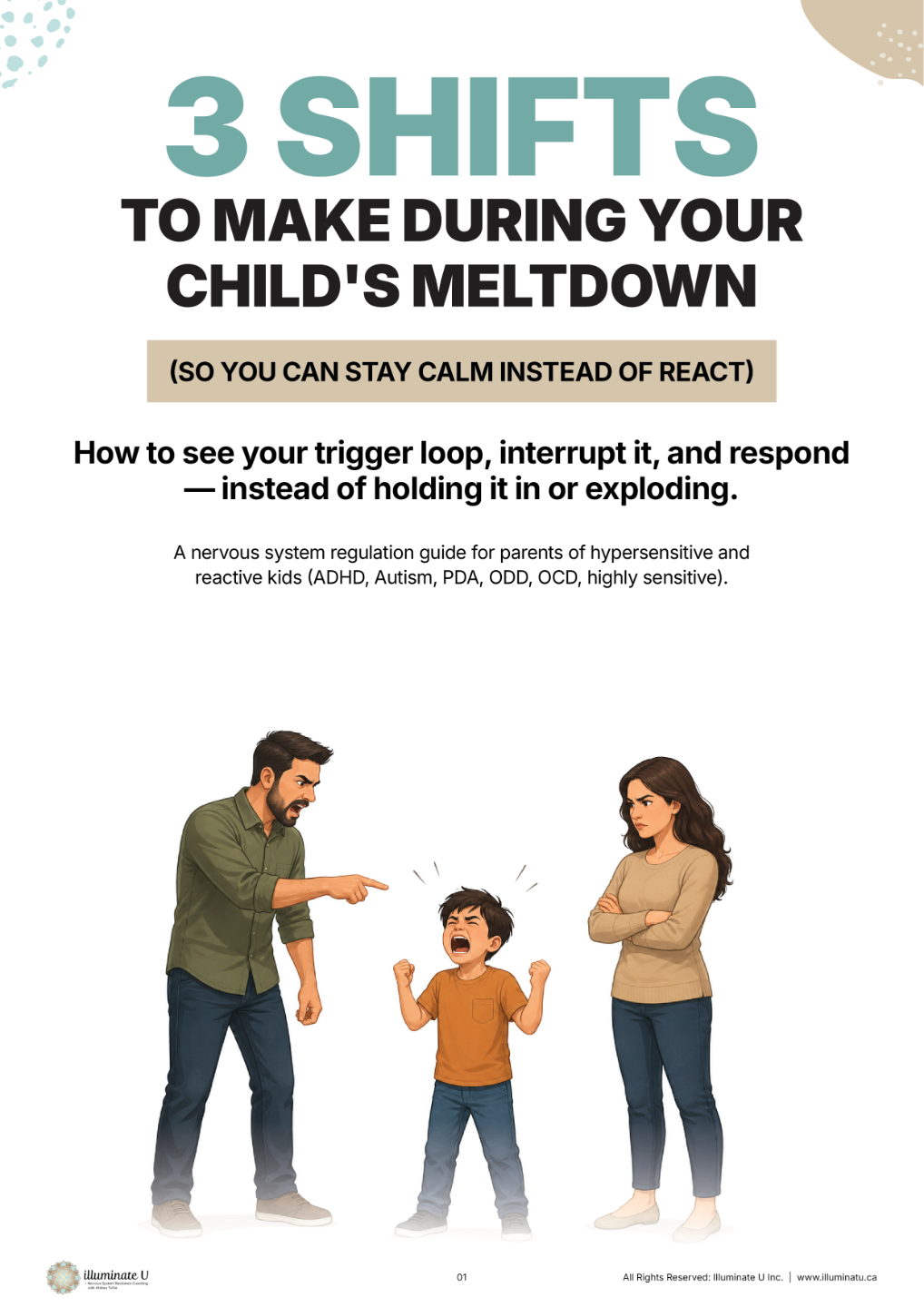
Free: The 3 Shifts Guide
The trigger loop and 3 patterns you get stuck in during meltdowns — and how to shift them so you can stay calm instead of react.
Free: 7 Truths About Why You React to Your Child Guide
Why you react even when you know better — the conditioning, nervous system states, hidden beliefs and patterns, and buried emotions running the show.

