
When Your PDA Child Hits Burnout — and Your Fear About The Future Starts Growing

**You can also listen to this in audio format only on The Regulated Mother Podcast on Apple or Spotify. Look for Episode #38
**Below is the blog article for easy reading.
When Your Child Does Less and Less And Your World Gets Smaller
There is an experience many parents of highly sensitive, PDA, autistic, or otherwise neurodivergent children go through that almost no one talks about.
It’s not the meltdowns.
It’s not the arguments.
It’s not even the daily intensity that can come with parenting a nervous system that feels everything deeply.
It’s what often happens when a child’s nervous system goes into burnout.
Because when burnout hits, something very strange — and very frightening — can begin happening.
Your child slowly starts doing less… and less… and less.
One activity disappears.
Then another.
Maybe it’s school.
Maybe it’s sports.
Maybe it’s friends.
Maybe family gatherings start becoming too overwhelming.
Maybe vacations stop.
Maybe even simple things — like going outside, watching a show together, or playing a board game — start disappearing.
And slowly, often without anyone planning it, the world starts getting smaller.
Smaller for your child.
But also smaller for you.
And smaller for your whole family.
And as that world gets smaller, something else begins happening inside of you.
Your fear starts growing.
Fear about the future.
Fear about whether life will always be like this.
Fear about whether your child will ever re-engage with the world again.
And sometimes there is a thought many parents carry quietly that can feel almost unbearable to say out loud:
What if my child never comes back into life?
What if this is just how things are now?
If you’ve ever had that thought, you’re not alone.
Many parents reach a point where they feel like they are trying everything to help their child — and nothing seems to work.
They start feeling trapped.
Helpless.
Like the life they imagined for their child… and their family… is slowly disappearing.
Today I want to talk about this experience.
What’s really happening underneath it.
Why the fear becomes so intense.
And why this period — as painful as it is — can sometimes become a passage into something deeper for both you and your child.
Because I’ve lived through this myself.
And I want to tell you that even though this experience can feel terrifying and painful, there can also be meaning in it… and dare I say — even a gift.
So stay with me, and let’s explore this together.
When Our Life Started Getting Smaller
For us, it started one summer when my son said he didn’t want to go to camp.
At the time it didn’t feel like a big deal. Kids change their minds about camp all the time, so we said okay. We figured maybe he just needed a break that summer.
But that small moment turned out to be the beginning of something much bigger.
When school started again that year, something in my son’s nervous system completely froze. He couldn’t go into the building. Every morning became a cycle of panic, meltdowns, and shutdown.
When he came home from school, he looked almost catatonic — like his whole system had collapsed under the pressure of trying to get through the day.
Eventually we made the decision to pull him out of school. At the time we thought we were just giving his nervous system space to recover.
But then something else started happening.
He stopped wanting to go out.
Then he stopped wanting friends over.
Cousins coming over became too overwhelming.
Family visits stopped.
Vacations stopped.
Going out of the house stopped.
Even simple things — like watching a movie together or playing a board game as a family — started disappearing.
Little by little, the things that used to make up our normal life began falling away.
What started as a few changes slowly turned into years.
More than six years of our son withdrawing from many parts of the outside world.
During those years there was fear. A lot of fear.
Fear about whether this was temporary… or whether this was how life would always be.
There was grief — for the loss of all the things we couldn’t do anymore.
And there were moments when it felt like our whole life was shrinking.
If something similar is happening in your family, you probably know exactly what that feeling is like.
Because when your child’s world starts getting smaller, something very powerful begins happening inside your nervous system.
Your fear starts growing.
And once that fear takes over, most parents unknowingly enter a very predictable cycle.
The Cycle Many Parents Enter When Their Child Burns Out
When a child goes into burnout, many parents unknowingly move through a very recognizable emotional and nervous system cycle. It’s a pattern I see again and again in the families I work with, and it’s one I have lived through myself for many years.
The pattern often unfolds like this:
Fear gets triggered → followed by a lot of efforting → followed by feeling helpless to affect change in your child → followed by feeling like you’re failing, and then shame begins to take hold → followed by a deep sense of grief.
And this cycle tends to live on repeat… waiting for your child to change so that you can finally feel better.
But what many parents don’t yet realize is that this cycle isn’t actually broken by your child changing.
It’s broken by bringing awareness to what is happening inside of you.
So let’s walk through each part of this cycle, so you can begin to recognize it in yourself — not as something wrong with you, but as a very understandable nervous system pattern.
And from that awareness, you begin to create the possibility of stepping out of it.
1. Fear: When the Future Suddenly Feels Terrifying
The first thing that gets triggered when your child stops participating in life the way they once did is your brain immediately jumps into future fears.
And this makes sense. You’re the parent. You feel responsible for your child’s well-being and their success in life. Of course your system reacts. Of course fear shows up.
But it’s important to understand something about the brain in moments like this.
We all have a brain designed to do what it does best — ensure survival at all costs. And when the brain senses a possible threat to your child’s future, it does something very predictable.
It starts trying to solve the future.
Your mind begins scanning ahead, searching for answers, trying to make sure your child will be okay. And as it does that, your system can start spiraling into fear, sending your mind and body into chronic stress mode and mounting an enormous stress load.
The brain begins generating questions that feel urgent and impossible to ignore.
Will they ever go back to school?
Will they ever leave the house again?
Will they ever work? Will they ever have relationships?
And eventually another question may quietly surface — one many parents carry but rarely say out loud because it feels almost unbearable to think about.
What will happen to my child when I’m no longer here to help them?
Your brain tries to answer these questions immediately.
But the truth is, these are questions that cannot actually be solved right now.
And because they cannot be solved, your nervous system stays activated, trying to protect your child from a future it imagines could be catastrophic.
The brain is doing exactly what it was designed to do — scanning for danger and trying to ensure survival.
But when fear rises in the nervous system like this, it naturally pushes us toward action, fuelling the stress response even more.
2. Efforting: Fight-or-Flight Disguised as Helping
This leads us to the second pattern that gets activated when your child hits burnout: efforting in an attempt to help or change the situation, but fuelled by a lot of stress energy.
When your brain senses danger — especially danger to your child’s future — it mobilizes. It tells you “do something, do something…anything to change this!”
That mobilization often shows up as effort.
You research everything you can find.
You advocate.
You search for therapies, strategies, accommodations, and answers.
You adjust routines.
You adjust expectations.
You try everything you can think of.
This effort comes from love.
But underneath that love is often the survival energy of fight-or-flight — the nervous system’s urgent need to do something.
Because sitting with the fear feels unbearable.
Your survival system keeps repeating the same message:
Fix this.
Find the answer.
Do something.
And underneath all that effort lies a very human hope:
If I try hard enough, maybe I can turn this around.
But when a child is in deep burnout, effort doesn’t always lead to immediate change, and when we see that whatever we do does not help or change the situation, our system drops to feeling helpless.
3. Helplessness: When Nothing Seems to Work
When nothing seems to work to change the situation, we tend to cycle into the dorsal shutdown state of helplessness and powerlessness.
This is a painful place to be. You’re trying so hard, but the strategies don’t work. The progress doesn’t come. And the constant effort begins to feel exhausting and futile.
Parents can find themselves swinging between trying harder and giving up.
One day you’re researching again, determined to find the answer. The next day you feel so depleted you think, “Fine… just watch YouTube all day.”
Not because you don’t care. But because you feel powerless to affect change. The situation starts feeling impossible to solve.
And somewhere inside, a painful thought begins forming: Maybe nothing I do actually matters.
This is often the moment when helplessness begins settling into the nervous system.
4. Shame: When It Starts to Feel Like You Are Failing as a Parent
For many parents, helplessness is quickly followed by another painful emotion.
Shame.
When nothing you try seems to work, it can begin to feel like the problem must somehow be you.
You start questioning yourself in ways that can be incredibly harsh and lonely.
Am I not trying hard enough?
Am I missing something other parents would know how to do?
What am I doing wrong?
Sometimes the worry expands beyond your own thoughts and into what you imagine others must be thinking.
You may start wondering what doctors, therapists, teachers, neighbors, family members, or other parents think about your child’s life — and about your parenting.
Why can’t they get their child to school?
Why can’t they get their child to function?
And slowly, those imagined judgments begin turning inward.
If my child can’t function… maybe I’m not a good enough parent.
Maybe other parents would know how to fix this.
Maybe I’m failing.
This is one of the most painful parts of this experience, because it touches something very deep in many of us — the belief that our worth as parents is measured by how well our children fit into the world.
If our child is thriving according to society’s standards, we feel successful.
But if they’re struggling to function inside those systems, we can begin to feel like we’ve somehow failed.
And yet the truth is this:
Your child’s nervous system challenges are not a reflection of your worth as a parent.
In fact, the very fact that you are still here — still searching, still learning, still trying to understand how to support your child even when it feels incredibly hard — speaks to something much deeper than failure.
It speaks to love.
It speaks to perseverance.
It speaks to not giving up on your child.
And at the same time, when shame enters the room, it often keeps your nervous system cycling between states.
You may find yourself moving between sympathetic fight-or-flight — “do something now!” — and dorsal shutdown — “I’m failing… nothing I do matters.”
And once shame becomes a dominant part of this season, it often brings another emotion with it.
Grief.
5. Grief: The Life That Feels Lost
There is real grief in this experience.
Grief for the life you imagined for your child. Grief for the family life you thought you would be living. Grief for the activities, relationships, and experiences that now feel out of reach.
Sometimes it can feel like the world is continuing to move forward for everyone else while your family is stuck in a life that has become smaller and smaller.
You can love your child exactly as they are… and still grieve the life you thought they (or you) might have. Both of those things can exist at the same time.
And allowing that grief is not giving up. It is part of the passage.
Because underneath the fear, the efforting, the helplessness, the shame, and the grief, something deeper is often being revealed.
And that revelation has less to do with your child… and more to do with the systems and expectations we were all raised inside.
When the System We Were Raised In Starts Breaking Down
When parents end up chronically cycling through fear, efforting, helplessness, shame and grief, it can feel like everything is falling apart.
But sometimes what is actually breaking down is something much older.
The belief system we were raised inside.
Most of us grew up with a very specific understanding of what success looks like.
Children go to school.
They work hard.
They develop skills.
They become independent, responsible.
They contribute to society.
Underneath those expectations were deeper messages many of us absorbed growing up.
Productivity equals worth.
Efficiency equals intelligence.
Hard work equals success.
Push through obstacles.
Solve problems.
Control outcomes.
Many of us managed to live successfully inside those systems ourselves – at least until now.
But our children’s nervous systems often cannot.
And when they can’t, it feels like the child — or the family — must be failing.
But sometimes the truth is something else entirely.
Sometimes the system itself – the flawed system, in my opinion – is what is being revealed.
A Question That Put Words to What I Was Already Seeing
Over the years of supporting my son through burnout, I slowly began realizing that something deeper was happening.
It wasn’t just my son struggling.
It was that the way we define success, productivity, and functioning in our culture may not actually work for many nervous systems.
Recently I came across something written by neurodivergent clinician Dr. Geethika Pillai that captured this realization beautifully.
She posed a simple but powerful question:
Instead of asking “How do we make people more efficient?”
What if we asked:
“What if the definition was too small?”
That question resonated deeply.
Because when you step back and really look at the systems we live inside — schools, workplaces, even many parenting frameworks — they tend to reward one particular type of nervous system.
Steady energy.
Predictable regulation.
Consistent productivity.
Linear progress.
But human nervous systems are far more diverse than those systems were designed for.
And in many ways, our children are revealing where those systems are too narrow.
Rebuilding What Was Never Built
One of the things many families eventually discover during burnout is that the old way of living wasn’t actually working for anyone.
Not just for the child but for the entire family.
Many of us were raised in generations where nervous system health was not understood.
Stress was normalized. Pushing through exhaustion was normalized. Emotional suppression was normalized.
Success often meant overriding your body again and again.
But our children’s nervous systems often cannot live that way.
And in many ways, that is revealing something important about the path humanity has been on.
Burnout can become a moment where families begin rebuilding something that was never fully built in generations past.
A foundation of nervous system safety.
Learning how to regulate.
Learning how to co-regulate.
Learning how to prioritize connection, full acceptance of who one is, and support instead of pressure and performance.
And that rebuilding work changes everything.
The Cocoon
During those years when our son withdrew from so much of the world, there were many times when it felt like our life was breaking down.
And in many ways it was.
The expectations we had.
The meanings we had inherited.
The conditioning we had been living from.
All of those things started to crack.
But slowly we began to realize something else.
Our son wasn’t the only one being asked to slow down.
Our entire family was.
We were being invited to look inward. To question the beliefs and inherited patterns we had been living from. To rebuild our own nervous systems from something deeper and more aligned with our truth, not the world’s version of it.
Looking back now, those years felt like a cocoon.
From the outside it looked like life had stopped. But inside something profound was happening. Old structures were dissolving, and something new and more stable was forming.
A Different Kind of Life
Today our life still doesn’t look like what most people would call normal.
My son still doesn’t go to school. But he wants to learn again. He’s curious.
He’s slowly working through fears about being in the world again. And that movement is coming from his motivation — not from our fear.
But the biggest shift is this: We have moved from fear to trust.
We trust our son. We trust his nervous system. We trust that development does not have to follow society’s timelines. We trust that his life can become meaningful in ways that are true to who he is.
And that trust has brought a kind of freedom to our family. Freedom to define success differently. Freedom to build a life rooted in connection, safety, love, and authenticity.
The Hidden Gain
If you are in the thick of it right now, where your child’s world is getting smaller and your fear is growing, I want you to know that your pain makes sense.
Your nervous system is trying to protect your child.
But sometimes what looks like collapse and break down is also a passage.
A passage that invites you to slow down.
To question the conditioning you inherited.
To rebuild your life from something deeper that is more aligned with your true values and your authenticity – not from who the world told you to be.
What your survival brain interprets as loss may also hold a profound gain.
Not only for your child.
But for you.
For your family.
And perhaps even for the larger shift our children are helping guide us toward.
Sometimes the chapter of parenting that feels the most frightening becomes the one that ultimately leads us to the greatest freedom — for ourselves, our children, and the lives we are learning to build together.
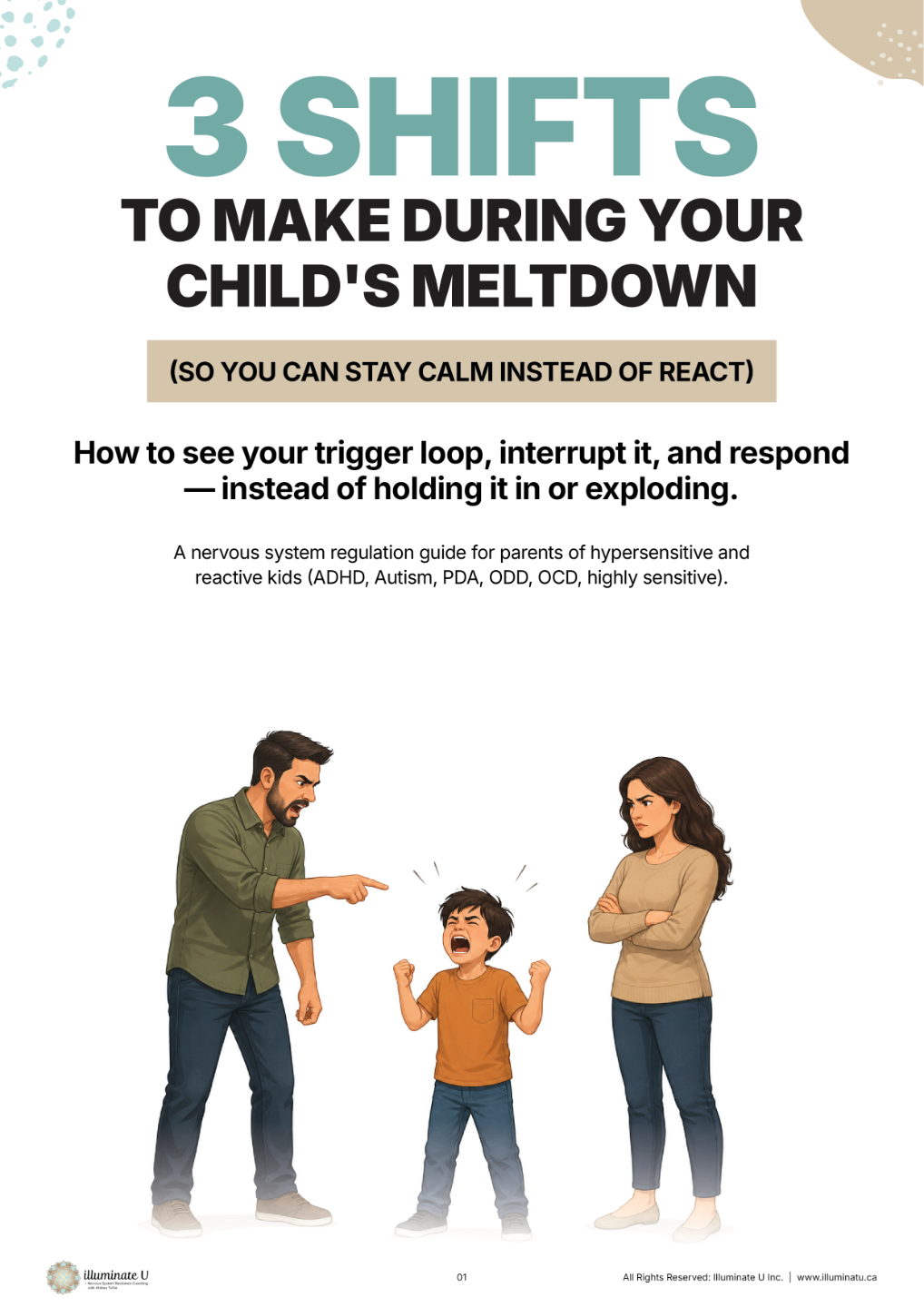
Free: The 3 Shifts Guide
The trigger loop and 3 patterns you get stuck in during meltdowns — and how to shift them so you can stay calm instead of react.
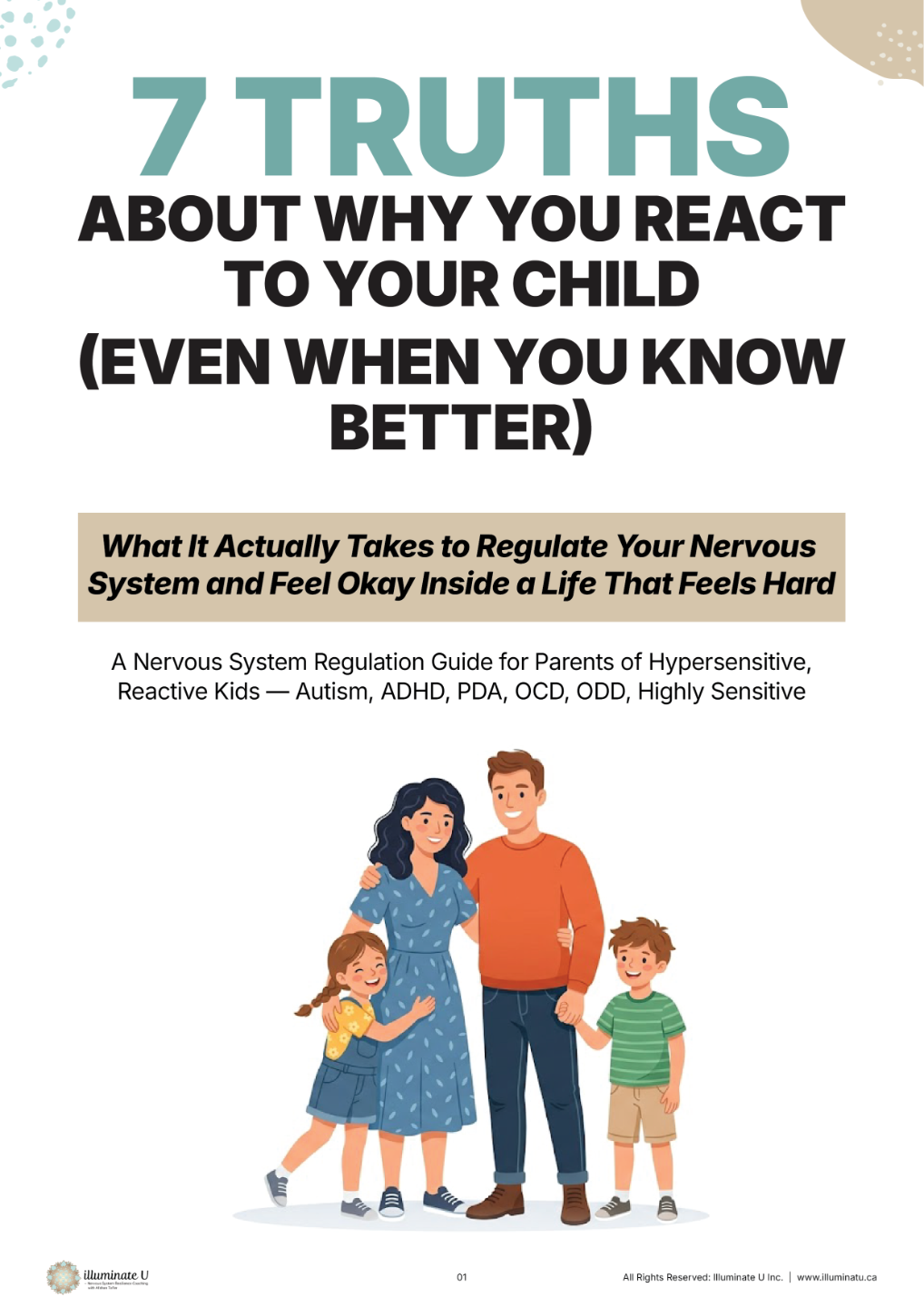
Free: 7 Truths About Why You React to Your Child Guide
Why you react even when you know better — the conditioning, nervous system states, hidden beliefs and patterns, and buried emotions running the show.

