
What to Do When Your PDA or Autistic Child Is Hitting You (Part 2)

**You can also listen to this in audio format only on The Regulated Mother Podcast on Apple or Spotify. Look for Episode #55
How to meet the storm from a safe-enough state — instead of trying to stop it
Part 2 of a three-part series
What Do You Do When Your Child Is Hitting You?
Your child is hitting you. Maybe they're chasing you through the house, punching the door you've locked yourself behind, or aiming for the one spot they know will hurt. And there's one question screaming in your head — the one I get asked more than any other: what do I do when my child is hitting me?
Because you don't want to be hit. Of course you don't. And yet every option feels wrong. You walk away, they follow. You close the door, they punch it. You stand there, and you're the one getting hurt. You block with a pillow, and it escalates even more.
It always feels like there is no good choice. And underneath it all is a bind I know in my bones: nothing is working to make them stop — but I have to stop it now, or they'll never learn this isn't okay. And that collapses into the worst feeling of all: I'm trapped, and this is never, ever going to end.
I lived in that trapped, powerless and fearful place for years. And I want you to know, right at the top — because I so needed the hope when I was in it: this got so much better for us. Our storms went from five hours of daily rage to about thirty minutes, maybe once a week — and far less intense. Not overnight. But over time.
And here's what changed it — it's not what you'd think. It was never the perfect strategy or the perfect thing to say; the reason you can never find the perfect thing to do is that there isn't one. What changed things was learning to pull myself out of that trapped, powerless cycle and back into my own power, right in the middle of the storm.
And that's what I'm going to walk you through today: what to do in the heated moment when your child is hitting, and what you can change within you so you can weather the storm with more safety, more capability, and even, over time, more confidence.
First, Where This Fits in the Series
I want to first orient you. This is Part 2 of a three-part series, and Part 1 is the foundation it's built on. Part 1 was all about what happens inside YOU when your child gets aggressive — why you can't feel calm (and how chasing calm backfires), the survival patterns that quietly fuel the fire, and the shift from aiming for calm to aiming for "safe enough." If you haven't heard it, I'd start there, or come back to it after this.
Today builds on that. We're still looking at what has to shift in you — that's the engine of all of it — but now we move into the practical side: what we actually did, both inside ourselves and with our son, when the aggression hit. So let me start where it began — with a moment that was not pretty but was part of my journey of working towards creating change in my own nervous system.
My Story: The Day My Rage Took Over
There were many days this kind of story played out on repeat, but I remember this one clearly. My son was deep in burnout — no medications or natural alternatives were helping, he was barely sleeping and barely eating — and he started to escalate because he couldn't have something. And I had been holding in my own activation for days, barely sleeping myself, teetering on the edge of despair, so tight all over my body.
He started to bang the glass dining table, and I saw a chip appear in it. And in a flash, I was gone. My rage took over. I ran after him, yelling, telling him to stop breaking things. I reached him in the other room, and he started to hit my arms, so I grabbed his hands. He dropped to the floor and I dropped with him, trying to pin his arms down. It was ugly.
I was just so tired of feeling so helpless — against all the things he'd already broken that week, and against the pain of being hit. The broken items were piling up: the TV, the glass stovetop, his iPad, holes in the wall. But I'd held it all in, and now the feeling of letting him break one more thing hit a powerless wound in my system, and boom — my own rage came out to protect me. And then I saw the look of fear in his eyes, and something in me woke up. I let his arms go and walked, with seething breath, into the other room while he cried on the floor.
I later repaired with him. But it's a moment he remembers to this day, so I know I left some scars. I apologize for it when he reminds me — and he tells me he's so happy my parts are healing, and that he knows I always love him, no matter what.
I share this because I know so many of you have been here. And back then, I was so hard on myself for not being calm. But today I understand that my survival system took over — and it made sense — because I felt so threatened, so trapped, with no good choices. My system didn't want to stay in that trapped place of "nothing works," with the future-fears of how he'd turn out lurking behind the scenes every single day. So it catapulted me into fight-or-flight, where at least I could feel like I had some agency.
And if I'm honest, it often felt like putting the fear in him was the only way to get him to stop. My whole focus had become: how do I get this kid to just stop? And the rage did work sometimes — but other times it didn't, and it often led to big ruptures that kept us both stuck, cycling in the same patterned loops. That was the trap. And getting out of it started with seeing it clearly.
What I Hear From Parents — and What's Underneath It
Before we get into what needs to change, I want to name what I hear from parents all the time. A lot of it comes from the survival system — but it's also made of completely legitimate concerns that deserve to be validated, AND gently widened, so we can see the bigger picture of what's actually happening here.
No parent wants to be hit. Every parent needs this to stop. And almost every parent carries some form of future-fear about how their child will turn out, along with a deep sense of responsibility to "teach" their child that this is not okay. So when you're handed advice — even by me — to regulate, ride the wave, and not fuel the fire, it can feel like you're being told to just stand there and take the blows, or let your house be destroyed. Or maybe you've thought: I did stay calm. I didn't use any words. And things still got worse. So you're left feeling confused, beaten up, and hopeless.
And here's why. The main focus has quietly become: how do I get my child to stop, in this moment, right now? — and all of your energy pours into that one thing. But your child's hitting or aggression is so much more complex than this single moment. It's a combination of your nervous system, their neurodivergence and nervous-system sensitivity, and their developmental timeline. That's exactly why this is a three-part podcast series — because no one moment, and no one strategy, was ever going to be the whole answer.
So let me be really clear before we go on. This is not about letting your child hit you. It is not about being a punching bag, and it is not about teaching them that hurting people is fine. Keeping everyone safe — including you — always comes first. You will stop the behaviour when you need to: you'll block, redirect, create distance, get a sibling clear, hold a firm limit. There are real, in-the-moment things to do, and I'm going to walk you through them — and you'll always use your own judgment about what actually fits your child, because you're the one who knows them.
And if you've tried staying calmer and it only got worse — please hear this: that's often not you failing. Because our kids' brains are built around predictability, a change in you can feel unfamiliar to them at first, and they may push harder before it starts to feel safe. New patterns in you simply take time to become new patterns in them. (Much more on this in Part 3.)
And here's the deeper truth I'll keep coming back to: the storm itself isn't where the biggest change happens. It's the state you bring to it — the one that finally lets those stuck patterns loosen their grip. So today is about the moment: what to do, and what to shift in you so any strategy works better over time. Building your child's capacity, and setting the future-fear down for hope instead, is Part 3.
The Shift That Changes Everything: A Different Way to Be in the Storm
So here's the thing that changed it all for me — and it wasn't a technique. It was a completely different way of seeing these moments, and of being in them.
For years, when my son would rage, hit, and destroy, my mind went to the exact same place every single time. First: this is chaos. This is not okay. This must stop. And then, right behind it: nothing works. There are no good choices. I'm trapped. This will never end. That's what's called the trauma vortex — and I need you to hear that it is not you being dramatic. It's the story a flooded nervous system tells when it can't find a way out. And it's a loop: the same track, pulling you down, every single time.
But there's an opposite to it. In Somatic Experiencing — a body-based, nervous-system approach to healing — they call it the counter-vortex, or the healing vortex — the pull back toward safety, regulation, and life. For these intense moments, moving from the trauma vortex toward the counter-vortex is a felt sense I call the Safe-Enough State. It isn't calm, and it isn't the storm being over. It's your nervous system finding just enough safety, right in the middle of the chaos, to say:
I know what's happening, and why. I know how to help myself and ride this wave. I'll do the best I can to support my child and keep everyone safe until the storm passes. And over time, I'll make this more predictable — so I know what to do inside the chaos.
Feel the difference between those two states in your body, because that's the whole thing. The vortex feels like drowning — no ground, no exit, everything closing in. The Safe-Enough State doesn't make the storm smaller, but it puts ground back under your feet. You can breathe. You can think. You can see that there's a next thing to do.
And this isn't only a nicer way to feel — it changes what you're actually capable of. In the vortex, you can't reach your own judgment, and your alarm pours more fuel on the fire without you ever meaning to. In the Safe-Enough State, all of that opens back up: you can keep everyone safe, you can actually choose what to do, and you can ride the wave instead of being swept under it.
But there's a deeper reason still. Your steady, safe-enough nervous system is one of the most powerful things your child's nervous system can borrow from. Which means the goal was never to reach in and stop their storm from the outside — you can't, and you were never meant to. The goal is to become safe enough to be in it with them, because that, repeated over time, is part of what helps their body learn it doesn't need the storm so much.
Let me name the shift as plainly as I can, because it really is the whole thing.
We inherited a model of parenting that asks one question: how do I get my child to stop this behaviour?
I want to invite you into a different one…
What does my child need, from me and over time, so that this behaviour is no longer necessary? And who do I need to become, so I can help them get there?
I'm not saying the behaviour doesn't matter. I'm saying we change where the change begins: from controlling the behaviour and hoping capacity follows, to building safety and capacity so the behaviour can change as the whole system does.
What if the hitting moment was never a problem to solve from the outside — but a wave to be met, from a steadier place inside you?
So the whole work of Part 2 is learning to move your nervous system out of the vortex and into that Safe-Enough State. It doesn't happen in one leap. It happens through three things: what shifts inside you, what you do with your child in the moment, and what you do before and after that slowly shrinks the storms over time. Let's take them one at a time.
One thing before I start: none of this is prescriptive advice, and there's no one right way to do it. What soothed my son might escalate yours, so take what resonates, run it through your own discernment, and leave the rest. And one more thing to hold about today — what I'm giving you here is the shifts and the real steps I took. The how, in depth — the body tools, and learning how to build capacity, and building your own plan — is what I teach step by step inside The Regulation Rebuild, my live course on nervous-system regulation for parents of high-needs kids.
Part One: What Shifts Inside You
This first movement is the inner work — and it's the ground everything else stands on. As you read these, hold both things at once: how to steady yourself when the hitting is actually happening AND, notice how each of these inner shifts is also, quietly, teaching your child's nervous system something new. The moment and the long game turn out to be the same work, done from the same steady place.
Shift 1: Steady yourself before you try to steady your child
When you're in the vortex, all of your focus is locked onto your child — on getting them to stop, to change, to calm down — while they're flooded and simply can't. It keeps you fixated on the one thing you can't control, and it leaves your own system to spiral.
So the very first shift is to turn your focus back to one of the most powerful things you can work with in this situation: your own nervous system. This is the whole foundation from Part 1, now lived. It means learning to tolerate and be with your own fight-or-flight energy, and to let it move and release — through grounding, through movement, through anything that helps you sense, in the present moment, that you are safe enough even while your child is doing this.
Here's how it looked for me. I'd catch myself trying to make my son stop, and instead remind myself: he needs to let this energy out — and I need to let my own fight energy out too, so I don't hold it in and end up unleashing it on him. So I'd grab a pillow and block his hits, or stand in front of the TV to keep it from being broken — but in between, I was tensing and releasing my body, exhaling longer than I inhaled, orienting for a second to the tree outside the window, or letting a blanket in the room cue a little comfort. Anything to signal safety to my nervous system, so I could work with that fight-or-flight energy and release some of it. Because if that energy just builds with nowhere to go, it tips you into rage, or drops you into freeze and shutdown. Most of us hold this energy in because we think that’s what a good parent does, but the holding is creating an internal pressure cooker situation.
And the reframe that helped me so much is this one: I moved from "As a parent, it's my responsibility to make this stop" — which is pure fight-or-flight (and the conditioning I inherited) — to "My nervous system is the intervention. My job is to help myself, as well as keep things safe enough." That switch let me finally stop fighting reality. And my son felt it, more and more over time — which slowly helped him let go of his fight, too.
Shift 2: There is still a choice — even when every option feels awful
In the vortex, you're stuck between two or more terrible options. You stop them or block them, and it gets worse. You do nothing and try to stay calm, and you get hurt, or something gets destroyed. Your body reads "no good options" as "I am powerless. I'm trapped." And powerless and trapped is the doorway straight back into the vortex.
Choice is imperative for the nervous system to feel safe. So the shift is to acknowledge that there is still a choice here — even when every option feels shitty. And that it's okay to choose the hard one. It's okay to choose the option that feels awful, even the one you know might escalate your child further. Not a good choice. Just a choice. For me, sometimes that meant choosing to let something break rather than move toward him and pour fuel on the fire. And for those of you managing more than one child, sometimes the hardest version is choosing to protect one child knowing it may escalate the other — and that, too, is a choice, even when it feels like a crappy one because you can't help both at the same time.
Just feeling that I was choosing — even between two things I hated — was my first foothold out of trapped and powerless. I'd say to myself: it's okay. This sucks. And I am still choosing here — to support myself, to let that thing break, or to block him even though it might escalate him. Feel the difference in your body between a choice — even a crappy one that comes with real disappointment — and trapped or powerless. That difference is everything, because choice keeps you in your power. And when you're in your power, you feel more capable and confident to handle the storm — and your child reads that, and begins to trust you more.
Shift 3: Hold Both: Your Activation and Your Safety, At The Same Time
In the vortex, underneath everything, your body is broadcasting one message: I am not okay with this. I need you to stop, so that I can feel safe. And your child's nervous system feels that.
The shift is to learn to feel safe in their storm even when they don't. And here's the part people miss — this does not mean you stop feeling the big energy inside you. You will still feel it. Your system activates when your child's activates; that's part of the human design. It means you learn to hold that activation with a felt sense of safety at the same time — to hold both. You feel the surge, and you notice it: okay, this activation in me makes sense. And then you wrap it in confidence and capability: I've got this, even if it's big. And I've got you.
And here's the deepest version of this — the felt sense that, honestly, was the single biggest thing for us. It's this: no matter what, I can handle this. I will be okay. And I don't mean thinking it, or talking yourself into it on top of the panic. I mean knowing it, in your body. That knowing is earned — it's built by going through these storms and coming out the other side, again and again, until your system finally has proof: I have survived this a hundred times, and now I have tools. It's what let my husband and me stay steady even when our son raged for five hours, or hit us a hundred times. Underneath it all, our bodies knew: this is awful, and I can handle it, and I will be okay. (And notice — that's the exact opposite of "this will never end.")
But here's the piece we most miss: you have to actually let yourself feel that you made it through. The storm ends, and we just brace for the next one — so our nervous system never registers that we survived, and a system carrying old trauma can stay stuck back there, not knowing it ever reached the other side. So turn toward it on purpose: let yourself feel that you have come through this, so many times — not just the exhaustion, but the strength and perseverance underneath it. Search for that feeling, because it's true, and your body needs the proof.
And this is the real heart of co-regulation. It isn't always about showing your child your calm — just as much, it's showing them that felt sense: I can handle this, no matter what. That steady, capable presence is one of the most powerful things their nervous system can borrow from, and over time it can help them learn to do the same with their own big energy — no words needed. For me, it often looked like meeting his eyes in short moments, with no fear in my body — letting him feel: you can't scare me away. I can be with you, and with your storm, and still be okay.
And this felt sense mattered most of all around boundaries — not the demands you pile on while they're already raging, but the boundaries you sometimes have to hold even though you know they'll set off a storm. For us, that was my husband holding a hard limit around not letting our son control his bathrooming — something tied to his OCD, where giving in would only have fed it. He knew the rage would come. What let him hold it was exactly this: the confidence, in his body, that he could handle the storm that followed. And here's the beautiful part — it was big at first, but over time, because he could hold that energy without caving or collapsing, the storms around those boundaries got smaller.
Shift 4: Give it context — and update the old meaning
In the vortex, the thought is: I don't know why this is happening, and nothing works. And notice what that does — it creates even more internal chaos. Your nervous system has no context (or truthful meaning), so it just spins. And very often, underneath, this is your own past trauma being triggered in the present — old feelings of chaos, overwhelm, and powerlessness rising up. On top of that, most of us were never given the right mental models for what this behaviour even means. So the only model we have, handed down through conditioning, is that this behaviour is bad — and that people who behave like this end up in jail, or cast out of society.
And it's worth really taking in that both forces — old trauma and old conditioning — shape how big and dangerous the behaviour feels today. In my case, I had to work with both: my own trauma getting triggered, and the meaning my brain had attached to what my son's behaviour "meant" — recognizing when it was old stuff getting activated, making this feel bigger than it was, and that those old meanings simply didn't apply to him today, especially through the newer neuroscience lens.
So in a safe-enough state, you give your nervous system context — you help the old trauma that's getting triggered feel safe in the present, and you help your brain update to a new meaning that's more truthful about what this behaviour actually is. Context that's more aligned with truth is one of the things a nervous system needs to feel safe, especially a system carrying old trauma. So instead of "I don't know why," it becomes: I know why this is happening. His body is overwhelmed, and this built-up energy needs somewhere to go. This is expected. This makes sense. And I know my job here is to help myself, and everyone else, feel safe enough to weather it. That shift — from confusion to understanding — settles the internal chaos, even while the external chaos is still going.
Here's what that shift can actually sound like. The survival meaning says: "If I don't stop this right now, my child is going to grow into someone who hurts people." The present-moment truth is quieter, and it's truer: "My child is overwhelmed, and doesn't yet have the capacity to move this much energy safely. My job is to keep everyone safe now — and to help that capacity grow over time." Same moment. Two completely different stories. And the second one is the only one that actually lets you help. (That fear about the future is so big it gets its own piece — that's Part 3.)
Part Two: What You Do With Your Child in the Moment
Now to the outer moves — the concrete things you actually do when the hitting is happening. And notice how they only work from the safe-enough state we just built: the same action, done from the vortex, lands completely differently.
Lead with safe action, not words
In the vortex, you try to set the boundary and teach right in the heat of it — "No hitting. Hitting hurts" — the way almost every parenting expert out there tells you to. And for a lot of kids, that may work. But for our PDA, autistic, and demand-avoidant kids, in that flooded moment, they have far less access to the part of their brain that can think, reason and learn, and those words land as one more demand. So the very boundary you're using to teach actually escalates them.
So instead, you lead with safe action rather than words — not as a punching bag, but as the safe enough, steady container in the room, not the target. You keep everyone safe, and you move the big energy somewhere safe. So I'd do the best I could with whatever helped — walking away to keep my body safe, holding pillows up, redirecting him to hit the couch or a boxing bag, taking a break when I needed one — all while keeping an eye on his safety too.
And here's the piece that trips so many parents up: sometimes those very things — the pillow, the redirect, the break — made him escalate more. And parents get so discouraged by that. But this is exactly where your own nervous system has to know: it's okay if he escalates more; I can handle it; and it's still okay for me to use these tools if I need them. That permission changes everything.
And if my son could take a few words, I never told him what NOT to do. I told him what we could do, and I used "we." Something like: "We can hit the couch. There's a lot of energy to get out. I'm here. I can help you. I can handle it. I'll release it with you." Reassuring him that it's okay to let the big energy out — with minimal words, or none at all, depending on what he needed in that moment. And through all of it, I was always cueing in: reading what he actually needed, trying something, getting it wrong, adjusting. Never perfect. Just safe enough to ride the wave.
This is the same reason that, if your child were about to run into the street, you'd call out "Stop!" — you tell them what you want them to do, not "Don't run into the street," which only plants the very thing you're afraid of. ("Stop" is exactly right, by the way, when there's real, immediate danger.) And often I'd skip the words altogether — I'd just walk over and start hitting the couch myself, so he could see he could do that too, without me ever telling him to.
Now, I want to name the fear hiding underneath all of this, because it stops so many of us: if I'm not correcting or punishing the hitting, aren't I just letting it happen?
Here's the reframe that helps so much:
Stopping unsafe behaviour and punishing a child are not the same thing.
You can absolutely stop the hitting. You can block it with a pillow or cushion, put your body between the siblings, create distance, get a sibling to safety, hold a firm "I won't let you hurt me." That is stopping, and it is not permissive. What you don't need — and what actually backfires — is fear induced anger or rage, shame, or harsh consequences as the mechanism you expect your child to learn from.
And you can feel the difference in your own body. Stopping them from a safe-enough place is protective — steady and clear, with "I've got this, and I'm keeping us both safe" underneath it — and your child's system reads that as safety, even as you block or hold a limit. Punishing from fear comes from your own threat state, and their system reads that as danger, which only adds to the fire. From the outside the two can look alike; it's the state underneath that your child feels, and that's what decides whether they can settle, and — over the long run — truly learn.
When the hitting is aimed at a sibling
When it's your other kids in the room, the vortex has its own particular story: it's not fair to them. I'm failing them. And that guilt is so real — it pulls you right under. So the shift is to move to: I'm doing everything I can to keep them all safe, and I will take action to keep them all safe. You get the other children out of the room and to safety — which, as Studio 3 and the Low Arousal Approach teach, also removes the audience and takes real pressure off the child who's melting down.
And when things are calm, you help your other children understand: their sibling isn't bad — they've got big energy they need to get out in safe ways, and by giving them space, you're helping them too. You let them know you will always try to protect them. And if it resonates for you, there's a wider view I hold — that on some level each of us, siblings included, came here with our own journey and our own hard things to work through. That doesn't mean you become passive. You still step in and protect them, every single time. It just takes some of the crushing guilt off, so you're not drowning in it while you act.
And when your child is actually hitting someone else — a sibling, your partner, anyone — safety comes first, full stop. You move fast to get between them, or get the other person out. The work, as everywhere else, is to stay safe-enough inside while you do it, so protecting doesn't tip you into your own rage. Acting fast to create safety is not a failure of regulation — it's part of it.
Part Three: The Bookends — What You Do Before and After
Remember what I said earlier — that the storm itself isn't where most of the change happens? This is where a lot of it actually does. Two things around the storm do the quiet, long work: what you set up before it, and how you repair after. These are the bookends, and over time they're what make the storms shorter, gentler, and less frequent.
Before: a plan, and catching the storm earlier
In the vortex, it's: I don't know what to do, and nothing works. No plan, no predictability — just bracing for chaos, every single time. The nervous system loves predictability, especially when there is danger present. In a safe-enough state, it becomes: I have a plan — and over time, as we stay consistent with it, it will actually reduce how intense and how long these episodes are. Because predictability is another one of the big things a nervous system needs to feel safe. It's a big category — it takes ironing out the details, and really observing what your particular child and family need — but when you have it, it brings this huge felt sense of: okay, this is do-able now. Even if I don't like it, I know what to do.
For us, the plan had a few parts. We secured the environment in advance — locks on cabinets, valuables and devices put away the moment he escalated, a protective screen over the TV, pictures off the walls, even a clear pad over that glass dining table from my story. We got clear on who does what — one adult leads and stays with him (one person at a time tends to be better), and in families with siblings, the other gets the siblings out. My husband and I would tag-team so whoever was running low could step away and regulate — which mattered enormously for the meltdowns that lasted hours. We talked to the neighbours ahead of time, so their reaction wasn't one more trigger for me. And everyone in the house knew the plan, so we acted as a team instead of scrambling. This built confidence and capability in us that we knew how to handle this storm when it arrived.
And maybe the most powerful part of predictability is learning to catch the storm earlier. Because helping your child when they're only mildly triggered is so much easier than reaching them when they're already at a full-blown 100 out of 100. So we got curious, almost like detectives, about his specific cues — his triggers, his early warning signs (the shift in tone, the pacing), and also what we ourselves were doing that might be triggering him — so we could step in sooner: dropping demands, co-regulating, and helping him discharge that building energy through daily physical activity and play, before the wave ever crested. Building a plan like this — mapping out your own child's triggers, their early cues, and exactly what to do at each stage — helped us immensely, and it's one of the things I walk parents through in my course.
After: repair — your relationship is greater than any storm
In the vortex, after the storm — or even in the middle of it — the story turns on you: this is hopeless. I'm damaging my child. I'm failing all my kids. And that belief is its own kind of vortex, keeping you drowning in shame long after the storm itself has passed. But the truth is the exact opposite of that hopeless story: your relationship is greater than any storm. So after it passes, you come back and mend it. Not from guilt or shame, and not the second it's over if they're still raw, but when you're regulated enough to be sincere — even if that's hours or a few days later — and in whatever form your child can actually receive it: face to face, a text, a note, a social story graphic, or through play.
What I do is I come back to a few messages, and I say them to my son in a way that separates what happened from who I am, because I also like him to separate his threat response from who he truly is.
First, I always say: it's not your fault — this was my own stuff, my past trauma getting triggered, not because of you (use age appropriate language for your child).
Then: I'm sorry — my nervous system got activated and took me over, but that is not who I truly am; my true Self always loves you, and I'll keep working on helping my nervous system feel safe.
And: our relationship is stronger than any storm — there is nothing you could ever do that would make me stop loving you.
And here is why repair matters more than you know. The nervous system is built for rupture AND repair — it was never built for perfection. Some rupture is part of every relationship, part of being human.
What teaches your child's nervous system to regulate, and what builds secure attachment, is not a parent who never ruptures — it's a parent who ruptures and comes back.
So can that be okay? Can rupture be a normal part of life, as long as you keep bringing the repair back in? Because every single time you come back, you teach your child that your love is bigger than any bad moment — that you are always connected to them, no matter what. And that is deep safety for a child. It matters more than you will ever know.
This Isn't Just Me: What the Research Says
Remember Studio 3 and the Low Arousal Approach from Part 1 — the UK team whose work I love? In Part 1 I shared why it works. Here's the practical side, and it lines up almost exactly with these shifts:
What the research says to do in the moment — Studio 3 / Low Arousal Approach
Their whole approach comes down to one phrase: "Don't pour fuel on the fire." They see aggression and property destruction as a stress-and-panic response, not willfulness — so the goal is to lower arousal, not to correct behaviour.
In the moment they recommend: reduce demands and requests (they even say don't tell the person to "calm down," because that escalates); reduce talking, and keep any words gentle and simple; give space and distance; take away arousing triggers — for them that's staring, touch, and an audience, which for families means getting siblings out of the room, and for us meant just one parent working with him at a time rather than both of us hovering; keep your own body language calm and non-threatening; and above all, manage your own arousal, because they treat the supporting adult's regulation as the actual intervention.
And afterward: give lots of recovery time, and don't ask for an apology, make demands, or bring back the trigger while the system is still activated — repair comes much later.
What Became Possible, Over Time
I told you at the top that our storms went from five hours of daily rage to about thirty minutes, maybe once a week. It wasn't a switch I flipped, and it didn't happen overnight. But as I became steadier — as my body learned to stay safe enough in his storms instead of being swept into them — his rages got shorter, and he found his way back to me faster. His nervous system finally had something safe to keep mirroring, and slowly it learned what mine was learning: that his big feelings weren't too much, that the storm would pass, and that we'd always come back to each other. Over time, he could feel safe within his own storm — and from that safety, he began building real regulation skills of his own and learning to hold his own distress too with safety on board.
And it changed my husband and me, too. All of it — the plan, the roles, the tag-teaming, riding the long ones together. It stopped being each of us drowning separately, and slowly made us a team. We weren't blaming each other in the storm anymore; we were on the same side, with the same map, holding it together. That did something for our marriage, and it did something for our son — because two regulated-enough adults, working as one, is a powerful cue of safety.
None of it came from the perfect strategy. It came from working with the one thing that gives you the biggest bang for your buck — your own nervous system. It's one of the most powerful interventions you have. And in our home, it became the most powerful one of all.
So — This Is What a Regulated Parent Actually Is
I want to name something I've come to believe with my whole heart, because it quietly reframes everything I've said today.
A regulated parent is not a calm parent.
A regulated parent is someone who can notice when survival has taken them over, find their way back to enough safety inside themselves to reach their own wisdom again, and respond to what is actually happening — instead of to what fear says it means.
They still get angry. They still get activated. They still get it wrong. And then they repair. They return. Again and again. That's it. That is the whole thing.
Because regulation was never about becoming someone who never gets activated. It's about creating enough space inside the activation that more of you becomes available — the part of you that can pause, choose, protect, love, hold a boundary, change course, or simply stay. That's the truest part of you, underneath the survival response. And regulation is simply what makes more of that part of you available, more of the time. That's the parent your child is really borrowing from. And it's the parent you're becoming, every time you come back.
A Word on the Fear of the Future
I hinted at this fear a moment ago, and I want to name it fully, because it sits underneath so much of this. For a lot of us, the hardest part isn't only today's storm — it's the fear of where it's all heading, and for some of us, the quiet fear that our child could grow into someone who hurts others. That fear is so human. Most of us absorbed, from everywhere around us, the belief that a child who acts this way now will "keep doing it and end up hurting people," so we have to stop it now, at all costs.
That fear deserves far more than a paragraph, so it gets its own piece in Part 3. For today, hold just this: reducing your child's stress and helping their nervous system feel safe is not permissive, and it is not naive. It is, quietly, the most protective thing you can do — for them, and for their future.
Where to Go From Here
So — as you can see, helping your child through intense aggression is no small task. It's a huge cognitive load to hold all of this in the heat of the moment, and it takes deep nervous-system work to change the thing that may be the most powerful intervention of all: you.
Because here's the truth — you may already know your child needs safety, connection, and co-regulation. But knowing that, and being able to live it when your own nervous system is screaming danger, are two very different things. That gap is exactly where this work begins — and it's exactly what Regulation Rebuild is for. It closes that gap not by teaching you to become a perfectly calm parent, but by helping you build the capacity to become the parent you already know you want to be, even when life is unbearably hard. That's why I built it as an 18-week course — to walk you through it, step by step, so you're not trying to piece it together alone in the middle of the storm.
It's my signature program, The Regulation Rebuild — twelve nervous system shifts for parents of high-needs, PDA, and autistic kids. It's a rebuild, not just a reset, because most of us were never taught these capacities in the first place — and that's what creates lasting change, not only for these storms but for your whole family. It's where everything I've talked about today becomes something you can actually live, including how to build a real safety plan for your own home. The doors open September 2026, so get on the priority list now HERE and you'll be first through the door. And if you just want somewhere to start today, for free, my guide The 3 Shifts To Make During Your Child's Meltdowns has some of these tools in it too. Both links are in the show notes.
From "What Do I Do" to "How Do I Be"
So if you're in the thick of this right now — being hit, walking on eggshells, lying awake wondering what's wrong with you because you can't stay calm — I want to leave you with the thing it took me years to understand. It was never the perfect strategy that brought my son back to me – because to be honest, for a long time I thought I had lost him and lost me. What helped me the most was that my own nervous system slowly learned to feel, underneath all the noise: this is safe enough. I can be with this. He needs to get this out, and it will pass, and I can help him ride it out.
You were never failing, my friend. You were just asking the only question you'd ever been handed — "what do I do?" And what I want to invite you into is a different one: "how do I be?"
And that steady, safe-enough presence of being, brought again and again, is one of the most powerful things that helps your child's nervous system change over time — including the hitting and aggression. It's already yours — it's within you. It just gets covered over by your survival system.
And always remember…Your relationship is always bigger than the storm. Keep repairing, keep coming back to each other, and be so gentle with yourself in the meantime. This is some of the hardest parenting there is — and you are not failing.
If this helped you today, share it with another parent who's carrying this alone. Sending you so much love, strength and courage…And I will see you again in Part 3.
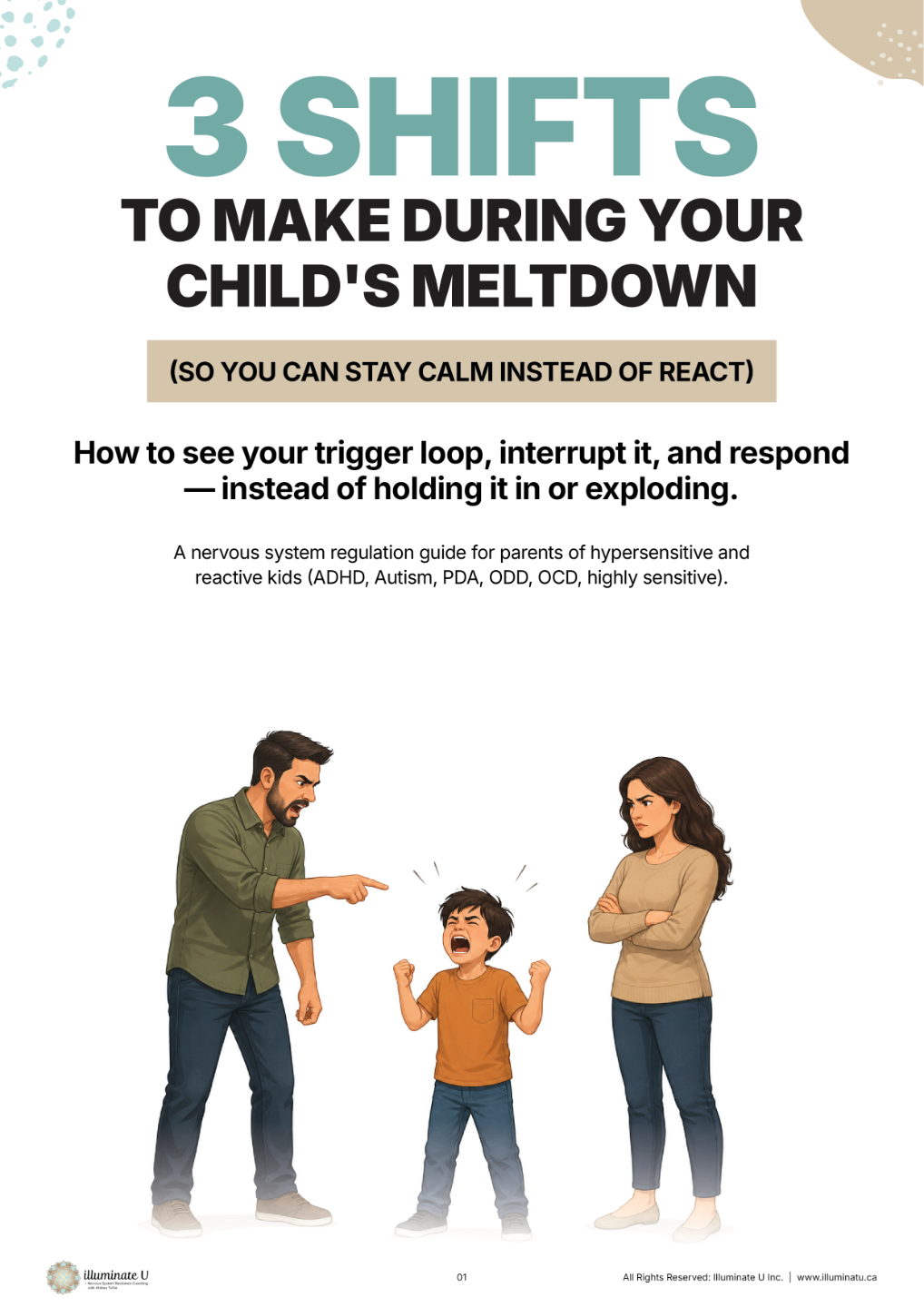
Free: The 3 Shifts Guide
The trigger loop and 3 patterns you get stuck in during meltdowns — and how to shift them so you can stay calm instead of react.
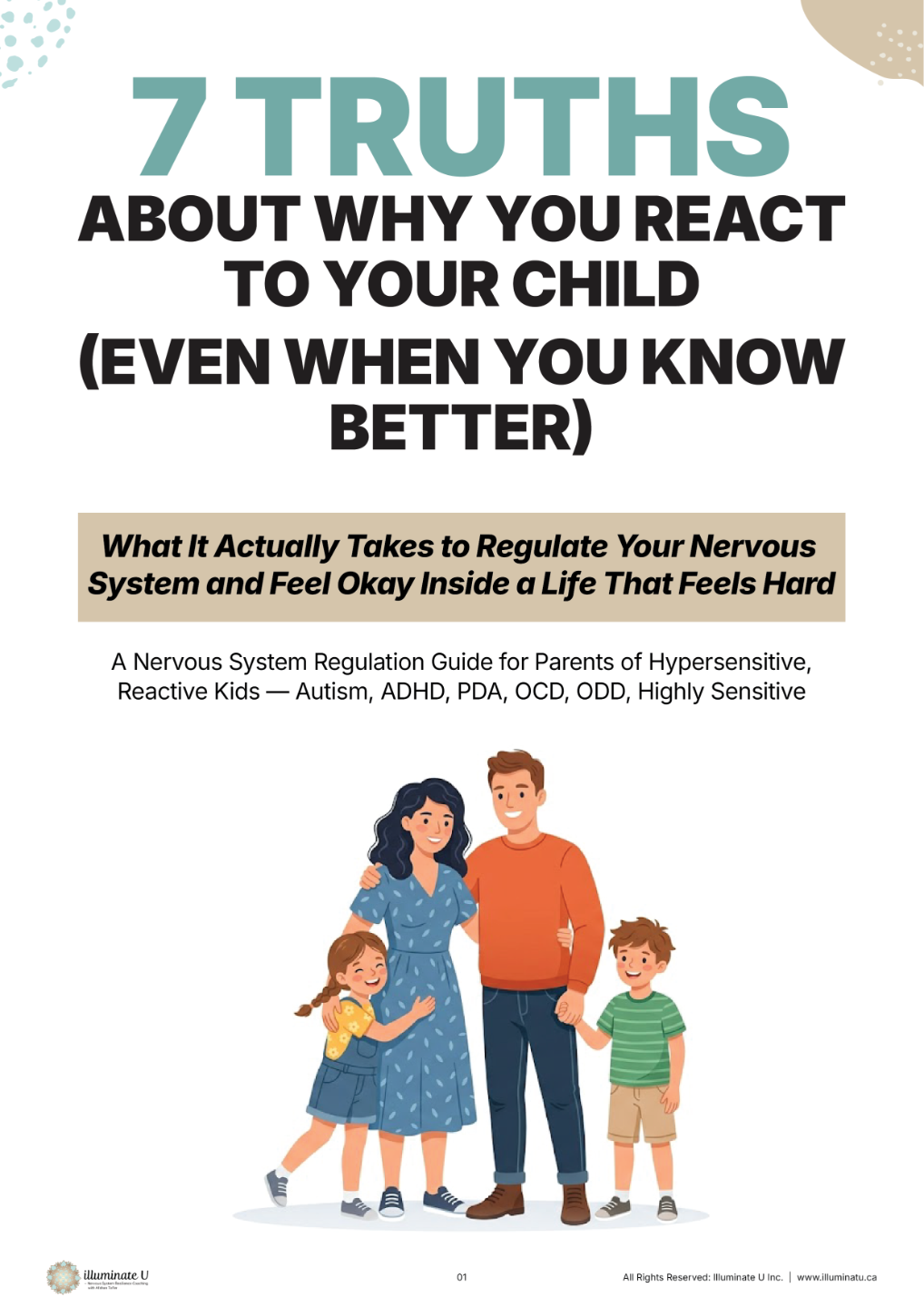
Free: 7 Truths About Why You React to Your Child Guide
Why you react even when you know better — the conditioning, nervous system states, hidden beliefs and patterns, and buried emotions running the show.

