
When Your PDA Child Hurts a Sibling: Parenting Inside an Impossible Bind
**You can also listen to this in audio format only on The Regulated Mother Podcast on Apple or Spotify. Look for Episode #34
**Below is the blog article for easy reading.
When Protection Takes Over
There are many hard moments in parenting — but for most parents, nothing dysregulates quite like the moment one sibling hurts another.
It’s the moment where your thinking brain disappears and your survival system takes over.
Your chest tightens.
Your breath gets shallow.
Your muscles brace.
And suddenly, you’re not just responding to behavior — you’re trying to protect more than one child at once.
Everything you understand about nervous systems, compassion, co-regulation, and PDA suddenly feels out of reach.
You might know why your child is doing what they’re doing.
You might understand this behavior comes from survival, stress, or a need to equalize.
And still — your body reacts as if something has gone terribly wrong.
Because in that moment, it has.
In the aftermath, many parents are left with a heavy, sinking feeling in their gut:
This is unfair.
I failed both of them.
I couldn’t protect one child enough — and I couldn’t accommodate the other either.
It feels like a no-win situation — one that leaves your nervous system stuck, braced, and questioning everything.
Today, we’re going to look at what gets triggered in these intense sibling dynamics — and how to help your nervous system move through both the moment and the aftermath with more regulation, clarity, and self-compassion.
The Moment That Breaks Regulation
Many of the parents I work with tell me this is the moment they dread most.
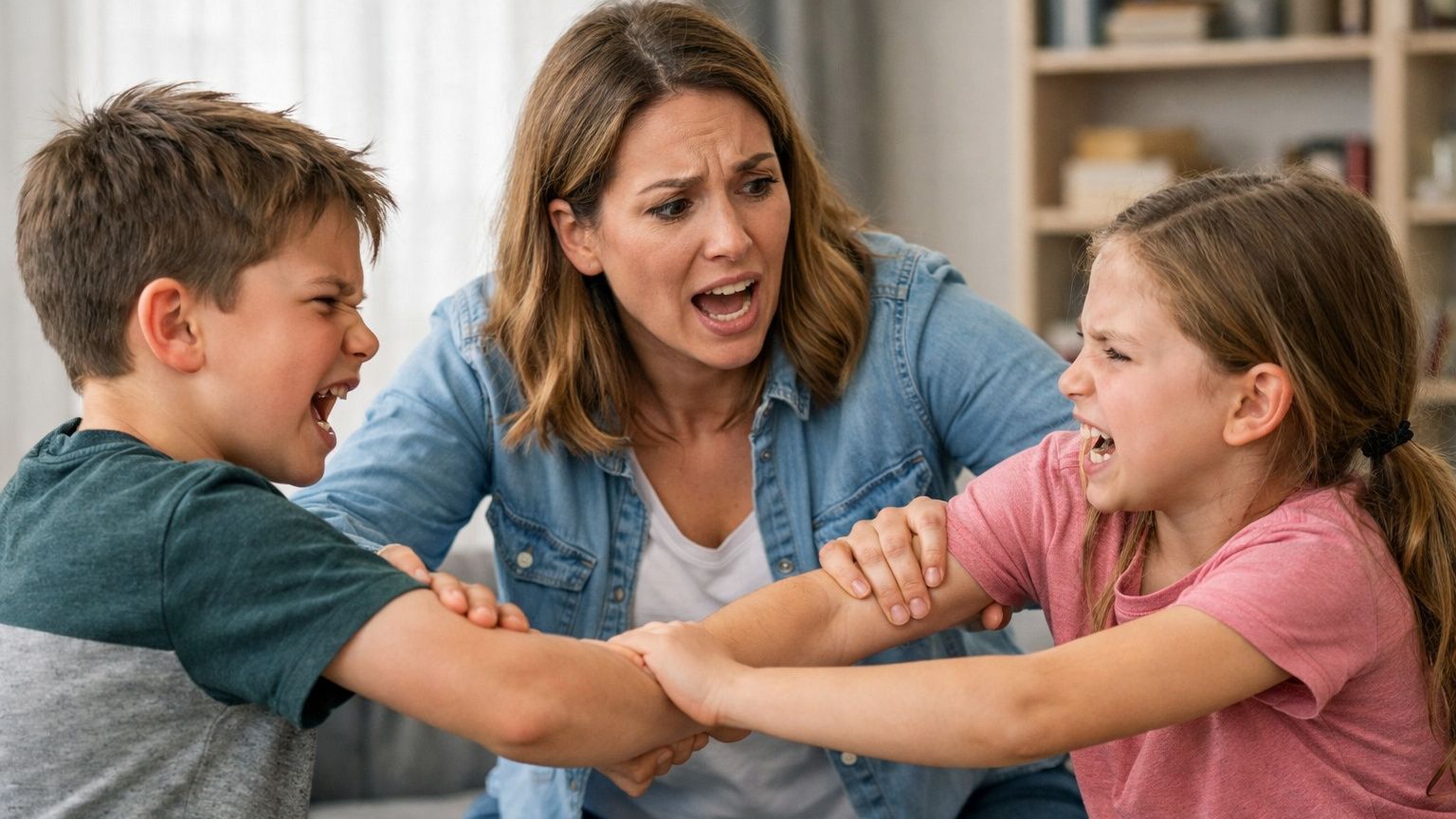
A child hits, pinches, spits on, throws things at, or verbally attacks a sibling.
A younger child cries.
Your heart drops into your stomach.
You might even hear yourself thinking, “He’s having a hard time.”
And yet something inside you snaps anyway.
This is not right. They can’t do this. This is unacceptable.
I’ve felt a version of this myself — even though I only have one child.
I remember a time when my son had a younger, smaller cousin over. At one point, he yelled and swore at her, and even threw something at her. Instantly, my nervous system flooded. I felt a jolt through my body — a surge of energy that said, Protect. Now.
She was smaller.
More vulnerable.
Clearly distressed.
At the same time, I knew that if I corrected my son harshly or publicly, his nervous system would escalate. He would feel misunderstood, shamed, or abandoned — and things would likely get worse.
I felt frozen.
If I stepped in strongly, I worried about what my son would take in about himself — and that he would escalate further.
If I didn’t, I felt like I was failing to protect the younger child.
Every option felt wrong.
I was stuck between two competing responsibilities:
the felt sense that it was my job to protect the younger child,
and the felt sense that it was also my job to de-escalate and regulate my son so things didn’t spiral further.
That internal bind — holding two urgent, opposing needs at the same time — often caused me to freeze in place.
Underneath the freeze, I could feel anger building — hot, tight, buzzing in my body. I noticed my mind starting to see my son as the aggressor… the perpetrator. I felt pulled in multiple directions at once, trying to accommodate everyone, knowing safety had to come first — and also knowing the cost of that choice wouldn’t be small.
There was no good option.
Only trade-offs.
And that is exactly what parents of multiple children — especially those parenting a PDA child who equalizes a lot — describe to me again and again.
The Emotional Aftermath Parents Carry
After moments like these, parents often walk away feeling completely wrecked.
They tell me:
- I failed both kids.
- I didn’t protect the vulnerable one enough.
- I couldn’t stay patient or understanding with the child who was dysregulated.
- I became louder, harsher, or more reactive than I wanted to be.
What lingers isn’t just exhaustion — it’s a heavy mix of anger, guilt, shame, grief, resentment, and a deep sense of unfairness.
Many parents carry a quiet belief in their bodies that something is fundamentally wrong — with them, with their parenting, or with their family — when in reality, they are parenting inside an impossible bind.
To understand why this moment is so hard, we have to slow it way down and look at what gets triggered inside the parent.
What Gets Triggered in the Parent
In moments like these, our attention often goes straight to what we should do differently. What strategy will stop this? What tactic will prevent it next time?
That urgency comes from our survival system — it’s trying to regain control.
But these moments rarely resolve through strategy alone. They require clarity, creativity, and presence — and that starts by understanding what gets triggered inside of you and working with it. When you can bring more safety and regulation back into your own nervous system, even an impossible bind becomes more workable.
Because once parents understand why their nervous system reacts the way it does, shame loosens its grip — and real choice becomes possible again.
1. The Biological Protector Response
When one child hurts another, the parent’s nervous system detects real danger.
This isn’t imagined threat.
This isn’t misinterpretation.
It’s a true safety cue.
Fight energy surges automatically to stop harm. You may feel it as:
- your voice getting louder
- your body moving faster
- your chest tightening
- a sharp urgency taking over
This is not always dysregulation, although it can be layered with it too.
It's the biology of a survival system that works very fast when it detects a real threat too.
Your nervous system is doing exactly what it was designed to do: protect.
Let’s just take a moment to normalize this. You are allowed and it makes sense that this protection response comes out. You are not bad or wrong for having this automatic protection response and nor are you supposed to stay really calm when you’re watching someone else get hurt.
Over time, the work isn’t about eliminating this response. It’s about learning how to hold protection with enough regulation that it doesn’t spill into dysregulation like rage, shaming, terror, or disconnection. But in the moment itself, the presence of this protection fight energy makes sense.
2. Trauma Layering That Intensifies Protection
For many parents, this protector response is amplified by trauma.
You may carry memories in your body of:
- being harmed as a child
- witnessing violence or bullying
- your own sibling trauma
- moments when no one protected you
When a child hurts another child, the present moment reaction is compounded by these past experiences getting triggered too. Your nervous system reacts as if more is at stake than just what’s happening now.
Sometimes you aren’t only protecting your child.
You’re protecting a younger version of yourself.
That’s why the reaction can feel instantaneous, overwhelming, and far bigger than the situation might appear from the outside.
3. The No-Choice Bind: Stuck Between a Rock and a Hard Place
In these moments, parents often feel profoundly trapped.
If I protect the sibling firmly, my PDA child may feel misunderstood or abandoned — and escalate.
If I stay gentle to avoid escalation, the sibling feels unsafe.
If I intervene strongly, I worry about trauma.
If I don’t, I feel morally responsible — and fear the sibling will be traumatized anyway.
Your nervous system reads this as no good choice and no escape.
This often shows up first as a moment of freeze — your body goes still, your mind blanks, time feels suspended — followed by a surge of energy to do something, anything, to stop the threat.
Feeling trapped with no good options is one of the strongest danger signals the nervous system knows. When the system perceives entrapment, it will often swing to one of two extremes:
either freezing and shutting down, leaving you feeling helpless and immobilized,
or launching into rage in an attempt to protect at all costs.
The key is not to make these moments disappear, but to recognize when you’ve entered this trapped state and gently help your nervous system feel that there are choices — even if none of them feel good. Restoring a sense of choice can interrupt the spiral into rage or collapse, and help you respond with more regulation instead of being overtaken by the survival response.
4. When Your Child Becomes “The Perpetrator”
Even parents who deeply understand nervous systems experience this internal dilemna.
When harm is happening, the brain organizes around danger. And in that moment, many of us automatically view the child who is hurting another through a familiar mental model — one that says:
- someone who hurts others is bad
- they are unworthy
- they deserve punishment
- they need to be controlled
Those mental models don’t just interpret the behavior — they shape what your nervous system perceives. They can turn your child, in that moment, into a cue of danger to your brain and body. And once your system is perceiving “danger,” compassion collapses — not because you don’t care, but because safety has taken priority.
Under stress, these models can rule how we see our child in the moment. Under chronic stress, they can become the lens we start seeing them through more of the time.
This is where the nervous system and PDA framework becomes essential — not to excuse harm, but to restore accuracy. From this perspective, equalizing behaviors arise from survival. Power equals safety. This isn’t cruelty — it’s desperation.
Understanding this doesn’t mean allowing harm or removing boundaries. It means keeping your protective response from turning into rejection. When we challenge the old mental models and begin adopting new ones based on nervous-system accuracy and neuroscience, we create enough space for regulation to return — and for real choice to come back online.
5. The Crushing Belief: “I’m Not Doing My Job as a Parent”
This belief sits at the center of many intense reactions.
Parents often carry an unspoken internal rule that sounds like:
- I’m supposed to protect the vulnerable.
- I’m supposed to meet my child’s needs.
- A good parent wouldn’t let this happen.
When sibling harm occurs, the nervous system quickly draws painful conclusions:
- I failed.
- I’m not doing this right.
- I’m letting everyone down.
This belief doesn’t just create distress — it pulls the nervous system into a shame-based survival loop. When we feel bad about ourselves as parents and get stuck in that energy, the system often swings between two extremes:
- trying to control the situation harder, in an effort to stop the pain and prove we’re doing it right, or
- dropping into shutdown, collapse, and helplessness, feeling like we’re failing at parenting — or even at life.
Neither of these states brings more safety or clarity. They keep the nervous system cycling in threat, making these moments feel heavier, more charged, and harder to recover from.
6. Guilt, Grief, and Rage at the Unfairness
From here, guilt pours in — heavy and sharp:
- guilt for not stopping it sooner
- guilt for exposing the sibling
- guilt for reacting harshly
Grief follows closely behind:
- grief for the sibling’s experience
- grief for the family you imagined
- grief for how hard this is
And often, underneath it all, there is rage:
Why is this all on me?
Why do I have to hold everyone’s nervous system?
Why are there no good choices?
These feelings are rarely spoken aloud — but they are incredibly common.
Working With These Triggers So They Soften Over Time
Let’s shift now into how to work with what gets triggered inside you — so these sibling dynamics don’t leave you feeling trapped, failing, or like there are no good options.
The goal here is not to eliminate these moments or make them “easy.” It’s to help your nervous system move through them with more safety on board, so they don’t hijack you or define you afterward.
1. Allow the Protector Response & Keep Safety On Board
We’ve already named that going into a protection-based fight response when one child is hurting another is expected — and often necessary. Can it be okay to let that truth land?
Needing to protect does not mean you are a bad or dysregulated parent. It means your nervous system is responding to a real safety cue.
Rather than suppressing this response, the first step is to become aware of it and allow it to be here:
- Of course this is here.
- Someone is being hurt.
- My nervous system wants to protect.
The key is not to get rid of the protective energy, but to be with it without being taken over by it. This is what we call unblending from the reaction — creating just enough space to notice the response without letting it run the show.
Allowing the response doesn’t mean acting it out. It means letting safety and regulation come online alongside the energy, so you can take the action you need to take with more presence.
What is allowed begins to soften.
What is fought often intensifies — and can quickly turn antagonistic or shaming.
Safety still comes first. Sometimes quick action is absolutely necessary. But how protection is delivered matters. When it comes from grounded presence rather than panic or rage, children are less likely to encode shame or abandonment — and repair becomes much more possible afterward.
2. Restore a Felt Sense of Choice
Even when no option feels good, restoring some sense of choice matters.
Can it be okay that there are two really hard choices?
You might anchor into:
- These choices are awful — and I’m choosing the least harmful one right now.
- I can protect now and repair later.
- One child may feel hurt — and I can support them through that.
Choice doesn’t mean a perfect outcome.
It means your nervous system isn’t trapped in failure.
3. Updating Context and Meaning Over Time
Many parents carry meanings like:
- This shouldn’t be happening.
- This is unfair.
- I should be able to protect everyone.
- If I can’t, I’m failing.
If these meanings stay unconscious, the nervous system stays stuck in shame and grief.
When we gently update meaning — not to deny reality, but to meet it — the nervous system can begin to move again.
This includes allowing truths like:
- sibling conflict happens in families
- this is not a sign of parental failure
- PDA behaviors arise from nervous system threat
And then the reframe many parents find both challenging and relieving:
Can this be part of the sibling’s life experience — because they are supported through it?
Hardship alone doesn’t create trauma.
Hardship without support does.
When a sibling is protected, believed, soothed, and repaired with, their nervous system learns that difficulty can be survived with connection and support.
Your presence changes how these moments are encoded.
4. Always repair with all kids involved
Rupture is inevitable in nervous-system–intense homes.
Repair is what builds resilience.
Can it be okay to let this truth land?
Even when you had to make hard choices — when you protected one child over another, or when you couldn’t protect in the way you wish you had — repair is what teaches your children something essential: that no matter what happens, we can come back to connection, and support is still here.
Repair doesn’t erase what happened. It helps the nervous system metabolize it.
When repair is present, children learn that moments of disconnection, fear, or hurt don’t mean the relationship is lost — they mean support is coming.
Repair with the sibling who was hurt can include:
- validating their true experience
- reassuring safety
- offering age-appropriate context for why the other child hurt them
- giving them voice
- reaffirming that you are there to protect them
This helps their nervous system feel seen and held, rather than alone with the experience.
Repair with the PDA child happens once regulation returns:
- reflecting that their behavior came from a survival response, reducing shame
- restating boundaries if needed, without threat or punishment
- offering safer routes to power, control, or release
This preserves dignity while still holding limits.
And repair with yourself matters too:
- naming the grief of how hard this is
- releasing shame about not doing it perfectly
- offering yourself compassion for being in an impossible position
Your nervous system needs repair just as much as your children’s.
Nervous systems grow through rupture and repair — not perfection.
5. A Broader Lens, If It Helps
Some parents find it supportive to hold a broader perspective — that life includes challenge, and growth often comes through difficulty.
I personally believe we each come into this life with lessons to learn and experiences to grow through — and that on some level, our children chose their journeys too.
This lens doesn’t erase grief.
It doesn’t minimize harm.
It doesn’t replace protection.
It simply offers context when despair threatens to take over.
You don’t have to hold this belief for it to help. It’s an invitation — and one that has helped me deeply as I’ve grieved my own child’s suffering. It helps to know that there is always meaning and purpose to this pain, for everyone involved.
Naming the Impossible Role
When sibling harm happens, it doesn’t just activate your child’s nervous system — it activates yours. Protection, fear, guilt, grief, and responsibility all collide at once, and there is no perfect way through.
You are not failing because this is hard.
This is hard because you are holding multiple nervous systems at the same time.
The work is not preventing every rupture.
The work is protection, context, repair, shifting meaning and growing capacity over time.
Your family is not broken because it is complicated.
And you are not doing it wrong because you are human.
And although your brain may want to label these experiences as good or bad, if we can loosen our grip on those labels, we can shift from “this is bad and I’m failing” to “this is a complex, human experience that can be allowed to exist and worked with.” When we do this, the nervous system softens — and more clarity, choice, compassion, and regulation become possible.
Free: The 3 Shifts Guide
The trigger loop and 3 patterns you get stuck in during meltdowns — and how to shift them so you can stay calm instead of react.
Free: 7 Truths About Why You React to Your Child Guide
Why you react even when you know better — the conditioning, nervous system states, hidden beliefs and patterns, and buried emotions running the show.

