
Why a PDA Child’s Need for Control Can Feel So Dysregulating for Parents

Do you ever feel like your PDA child is controlling you? When my son started controlling when I could eat, rest or use the bathroom, my nervous system felt trapped. This post unpacks why a PDA child's need for autonomy is so triggering for parents, and how to support it without losing yourself in the process.
You can also listen to this in audio format only on The Regulated Parent Podcast on Apple or Spotify. Look for Episode #31
When Understanding PDA Still Leaves You Feeling Controlled
Do you ever feel like your PDA child is controlling you?
And I don’t mean in a way that makes you question whether you understand PDA — because you do. You’ve learned what their nervous system needs to feel safer and function better. You know autonomy matters. You know choice matters.
So you’re accommodating.
You’re doing more for your child.
You’re adjusting how you speak, how you move, how you show up.
But deep down, something inside you is struggling.
Because the more autonomy you give, the more it can start to feel like you have none.
They tell you when to get their food.
Where you can sit.
When you can eat.
When you can go to the bathroom.
They can watch their screen — but you can’t look at yours.
And even though you understand, intellectually, that your child isn’t trying to control you… your nervous system feels trapped, threatened, or on edge anyway.
In this episode, we’re going to unpack why we can get so triggered when our child needs so much control over us and how to support your child’s need for autonomy and control without losing yourself in the process.
If you’ve ever felt torn between doing what helps your child and needing to feel like you also have some control and sense of agency, I will help you make sense of that tension and give you some ways to lessen the triggering so that accommodating your child can feel easier.
Let’s begin.
A Story Many Parents Don’t Know How to Say Out Loud
In the early days of understanding PDA for my son, something finally clicked.
I remember reading about Pathological Demand Avoidance and feeling that light-bulb moment — this explains everything. His anxiety. His resistance. The way even subtle demands seemed to send his nervous system into fight-or-flight. For the first time, I didn’t feel like I was failing as a parent. I felt like I had a map. I had words to describe what my son was experiencing.
I knew I had to adopt a PDA-informed approach.
More autonomy.
More choice.
Helping him feel more in control.
At first, it seemed to help.
He could eat better again.
He could sleep more.
Some basic needs became accessible.
And then… it morphed.
Suddenly, he wanted control over when I could go to the bathroom, when I could eat, when I could rest, or whether I could watch TV while he watched his. He could watch — but I had to look the other way. Then it became about when I could sleep.
It felt like it was spiraling out of control — because inside, I was losing so much control, and that felt deeply threatening to my nervous system.
And yet, every time I saw him meet a basic need — eat something, use the bathroom, get some sleep, access hygiene — I told myself: This must be the right thing. Even though it was costing me.
Underneath it all, fear was running the show.
Not just fear of conflict — but fear of consequence:
I have to do this or else he won’t eat.
If I push back, he’ll lose access to the bathroom.
If I get this wrong, he won’t sleep.
If I don’t accommodate, everything will fall apart.
It’s all on me or else he can’t access any skills.
There is no other way.
I would reach points where I couldn’t take this much control anymore. The pressure would build and build until I would blow. Then I’d feel bad. Then I’d swing back into what felt like “giving in” again — because the fear returned, and because I didn’t know how to meet my own needs inside this context without making things worse.
My inner critic was relentless:
You’re doing it wrong.
You’re giving him too much control.
Kids shouldn’t have this much control.
For a kid with anxiety, this is too much for them — you’re making it worse.
Then came the resentful thoughts I was ashamed to admit:
I hate my child.
He’s controlling me.
He knows what he’s doing.
And then the despairing thoughts:
I can’t meet my needs.
It’s either him or me.
I’m powerless.
I give up. I give in.
So the cycle continued — giving him everything while slowly collapsing inside… then exploding just to feel some power and agency again.
If you’ve lived some version of this, nothing is wrong with you. Your nervous system is responding to an impossible bind.
What’s Really Going On When a PDA Child Needs So Much “Control”
To make sense of why this feels so destabilizing, we first need to understand what a PDA child’s behavior is actually communicating — and what it isn’t.
A PDA child’s need for what looks like “control” is usually not about dominance, manipulation, or power over you.
It’s about autonomy as a nervous system safety need.
For a PDA nervous system, demands — even subtle ones — register as threat. Autonomy isn’t a preference. It’s protection. It’s how their nervous system avoids panic, collapse, or rage.
So when your child tries to control the environment — or you – or their siblings — their system is often saying:
“I need this much predictability and autonomy to feel safe enough to function.”
Understanding this doesn’t make it easy — but it can help us stop personalizing something that was never about harming you or others.
Most parents I work with already “know this in their heads.” They understand their child isn’t trying to control them, manipulate them, or cause harm. And yet, their nervous system still reacts as if something dangerous is happening.
I name this here not as a demand to think differently, but as a reframe we slowly work toward embodying — so that our nervous systems don’t stay locked in threat in response to a deeper need that actually helps our PDA children function and survive.
Because even when we understand this, it doesn’t mean we’re not still profoundly affected. And that’s where the real work begins — in understanding what this dynamic activates inside us.
What Gets Triggered in Parents (And Why It’s So Dysregulating)
Once we understand what’s happening for the child, we also need to name — without minimizing — what this dynamic activates in parents, so that we can work with it and lessen the triggering.
1. Conditioning: “Parents Should Be in Control”
Even parents who consciously reject authoritarian parenting still carry deep conditioning that says:
- parents should lead
- children should comply
- allowing a child this much control means you’re failing
This conditioning lives in the nervous system, not just the mind. When it’s activated, inner criticism and shame often follow immediately:
I’m doing this wrong.
I’m letting things get out of hand.
I shouldn’t be allowing this.
That shame adds another layer of dysregulation on top of an already stressed system.
It’s important to really become aware of this conditioning as it’s often running the show unconsciously in the background.
2. Autonomy Collision: When Two Sensitive Nervous Systems Need to Feel in Control
Here’s a critical truth that often gets missed:
Many parents of PDA children also have sensitive nervous systems that need a strong sense of autonomy and control in order to feel safe.
At a basic level, all nervous systems need choice and self-direction. Autonomy is a biological requirement for regulation and feeling safe in life. It’s not a preference or a personality trait.
For people with more sensitive nervous systems, that need is even stronger. Safety is often created by having a high degree of control over one’s external world — how things are done, when they happen, how much stimulation there is, and what is predictable. This is often because sensitive nervous systems have a more intense inner world with more sensory overload and teetering on overwhelm a lot. So creating control over the outside world becomes the adaptive survival pattern.
If you grew up learning that control was how you stayed regulated — by being hyper-responsible, compliant, prepared, careful, or self-contained — then losing control now doesn’t just feel uncomfortable. It feels threatening.
So when you parent a child whose nervous system also requires a high degree of autonomy — and who meets demand with resistance, panic, or rage — your system may register this as danger.
Not because you want to control your child.
But because your nervous system is losing the conditions it needs to stay regulated.
This is often when parents find themselves swinging into:
- shutdown or collapse
- freezing and giving up
- defensive rage or panic
If you notice PDA-like traits in yourself, this collision can feel even more intense. Your child’s need for autonomy can land in your body as a constant demand — one that leaves no room for your own need for choice.
This is an incredibly hard predicament to be in.
It’s not a failure of intention or compassion. It’s biology taking over when two nervous systems both need autonomy in the same space — and there doesn’t yet feel like enough room for both.
3. Loss of Agency: When It Feels Like “I Have No Choice”
This is different from autonomy — and it’s often the deepest trigger.
Autonomy is about self-direction.
Agency is the felt sense that I have options and I’m not trapped.
Many parents don’t feel like they’re choosing accommodation and allowing their child more control because it’s a really good choice. They feel like they have to.
Because when your child can’t eat, sleep, toilet, access hygiene, or learning, or is constantly melting down and can’t handle being around others, fear enters the picture:
If I don’t do this, he won’t eat.
If I get this wrong, he won’t sleep.
If I push back, they have violent outbursts or everything collapses.
That creates a sense of entrapment — and entrapment is one of the strongest activators of fight, flight, freeze, and shutdown.
The nervous system needs choice in order to feel safe and function well. This is a biological imperative. When a situation is experienced as having no choice, the nervous system moves out of regulation and into survival — leading over time to panic, collapse, resentment, rage, or burnout.
4. Trauma Echoes: Being Controlled or Silenced
I often tell my clients and students that much of what we react to today is rooted not in the present moment, but in past trauma and relational wounds from childhood.
If you grew up having to suppress your needs, emotions, or impulses in order to stay connected, safe, loved, or approved of, parenting a PDA child can reopen those old wounds. Situations like this can reactivate deeply embedded beliefs — beliefs that taught your nervous system that it wasn’t safe to be who you truly are.
Your body remembers:
- not being allowed to say no or have a boundary
- not being allowed to rest or give yourself what you truly needed
- not being allowed to be yourself or express your true feelings and impulses
So when you need to change who you are now — overriding your natural impulses, blocking your true “no,” or suppressing your authentic expression in order to accommodate your child’s nervous system needs — your system may react as if that childhood trauma is happening all over again.
Even when you understand intellectually that this situation is different, your body may not experience it that way.
The past compounds the present moment, intensifying the emotional charge and making it much harder to stay regulated, grounded, and able to see your child with the clarity and compassion you genuinely want to bring.
5. “My Needs Don’t Matter”: Attachment Wounds & Fawning
For many parents, this dynamic intensifies a deep relational wound:
Other people’s needs matter more than mine.
If you learned early in life that staying connected meant being accommodating, compliant, or emotionally available at the expense of yourself, parenting a PDA child can quietly reactivate this pattern.
Your nervous system may default to people-pleasing, appeasing, and self-erasure — not because you want to disappear, but because this was once how you stayed safe and connected.
Over time, repeatedly putting your own needs last can lead to:
- apathy
- despair
- depression
- emotional collapse
On the other end of the spectrum, when the system can no longer tolerate the self-abandonment, it may swing into explosive rage as the only way to reclaim a boundary and feel some sense of power again.
Both responses are not character flaws.
They are nervous system adaptations to prolonged loss of agency and unmet attachment needs.
6. Identity Erosion & Self-Betrayal
When you repeatedly override your own body, impulses, and needs, something deeper can happen over time.
You may begin to feel:
- I’m disappearing.
- I don’t recognize myself anymore.
- I’m betraying myself just to get through the day.
This isn’t just burnout or exhaustion.
It’s a rupture in your relationship with yourself — created by having to consistently abandon your own signals, boundaries, and truth in order to survive the parenting context you’re in.
7. Fear Rooted in the Child’s Past Dysregulation, Harm, or Self-Harm
Many parents also carry deep fear rooted in real past traumatic experiences with their child.
When you’ve lived through repeated episodes of severe dysregulation, your nervous system learns very quickly that something terrible can happen when things go off the rails. So when your child shows intense needs for control, it may feel safer to give in than to risk what you’ve already survived.
Parents often fear re-experiencing:
- severe and prolonged dysregulation
- their child engaging in self-harm when overwhelmed
- harm toward you or others — especially siblings
- terrifying escalations involving violence or destruction of property
When this history is present, your nervous system may be holding a belief like:
“If I don’t do this perfectly, something terrible could happen.”
That level of responsibility is overwhelming.
It shapes every decision you make — how you speak, how you move, what you allow, what you suppress. It can leave you walking on eggshells, giving up your own needs and autonomy in an attempt to maintain some level of external safety when the internal sense of safety feels almost nonexistent.
This isn’t overreaction.
It’s a nervous system trying to prevent a repeat of real danger.
How to Lessen Triggering While Still Supporting Autonomy for Your PDA Child
This is not about choosing your child over yourself — or yourself over your child.
It’s about finding ways to support autonomy without losing yourself, and about gradually bringing choice and agency back online for your nervous system so you can keep going.
Below are some ways to help lessen the triggering and help your nervous system feel more choice, autonomy, and balance — even while your child still needs a high level of accommodation.
1. Reframing the Word “Control”
For many parents, the word control itself is deeply activating. It can immediately signal domination, threat, or being overridden and trigger old conditioning and programming — which sends the nervous system into defense.
Reframing matters because meaning shapes how the nervous system interprets what’s happening.
Instead of thinking in terms of control over me, these reframes describe what is actually happening in the child’s nervous system in more concrete ways:
- My child is trying to reduce uncertainty in his body.
- This behavior is about needing predictability, not power.
- He needs to organize the environment to stay regulated.
- This is his way of preventing overwhelm, not trying to dominate me.
- What looks like control is his nervous system asking for more safety cues.
If your system reacts strongly to the word control, you can also mentally replace it with:
- structure
- predictability
- environmental safety
- reducing unknowns
Use the language that helps your body feel less threatened.
Reframing control in this way doesn’t mean ignoring the impact on you. It simply helps your nervous system stop interpreting the behavior as a personal or relational threat, so you can respond with more clarity rather than defense.
2. Meeting Your Needs in Small, Real Ways
When autonomy disappears completely — when you feel like you can’t meet even your basic needs — the nervous system gets triggered.
So instead of trying to reclaim autonomy in big, confrontational ways, we bring it back in micro-ways. These small moments help restore the felt sense of “I matter too.”
Before responding to a demand, pause and:
- feel your feet on the floor
- take one slow breath
- stretch your hands or shoulders
- take a sip of water
These small acts matter because they signal:
I still have choice. I still exist. I can give myself what I need before I meet another need.
Agency doesn’t require big boundaries. It starts with tiny ones — with awareness and intention on board. When you help yourself feel, even briefly, that you can follow your impulse and care for yourself, your nervous system feels like it has choice to do something instead of stay stuck, and it settles and feels safer.
3. Working with Control Over Your Basic Needs in Safety-Informed Ways
I want to be very clear here.
I am not advocating that parents permanently give up control over their basic needs — eating, drinking, resting, using the bathroom, or sleeping.
There was a period where it felt like I had no choice because safety was fragile and basic needs were barely accessible for my son. But that was not the end point.
As more safety came online, I worked one step at a time to help my son feel safe without controlling my basic needs.
I did this by:
- offering autonomy and choice in many other areas
- slowly shifting expectations around my basic needs
- working on my own nervous system so I could tolerate his distress and rage when I didn’t comply
I realized something important:
If I didn’t feel safe meeting my own basic needs, my child would never truly feel safe either.
This wasn’t about enforcing boundaries.
It was about building enough safety that autonomy didn’t have to come at my expense.
4. Redistributing Control So It Doesn’t All Fall on You
There was another turning point that made a profound difference for both my son and me.
I realized that his need for control didn’t actually have to be met only through me.
At one point, I hired a caregiver — someone my son could direct, control, and feel autonomous with. This gave him a place to fill that “control bucket” without all of it landing on my nervous system.
The impact was significant.
It reduced the pressure on me.
It softened the intensity in our relationship.
And it gave me something I desperately needed: space.
Space to rest.
Space to regulate.
Space to heal my own triggers without being constantly activated.
What surprised me most was how much this helped our relationship. When I wasn’t carrying the full weight of his need for control, I could show up with more patience, clarity, and genuine connection.
This wasn’t giving up or avoiding the work.
It was recognizing that one nervous system cannot hold everything alone.
For many PDA children, having autonomy and control with someone else can be deeply regulating — sometimes even more so — because it removes some of the attachment charge from the parent-child dynamic.
For some of you that are not able to get support for various reasons, my suggestion would be to keep working on taking micro-moments of self-care and feeling your autonomy and choice in the little moments, because over time, this does add up and help a lot.
5. Allowing Grief and Reclaiming Yourself Over Time
Some of what this parenting journey brings up isn’t something to regulate away — it’s something to grieve.
Grief for:
- the loss of ease
- the loss of spontaneity
- the loss of meeting your own needs freely
- the loss of who you thought you would be as a parent
When grief is bypassed, it often shows up as numbness, depression, resentment, or rage. Allowing yourself to name what has been lost — without judging it — helps your nervous system stop carrying that weight alone.
This is also part of how you reclaim yourself. Not all at once, but in small moments where you remember:
I am still here. I still matter.
Grief is not giving up.
It’s how the nervous system metabolizes reality so it can move forward again.
6. Letting Fight and Flight Energy Complete
Every time you feel an impulse to say no, that is fight energy.
Every time you feel an urge to run, disappear into your phone, or escape — that is flight energy.
When those impulses are repeatedly thwarted (or blocked) with nowhere to go, that energy gets trapped in the body. Over time, trapped fight-flight energy leads to:
- exhaustion
- burnout
- numbness
- rage
It’s important to help this energy complete in safe, intentional ways.
When you’re alone or take a mini bathroom break:
- Push your arms outward like you’re pushing a big boulder in front of you (this helps you feel like you can say No and get some space)
- Growl (to get the trapped anger out)
- Say “NOOOOO”
- Stomp your feet
- Press against a wall
- Shake your whole body
After you do one of these movements, let your system come fully back down to relaxed and let yourself feel the safety of the present moment. These actions help release what your body couldn’t do in the moment — and restore a sense of agency and completion.
An Opening Into Choice, Power, and Freedom
There is another shift that can happen here as you work with your own triggering and give yourself a felt sense of choice and agency in a situation that feels like it’s so controlling over you.
It comes from changing how you see what’s happening.
When we continue to see our child’s need for control as a threat, a problem, or something that’s taking something from us, our nervous system stays locked in defense. But when we slowly — gently — begin to see that need as a communication of safety, something begins to soften inside.
As Wayne Dyer said, “When we change the way we look at things, the things we look at change.”
This doesn’t mean the behavior disappears.
It means your relationship to it changes.
And that changes everything.
When you can hold your child’s need for autonomy without personalizing it, and at the same time begin to meet your own needs in small, real ways…
When you allow what is in your child without abandoning yourself…
When you stop fighting reality and instead start working with it…
The experience inside your body begins to shift.
What once felt like one heavy, impossible problem starts to feel like an opening.
An invitation.
A place where you are learning — not just about your child — but about yourself.
You begin to discover that your power was never about controlling the situation.
It was about how you meet it.
And as you heal the triggers inside, reclaim agency in small ways, and grow your capacity to hold both yourself and your child, something unexpected emerges:
A felt sense of autonomy.
A sense of choice.
A sense of freedom — even inside a hard reality.
Not because the situation is easy.
But because you are no longer trapped inside it.
That is the kind of power that doesn’t collapse.
And that is what makes this path not just survivable — but transformative.
Questions Parents Ask
Why does my PDA child try to control everything I do?
A PDA child's need for what looks like control is usually not about dominance, manipulation, or power over you. It's about autonomy as a nervous system safety need. For a PDA nervous system, demands, even subtle ones, register as threat. Their system is often saying: "I need this much predictability and autonomy to feel safe enough to function."
Why do I feel so triggered when my PDA child controls me?
Many parents of PDA children also have sensitive nervous systems that need a strong sense of autonomy and control in order to feel safe. And when it feels like "I have no choice", that creates a sense of entrapment, one of the strongest activators of fight, flight, freeze and shutdown. Old conditioning that parents should be in control, and childhood wounds of being controlled or silenced, can add to it.
How do I support my PDA child's autonomy without losing myself?
Bring autonomy back in micro-ways. Before responding to a demand, pause and feel your feet on the floor, take one slow breath, or take a sip of water. These small acts signal: I still have choice. I still exist. Agency doesn't require big boundaries. It starts with tiny ones, with awareness and intention on board.
Should I let my PDA child control when I eat, sleep or use the bathroom?
I am not advocating that parents permanently give up control over their basic needs. There was a period where it felt like I had no choice, but that was not the end point. As more safety came online, I offered autonomy and choice in many other areas and slowly shifted expectations around my basic needs. If I didn't feel safe meeting my own basic needs, my child would never truly feel safe either.
How do I release the anger of feeling controlled by my child?
Every impulse to say no is fight energy, and every urge to escape is flight energy. When those impulses are repeatedly blocked, that energy gets trapped in the body. When you're alone, push your arms outward, growl, stomp your feet, press against a wall or shake your whole body. Then let your system come fully back down and feel the safety of the present moment.
Why Parenting a PDA or High-Needs Child Requires Letting Go of Control
your own need for control as a parent
How to Accommodate Your PDA, Autistic Child Without Fear, Burnout, or Losing Yourself
accommodating without losing yourself
Why Lowering Demands for Your PDA Child Can Make You Feel Like You're Falling Apart
why lowering demands feels so destabilizing
Why Your PDA, Autistic Child Needs More Flexibility
why flexibility is so hard on parents
The Belief That Most Dysregulates Parents, Especially With PDA Children
the conditioning that keeps you triggered
I have three free guides for parents of PDA, autistic and high-needs kids: the 3 Shifts guide for meltdowns, the 7 Truths guide on why you react even when you know better, and the Meaning guide for finding your way back to yourself. Pick whichever one fits where you are right now.
And if you want to go deeper with me, the Regulation Rebuild is my course for parents who want to rebuild their own nervous system capacity, step by step. Join the waitlist to hear first when the next round opens.
About the author: Afshan Tafler is a Nervous System Resilience Coach, host of The Regulated Parent podcast, and a parent raising a PDA autistic teen with high anxiety and OCD. She is trained in Internal Family Systems (Level 3), Havening, polyvagal-informed practice and EFT, and is completing her Somatic Experiencing training. She has guided hundreds of parents of ADHD, autistic and PDA kids from burnout and barely coping to steadier, more connected and more alive, within the life they are actually living.
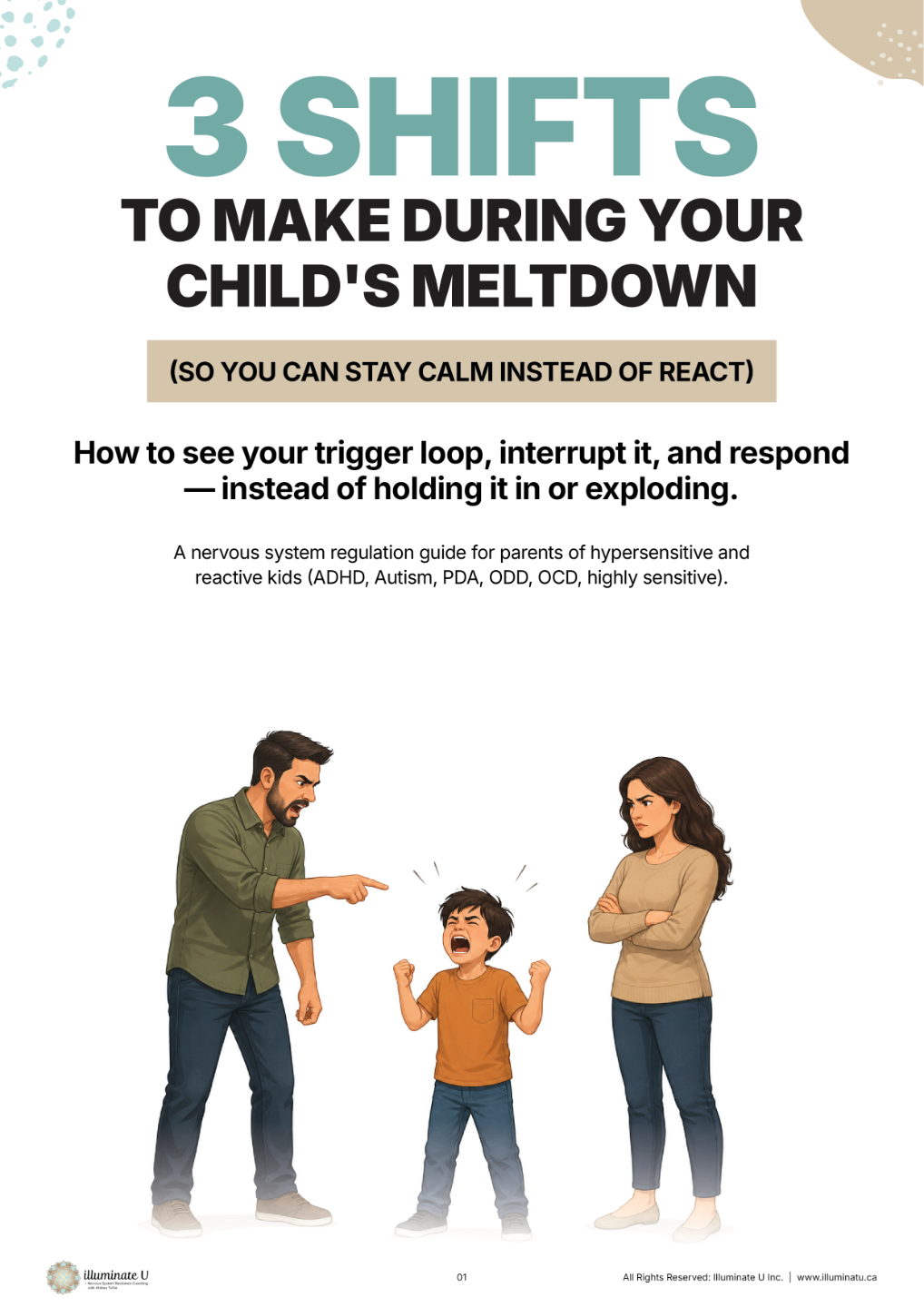
Free: The 3 Shifts Guide
The trigger loop and 3 patterns you get stuck in during meltdowns — and how to shift them so you can stay calm instead of react.
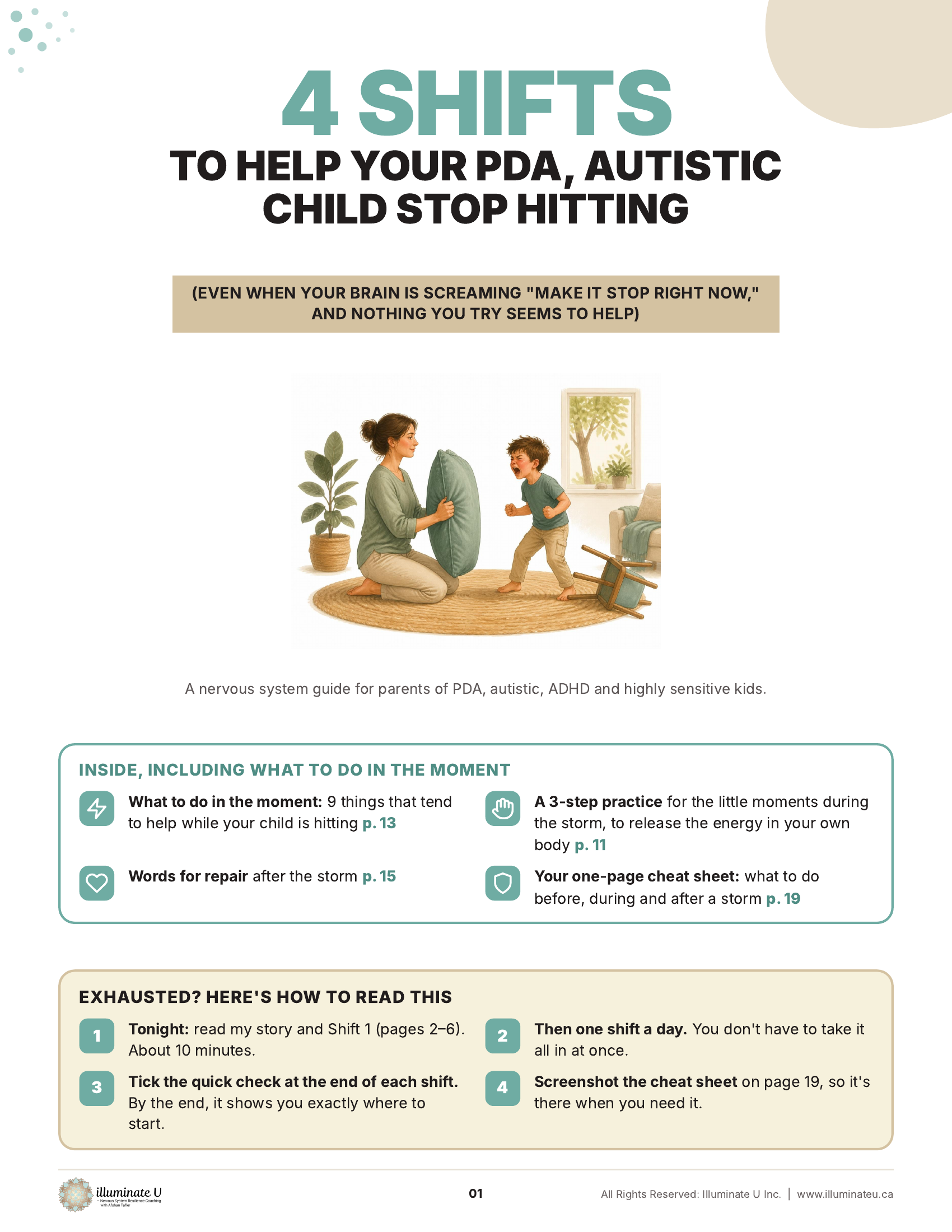
Free: 4 Shifts to Help Your PDA, Autistic Child Stop Hitting
What to do in the moment your child is hitting you, a one-page cheat sheet to keep on your phone, and the 4 shifts that changed things in our home.
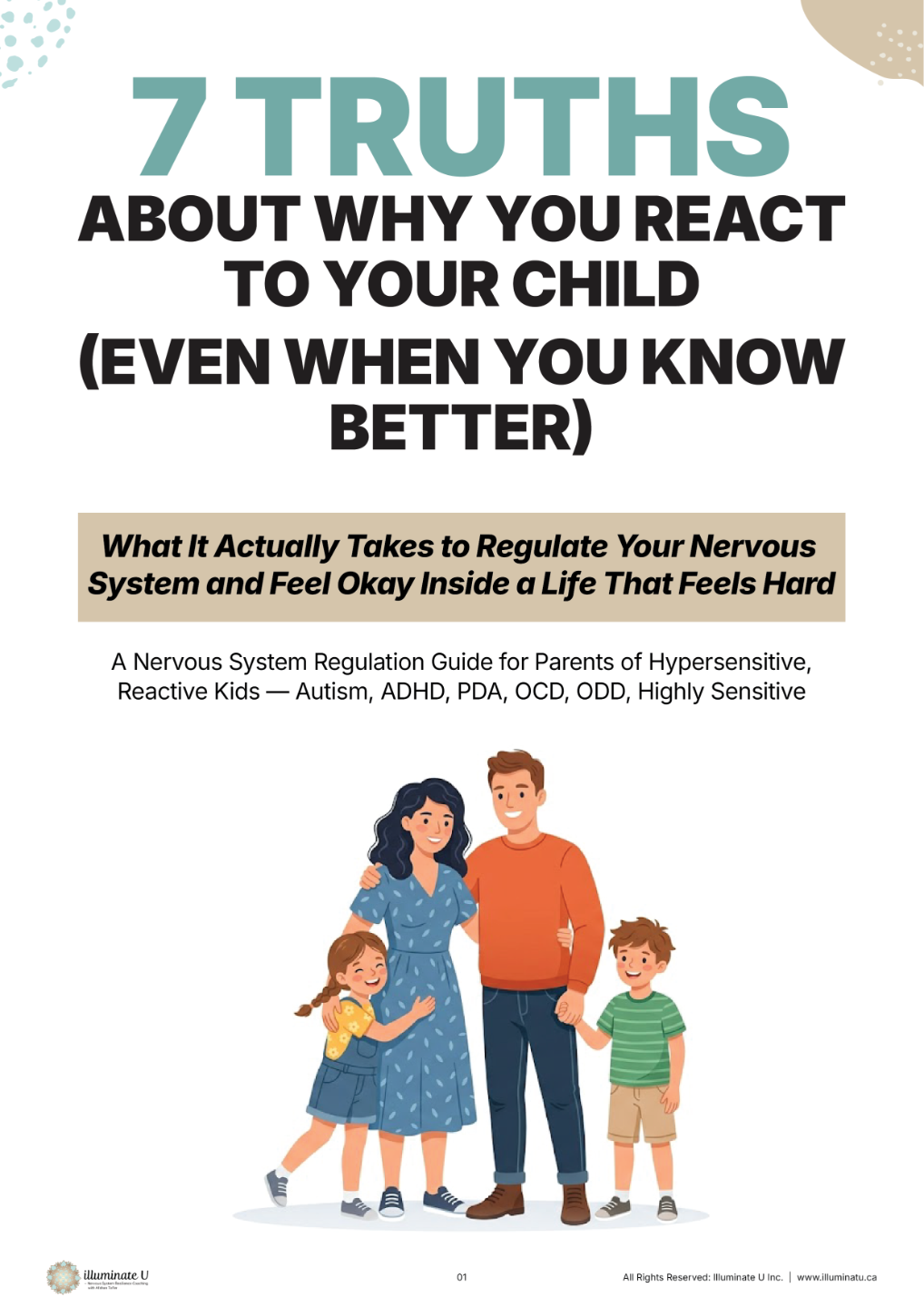
Free: 7 Truths About Why You React to Your Child Guide
Why you react even when you know better — the conditioning, nervous system states, hidden beliefs and patterns, and buried emotions running the show.
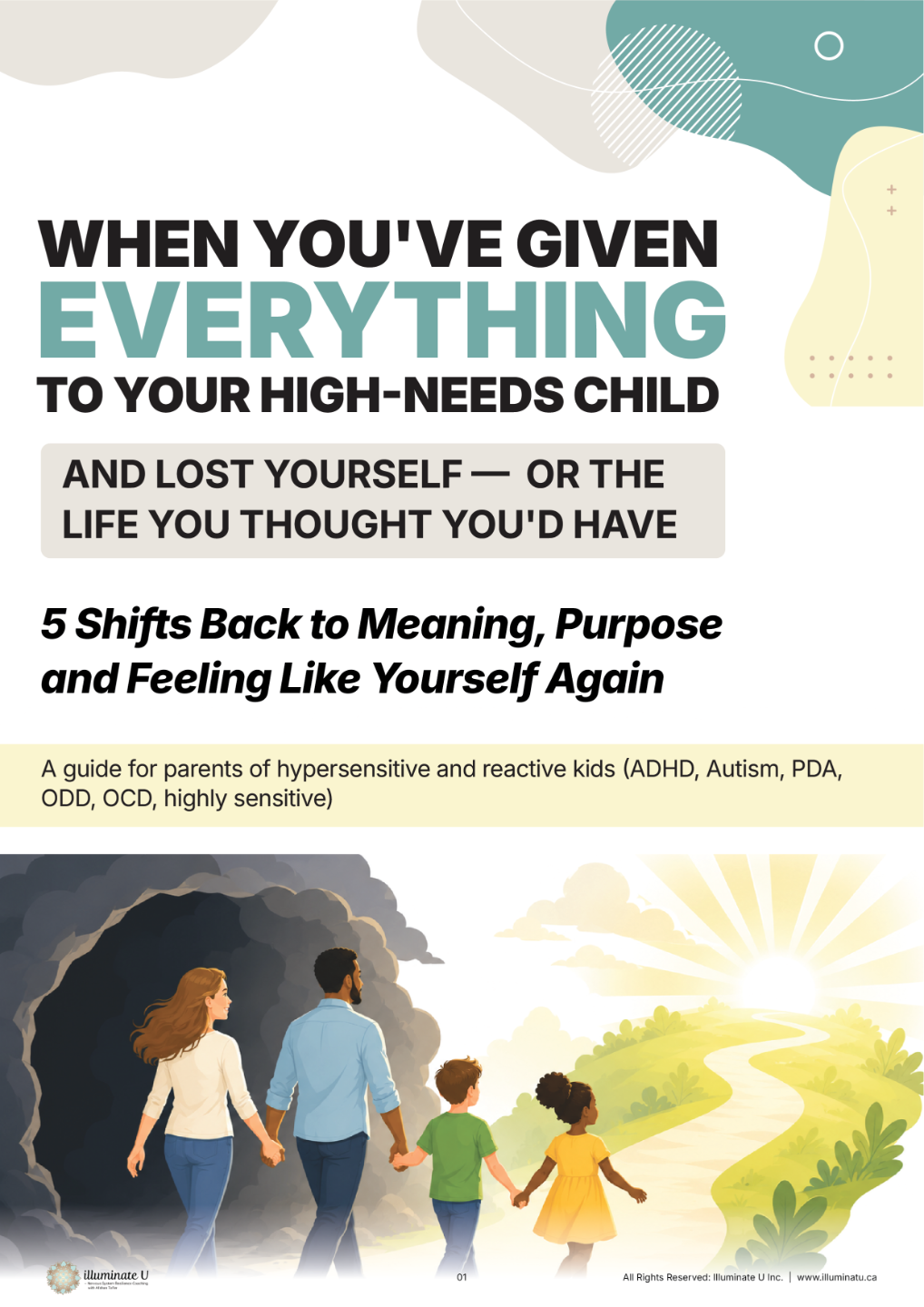
Free: 5 Shifts Back to Meaning Guide
For when you've given everything to your high-needs child and lost yourself — 5 shifts back to meaning, purpose and feeling like you again.

