
How to Accommodate Your PDA, Autistic Child Without Fear, Burnout, or Losing Yourself

**You can also listen to this in audio format only on The Regulated Mother Podcast on Apple or Spotify. Look for Episode #46
When Accommodation Starts to Feel Like a Trap
If you’re parenting a PDA, autistic, or high-needs child… you’ve probably found yourself in this position.
You know your child needs more support.
So you start accommodating.
You lower demands.
You do more for them.
You try to create safety.
But then…
Things don’t necessarily get easier – at least at first.
Sometimes they get more intense.
The behaviors get bigger.
Then they need even more of you and from you.
And you start to feel completely exhausted.
And now you’re stuck in this push-pull:
If I don’t accommodate, everything falls apart.
But if I do… am I ruining their future?
At the same time, you’re burning out and starting to feel like you’re losing yourself in the process.
What most parents don’t realize is that this experience isn’t random.
There are actually 3 things that get triggered when you begin accommodating your child and lowering demands.
And if you don’t understand them, it can feel like accommodation is the problem.
But when you learn how to work with these three things— especially the fear and conditioning underneath them— you can start to feel more grounded, more confident, and actually trust yourself in how you support your child…
without burning out,
and without losing yourself.
And that’s what we’re going to get into today.
Because these are the essential things that parents of PDA Autistic kids need to work through if you want accommodations and lowering demands to go more smoothly for both yourself and your child.
Let’s begin.
When Everything Started to Shift
When my son first began moving from a more internalized expression of PDA to a more externalized one, it felt like our entire life was turning upside down.
I remember thinking: Who is this child? Why is he being like this? This is not the son I knew for so long.
He had always been demand avoidant—that part wasn’t new. From a very young age, he needed extra support. He had low muscle tone, delays in fine and gross motor skills, ongoing struggles with eating, sleep and anxiety that lived in his body. So I had already learned, over time, how to accommodate him in certain ways—helping him eat, sleeping with him, supporting him with dressing, meeting him where he was.
But something started to change.
What once looked like internal frustration—holding it in, crying when overwhelmed—began to come out in more external ways. His reactions became bigger, more intense. What he used to hold inside was now coming out as increased resistance, aggression, and a level of dysregulation that felt completely different from before.
At school, it was still somewhat contained, but there were signs emerging. And at home, it was becoming harder and harder to manage.
Eventually, everything culminated in him not being able to go to school anymore. And I found myself scrambling—trying to figure out what to do, trying to understand what was happening to my child, and what had happened to our life.
When I learned about PDA, everything clicked. For the first time, I understood that this wasn’t about behavior—it was about a nervous system that couldn’t handle the demands being placed on it and a survival need for more autonomy.
So I knew I had to accommodate more. I had to take the pressure off of everything so that we could get to a better baseline.
And when I started to do that, it definitely helped in some ways. There were pockets of seeing the improvements, especially around basic needs, but then something unexpected also happened.
Things didn’t get easier at first. They got harder.
Because my son had been holding it together for so long.
At school.
In public.
In environments where he didn’t feel safe to fully express what was happening inside.
He had been masking.
Suppressing.
Containing.
And when the pressure started to come off… when things began to feel even a little bit safer…
That holding in began to release.
All the fight/flight energy that used to stay inside and be contained inside a freeze response… started to come out even more.
More intensity.
More aggression.
More dysregulation.
It felt like everything was escalating, not settling.
And I didn’t understand it at the time.
It felt like,
This isn’t working.
I’ve made things worse.
At the same time, this wasn’t easy for another reason.
Everywhere I went, there were reminders—sometimes subtle, sometimes direct—that I was doing it wrong.
At family gatherings, there were comments about how I was coddling him and that he would never learn.
Professionals told me not to accommodate things like eating—that he could use utensils and needed to learn. But when I tried, he would just sit there and not eat… and he was already under the growth curve.
Even at home, there were moments where my husband would say, “He needs to get his own snacks instead of barking orders at us. He has to learn.”
Doctors told me I needed to push more—that he wouldn’t learn if I kept accommodating.
And inside me, there was this constant push-pull.
Because deep down, I could see that accommodation was what my child needed, because if I didn’t then his basic needs would go out the window…and at the same time, I was terrified that I was doing it all wrong.
And then….as his behaviors became more intense—more aggressive, more volatile—accommodation began to feel less like a choice and more like something I had to do.
Because if I didn’t, there would be hours of rage, destruction, and escalation.
And then it started to feel like I was trapped.
Like I had to do this… or my life would become even more unbearable.
But there was another layer that was building quietly over time.
My son needed so much from me.
More co-regulation.
More presence.
More attention.
There were long stretches where it felt like he needed me almost constantly just to stay regulated.
And slowly, I began to feel it in my own body…The exhaustion.
Not just from doing more…but from never really getting a break.
There was very little time for me. Very little space to meet my own needs.
Even basic things—rest, quiet, taking a moment for myself, bathrooming and eating—started to feel hard to access.
And underneath that, something even deeper began to surface.
A feeling I didn’t have words for at the time: “My needs don’t matter.”
It felt like everything had to revolve around what my child needed just to function.
I adjusted how I spoke.
My tone.
My language.
What I expected.
How I moved through the day.
I served more.
I picked up more.
I did more.
For years!
And over time… it started to feel like I was losing myself.
So I lived in this space for years.
Going back and forth between knowing this approach was what my child needed, and fearing that I was failing him.
That I was being too permissive.
That he wouldn’t learn how to take care of himself.
That I was setting him up for a life where he wouldn’t be successful.
And because things had gotten harder after I started accommodating…because of that unmasking, that release, that intensity…the fear became even louder.
What if this isn’t working?
What if I’ve made things worse?
What if I’m doing damage I can’t undo?
And that’s the space so many parents are living in.
Knowing deep down what their child needs now…and at the same time, being consumed by fear about what it might mean for their child long-term.
This Is What I See in So Many Parents
This is what so many parents who come to me say.
They know accommodating their child is the right thing.
They’ve seen it in real time — that the demands of everyday life, as they were, were simply too much for their child’s nervous system. That their child wasn’t accessing skills. That everyone in the family was stretched, overwhelmed, and barely coping.
So they begin to accommodate.
They lower demands.
They take pressure off.
They try to create more safety.
And very often… things get harder before they get better.
There’s unmasking.
There’s more expression.
There’s more intensity.
And that’s when the fear comes in — not quietly, but loudly.
What if I’ve made things worse?
What if this is the wrong path?
What if I’ve just reinforced something that will never change?
What if my child never learns the skills they need?
And underneath all of that…
If this ends badly… it’s because of me.
What Most People Don’t Tell You About Accommodation (The Unmasking Phase)
Before we get into how accommodating affects your own nervous system, I think it’s important to name the phase that many kids go through when we begin accommodating them, that often causes a lot of fear of making the wrong decision in parents – and this is the "unmasking" phase.
When you begin to truly accommodate your child—not just in small ways, but in a meaningful and consistent shift of reducing pressure and meeting their nervous system where it is—there is often a phase that feels deeply unsettling because things don’t always improve right away.
Sometimes… they intensify. And without understanding why, it’s very easy to interpret that as failure.
Your child has likely been holding it together for a long time.
At school. In public. In environments where they didn’t feel safe enough to fully express what was happening inside.
They’ve been masking. Suppressing. Containing. Holding in their fight responses at times. Holding in their urge to escape (the flight responses). Holding in the overwhelm.
And when safety increases, masking decreases. And as masking decreases, the nervous system begins to feel safer to let all the activation it’s been holding (often for years) out.
Our kids often have chronic stress responses to the world around them as well as reacting to what’s going on inside of them too. They just have more sensitive nervous systems. So they can end up holding a lot of this in – automatically. Anytime we have a stress response, followed by an instinct to fight or flee, and we hold that energy in, then that energy doesn’t complete and release from the body. Instead, it stays bound up as an incomplete threat response in the body because it doesn’t have a safe place to move.
When safety increases, the nervous system doesn’t just calm. It begins to release that bound stress energy. And that release can look like: More aggression, dysregulation, bigger emotional reactions, more intensity than before, and this can be incredibly confusing.
Because from the outside, it looks like: Things are getting worse. And that thought alone can pull you straight back into fear.
But what’s often happening here is not regression. It’s processing and releasing.
When your child feels safer, the need to mask decreases. The nervous system has more capacity and stored survival energy begins to move. And that movement is necessary, because what is held in the body needs a pathway out.
This is where your role begins to shift.
From trying to control behavior…to helping contain and support release. That might look like:
Encouraging movement.
Allowing safe expression of anger or fight/flight energy.
Supporting physical discharge through play or activity.
Staying present, allowing, without shutting it down.
And this phase—while intense—is often temporary when it’s supported with understanding and enough capacity. But without that understanding, this is where many parents turn back. Because it feels like proof that the approach isn’t working— when in reality, it can often be a sign that all the accumulated stress load of the past is being released, and they can express more of their impulses now that it’s safer.
This makes complete sense from a nervous system perspective – safety increases one’s ability to be with and process activation – but as parents, we need to find ways to support safe releases instead of being driven by fear of these reactions.
The 3 Things That Happen When You Begin Accommodating
When you begin to truly accommodate your child, three major experiences almost always come online for parents. And if you don’t understand these, it’s very easy to think the problem is the accommodation itself.
1. The Double-Edged Sword of Fear
Fear doesn’t just show up in one direction.
It shows up on both sides.
On one side you fear what will happen if you do not accommodate:
The meltdowns.
The rage.
The escalation.
The unpredictability.
The lack of access to their basic needs as well as their skills and abilities.
You’ve lived it — and your body remembers.
On the other side, if you do accommodate, you fear how this may affect their future.
What if they never learn?
What if they never become independent?
What if I’m reinforcing something that will make life harder for them later?
What if I’m failing as a parent?
So no matter what you do…fear is present.
And this creates an internal tension that can feel impossible to resolve.
You accommodate — but you’re feeling anxious, unsure, even guilty a lot of the time.
You don’t accommodate — and everything escalates, or your child’s basic needs and access to skills go out the window, and you feel overwhelmed, regretful and like you’re failing them.
This is a no win situation in which shame begins to build.
Because it can start to feel like:
I’m just giving in.
This is permissive parenting.
I’ve lost control.
Even when what you’re doing is actually helping your child in the long run.
2. The Burnout From Suppressed Fight/Flight Activation
This is one of the least talked about pieces — and one of the most important.
When you begin accommodating, you are often going against your own conditioned survival based responses and block your own natural fight or flight instincts that will get triggered.
Your instinct to correct.
To push.
To say no.
To enforce.
Those all still get triggered, but instead, you hold back.
You soften.
You adapt.
You choose a different response.
But those original impulses don’t disappear.
They get suppressed.
Your frustration.
Your anger.
Your urgency.
Your need to say No that you overrode.
Your need to regain control.
All of that is fight/flight energy in your body. And when that energy doesn’t have a place to go…it builds in your body.
Over time, your system starts to feel tight, activated, on edge, or completely overwhelmed.
And eventually, it can’t sustain that level of activation.
So it shifts into shutdown - the state where you become more exhausted, heavy, and maybe even depressed and full of grief and despair at times. This is often burnout. Not just from doing more…but from holding in so much internal activation without release.
This is why so many parents who are accommodating feel:
exhausted in a way that sleep doesn’t fix,
numb or disconnected,
easily overwhelmed,
like they have nothing left to give.
And this is a critical piece.
Because if you don’t support your nervous system to let out those fight or flight instincts and accumulated stress load, then accommodation becomes unsustainable.
3. The Loss of Self — “My Needs Don’t Matter”
And then there is a deeper emotional layer that often emerges over time.
As you accommodate your child — especially when their needs are high — it can begin to feel like: everything revolves around them.
You adjust your tone, your words, your expectations, your environment, your timing, your energy. You give more, serve more, anticipate more. You hold more. Likely, for years.
And slowly, it can begin to feel like:
Where am I in all of this?
There may be very little space left for rest, quiet, your own needs, and even your own identity.
Even your own basic needs can start to feel hard to meet.
And underneath that…a painful belief can begin to form:
My needs don’t matter.
This can bring up resentment, grief, disconnection, and a sense of losing yourself.
And again, without understanding this, it’s easy to think: This approach is the problem.
So, keep in mind that these 3 things - the fear, the thwarted or blocked fight/flight instincts, and the feeling that your own needs go out the window are what often get triggered when you start accommodating your PDA, Autistic or high needs child.
Now let’s understand the deeper roots of what triggers these 3 things.
The Conditioning That Shapes This Fear
The fear around accommodation is rooted in deep conditioning.
Most of us were raised in systems that taught us:
- learning happens through structure, repetition, and compliance
- success comes from pushing through discomfort
- independence means doing things on your own early
- there is a right way to develop
- there is a right timeline to follow
And underneath all of that is a core belief:
If you don’t do things this way… you won’t be safe, lovable, belong or successful.
These are not just thoughts.
They are deeply wired meanings that live in our nervous system and trigger us. And they are formed through exposure and influence from:
- school systems,
- family expectations,
- cultural norms,
- our own lived experiences or traumas.
And these meanings we made were often reinforced when we were:
- praised for compliance
- rewarded for performance
- and disconnected from when we struggled
So now, when your child cannot follow that path, your brain doesn’t just see a difference.
It sees a threat to theirs and your own safety, lovability, belonging, and success in this life – because this is what the brain cares about the most.
What Accommodation Actually Looks Like (And Where Fear Shows Up)
Let’s go deeper into how the fears and conditioning show up so you can become aware of what’s happening in you.
Because when you can see what’s getting triggered inside of you— the thoughts, the meanings, the fears— you begin to have more clarity, more context, and even more choice.
Instead of the fear automatically creating a stress response in your body and driving your reactions, you can begin to work with it and even change it so that you can accommodate from a more peaceful and self-trusting kind of way.
Much of what I’m about to describe is also reflected in the work of Casey Ehrlich of At Peace Parents, who teaches that these are not “permissive parenting strategies,” but necessary accommodations for a nervous system that experiences demands and loss of autonomy as threat. I highly recommend you check out her work if you haven’t already.
Her work emphasizes lowering threat, increasing safety, and restoring a sense of autonomy so the child can move out of survival states and into their thinking brain.
There are different kinds of accommodation we provide to our kids, and it’s important to understand how each one activates a different layer of conditioning and fear inside of you.
1. Reducing or Removing Demands
(Low-demand parenting, lowering pressure)
This can look like:
Shortening or pausing school expectations
Letting go of non-essential tasks
Pausing active skill-building temporarily
Removing environments that are overwhelming
Doing things for them even if they have the skill
Serving them food when they ask (or demand it)
Letting go of responsibilities around the house
Letting go of eating meals together at specific times
Letting go of a consistent sleep schedule
Dropping expectations around politeness and proper behavior (“please,” “thank you”)
And the fear based thoughts that arise can be:
“If I let this go now, they’ll avoid everything forever.”
“They won’t build discipline.”
“They won’t learn how to push through.”
“They won’t learn how to take care of themselves or be responsible.”
“I’m letting them fall behind.”
“Other kids can do this… why can’t mine?”
Take a moment to notice here what automatically gets activated in you.
2. Increasing Autonomy & Equality
(Autonomy-first strategies, equality accommodations)
Letting your child have more genuine control over:
What they do.
When they do it.
How they do it.
Allowing them to feel “equal” or even “in charge” in certain moments.
Letting them win games.
Letting them go first or have “more”.
Shifting from authority to collaboration.
Allowing them to initiate interaction instead of directing them.
And the fear that gets triggered may be:
“They’ll never follow rules.”
“They’ll only do what they want.”
“I’m losing authority.”
“They’re going to think they’re in charge.”
“They won’t learn limits or boundaries.”
“They’ll never choose what’s right for them.”
So, take a moment to see what gets triggered in you. Also, notice how much this feels like truth in your system – when in fact, it is not truth, it’s just a belief you took on because of how you were raised.
3. Flexibility in Routines & Structure
(Letting go of rigid systems and timelines)
This can include:
Letting go of fixed schedules.
Adapting to your child’s capacity in the moment (i.e. changing plans or expectations based on nervous system load at the moment).
Allowing variability instead of consistency.
Letting the day unfold based on nervous system state instead of expectation.
And the worry thoughts that can get triggered:
“They need consistency to function.”
“This is too chaotic.”
“I’m creating instability.”
“They won’t learn structure.”
“Life doesn’t work this way.”
4. Co-Regulation & Increased 1:1 Attention
(Nervous system safety, relational regulation)
This may look like:
Staying physically and emotionally closer.
Giving more undivided attention.
Regulating them at the first sign of distress.
Being a calm, safe presence instead of sending them away to “figure it out”.
Prioritizing your own regulation so they can feel safety through you.
And the fear:
“They’ll become dependent.”
“They won’t learn to self-regulate.”
“I’m reinforcing this.”
“They’re being spoiled.”
“They should be able to handle this on their own.”
Notice here what gets triggered in you – I know a lot of parents feel like this much undivided attention may spoil their child instead of helping them develop a nervous system that feels safer. But that simply is not the truth. Our kids have a different developmental timeline and often need years more of intense co-regulation to help develop their own safety and attachment system to be able to eventually function on their own.
5. Adapting the Environment & Using External Regulation Supports
(Sensory support, novelty, special interests, screens)
This may include:
Adjusting the environment to reduce sensory overwhelm.
Creating safe spaces.
Using screens as a regulation tool.
Leaning into special interests deeply.
Using novelty, dopamine, and sensory experiences to reduce threat.
And the fear:
“The real world won’t adapt to them.”
“I’m making them too sensitive.”
“They won’t cope.”
“They’ll become dependent on screens for comfort.”
“They need to learn to tolerate discomfort.”
What do you find yourself thinking a lot? Let’s bring it into your awareness now so you can see how your brain automatically judges and reacts because this is such a radically different way to parent.
6. Lowering Pressure in Communication
(Using declarative language, diffusion, humor)
This may include:
Softening your tone.
Using indirect or declarative language instead of commands:
“I wonder if…”
“I notice…”
“The shoes are by the door…”
Letting go of needing them to respond or comply.
Using humor, silliness, or lightness to diffuse tension.
Not correcting or disciplining during survival states.
And the fear based thoughts that come up:
“They won’t respect expectations.”
“They won’t listen.”
“I’m walking on eggshells.”
“This isn’t how real life works.”
“They need to learn to respond when spoken to.”
Notice what often gets triggered in you when you adjust yourself in this way to help your child’s nervous system feel safer.
The Pattern Beneath All of This
If you step back and look at all of these, you’ll start to notice something.
Every accommodation touches a belief. And every belief activates a fear about the future.
Because these accommodations are not just practical changes.
They directly challenge everything you were taught about:
- discipline
- responsibility
- independence
- success
- what it means to be a “good parent”
- what it means to be a successful human
And this is why this work feels so hard. Not because accommodation is wrong, but because it asks you to question and go against deeply wired meanings about what your brain believes is right.
But what your brain believes is the right way is based on old meanings and learnings that don’t work for this situation with your child and the life you’re living now…So it’s time to let these go.
Yes – easier said than done, that’s for sure. But when you can let go of the old mental models of how things should be, then you begin to feel a freedom to follow your true instincts for your child, and that feels freeing and so rewarding too.
The Shift That Changes Everything
The question is not:
Should I accommodate or not?
The question is:
Can I begin to accommodate from clarity and trust… instead of fear?
Working With the Fear & Rewriting the Conditioning
Understanding the fear is one thing.
But when it’s in your body—when it feels urgent, convincing, and real—it doesn’t just go away because you understand your child and what they need.
The work is not to eliminate fear…but to learn how to be with it, without it taking you over, and to work with it—and the conditioning underneath it. Freedom lies in not fully buying into it as the only truth.
Step 1: Notice the Fear
The first step is simply becoming aware.
Pause and name what’s happening inside you.
I’m feeling scared right now.
Not failing.
Not doing something wrong.
Not making a bad decision.
Just… scared.
Because so often, the fear is running in the background.
Driving your reactions.
Driving your urgency.
Driving your doubt.
Without you even realizing it.
Step 2: Allow the Fear & Support Your Nervous System
The instinct is often to override it.
To tell yourself you shouldn’t feel this way.
To push through.
To think your way out of it.
But your nervous system doesn’t respond to logic first.
It responds to safety.
So instead of pushing the fear away, see if you can allow it.
This helps you to tolerate being with it so that you do not let it take you over and act from it.
Let it be there—while you support your body.
This is where regulation comes in.
I often say to come out of the thoughts and work with the body first. Do some:
Grounding – feel your feet on the floor.
Orienting – notice something you appreciate in your environment.
Breathing – slow down your breathing, with longer exhales.
Letting your body settle just enough so you can stay present.
Because when your nervous system begins to feel safer, you gain access to something incredibly important:
You can tolerate being with the fear without it taking you over…AND…
You begin to be able to access Clarity and Perspective.
This means your higher thinking brain is more accessible to you now to see it differently.
Step 3: Make the Fear and Belief Beneath It Explicit
Then gently ask:
What am I actually afraid will happen if I choose accommodation here?
Let the real answer come up.
Not the surface one—but the deeper one underneath.
It might sound like:
They’ll never go to school.
They’ll depend on me forever.
They won’t have a normal life.
They won’t be successful.
I will have failed them.
Say it clearly.
Because when the deeper meaning to the fear stays vague, it has more power over you.
When you bring it into awareness, you can begin to question it, work with it and even change it.
Step 4: Trace It Back to the Conditioning and the Mental Model You Learned
To gain even more clarity, then ask:
Where did I learn this?
Where did I learn that this is what success looks like?
Where did I learn that this is what makes someone capable?
Where did I learn that this is what I needed to do to be:
safe,
loved,
accepted,
like I belong
successful?
For many of us, this goes back to our own childhood.
To school systems.
Family expectations.
Cultural norms.
To moments where we learned:
I have to be this way… in order to be okay.
Step 5: Question the learned Meaning
Now ask yourself…Is this learned meaning, belief, way of seeing things serving me and my child today?
Is it helping or harming us today?
This is an important step because you need to feel in your heart how much adhering to these beliefs are not working for your family system today, and a new way of thinking and being is required as well as a new definition of lovability, worth, belonging and success.
Step 6: Update the Meaning (This Is the Shift)
This is where the real shift begins.
To gently begin to see this is not truth.
This is a learned belief. A meaning shaped by your past.
And to open to something new:
What else could be true?
Because the reality is:
There are many ways to be safe.
Many ways to be loved.
Many ways to belong.
Many ways to build a meaningful, successful life.
The old conditioning does not need to be the one and only truth.
Choose what you want to believe now.
This doesn’t mean forcing yourself to believe something new overnight.
It means beginning to orient toward a new possibility.
Something like:
My child can find their own path to a meaningful life.
Success does not have to look one way.
I can support growth in a way that works for their nervous system.
There is more than one way to become capable.
And then coming back to the present moment:
What does my child need right now?
This is where self-trust begins to build.
Not because fear disappears, but because you are no longer letting it decide what’s true.
Avoiding Burnout and Loss of Self
In addition to working with the fear, the second area to work on is having outlets to process and release blocked fight/flight activations that happen inside of you due to the conditioning and fear.
The path here is to work with activation when it comes up instead of pushing it down, holding it in, and suppressing it, which just leads to exhaustion. I have talked about this on other podcasts, so I will not get into the details here. I also teach how to do this in my signature program, The Regulation Rebuild.
The third thing is to work with the wound that gets triggered when you feel like your needs just don’t matter anymore because you are lending so much of your nervous system to them and their needs. As we dive into accommodating our child, we often lose our ability to meet our own needs, which triggers a core childhood wound that “I don’t matter” and “my needs don’t matter”.
It’s important to keep in mind that there are two truths to this feeling: 1. It often comes from childhood, and the work here is to recognize that this wound compounds the present day feeling, and, 2. There is also truth to how hard it can be to meet your needs when your child needs so much of you. And there can be a lot of grief here to process.
It’s important to find ways to heal this wound by finding ways to meet your own needs in little ways, even if you don’t have a lot of time to give to yourself. I also talk about this in other podcasts so I won’t get into the details of this here.
Redefining Success
A huge part of this work is redefining what success even means.
Because the truth is, most of us are operating from a very narrow, conditioned definition.
One that says success looks like:
Going to school.
Learning in a structured, linear way.
Being compliant.
Being responsible in specific ways.
Meeting expectations.
Fitting into the system.
And when our child doesn’t follow that path, our survival system reacts, because it learned:
This is the path to being okay.
But part of accommodating your child is being willing to question that and to open yourself to a different possibility: that your child’s version of success may look very different from yours.
Can that be okay?
Can you learn to feel safe in a reality that doesn’t match the one you were taught?
Can you trust that your child can still find:
meaning,
connection,
worth,
and even happiness…
in a life that looks different?
Because for me, the meaning of success has shifted completely.
It’s no longer about getting my son to measure up to society’s standards.
Or even my own conditioned standards.
It’s about asking:
How can I support him to find his own greatest potential… in a way that works for him?
How can I support a life where:
he feels safe in his body,
he understands himself,
he can access his capacities when he’s ready,
he builds something meaningful in his own way.
And this is bigger than just our children.
This is how we begin to change generations.
This is how we move toward a world where there isn’t just one definition of success.
Where different nervous systems…
different ways of being…
different paths…
are not only accepted…but supported.
This is huge, meaningful work that we are doing. I like to call this the work of warriors – and that’s what we are in a sense.
Finding Meaning in the Hardest Parts
And this is why it’s so important to connect to the deeper meaning of this work.
Because this work is not easy.
Accommodating your child in this way asks a lot of you.
It asks you to question what you were taught.
To sit with uncertainty and discomfort.
To move through fear.
To stay present when things feel hard.
And there are moments where it can feel like:
Why is this so hard?
Why do I have to do this?
But there is something deeper here.
What if this isn’t just something you have to do, but something that holds purpose?
What if, through this experience, you are being invited to:
break patterns that have existed for generations,
redefine what it means to be successful,
create a different kind of relationship—with your child, and with yourself.
Because when you begin to accommodate from a place of understanding you are not just helping your child function, you are helping them feel:
seen,
accepted,
supported,
and loved for who they are…
not for how well they can meet expectations.
And for many of us that is something we never fully received.
So this work becomes more than just parenting.
It becomes healing your own past and probably many generations past too.
A way of offering your child something deeper:
the experience of being accepted without having to prove anything.
And when that happens, accommodation begins to shift from something you feel forced to do, to something you can begin to trust yourself in.
Even choose.
Because you know you are helping your child build a life where they can truly be themselves and be valued and honored for who they truly are.
And that…is a different kind of success. One – that in my opinion – is way more meaningful than any other definition I ever held before.
The Regulation Rebuild course
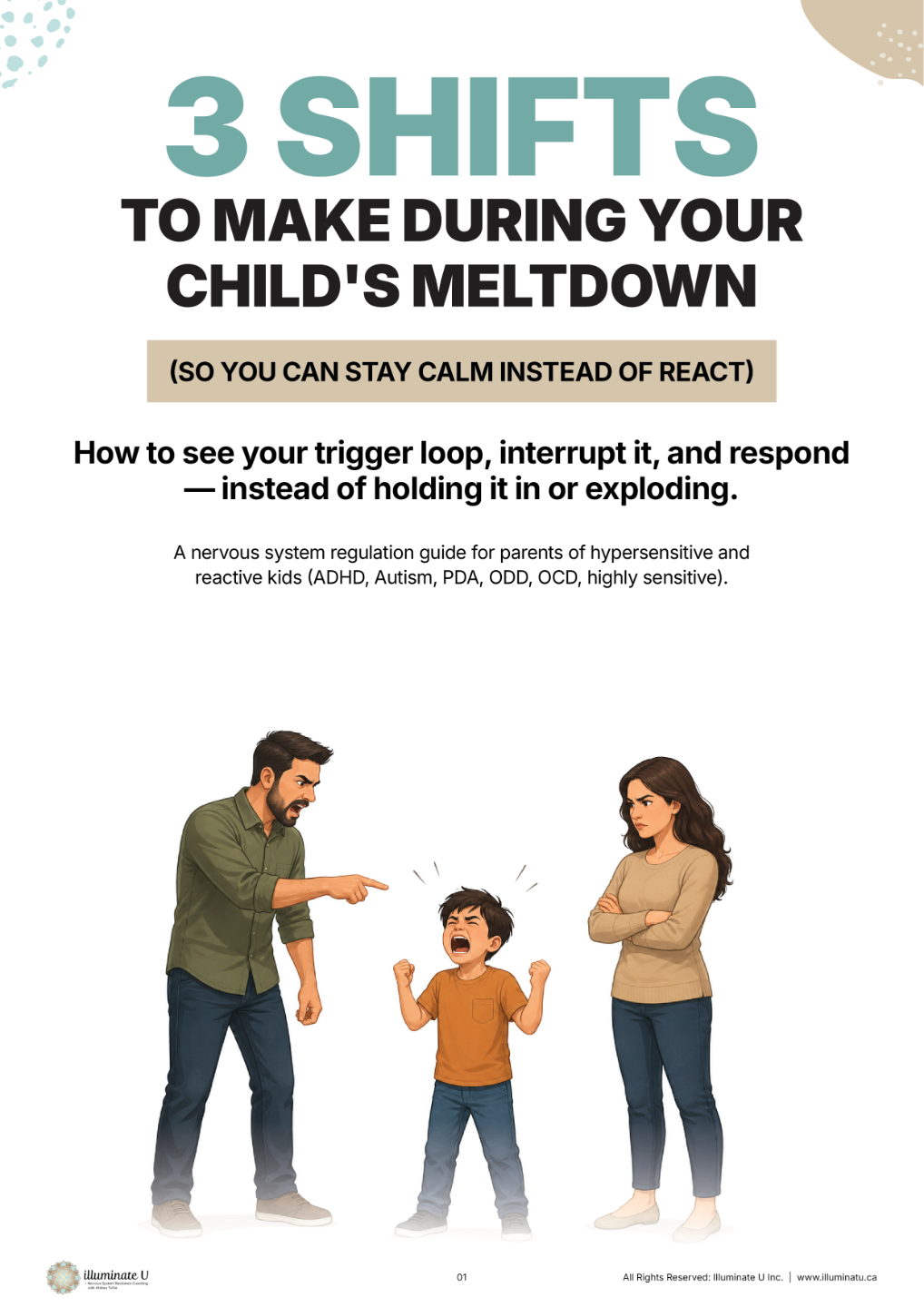
Free: The 3 Shifts Guide
The trigger loop and 3 patterns you get stuck in during meltdowns — and how to shift them so you can stay calm instead of react.
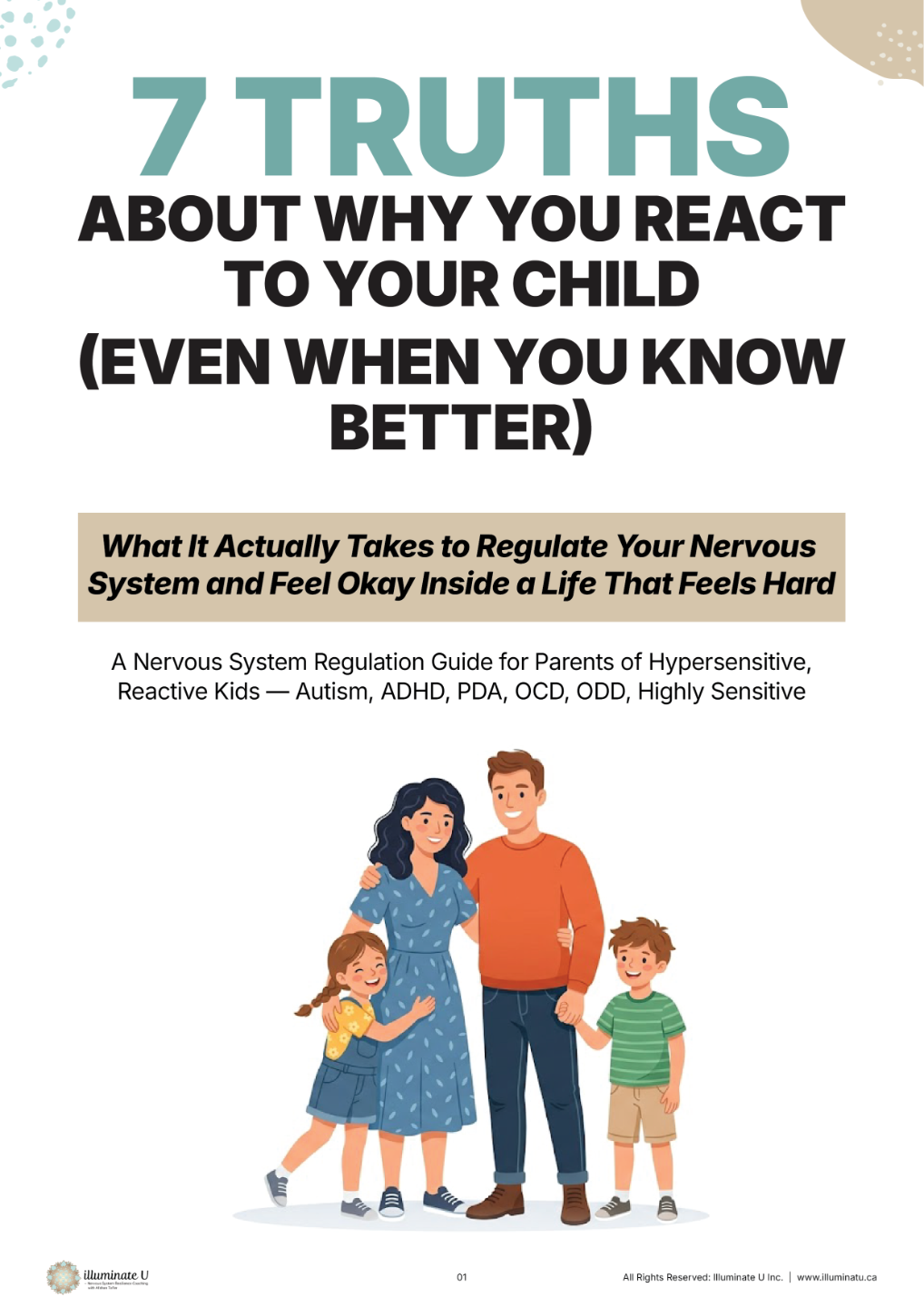
Free: 7 Truths About Why You React to Your Child Guide
Why you react even when you know better — the conditioning, nervous system states, hidden beliefs and patterns, and buried emotions running the show.

