
When You Feel Like You're Failing Your PDA, Autistic Child: Changing the Standard You Measure Yourself By

Why you feel like you're never doing enough, and how to let go of a standard that was never made for a family like yours.
Why Do I Feel Like I'm Failing My PDA, Autistic Child?
"No matter how much I do for my child, it never feels like enough, and I often feel overwhelmed by how much I need to do for them."
If you're parenting a PDA, autistic or high-needs child, there's a good chance you know this feeling. I see it in so many of the parents I work with, and I lived it myself for years.
Here you have a child who needs so much of you. The co-regulating, the accommodating, adjusting your whole life, researching late at night, trying to find a way to help them.
And yet when you look at your child, you don't see the effects of everything you're doing. You see what they still can't do.
So when they're not getting better in the way you think they should, the thought comes in, "What if I'm not doing enough?"
And when you reach exhaustion and overwhelm, and you just can't do every single thing they need, the guilt comes too. "I should be able to do it all. Why can't I do it all?"
And then you drop into the pit of despair, and the feeling that you're failing your child.
And this loop runs on repeat, day after day, often for years.
But what if you're measuring yourself by a standard that was never made for a family like yours?
Today I want to help you see the pattern so many of us get stuck in, and where that standard comes from. And I'll share what helped me step off it, so that this life, just as it is, can start to feel more manageable, and you can finally feel like you're doing enough.
The Years I Tried to Be Superhuman
I want to take you back to the thick of it, as I often do, when my son was in the middle of his burnout.
There was one day I spent doing everything for him. And it wasn't just one day. There were many days like this, but I'm going to take you into this one.
I was bringing food to the couch. Brushing his teeth there. Wiping his bum, even though he knew how to do it himself. I was going nonstop all day, handling meltdown after meltdown, demand after demand, and not eating or even drinking water when I needed it. Can you relate? I'm sure some of you can.
I'd be over by the kitchen, looking at him on the couch. Dishevelled, his hair oily from not having showered for so long, grouchy and irritable. After a whole day of helping my child in all the ways, I couldn't feel any fulfillment from it. Because he still wasn't okay by my standards at the time.
He'd barely eaten all day, and then at midnight he finally felt hungry. So I pushed myself to stay up way past when I wanted to, made him a meal, of course, and sat with him for an hour while he ate it slowly.
He had also been holding his pee for 18 hours. This was so stressful for me at the time, and I could not rest until he went.
By the end of the night, I couldn't hold it in anymore. All the fear I had been pushing down came up, and I cried right in front of him. "Please, please go pee. I can't take this anymore."
That led to another big meltdown. And I fell right into the pit of despair and shame. I'm failing my kid again. How will he ever get better if I can't be okay and help him?
That night, when I finally collapsed into bed, I burst into tears, and I had my conversation with God, as I often did when I reached these very low points.
"Why, God? Why do I have this life? Why do I have this nervous system and this body that can't handle this life? Why was I given a child who needs so much of me, when I just don't have the capacity to give him everything he needs? Why? Why? Why?"
And then I heard a voice. It said, "You don't have to do it all. You're allowed to give yourself a break. And he will be better off for it."
But I didn't know how to listen to that voice yet. To me, it felt like if I didn't keep pushing myself in this way, then he would not be okay.
And that day wasn't unusual. For years, I felt like I had to be everything for him. His teacher, his therapist, his coach, his OT, his PT, his friend to play with. I call it trying to be superhuman, and so many of the parents I teach in my course call it that too.
I was living in fight and flight, researching late at night, trying new strategies, seeing therapist after therapist. I remember thinking, "I have to find a way to help my child and make this life better. There has to be a way."
And the load kept growing. I was being triggered a hundred times a day. I hadn't taken a vacation in years. My friendships slowly fell away. And my body was so stressed, and my immune system so low, that I developed chronic Lyme disease on top of everything.
With the chronic fatigue, I often didn't have the energy he needed from me. And then a critical voice in me would say I couldn't be a good enough mother because of this body and these health issues.
I was so exhausted, clearly doing so much, and yet never able to see the fruits of my labor. Because if he wasn't getting better, I constantly felt like I wasn't doing enough.
Then I'd go on social media (ugh), see other families doing this and that, and think, "Well, you can do that, but we can't." And I'd think, "Why can't I handle this? If only my nervous system were stronger. If only I could be like those other parents who manage it all and do it all."
And I would drop into guilt and despair, so hard on myself. Then I'd put on "Try Everything" by Shakira, from the movie Zootopia. That song kept me going through so many hard times. It reminded me to keep going and stay perseverant. I would dance around the room and cry, and release some of the stress and emotions, and then I would get back up and push again.
And then I'd fall again.
For a long time, I thought this was just me.
The Pattern So Many of Us Are Stuck In
And then I started hearing from so many parents I worked with, and from so many of you, and I realized how many of us are living inside this same pattern, often without being able to name it.
One parent said, "I'm so exhausted from trying to play this chess game 10 moves out." Can you relate to that? Constantly ten moves out, trying to make sure nothing goes wrong.
Another said, "I have to be doing and responsible and can't stop, or else it will all fall apart." I can't tell you how many times I've heard that one.
And another described it as feeling like you're pushing so hard and breaking, but somehow doing it invisibly. No one can see all the invisible labor that goes into this kind of parenting.
When I walk parents through the pattern we often fall into, it so often goes like this.
1There's a picture of where our child should be.
2Underneath it is fear for their future.
3So we go into fight and flight and try everything.
4The load becomes enormous.
5We tell ourselves we should be able to do it all.
6Then we push harder, or we collapse, and it starts again.
1There's a picture, or an expectation, of where our child should be.
We expect them to be doing what other kids their age are doing. Going to school, being out in the world, more independent, behaving a certain way.
2Underneath it is fear for their future.
Your child isn't meeting that expectation, and the fear gets triggered. When our child isn't where we expected, fear kicks in and pushes us into fix-it mode. If I don't fix this now, will they ever be okay? Will they ever be able to live their life, at least according to the norms?
3So we go into fight and flight and try everything.
That fear mobilizes us. Find a solution. Do anything so we don't have to feel this way. Find a therapy. Find a strategy. Find the accommodations that work. Every late night of researching.
We try to be their teacher, their therapist, their coach, their OT, their friend to play with. We try to be superhuman for them, their everything. But it's coming from this low-grade fight and flight, trying to keep some level of control so that we don't feel this much fear and vulnerability.
4The load becomes enormous.
We burn so much energy staying stuck in the "on" position of low-grade fight and flight. And we can't relax, because of the weight of responsibility we feel to do all the things to make sure our child turns out okay.
Then our own needs don't get met. Our sleep, our eating, even going to the bathroom keeps getting pushed to the side. We ignore ourselves, and we walk around carrying this huge weight and feeling so empty, because we can't fulfill our own needs.
5We tell ourselves we should be able to do it all.
We put pressure on ourselves, and we measure ourselves against people who are not living our lives. But there always comes a point where we feel like we can't do it all, and we drop. Then comes the guilt, the shame and the worry again. I'm not doing enough. I'm failing my child.
We are so hard on ourselves, my friends.
6Then we push harder, or we collapse.
We don't want to stay in that drop for long, so our system pushes harder. The inner criticism reignites the fear, and we push. Or our nervous system takes over, and we drop into the dorsal shutdown state of "I can't. I just can't," for a while.
And as soon as we come out of that and have a little bit of energy again, we're back in sympathetic fight and flight, and it all starts over.
That's the pattern. It's the same hamster wheel so many of us know, and it actually comes from old conditioning from our childhood that says we have to keep doing in order to be enough. It just shows up here in a different form, around our child.
Carrying an Extraordinary Load While Expecting Yourself to Function as If You're Not
So much of what we carry is invisible, even to ourselves. So I want to take a moment and have you look at it with me, because gaining awareness of all of this is so important.
You're carrying a child who needs far more accommodation, flexibility and co-regulation time. They need more of your energy and support than most children do.
You're carrying the grief and loss of the expectations, the certainty, and the life you thought parenting would look like.
You're researching, learning, advocating and problem-solving far more than most parents ever have to. This is cognitive load, and it's huge.
You're trying to rewire and change your own nervous system while still getting triggered by your child.
You're facing challenges many other families never face.
And for some of us, there's more. We have our own neurodivergence or sensitivities. And so many of the parents I work with end up burnt out, or living with chronic fatigue, chronic illness or even chronic pain, after years of carrying this much. I believe the load our nervous systems hold for so long plays a big part in that. It did for me, with chronic Lyme.
And then, on top of it all, we're hard on ourselves for not having the energy or capacity our child needs, as if our body should somehow be able to keep giving no matter what.
The voices around us often add to it too. The professional who hints that we should be pushing more. The family who doesn't see it. My son's doctor used to tell me every few months that I needed to push him a little bit more, and I would feel that pressure.
One parent put it so well: "We're too mild to be eligible for help or intervention, and yet too impacted to live a normal life." Another parent said, "Nobody acknowledges how hard I'm trying."
The problem is often not that you're failing. The problem is that you're carrying an extraordinary load while expecting yourself to function as if you're not.
Let's take a pause to really take that in, my friends.
Why We Hold Ourselves to a Standard Made for Someone Else
Why do we do that? Why do we expect ourselves to function like all those other people who aren't living our challenging lives?
Picture this. You're at the park. Another child is playing calmly while their parent sits on a bench with a coffee, and your child is melting down because someone else is on the swing. The first thought is usually, "Why is my child like this? Why can't my child be calmer?"
And then when nothing you try calms them, when the outbursts keep coming even though you're doing everything possible to help, the thought starts to turn. "What am I doing wrong?" And you look at that other parent and think, "They must be doing something right."
Because we learned that a child's behavior shows whether the parent is a good parent. We didn't learn that a child's behavior is about their nervous system not feeling safe. That's what we're trying to take in now, but our brain's mental models don't hold it. So our brain says, if a child isn't behaving well, the child must be bad and wrong, which means that ultimately we must be bad and wrong. We must not be doing something right, if our child is turning out this way.
Just take a moment to take that in.
So much of this happens without us even realizing. We walk around with these automatic thoughts because of our deeper programming and conditioning, and because we carry deep mental models of what a good life looks like, what a good child is, and what a good parent does.
They're so wired into us that we believe they are us. But these ways of thinking are not us. They're old programs running on autopilot, passed down through generations, from systems and cultures that didn't understand nervous systems or trauma.
When you were young, you learned that being good means sitting quietly, being compliant, responsible, kind, working hard. You learned that talking back is bad, anger is bad, and if you rested too much, you were likely called lazy. You got more love, attention and connection for being a certain way.
So you learned early on, "I'm safe, loved and I belong if I behave in a certain way, and I'm not if I don't."
These are the mental models we now see our kids through, automatically. They run on autopilot, below the level of conscious awareness. So when our kids aren't doing well by the standards our brain holds, our brain shouts, "Do something! Change something! This feels dangerous." Or it tells us we're failing.
The Fight Response Turned Inward
And there's something else so many of us learned as kids.
When an adult in our life was in the wrong, we often couldn't blame them, because we needed to feel connected to them, and safe and loved by them. But we had all this fight energy. The part of us that wanted to say to the parent, "This isn't right. You've got it wrong," got turned inward instead. It must be me. I must be bad.
That's often where "What am I doing wrong?" comes from. That thing we constantly say to ourselves: "What must I be doing wrong, that this isn't going well?"
It's the fight response turned inward, now pointed at ourselves as parents, when we've tried so hard and still can't change what's in front of us.
And it lands right on that older wound. "I'm not enough if I'm not like them, like everybody else. Somehow I must be doing it wrong."
These are programs that often come from when we were much younger, and they get exacerbated in this kind of parenting. That's why it's so important to become aware of them.
When You Just Want Life to Be Different
Underneath all of this, so many of us just want life to be different than what it is. It's hard. Our lives are hard.
There's a sadness that comes with watching our child be so different, and struggle with things that come easily to other kids. One parent said, "I just want to be a typical family, vacation as a family, make memories together and actually enjoy being a parent."
And there's sadness for ourselves too, for the life we thought we'd have. Maybe it's the birthday parties you had to leave after ten minutes, or the family dinners where everybody sits at the table together. Watching your friends' kids go to sleepovers or head off to camp, and quietly wishing that for your child too.
And then many of us feel guilty for even wishing it were different, because we love our child so much and we don't want to wish away who they are. That feels awful.
I want you to know it's okay that you wanted these things. This is what our brain learned a good life looks like. That part of you that wanted it, and still wants it sometimes, deserves to be validated and honored.
Because these are real losses, and we rarely name them. We try to bypass them, because this is our child and it feels wrong to feel these losses. But they are real.
For me, it was the vacations (I hope I can go on vacation again soon, one day soon!), the friendships, my health, the outings, the family life I had pictured, and the parent I thought I would be.
Those losses need to be grieved. When grief stays unfelt, it keeps the nervous system stuck, and it shuts down the joy and aliveness too.
So for a long time, I did what I called weekly grief dumps. I would sit in my parked car with a sad song playing, or walk a quiet path in the forest, and I would connect to the feeling of the loss and grieve it. That's how I slowly let go of the old picture of how this life should be.
And once we've grieved what we wanted, we can start to ask a different question: whose standards am I measuring my life by? Because so many of them were never meant for a family like ours in the first place.
What If We Changed the Standards?
What if, instead of trying harder to meet the standard, we changed the standard?
Here we are, fighting upstream to meet these neuronormative standards, this picture in our mind of what a good life should be and what a good human should be. Instead of flowing downstream, with our own standards that help us flow through life instead of fight it.
I sometimes imagine us all living on an island, where every family's life looked like ours. Take a moment and picture it with me. On this island, it's normal for your child to need this much, and for a day to look like this.
On the island, it takes hours to get out the door, and that's just a normal day. It's expected. Nobody thinks, "What a waste of time, we got nothing done today."
A day where your child stayed home, felt safe, spent time connecting with you, and also played on their device counts as a good day.
When you tell another parent your child hasn't been to school in a year, they nod and say, "Oh yeah, ours too." Nobody asks what grade they're in. Nobody says, "Shouldn't they be going? How could you allow that?" Nobody tells you they just need more discipline.
Imagine how your body would feel living there. How much lighter you would feel. How much less you'd be fighting yourself.
Would you look at your life and see a bad life? Would you feel like you weren't doing enough for your child? Or would you feel like it's okay to live your life this way? That it's expected, and everybody else lives this way too.
This life can look different. Messy, chaotic, like we're getting nothing done, like it's taking so long for our child to come out of burnout. That's the reality of the life we're living. So why do we need the whole outside world to change before that can be okay?
It's really about changing the world inside of us, my friends. The way we see our own life.
We can start owning that our life looks different, and that we may not be able to get our child to every neurotypical standard, or maybe even any of them. And we can ask, "Why can't this be a good enough life, even though it's not the one we expected?"
Think about how you would feel inside, if this life as it is could be a good enough life. Everything changes. I know it has for me.
"Am I Giving Up on My Child?"
I know the fear that can come up here. If I let go of the standard, am I giving up on my child? So many parents come back with this pushback. It feels like giving up. But it doesn't have to be that.
When my son stopped going to school and nothing we tried was working, my husband and I stopped trying to fix him, and we worked on our own fear instead. We dropped the pressure, kept only the essentials we could, and stopped fighting him. That's what helped him the most.
I don't share that as a promise for your child, because there are so many factors at play, and each of our children is unique. But for us, letting go of the conditioned standard meant letting go of the pressure that was keeping both of us stuck.
So I didn't give up on my son. I didn't give up on life. I just gave up, slowly, on all the ways my brain kept telling me life should be. All of that conditioning and programming.
It's Okay to Not Do It All
I want to tell you about a night about a year ago, because this is still very much my life. I'm still in the trenches with you, my friends. There are still ups and downs. I still have fears, but I work with them. It's different now.
My son is 18 now. He wants to get out of the house so much, and yet it's still so hard for him at times.
That day, I was on Instagram and saw posts from friends, all out having fun with their kids and doing fun family things. And right away the thought came, "We need to get out more and have some fun. I'm not doing enough to help my child get out."
That's the automatic thought. The pressure, the pushing, the fear.
So we did it his way, even though I was tired and needed rest, and I knew how long it could take us to get out of the house. That day, it took all day to finally get into the car. I mean all day. By then it was 8pm, and we'd packed up our dinner to eat on the drive. Late dinner, as usual.
And the thoughts kept coming. I have to do this, or else he won't get out. He's going to go back to being housebound. I could hear the doctor's voice in my head, telling me I needed to help him get out more.
It had been a full day. I've also been on a journey of recovering from chronic Lyme. I was so tired, and still I pushed. Because if I didn't, what if he ended up housebound for years again?
Then, sitting in the car, he cycled into anxiety again and started doing his OCD rituals. Thirty minutes went by, just sitting in the garage. The garage lights went out, and he was escalating more and more.
And that's when I caught it. I said to myself, "It's okay not to do it all. It's okay that he's going out less right now. I don't have to push myself to the extreme just to make this happen. I don't have to live in fear that if I don't push myself, he'll become housebound again and won't be okay in this life. This is our life, not anyone else's, and we can live it our way."
So I regulated myself, and I said to him, "Sweetie, Mommy's tired. Maybe this is too much for us today. We can try again tomorrow. I'm going to go inside."
I waited a few moments for him to process. He got upset, and I stayed okay. And then he came around, and we went inside together. It turned out that night we cuddled on the couch and connected, and it ended up being a nice night that filled us both up.
A part of me still felt guilty, of course. There was still a little bit of fear that if we don't go, he'll stop going out altogether, because the OCD can turn anything into a pattern. But carrying the weight of doing it all for him was crushing me, and it wasn't helping him either.
I let the fear for his future be there, but I didn't attach to it as the truth. I recognized it, I allowed it to be there, and I let myself feel safe enough, even without pushing myself for him.
Because my system was saying, "If I push myself for him, then I'll feel safe enough." But that never worked, because pushing never guaranteed the outcome in him. So I never felt safe anyway.
This time, I didn't let it mean that something was bad, or that I wasn't doing enough. I was aware that this was the pattern running on autopilot.
What If Not Taking It All On Is Part of the Path?
It's been an ongoing life lesson for me that I don't have to do it all, all the time.
And I've come to believe that if I can feel okay inside this life, then my son has a chance to feel that too. If I can feel okay that he's "behind," that at 18 he's unable to do all the things my brain thinks he should be able to do. That his life looks so vastly different from other kids his age, and from the way I ever imagined it would be. If I can feel safe with our life exactly as it is, then he has a chance to feel that way about himself too.
And to be honest, that's the greatest gift I could ever give him. Because it gives him a chance to love and accept himself, and the way his life is, even when it's so vastly different from the norm. I truly believe that's the greatest gift we can give our kids.
What has helped me most in these situations is the soul perspective. I call it the bigger picture, the bigger meaning. I personally believe my son and I chose each other in this lifetime, to work through these challenges together. I believe a lot of these challenges are meant to be. I don't share this to convince you, and you can take it or leave it.
But from that place, I know deeply that it's okay for this to be just as it is, because this is part of the life I came here to live with my son. He's doing the best he can, and so am I.
And I've come to see that getting out into the world and doing all the things the way I did at his age might not be meant for his life. If he only gets out here and there for now, can that be okay? We can have fun at home, with lots of connection time. And I can still hold on to the possibility that it gets better in his future.
The pressured thoughts still come. But I meet them differently now. I feel the grief of it, I let go of wanting it to be different, and I come back to the present. That's where I find my peace, my self-love and my regulation. And that's where my child gets to feel all of that too, nervous system to nervous system.
Noticing the Pattern, and Letting What You Do Fill You Up
So how do we break this pattern we fall into? The one that leaves us feeling like we're never doing enough, and measuring ourselves by standards that were never meant for us?
I would tell you to stop comparing yourself, but it's likely not going to work. Our brains are designed to compare, so that we stay connected to the tribe and belong, so that we're like everyone else. It's part of being human. But we don't have to follow it.
So instead, what I invite you into is to just notice when your brain starts to compare you to others. And notice when the inner critic comes in and says, "You're not doing enough, because your child isn't doing well."
Then the second practice is simple. Every day, pat yourself on the back for what you did do, even if it didn't change your child, and let yourself feel the glimmer in it. This helps our brain come out of the chronic negativity bias we get stuck in.
Glimmers is a word from Deb Dana, who teaches polyvagal theory and therapy. It means the small moments of ease, safety or connection that are the opposite of triggers. Little moments of safety, and little moments of feeling like you're enough.
When my son was barely eating, on the nights he ate a little more, I'd say to myself, "Oh, he ate two small meals today. I am enough. Girl, I am enough." And I'd pat myself on the back, and laugh, and really feel it. This is how you shift your state, and take in something important, however small it is.
And even when he didn't eat enough, or I couldn't see any positives in him that day, I would still acknowledge myself for what I did, even if I wasn't calm all the time. I would lie in bed at night and go through the list of it all: the moments I showed up, the things I did for him. I would thank myself for being such a great mom, and let myself feel that in my body. Because I deserved to nourish myself too.
This is hard work we're doing, and we deserve to nourish ourselves. So I want you to know this. So many parents I've worked with who run large businesses have told me this is harder than their job as a CEO or an executive. And parents from the military have told me it's the hardest thing they've ever done.
It is not easy to parent kids like ours. It challenges us to the extreme. So be kinder to yourself. Developing that kinder inner voice is one of the 12 nervous system shifts I teach in my course.
Let yourself see what you're doing. Little by little, your brain updates its picture, until it becomes a real felt sense: I can handle this life. I am doing enough for my child. And parenting from that place is so much more satisfying.
You Don't Have to Be Superhuman
You don't have to be superhuman, my friends. Look, I still haven't taken a vacation. There are real realities in this life.
But my life is so much better now, because I'm so much kinder to myself, and I've stopped comparing myself to other families. This kind of life feels expected for a family like ours. And I feel like it's a good life. A good enough life.
It doesn't look like the picture my brain once had of a parent handling it well, calm all the time. It isn't perfect, it isn't always calm, and many days we don't make it out the door at all. Some days my son can spend hours spiraling into anxiety, and there are ups and downs in my nervous system too. This is my version of handling it well, and it's good enough.
The peace I found was there underneath the whole time. It was just covered over by all the pressure to be everything, and to make my life fit a standard that wasn't meant for me in the first place.
And that peace is in you too, my friends.
You are not failing your child.
You don't have to do it all.
And you are not giving up on them when you don't do it all.
This life, just as it is, can be enough. That's my invitation to you, to step into that.
Questions Parents Ask
Why do I feel like I'm failing my autistic child even though I do so much?
Because your brain is measuring your life against a standard built for families whose kids have very different nervous systems. When your child isn't where that standard says they should be, your survival system reads it as failure, even while you're carrying far more than most parents ever do.
Is it normal to feel guilty for wishing my life with my PDA child were different?
Yes. Wanting the life your brain learned a good life looks like is human, and it doesn't mean you love your child any less. These are real losses, and naming and grieving them is part of what lets your nervous system come out of being stuck.
If I stop pushing my child to meet expectations, am I giving up on them?
Letting go of the standard isn't giving up on your child. For my family, dropping the pressure is what helped my son most, and I never stopped being there for him. I don't share that as a promise for your child, because every child is unique, but you can let go of the pressure and still hold on to hope for their future.
How do I stop comparing my family to other families?
Telling yourself to stop comparing usually doesn't work, because our brains are designed to compare so we can belong. Start by noticing when the comparing and the inner critic show up, and allowing them to be there without treating them as the truth. Then, every day, acknowledge what you did do, and let it fill you up.
Before You Go
If this helped you in any way, I'd love to hear it. And if you know another parent who needs this message, please share it with them. So many of us are figuring this out alone, and we don't have to be.
If you'd like more support, I have four free guides for you.
One is on the three patterns most parents get pulled into during a meltdown, and how to shift them. That's the 3 Shifts guide.
One is on why you react even when you know better. That's the 7 Truths guide.
One is for finding your way back to meaning and purpose when you've given everything to your child. That's the Meaning guide.
And the newest one is for when your child is hitting you: what to do in the moment, what to do outside of it to help lessen the hitting over time, and how to support your own nervous system. That's the Hitting guide.
So pick whichever one fits where you are right now.
And I have a new Facebook group, The Regulated Parent, just for this podcast and my free guides. It's a place to connect with other parents on the same journey as you, share your insights from the podcast and blog, and ask any questions. I'll be posting there weekly, and I'd love to hear from you.
Thank you for being here.
About the author: Afshan Tafler is a Nervous System Resilience Coach, host of The Regulated Parent podcast, and a parent raising a PDA autistic teen with high anxiety and OCD. She is trained in Internal Family Systems (Level 3), Havening, polyvagal-informed practice and EFT, and is completing her Somatic Experiencing training. She has guided hundreds of parents of ADHD, autistic and PDA kids from burnout and barely coping to steadier, more connected and more alive, within the life they are actually living.
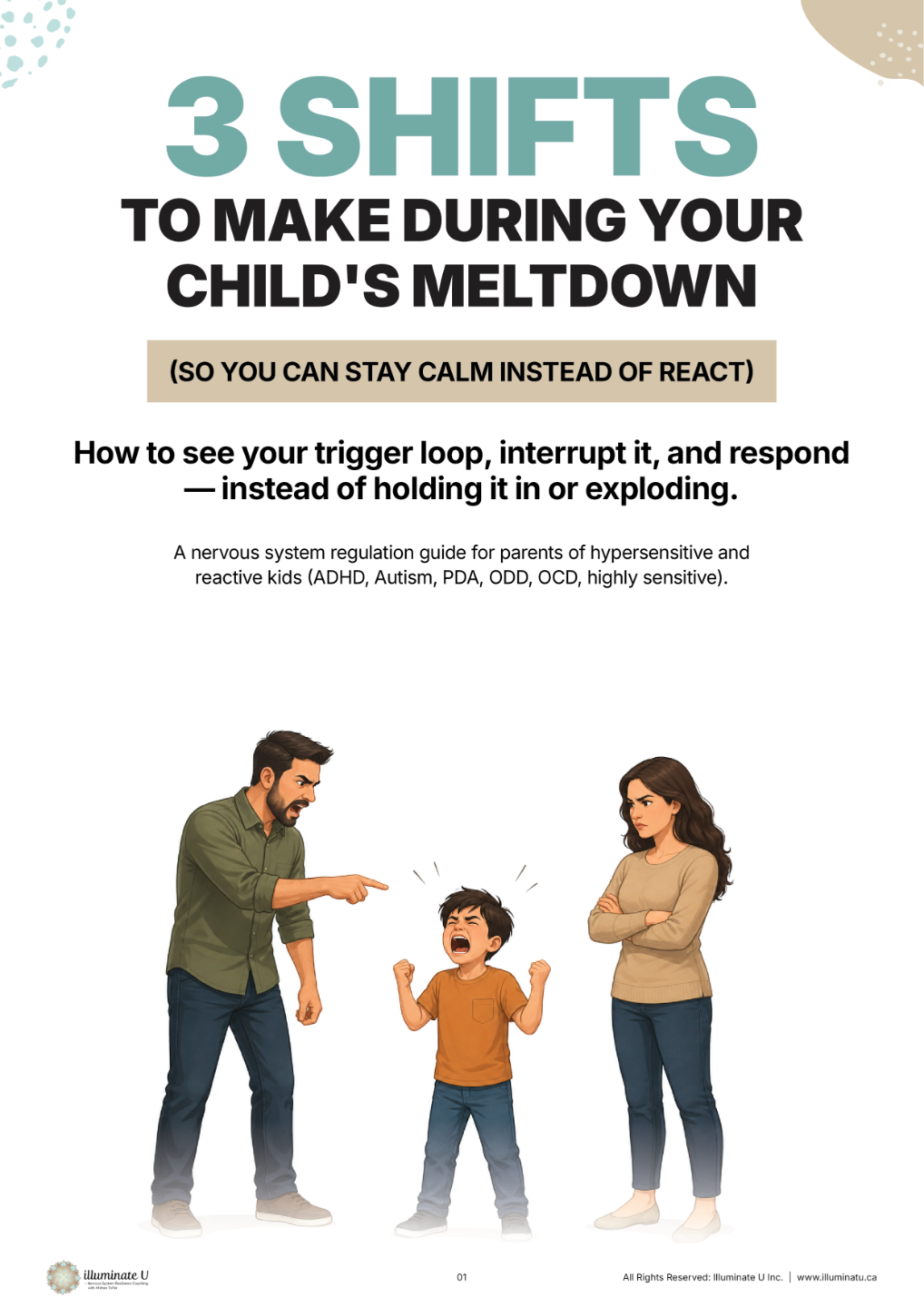
Free: The 3 Shifts Guide
The trigger loop and 3 patterns you get stuck in during meltdowns — and how to shift them so you can stay calm instead of react.
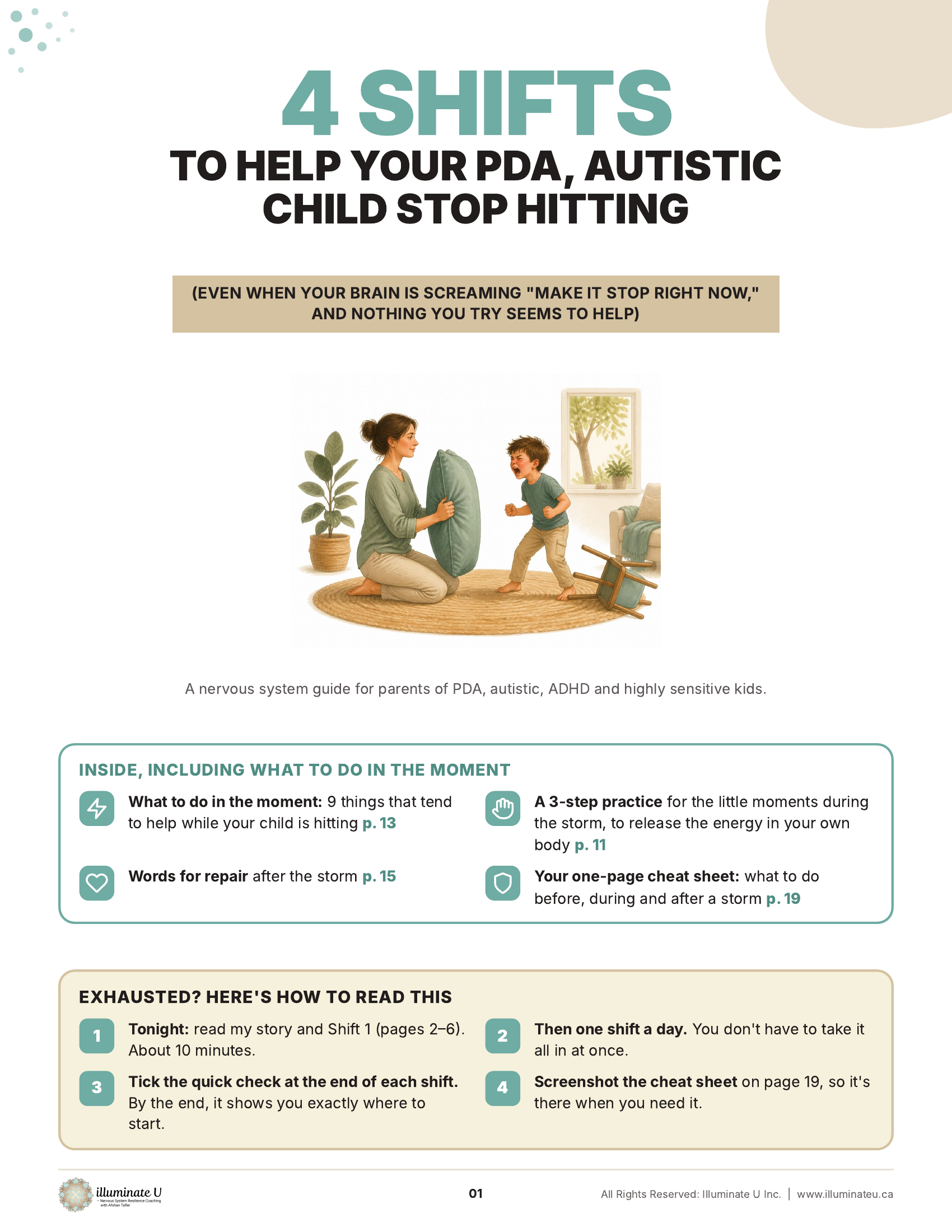
Free: 4 Shifts to Help Your PDA, Autistic Child Stop Hitting
What to do in the moment your child is hitting you, a one-page cheat sheet to keep on your phone, and the 4 shifts that changed things in our home.
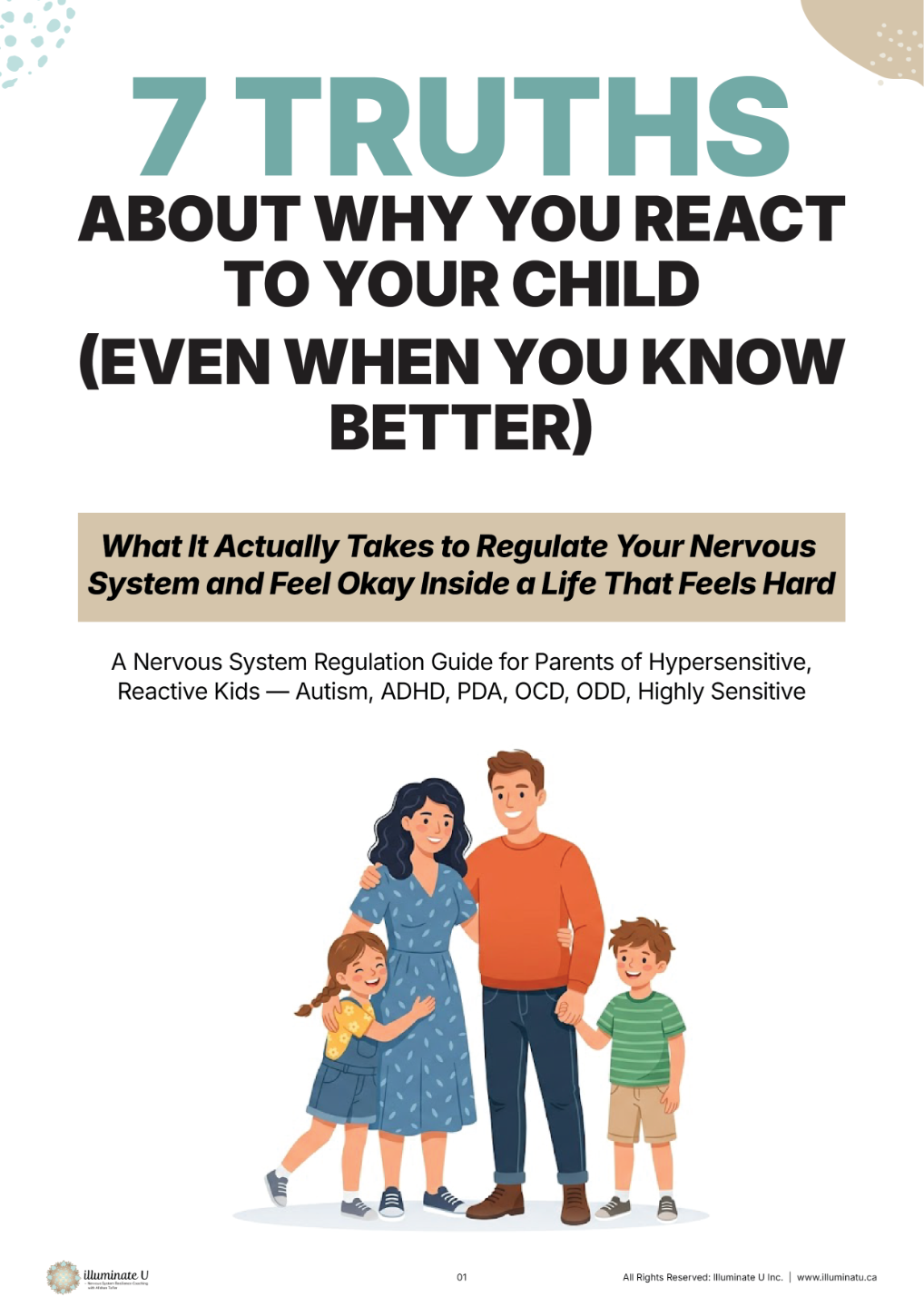
Free: 7 Truths About Why You React to Your Child Guide
Why you react even when you know better — the conditioning, nervous system states, hidden beliefs and patterns, and buried emotions running the show.
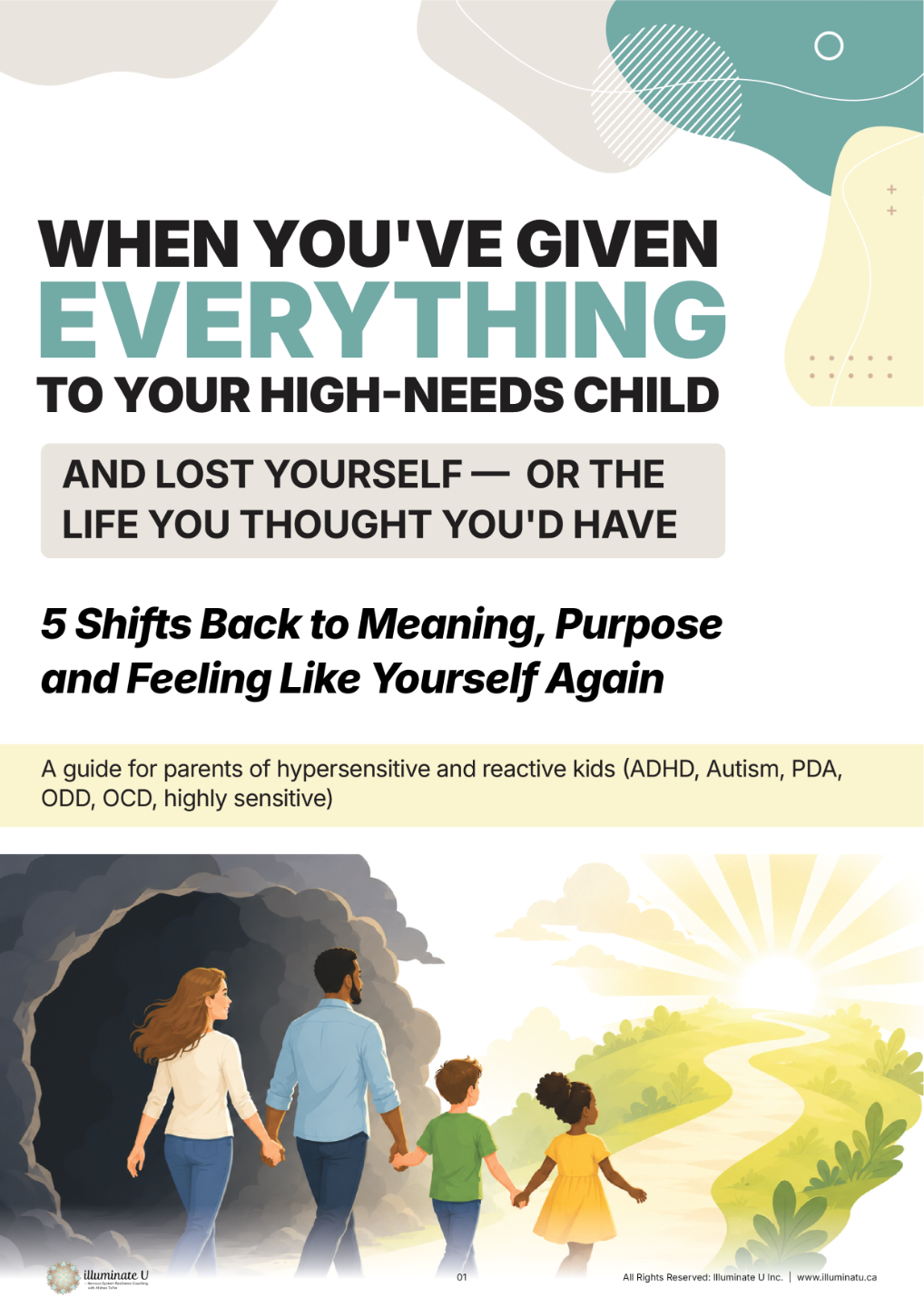
Free: 5 Shifts Back to Meaning Guide
For when you've given everything to your high-needs child and lost yourself — 5 shifts back to meaning, purpose and feeling like you again.

Free: The Regulated Parent Facebook Group
Ask your questions about the podcast and the free guides, and be with other parents who truly get it. Free and private.

