
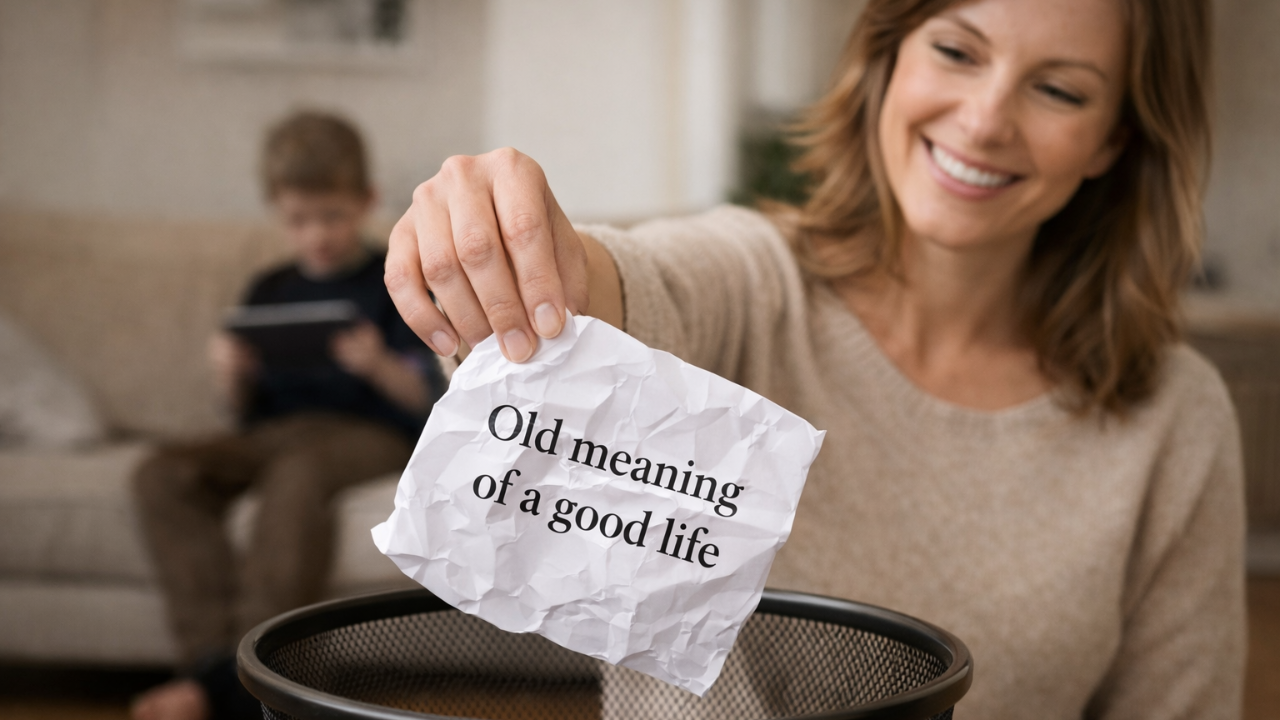
Why Parenting a PDA or High Needs Child Forces You to Redefine What a “Good Life” Means”
**You can also listen to this in audio format only on The Regulated Mother Podcast on Apple or Spotify. Look for Episode #35
**Below is the blog article for easy reading.
When It Feels Like You’re Losing at Life
Have you ever found yourself thinking…
“This isn’t the life I worked so hard to build.”
Maybe you don’t say it out loud.
But somewhere inside, there’s this quiet ache.
You did everything right.
You worked hard.
You made thoughtful choices.
You tried to build stability, security, a good family, a good life.
And now you’re parenting a high-needs or PDA child… and instead of feeling like you’re winning at life, you feel like you’re barely surviving it.
You look around at other families and wonder,
Why does it look easier for them?
Why does my life feel so hard?
Why does it feel like I’m losing and failing?
If that’s you, I want you to know something deeply important:
You’re not failing at life.
You’re measuring your life against a definition that no longer fits.
One of the hardest — and most essential — requirements for feeling like you’re finally winning at life with your high-needs child is this:
You have to redefine what a “good life” actually means.
Not in theory.
Not in denial.
But in a way that your nervous system can truly embody.
In today’s episode, I’m going to show you why your brain feels like you’re losing… how it built that expectation in the first place… and how changing your definition of a good life can radically transform how you experience the exact same circumstances.
Because sometimes the breakthrough isn’t changing your child or the external circumstances.
It’s changing the lens.
And that changes everything.
The Good Life That Fell Apart
It was two years into my son going into an externalized PDA presentation after he stopped going to school.
There was no home schooling. Not much fun. Hours and hours of daily meltdowns and rages. Even basic needs were hard some days. I felt like who I used to be was withering away.
I was exhausted. Full of despair. Losing hope.
One night, I sat on my bathroom floor crying — no, screaming — at God.
“Why? Why? It wasn’t supposed to be this way. I have done everything. I have worked hard. I studied. I built the successful career. I found a good man with great family values. I created this whole social circle of friends. I did everything right. I created the good life — the way it was supposed to be.
And now it’s all being stripped away from me.
What am I doing wrong? It wasn’t supposed to be this way. It wasn’t supposed to be this hard.”
I sobbed for hours that night, trying to reconcile why this was my life now — why it felt so hard and full of stress, with almost no joy. I had worked so hard to create a “perfect” life: a good career, a healthy body, a good amount of money, meaningful friendships, a loving husband, fun vacations, and hosting all the extended family gatherings. And slowly, it felt like it was all being taken away from me.
All I could see and feel was loss.
This was no longer a good life. It felt painful. Torturous. Full of hardship. A life that, from the outside looking in, might appear to be flailing, failing, nowhere near any version of what a good life should look like.
Little did I know then that what felt like everything breaking down was actually something breaking open.
But I couldn’t see that yet.
All I could see was that life had not kept its end of the deal.
The Contract I Didn’t Know I Had Signed
That night wasn’t just about exhaustion. It was about a broken contract.
Somewhere along the way, without ever consciously deciding it, I had formed an agreement with life:
If I do everything right, I will have a good life.
If I work hard.
If I sacrifice.
If I choose well.
If I love deeply.
If I follow the rules.
Then life will reward me with stability, joy, and a sense of “this is working.”
This belief didn’t feel arrogant. It felt logical. Responsible. Mature.
But it was conditioned.
And it was neurological.
How the Brain Builds a Mental Model of a “Good Life”
The brain is a predictive organ. It is constantly building models about how the world works and how life is supposed to unfold. Based on our upbringing, culture, education, religion, media, and personal experiences, we form internal templates for what “a good life” looks like.
These templates are not just thoughts. They are encoded expectations.
If I study and work hard, I will succeed.
If I choose a good partner, I will have a stable family.
If I parent intentionally, my child will thrive in predictable ways.
If I do it “right,” life will cooperate.
The brain uses these models to anticipate the future. Prediction reduces uncertainty. And reduced uncertainty creates a sense of safety in the nervous system.
When reality matches the model, the brain relaxes. It registers safety and success.
But when reality sharply diverges from the model — when the child stops going to school, when daily life revolves around dysregulation, when effort does not produce visible payoff — the brain experiences that mismatch as threat.
More specifically, it experiences it as loss and failure.
Not only loss of circumstances, but loss of predictability. Loss of identity. Loss of the imagined future. And alongside loss comes failure – that somehow you must be doing it wrong if your efforts don’t equal reward.
And here’s where it gets even more powerful: the brain doesn’t just passively interpret reality. It filters reality through its existing models. Through systems like the reticular activating system (RAS), it selectively highlights evidence that confirms what it already believes.
So if my mental model says, “A good life looks like ease, progress, and visible success,” then every meltdown, every canceled plan, every accommodation becomes proof that my life is failing that definition.
The brain starts collecting evidence:
See? This isn’t working.
See? You’re losing.
See? This is not the life you built.
And the more it gathers that evidence, the more entrenched the story becomes.
This is why parenting a PDA or high-needs child can feel not just hard — but catastrophic.
Because it doesn’t just disrupt your schedule.
It disrupts your model of what life was supposed to be.
Why I Felt Like I Was Losing Everything
What I didn’t understand at the time was that most of my suffering wasn’t only coming from the circumstances themselves.
It was coming from measuring my life against a conditioned definition of a good life.
That definition included:
Ease.
Predictability.
Linear progress.
Children who follow socially accepted developmental paths.
Effort that produces visible reward.
A life that looks stable from the outside.
A life that followed the norms of society.
As long as I held tightly to that lens, my life would always feel like loss.
Because it didn’t match the picture.
And when life doesn’t match the picture, the nervous system does not interpret that as “transformation.”
It interprets it as failure.
The Shift: Redefining What a Good Life Means
The turning point did not come because my circumstances suddenly improved.
It came because I began to question the definition I was measuring my life against.
For years, I had unconsciously equated a good life with ease. With smoothness. With forward progress that made sense from the outside. With children who followed socially accepted paths and who could also match the mold of what a successful child is. With effort that led to visible reward.
And when my life felt hard, messy, unpredictable, and overwhelming, I interpreted that as proof that something had gone wrong.
But what if the definition itself was flawed?
What if we’ve been taught that a good life is supposed to be challenge-free — picture-perfect, socially approved, and emotionally tidy — and anything outside of that must mean we’re failing?
Parenting a PDA or high-needs child exposes how narrow that definition really is.
Because a good life can also be a hard life.
Becoming who you truly are in a world that tells you to be like everyone else is not easy. Breaking free from inherited paradigms about control, productivity, and compliance is not easy. Letting go of socially rewarded definitions of success is not easy.
But difficulty does not equal failure.
Slowly, my definition began to shift.
A good life became less about how it looked — and more about how it felt from the inside.
A good life is laughing with your child after a stormy day and realizing your nervous system is more flexible than it used to be.
A good life is feeling grief, frustration, and overwhelm — and still being able to access joy in the same week, sometimes even in the same hour.
A good life is loving your child unconditionally so they know, in their bones, that they are enough — even when the world tells them otherwise.
A good life is offering yourself compassion and kindness you may never have received from culture, or perhaps even from your own parents.
A good life is finding your center in the middle of chaos.
A good life is watching your child follow their own path and realizing that their very existence challenges systems that were never built to honor authenticity.
A good life is no longer dependent on predictability, money, image, or social comparison. It is not about matching an inherited script.
It is about living from your truth rather than your conditioning. It is about being aligned with your values rather than with cultural approval. It is about presence — being here for what is — even when what is feels hard.
And here’s what I discovered:
Only when I changed the meaning of a good life could my brain begin to see gain instead of loss.
As long as I measured my life against the old template, it would always feel like I was falling short. But when I updated the template, something subtle but profound shifted in my nervous system.
I stopped scanning only for what was missing and gone wrong.
I began noticing what was growing and going right.
Seeing the Gains After Updating the Meaning
The meltdowns did not disappear.
The complexity did not vanish.
But something inside me stabilized.
Instead of scanning constantly for what was missing, I began noticing what was emerging: a deeper authenticity, a dismantling of perfectionism, a clearer understanding of what truly matters, a more grounded presence with my child.
The life that once felt like punishment began to feel like initiation.
Not because it became easy.
But because I stopped measuring it by the wrong definition.
And here is what is so important to understand:
This wasn’t just a philosophical shift. It was neurological.
When you redefine a good life in concrete, lived ways like this, you are giving your predictive brain new reference points.
For years, my internal equation looked like this:
A good life equals ease, compliance, visible progress.
And because that was the model my brain was operating from, it filtered reality accordingly. Every meltdown, every canceled plan, every deviation from the expected path became evidence that my life was failing.
But once I redefined a good life as authenticity, growth, nervous system flexibility, depth, and unconditional love, the model changed.
And when the model changes, perception changes.
Through systems like predictive processing and the reticular activating system, the brain highlights what matches the definition it is holding.
When the definition is “I am losing,” it finds loss everywhere.
When the definition becomes “I am growing,” it begins to notice growth.
The moment of connection after chaos.
The increased capacity to stay present.
The depth of empathy developing.
The courage it takes to advocate for your child.
Life itself may look the same from the outside.
But the lens is different.
And when the lens changes, the nervous system stabilizes — because reality once again matches the internal model.
Not because life is easier.
But because it makes sense.
A Larger Invitation
I believe parents of high-needs children are being asked to participate in something bigger than our individual stories.
For generations, we have inherited narrow definitions of what makes a life good: achievement, compliance, control, productivity, image.
Our children — especially those with PDA — disrupt those definitions.
They force us to confront where we are still attached to outcomes. They expose how deeply our nervous systems are wired for control and predictability. They challenge performance-based worth.
When we look at our lives through those old lenses, our child feels like a loss.
But when we update the lens, something else becomes visible.
Growth.
Depth.
Integrity.
Unconditional love.
A breaking of generational patterns.
Purpose…and Meaning.
An Invitation to Redefine a Good Life
If you are parenting a high-needs child and your life feels like loss, I want to gently offer this:
Perhaps the pain is not proof that your life is broken.
Perhaps it is evidence that your inherited definition no longer fits.
What if a good life is one where you are becoming more honest, more embodied, more aligned?
What if a good life is one where struggle refines you rather than defines you?
What if the meaning you choose to live from determines whether this feels like loss — or like transformation?
You do not have to deny the grief. You do not have to pretend this path is easy.
But if you change the meaning, you change what your brain sees.
And when your brain sees differently, your life begins to feel different — even before the circumstances change.
You are not losing.
You are being reoriented.
And that may be the beginning of a deeper, truer version of what a good life really is.
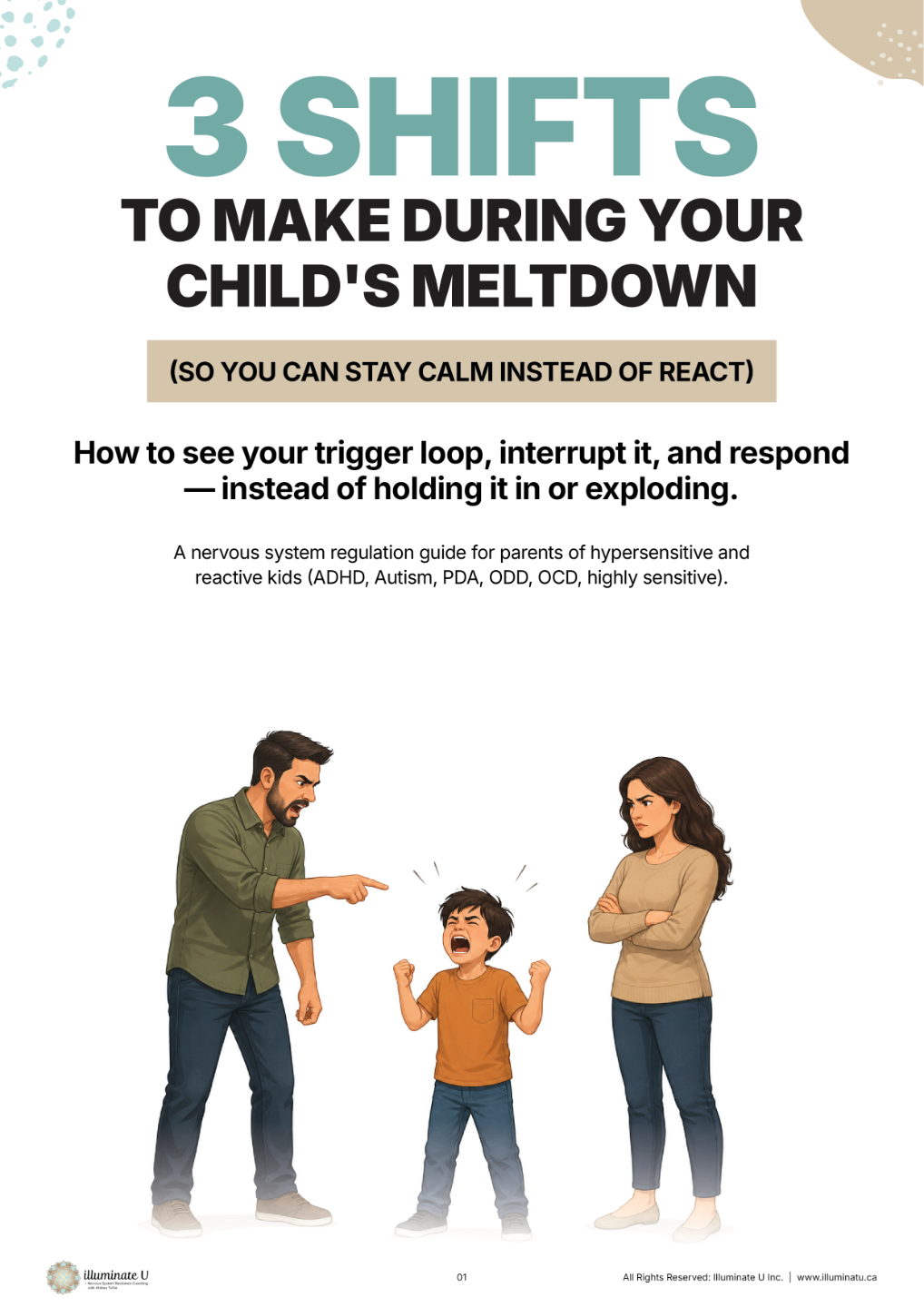
Free: The 3 Shifts Guide
The trigger loop and 3 patterns you get stuck in during meltdowns — and how to shift them so you can stay calm instead of react.
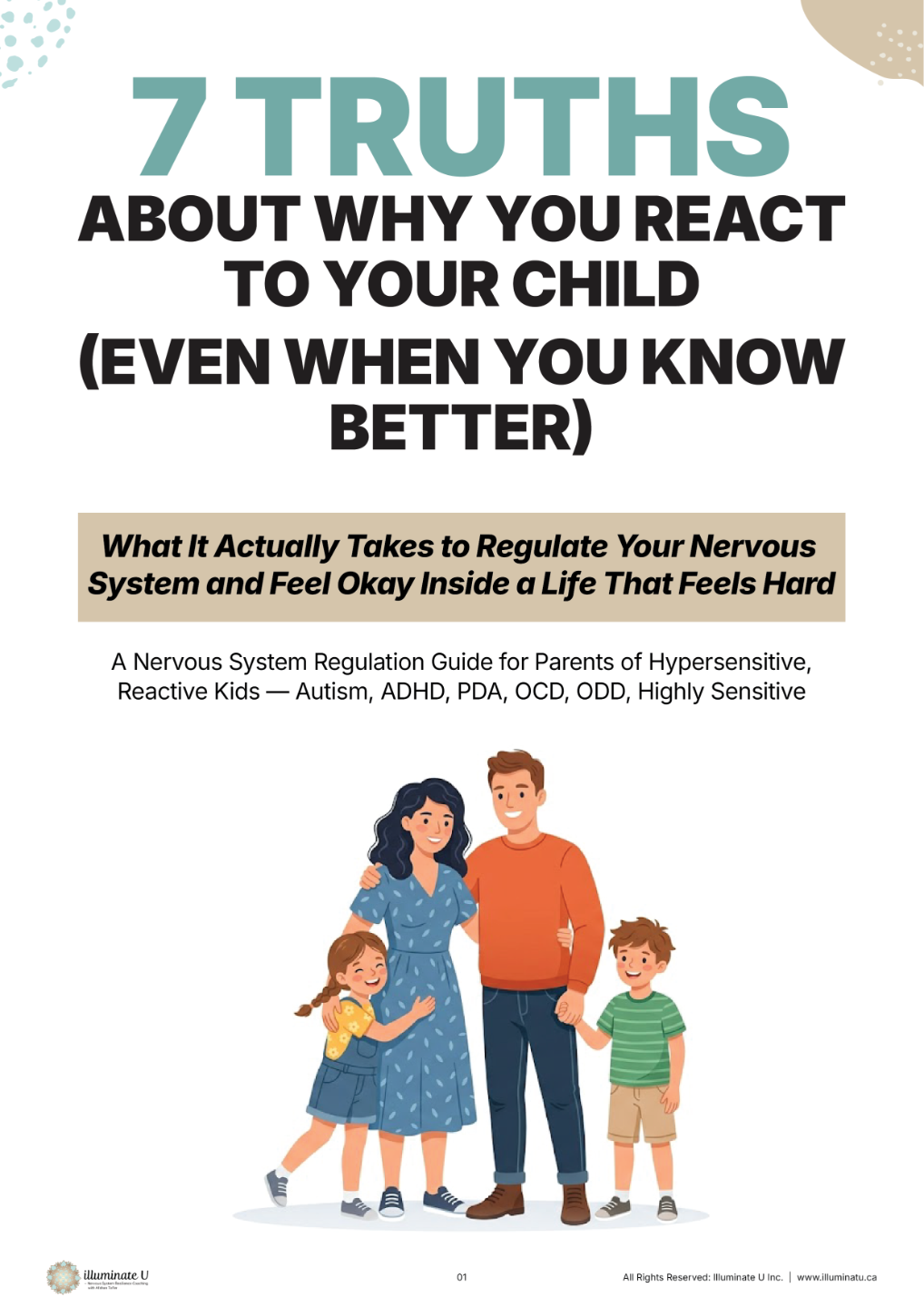
Free: 7 Truths About Why You React to Your Child Guide
Why you react even when you know better — the conditioning, nervous system states, hidden beliefs and patterns, and buried emotions running the show.

