
The Shame Spiral of “Not Doing Enough” For Your PDA, High-Needs Child

**You can also listen to this in audio format only on The Regulated Mother Podcast on Apple or Spotify. Look for Episode #30
**Below is the blog article for easy reading.
Why So Many PDA Parents Feel Like They’re Not Doing Enough
If you’re parenting a PDA or high-needs child, there’s a feeling I know you’ve probably lived with for a long time —
this constant sense that no matter how much you do, it’s never enough.
You give more time, more patience, more flexibility, more of yourself than most parents are ever asked to give…
and yet, it still feels like you’re falling short.
And then it happens.
A comment from a friend.
A suggestion from a therapist.
A subtle — or not-so-subtle — insinuation that if your child is still struggling, you must be doing something wrong… or not doing enough.
And in that moment, something drops inside you.
The shame hits — and it hits deep.
Before you know it, you’re no longer present.
You feel disconnected from your child, disconnected from yourself.
You just want to disappear… maybe even give up.
All of your effort suddenly means nothing in your own mind — even though, realistically, you are doing more than most parents ever have to.
And somehow, you are still the hardest on yourself.
In this episode, I’m going to help you understand why this shame spiral happens, why it isn’t your fault, and what actually helps you come out of it faster — without blaming yourself or pushing harder.
There are three key shifts I want you to walk away with — not to give yourself a free pass, but because you deserve to stop living inside this shame spiral.
You deserve to understand what’s actually happening in your nervous system, to come out of the spiral faster, and to hold a much truer — and kinder — truth:
That you are doing more than enough for your child…
even if they still have challenges.
Let’s break this down together.
When One Comment Sends You Into a Shame Spiral
Years ago, I was on a call with a therapist I had reached out to for support.
I wanted help understanding how to support my son’s attachment system — how to help safety and connection come online for a child who was struggling deeply.
At one point in the conversation, she made a comment.
I don’t even remember her exact words anymore.
But I remember the feeling with crystal clarity.
A subtle insinuation that maybe I needed to be there more for my son.
That perhaps I wasn’t giving him enough of what he needed.
And in that moment, my stomach dropped.
This feeling was all too familiar. There were many times I felt this before with well-intentioned friends making comments insinuating I must not be doing things wrong for my child to have these intense challenges.
If you are parenting a hypersensitive, high-needs child, chances are you have had a moment or many moments like this — where one comment, one look, or one comparison collapses months or years of effort into a single painful conclusion:
I’m not enough.
The Moment Shame Takes Over the Body
This comment came after months of:
- Canceling work days to be available to my child
- Sitting through hours of nightly rages
- Functioning on chronic sleep deprivation
- Doing everything I knew how to do to create secure attachment
All while parenting a child whose severe OCD and PDA made it nearly impossible for him to receive care or closeness unless he could control most of my basic needs — even when I could go to the bathroom.
And yet, one comment was enough.
My nervous system didn’t hear nuance.
It didn’t hear context.
It didn’t hear effort.
It heard:
You are failing.
You are not enough.
I went into a shame spiral.
For days afterward, I felt stuck.
My nervous system wanted to hide.
To disappear.
To go away.
I tried my best to still be there for my son, but inside I felt like one giant failure.
When Shame Compounds an Already Stressed System
What made this spiral even harder was that it wasn’t happening in isolation.
At the time, my system was already under enormous strain.
I was carrying so much shame about the moments when I did lose it — like the once-a-month rage that would surface when my son tried to control my most basic bodily needs.
Even though these moments were rare compared to how much I showed up, they took up the most space in my mind.
And then there was social media.
Watching other parents — seemingly calm, regulated, and “handling it better.”
I compared myself relentlessly to a friend who had:
- Two neurotypical children
- No major parenting challenges
- No partner struggles
- No health issues
- An essentially smooth, supported life where she had time and space to work out daily and meet her own needs.
I measured myself against people whose lives — and children — looked nothing like mine.
And still, I asked:
Why can’t I be like that?
Maybe if I was like her then my son would be better.
I honestly cringe now when I think of how hard I was on myself back then.
Why Are We So Hard on Ourselves?
Looking back, the question that stayed with me wasn’t just what happened — but why it affected me so deeply.
Why did I:
- Fixate on the moments I became dysregulated
- Ignore the countless times I showed up
- Discount the extraordinary load I was carrying
- Compare myself only to those with far fewer challenges
Why did one comment outweigh months of devotion?
The answer didn’t lie in the moment.
It lived much deeper.
The Deep Conditioning Beneath the Shame Spiral
Most of us don’t enter parenting with a neutral nervous system.
We carry deep-rooted conditioning that tells us:
- Our worth is tied to how much we do for others and how much we give.
- Our worth is tied to how well our child is doing — and how much we are doing for them.
- Being a “good” parent means self-sacrifice without limit.
- Struggle means failure, and failure means we are doing something wrong or bad.
- Differences in our child mean we did something wrong.
- Dysregulation means harm and imperfection — which is bad. Only perfection is good.
- Needing space means we are doing something wrong or being selfish.
Many of us learned early on that love, safety, or belonging were conditional — earned by being good, calm, accommodating, pleasing others or perfect.
So when parenting stretches us beyond capacity — as parenting PDA or high-needs children inevitably does — it doesn’t just feel hard.
It feels dangerous to our nervous systems.
It signals that something must be wrong for it to be this hard.
And underneath that belief lives a much deeper one:
If something is wrong, then I must be wrong. Bad. Unworthy.
Cue shame.
Shame here isn’t just an emotion.
It’s a survival response — an attempt to make us “better” so we can feel safer again.
But instead of protecting us, it often pulls us into a vortex of despair, unworthiness, and isolation… where we feel increasingly alone and increasingly convinced that we are failing.
The Shame Trap: Confusing Effort With Outcome
One of the deepest shame traps parents fall into is assuming that when their child’s challenges feel intense and difficult — and the outcomes are hard, unpredictable, or outside of their control — it means they are doing something wrong, rather than recognizing that they are navigating something genuinely complex and demanding.
This is especially true when parenting a child with a sensitive, reactive, or neurodivergent nervous system, where outcomes often do not match the amount of effort being put in.
We unconsciously absorb beliefs like:
- If we were “better,” the outcomes would be easier
- If we were more regulated, our child would be calmer
- If outcomes are hard, we must be doing something wrong
But parenting difficulty is not a measure of parental inadequacy — and challenging outcomes are not evidence of insufficient effort.
Please take a moment to let this land.
Your child’s sensitive nervous system and ongoing challenges are not a reflection of how good you are as a parent. They reflect nervous system sensitivities that are largely out of your control — not a lack of effort, care, or love on your part.
Instead of a measure of inadequacy, this is a measure of complexity — and complexity often produces hard outcomes even when extraordinary effort is being applied.
Some children require vastly more regulation, attunement, flexibility, and nervous system capacity than others. Some family systems are navigating layers of trauma, generational trauma, health issues, financial stress, isolation, or lack of support that others simply are not.
And yet, we judge ourselves as if everyone is starting from the same place — as if effort should guarantee outcome.
When we confuse effort with outcome, shame thrives:
- The harder the outcomes, the worse we feel about ourselves
- The more effort we give without seeing the outcomes we hope for, the more we discount or dismiss our own effort
- The more complex the situation, the more we internalize blame for outcomes we do not control
But here is the truth we are rarely taught:
Difficulty does not mean deficiency.
Struggle does not mean failure.
And effort does not guarantee ease or predictable outcomes.
Your child’s sensitive nervous system is not evidence that you are doing something wrong. It reflects innate sensitivities and challenges that are outside your control — not how much effort you are putting in, how much you care, or how deeply you love.
What Shame Does to the Nervous System
When shame takes over, the nervous system often moves into:
- Withdrawal
- Collapse
- Self-attack
- The urge to disappear
Pulling away from our children in these moments isn’t a moral failure.
It’s a system overwhelmed and trying to protect itself.
But instead of compassion, we add negative meaning:
This proves I’m not enough.
This will damage my child.
I should be better by now.
Shame convinces us we are alone in this — that everyone else is managing just fine — when in reality, many parents are quietly holding the same fears behind closed doors.
And the spiral tightens.
The Shift That Changed Everything: Coming Back Matters More Than Never Leaving
One of the most profound shifts in my healing was this realization:
It is far more important that we come back than that we never go away.
Most parents judge themselves harshly for moments of distance, numbness, or dysregulation.
We can sit in shame for days over the fact that we “went away.”
But the nervous system sometimes needs to go away — especially when there is no real break, no relief, no space.
And here is the greater truth that can be hard to take in:
The nervous system chooses automatically, on an unconscious level, whether it drops into dorsal shutdown or moves into dysregulation.
This isn’t deliberate.
It isn’t planned.
And it isn’t a conscious choice you are making.
Instead of focusing on where our nervous system went automatically, what truly shapes healing — for us and for our children — is what happens next, once we feel enough safety to begin coming out of it.
Do we come back?
Do we soften?
Do we repair?
Do we reconnect?
Human life is not about perfect presence all the time.
It’s not about never losing it or never losing connection.
It is about return.
Letting Go of the Meaning We Attach to “Going Away”
When I stopped asking,
Why did I go away?
And started asking,
Can I come back with love in my heart again?
Everything shifted.
I began practicing allowing:
- That I get dysregulated sometimes
- That my nervous system often chooses before my mind does
- That effort and growth matter more than perfection
And with that came a gentler question:
Can it all be okay — can I allow all of it to be here – without attaching “good” or “bad” to it?
Three Shifts to Hold When Shame Shows Up
These are not ways to “fix” yourself or think more positively.
They are gentle shifts in perspective that help bring clarity, compassion, and nervous system safety back online when shame starts to spiral.
Shift #1: Stop Comparing Yourself to a Path You Are Not Walking
We cannot compare ourselves to others — especially those who are not living our path.
We all carry different:
- Generational trauma
- Childhood experiences
- Nervous system capacities
- Life stressors, supports, and resources
Comparing yourself to people living objectively easier lives — with fewer challenges or very different children — is neither fair nor accurate.
The shift:
From “I’m not good enough.”
To “I’m doing the best I can in circumstances that require extraordinary effort and strength. What if I’m stronger — and doing better — than I realize?”
Shift #2: Your Nervous System Is Responding — Not Failing
Our nervous system is constantly scanning for safety and threat through unconscious neuroception.
When it “goes away,” shuts down, or becomes dysregulated, this is not a moral failure or a conscious choice — it is the body doing what it knows how to do to protect us in moments of overwhelm.
Nothing has gone wrong.
The shift:
From “I failed because I became dysregulated or disconnected.”
To “My nervous system did what it needed to do to survive this moment. From here — with awareness — I can gently support myself in coming back.”
Grace and compassion don’t excuse harm.
They create the safety required for regulation, repair, and choice.
Shift #3: What Matters Most Is That You Come Back
Rupture is not failure, so perhaps we can stop putting so much focus on self-blame for the rupture.
It is an inevitable part of being human, being in relationship, and living in a nervous system built for survival first.
What builds resilience — for us and for our children — is not perfection, but repair.
The shift:
From “I’m bad or not enough because there was rupture.”
To “Rupture is allowed. Repair is powerful. What matters most is that I come back to connection — again and again.”
The relationship is always stronger than the storm that passed through.
A Final Truth to Hold
You are not failing.
You are responding — again and again — to circumstances that are genuinely complex, demanding, and largely outside of your control.
When outcomes are hard, it is not because you are doing too little.
When you get dysregulated, it is not because you are broken.
And when you need space, it is not because you don’t care.
It is because you are human — parenting with a nervous system, under conditions that ask more of you than most people will ever be asked to give.
And each time you soften toward yourself…
Each time you release the meaning that something is “wrong” with you…
Each time you find your way back — with honesty, care, and love…
You are doing something far more powerful than being perfect.
You are teaching your child — and your own nervous system — that connection can stretch and bend without breaking.
That repair is real and meaningful and builds resilience.
That effort matters, even when outcomes are hard.
And that love doesn’t disappear when things fall apart — it finds its way back.
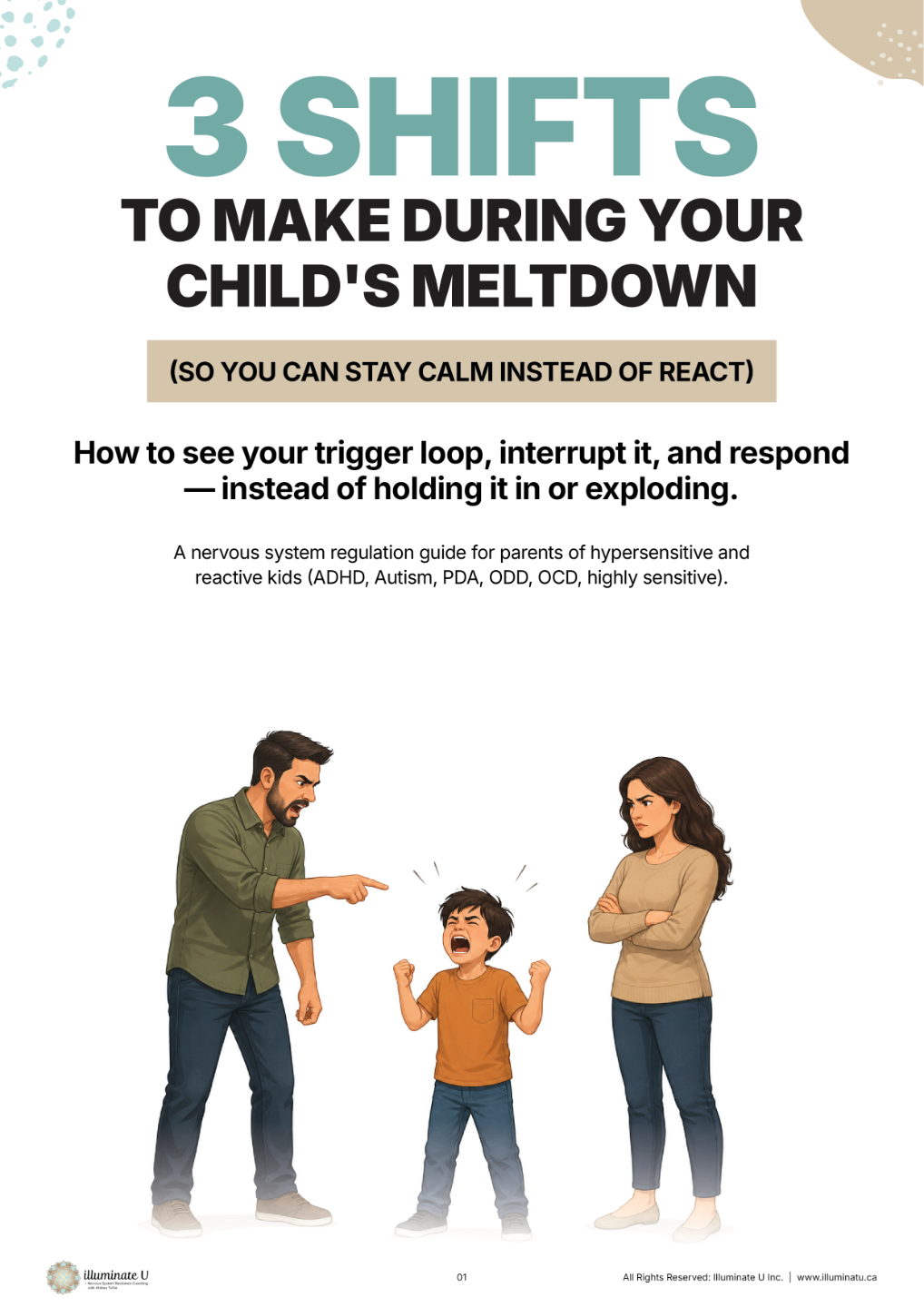
Free: The 3 Shifts Guide
The trigger loop and 3 patterns you get stuck in during meltdowns — and how to shift them so you can stay calm instead of react.
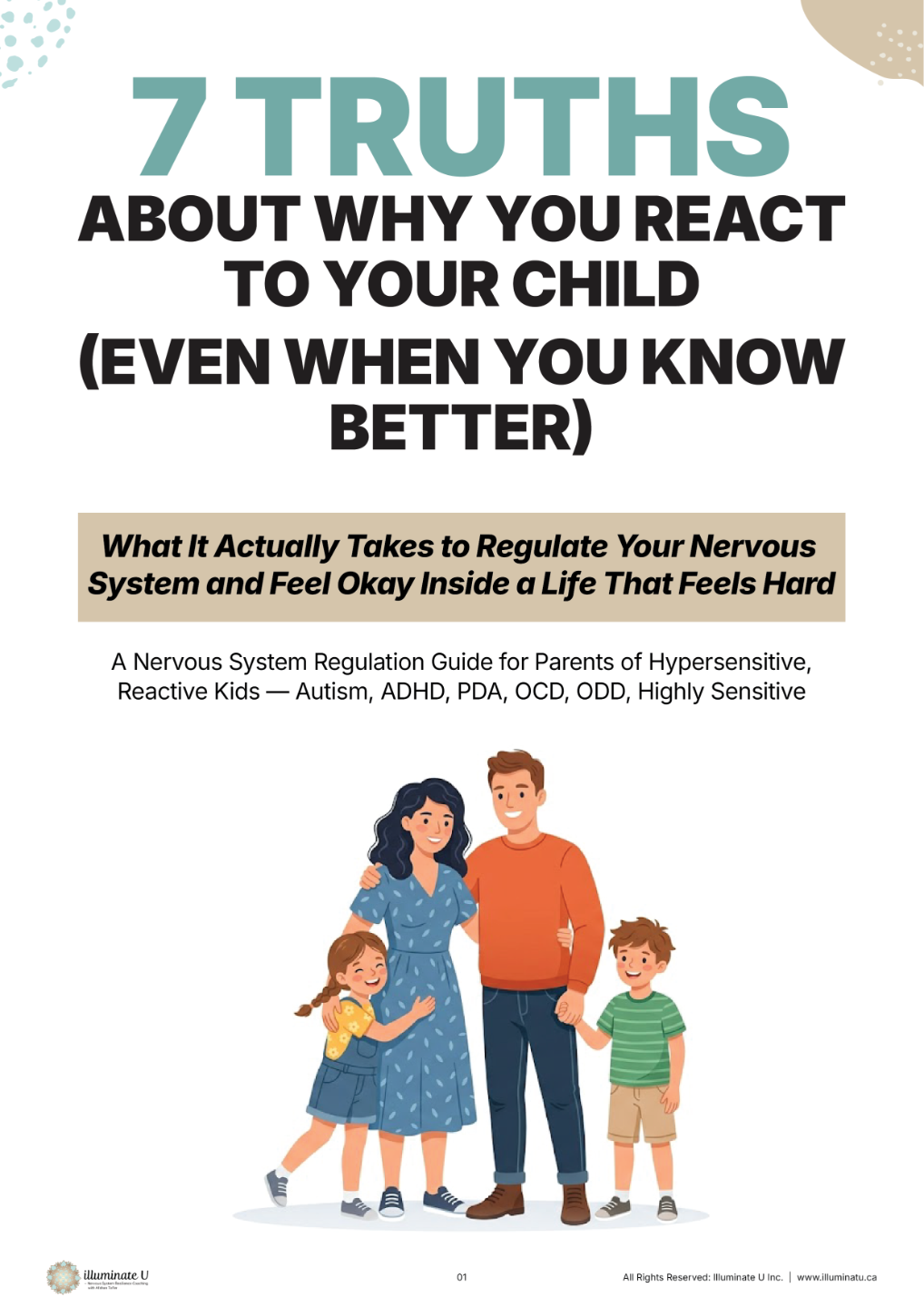
Free: 7 Truths About Why You React to Your Child Guide
Why you react even when you know better — the conditioning, nervous system states, hidden beliefs and patterns, and buried emotions running the show.

