
How Do I Know If I'm Accommodating My PDA, Autistic Child the Right Way?

Part 4 of a four-part series
Why you can't hear your own knowing, where the self-doubt got put into you, and how to come back to your own instincts.
How Do I Know If I'm Accommodating My PDA, Autistic Child the Right Way?
I'm accommodating my child, but it feels like I'm giving in.
It feels like I'm being permissive. Like I'm letting things slide that I shouldn't be letting slide, and that I'm not doing my job as a parent.
So then I stop accommodating, and I challenge them, and then everything falls apart.
So I go back to accommodating. And then I'm right back to feeling like I'm giving in.
And I go back and forth between those two, over and over, and I don't know which one is right.
And underneath all of it there's a quieter question, and it's much harder to say out loud. Am I ruining their future? Is this going to be the thing that I look back on and realize I got wrong?
And I feel like I'm failing as a parent.
So if you're parenting a PDA, autistic or high-needs child, I know you're carrying this, and I know how exhausting it is. Because you are doing one of the hardest versions of parenting there is, and you are doing it while doubting every single decision you make inside of it.
And so what we do is we go looking for someone to tell us. We take the course, we read the post, we ask in the group, we ask the professional. And we get three different answers, and we're right back where we started.
You are not failing. And you are not missing a piece of information either.
What's happening is that you can't hear your own inner knowing from where you're standing right now. And there are very real reasons for that.
So today I want to show you why that happens, and where the doubt got put into you in the first place, and how you come back to your own instincts and intuition. Because in the end, that is the only thing that is going to tell you what your child actually needs, and it is the place from which parenting your child becomes a heck of a lot easier.
Catching You Up on the First Three Parts
This is part four of a four-part series, and this is the last one.
In part one we went through what happens when your child can't separate from you, and the seven things that drain you.
In part two I took you through the seven moves for working with the things that get triggered in you, so that co-regulating doesn't cost you so much.
And in part three we went into your own child. Why they need this much from you, why accommodation on its own may still leave them stuck, and how I worked with my son on being able to separate from me.
And today is the question that comes right after all of that. How do you know if you're doing it right?
Let's begin.
The Fight My Husband and I Kept Having
My husband and I used to fight about how much attention and accommodation and co-regulation was really necessary for my son.
He would say some version of, "He can do it himself, but if you keep doing it for him, he won't do it himself." We were having a hard time at that point with me leaving, and he would say, "If you don't just leave and take time for yourself, he'll never learn to be okay. And if you keep staying, he'll never build the tolerance and the knowing that he is okay without you."
And then I would fight him on it.
Because it felt so uncomfortable for me. It felt like I was abandoning a child with a disability who needed this to function well in life. It completely went against my instincts from what I was observing in my son.
I knew my son's nervous system. I knew what happened when he was pushed past what he could hold. I knew that what looked like learning from the outside was very often just masking, and a stress load that kept mounting inside him. And then it would come out sideways later. He would not be able to meet his basic needs, or he would have a meltdown. And then what we thought we saw as progress just wouldn't stick.
So when my husband said these things to me, it landed in me as a threat to my child and to my own instincts, and I defended against it with everything I had.
But then it also triggered the doubt and the fear in me. That feeling of, am I doing this wrong?
And then, of course, I went looking to the outside to find the answer to whether I was doing this right or doing this wrong.
And Then I Went Looking for Someone to Settle It
But I want to step back for a moment here and tell you that this wasn't only my husband saying these things. These messages were coming from everywhere.
Every four months we would have a call with our doctor, and every four months I heard the same thing.
"You need to push him a little more."
"You need better boundaries."
"Let the behavior therapist come and show you what needs to be done."
And underneath all of this there was one message, which I heard very clearly even though nobody said it in those words. The message was, "You're not the expert. The behavior therapists are the experts."
Back then I had already been refusing behavior therapists for years. Because their approaches at the time, at least, did not align with how I wanted my son to be treated, and I was not comfortable with what they wanted to do with my son, or what they wanted us to do.
So I was already following my instincts to some degree by pushing the behavior therapy away. But it also felt like I was fighting against everything I was being told to do.
The challenge was that I could not have explained my instincts to anybody with any confidence. I had a feeling about something. It felt right in me. But a feeling doesn't hold up in a room with a doctor in it, who is telling you to trust the other experts.
And then I also got it from another angle, which was my friends.
I was out for dinner with my friends. My son was 13 at the time, and somewhere in the conversation I mentioned, without thinking much of it, that I still slept with him. That we would co-sleep.
And one of my friends said, "Aren't you enabling him and not teaching him to sleep on his own?"
At the time I think I tried to explain it, or justify it at first, but then I saw eyes glazing over, so I said something light and moved the conversation along. Because that is what I did in those years.
What I remember is the heat coming into my face, and going quiet for the rest of the night, and then lying in bed going over it, feeling again like I was doing something wrong.
So then what happens? I call this the number one pattern I see in parents. I went looking for the expert who could settle it for me. I went looking to the outside to find the answer.
I saw between 15 and 20 therapists over the years to try and help me with me and my son. Most of them told me how extreme our situation was, and that they really weren't sure how to help me. You could tell that they didn't have the confidence to help me through this kind of storm.
And then I contacted the few people in the world who had any real understanding of autism and PDA and OCD together, which is my son's profile, and which I mentioned in part three. And none of those people had a good answer for me either.
And every single time somebody didn't have an answer for me, or I could not find the answer from the outside, something in me got a little more frightened. Because if the people who were supposed to know these things, the experts, didn't know, then it was all on me to figure it out.
And I did not trust me. That was the challenge. I did not trust me. Especially when it was being mirrored all around me to not trust myself, and to trust someone on the outside instead.
The Night I Typed PDA Into Google
And then there was this one night, a long time ago. I didn't put this together until years later, and connect it to what I'm going to talk to you about now.
But there was one night a long time ago where I'd had a very hard day with my son and I was exhausted, and I went online looking for anything that would make sense of what I was living inside. Someone had told me about PDA in passing, but I hadn't looked into it at that point.
And then that night I typed "pathological demand avoidance" into Google.
And I started reading, and something inside me went very still, and this strong energy started to come up from my gut.
That is the only way I know how to describe it. My body recognized truth. Nobody handed it to me, and no professional sent me there. But this deep inner knowing came forth and said, "Yes, this is it."
For a long time afterwards the doctors around us did not understand PDA at all, and we did. There were a lot of challenges in that.
But off the back of that deeper knowing of truth inside of me, we then made one of the biggest decisions of our lives. We took my son out of school. And after a while we took structured learning out of the equation altogether.
And then what happened? I second-guessed it for years.
My body would tighten up. What if people are judging me? What if I'm doing the wrong thing here? What if this is the decision that costs him his whole future?
So what I understood much later was that this was the whole pattern, and it had very little to do with information.
It wasn't that I had no instincts about my son. My instincts were good. I had been reading him accurately for years, and I had been acting on that read, even while I was telling myself I had no idea what I was doing.
What I didn't have was any ability to trust what I was reading over somebody else who sounded more certain than I did.
And this was making my parenting experience so much harder than it needed to be.
What I Hear From Other Parents
And this is what I see and hear from so many of you. From my clients, and from parents who write to me and say things like this.
"I constantly hear from family members, or school, or even my partner, that they're not like this at my house, or with me, or at school. And since the professionals, and even extended family, or even the secondary parent, can mostly see the masked version too, I start to question myself and what I know is right and true."
And I also hear things like, "I have gotten such bad advice because the therapist had no idea what my life was like."
And, "I have done years of talk therapy, but still find myself hardwired with unuseful beliefs that make it hard to trust myself in this life."
And what I notice, again and again, is that so many of you come to me already holding the answer. You tell me what you think your child needs, and you're usually right. And then you ask me to confirm it for you.
The challenge with doubting yourself is that it always leads to the same place. You go searching high and low for an expert. Someone outside of you, who can tell you what to do and whether you're doing it right or wrong.
That part was so strong in me, and it's really strong in all of the parents I work with. And underneath it, if I'm honest, I thought that if I could just finally become the perfect regulated mom, then I could fix myself, and fix my child, and feel good enough.
But that was my survival system talking.
So if you can't hear your own knowing about your child, you are not the only one. And this isn't a flaw in you.
Where the Doubt Got Put Into You
1We give in, because we can't be with their distress.
2We push, because of what we were taught. Most of us swing between both of them, in the same week and sometimes in the same day. And while either one is running you, your own instincts are very hard to get to.
The Two Patterns Underneath the Swing
So let me come back to the swing I described at the start, between giving in and pushing your child.
In my experience, each of those pulls is a survival pattern with its own origin, and most of us go back and forth between both of them.
And these two are what get in the way of holding that calm and confidence when our child is in distress, or facing something hard. They are also what gets in the way of reading your own instincts and intuition about your child.
Pattern One: We Give In, Because We Can't Be With Their Distress
The first pattern is that we give in. We over-accommodate, we give too much control, and we do whatever it takes to keep the distress from happening at all.
Because for a lot of us, our child's distress isn't crying. It's a meltdown that can go on for an hour or more, and it can have a lot of aggression in it. It can involve being hit, or having things thrown, or watching our child hurt themselves. And it can involve watching them not be able to meet their basic needs.
So of course we avoid it. It makes sense, it's adaptive, and there's no shame in this. This is a hard parenting experience.
But for a lot of us, there's something older sitting underneath it too. Because some of us have a really hard time challenging our child at all, or helping them through something hard. We carry wounds around our own needs not being met when we were kids, and so we overcompensate now. Sometimes to the point where we lose ourselves in it.
When I was young, I was put in daycare after school, and it was hard for me. Then my mom would pick me up and we would go home. And she was there, doing all the things, being loving. But she didn't have the time to be truly present and attuned to what I needed, because of how much she had to do to keep things running.
This is such a common experience for so many people.
But when I went into this experience, and I was with this young part of me, I realized that what I needed most back then was for my parent to just hold me. To have some time to just be with my mom, to be co-regulated by her. And there just wasn't time for that, except maybe at bedtime.
And I don't say this to blame her. She did the best that she could.
But being loving and being attuned to our kids' emotional needs are two different things. A lot of us got the first one. Our parents were loving, they were there, and they did things for us. But we didn't get the second one. We didn't get them really tuning in and reading our needs and giving that to us, and there is a deeply healing experience that comes from that.
And then we carry real pain from that. And this kind of parenting can bring all of it to the surface.
So what happened as a result of this experience is that I became very independent very early in life, acting like I didn't need anyone. I'd override my own needs so easily with others, and then especially with my son when I had him.
But deep down, a younger part of me was always getting triggered if I didn't meet my son's needs. It felt like I was hurting my little girl all over again. And my system was trying to protect me from feeling that by giving my son everything.
So this is the part I think is worth checking in on. For all of us who do a lot of accommodation for our child, and feel like we're losing ourselves, and feel like we're giving so much to them.
And that's what was happening when I fought my husband so hard, too.
I couldn't see it at the time. But I was protecting myself at least as much as I was protecting my son. Because if I could keep my son from getting distressed, then I wouldn't have to feel my own past unhealed wounds.
And there was more underneath it too. A part of me didn't feel safe during his aggressive meltdowns either, and didn't want to deal with the hour-long episodes, so giving him what he wanted was how I felt safe again. And another part felt ashamed for the times I got angry with him. There was a lot of guilt and shame in my system. So my system was keeping me away from the risk that my rage would get activated, and then I would have to feel that shame and guilt on top of it.
So you can see how our wounds can drive our protective system to do almost anything to keep us from feeling what's underneath. This is survival.
Pattern Two: We Push, Because of What We Were Taught
The second pattern is the other side of the coin. We push. We make them do it. We decide that they have to learn.
And this pattern often comes from the environment that we all grew up in, as well as our own inner learnings around how our parents pushed us. Because we learn from mirror neurons, and we learn from all of our own experiences. And then when we start to parent, those patterns come up in us and we start to exhibit them.
A lot of us were raised inside behaviorism, whether or not we ever heard the word for it. It was the behaviorism era, and it is starting to come to an end now, hopefully. And alongside it, the patriarchy era version of what a strong and good enough parent is supposed to look like, and what a successful child looks like.
Many of us learned that for a child to learn something, they have to be exposed to it and pushed into it, even if they don't want to do it. It was almost like it's good for them to push your child a little. Rip the bandaid off and they'll be fine. Throw them in the pool and they'll learn how to swim. Leave them to cry and they'll learn how to settle on their own.
This is what we learned. It's programmed inside all of us. We learned that coddling creates weakness, and that a child who is given too much will never be able to cope or do well in life.
That was the water we were all swimming in. And whether or not we agree with any of it now, it is still in us, often running the show below the level of conscious awareness. So we need to shine a light on it and recognize it now.
Because it's in the voice that shows up at the worst possible moment and tells you that you're being too soft. It's in your mother's or your father's comment at dinner, when they see how you are with your child. It's in the look that the other parent gives you at the park. It's everywhere.
So we end up holding both things at the same time. The imprint that says push them or else they won't be successful, which means you won't be successful as a parent either. And the other imprint the body carries, that remembers exactly what being pushed felt like.
And So We Yo-Yo Between the Two
Remember the fight my husband and I kept having? He was in pattern two, the pushing. And I was in pattern one, the giving in. And we were both completely certain that we were right.
But most of us aren't only in one of them. Most of us are in both, in the same week, and sometimes in the same day.
We push for a few days, and then we feel awful about it, and then we swing all the way back into giving everything. And then we're depleted, and we snap, and we swing back again.
And living in that swing is exhausting. It's frustrating. It can feel despairing. And it can leave you absolutely full of shame, because it is also really hard on your child.
And from the inside, it can look and feel like you're just being an inconsistent parent, and like you're the problem.
But it's really just your survival system doing the protective patterns it learned, trying to protect both you and your child from failing at life. We are all built this way. Our survival systems are just trying to protect us.
And while a survival system is running you, your own instincts are very hard to get to. Because what's guiding you in those moments is that old protection, and not your real, true read on the child who is in front of you right now.
We Can't Heal What We're Not Aware Of
So the first piece of work here is to become aware of the patterns that are driving you into survival parenting instead of more regulated parenting.
See if you can start to notice which pattern is driving you in a given moment.
When you push, is that coming from your read of what your child needs right now, even when the push is a gentle one? Or is it the old imprint telling you that you're being too soft?
And when you give in, is that coming from what your child needs right now? Or is it that you can't be with their distress, or that you fear what will happen with their aggressive meltdowns if you don't give in?
So just notice with curiosity, and know that you don't have to do anything with it yet. These are survival patterns in your system that can take over. They are not the truth of who you truly are, and they're not who you want to be as a parent.
Eventually, what we want is to parent from a regulated place of, "I am okay even if you're not okay, and I can handle this." That's the felt sense we want on board when we parent our kids through these challenges.
And we want to parent from that intuitive place that has this deeper knowing of what our child needs. Where we're tuning into them, and we know what they need.
And I think this state only really becomes available to a nervous system that isn't being run by these survival patterns.
Why You Can't Hear Your Own Knowing
So let me show you what that regulated, intuitive place actually is, and why it's so hard to get to from where you're standing right now.
Because we talk about intuition as a deep knowing. And for some of us, that deep knowing can feel like a thought. But it actually isn't.
Your knowing about your child comes through your body first. It's a felt sense.
For me it's a deeper knowing that creates this feeling in my gut. Deep in the gut. And it's solid and it's steady, and it feels like truth, when I tune into it underneath all the survival that can be sitting around it.
And it's a deeper knowing that my mind sometimes can't explain, and that my mind also sometimes tries to deny and tell me I'm wrong. So you can feel that deeper truth, and then the mind comes right in and says, "Are you sure?" and puts doubt and skepticism in you. A lot of us carry that pattern, because we were taught for a lot of our lives not to trust our instincts.
So I can't always tell you why this knowing feels like truth. But it's a feeling of, I just know. I just know. And it's important to get to know this feeling, especially in parenting our kids.
Sometimes you can feel it and you can't put any words to it. And then when you do find the words for it, your body answers. Something opens, or lets go, or sometimes you sigh, or there's a feeling of relief.
And the skill we need in order to read our intuition is interoception, which is your ability to sense what is going on inside your own body. To sense your heartbeat, your breath, your gut, the tightening in your throat, the warmth or the heaviness in your chest.
And interoception is how your instincts about your child reach you in the first place.
So you can probably already see the problem for parents like us, and why this is so hard to read.
1Stuck on ON, in low-grade fight or flight. Everything feels urgent, so the quieter signal can't be picked out.
2Functional freeze, which I call pretend calm. You become a walking head, and all you get back is more thinking.
3Dorsal shutdown, stuck on OFF. Numb and flat, with almost nothing coming through at all.
You Can't Feel the Signal When Your Body Is This Loud
You can't feel the signal when your body is loud and stuck in chronic stress signals.
When your nervous system has been under this much stress for this long, that channel of your intuition becomes hard to read, because of three nervous system patterns we get stuck in with this kind of parenting. Just notice if you recognize these.
The first is stuck on ON, and constantly stressed in this low-grade fight or flight response. Always on, always braced for the next thing, always running with doing, doing, doing all day. And this is where I lived for years. Your survival system is loud, and there's alarm running through you most of the day. Your heart is up, your jaw is tight, your neck and shoulders are tight, you are braced and you are scanning. And in a body like that, everything feels urgent. Every signal reads as danger, because the volume on danger is already turned all the way up. So you cannot pick out the quieter signal underneath it.
The second is the functional freeze pattern, which is what I refer to as pretend calm. And this is the one a lot of us are in without knowing it. We think it's just us, because from the outside it looks like we're coping and we're fine. You're getting through the day, you're managing the appointments and the meals and the meltdowns. But underneath it you are braced and shut down at the same time, and you can't really feel your body. This is what I call being a walking head. You're thinking all day, so when you ask yourself what you should do about your child, all you get back is more thinking. More lists, more research, more tabs open at midnight. Your instincts are still there, but you can only reach them through your body, and your body is the thing you have lost contact with. It's the numbing layer that has made you lose contact with the body.
The third is dorsal shutdown, which is more being stuck on OFF. And this is further down than freeze. It's more numb, disconnected, flat. And here there is almost nothing coming through at all. There's no urgency, no lists, no searching. Just blankness, and a feeling of, I can't, and a feeling of giving up because it all feels so hard. And in this state it is hard to even ask yourself the question of what you're feeling, because it's completely muted.
And all of those were me, on different days in the same week. And this is most of the parents I see and work with.
Your State Decides What the Signal Means
Those three patterns are why the signal can be so hard to feel. We get stuck in them over and over again, and we're never in that place of being truly present and able to sense the safety signals inside of us.
And then there's one more thing sitting on top of that.
Story follows state. Whatever state your nervous system is in, your mind will make a story that matches it.
So when my friend asked me whether I was enabling my son that night at dinner, my body did not tell me she was wrong. My body gave me heat in my face and a drop in my stomach, and that is alarm combined with shame.
And then my mind took that alarm and shame and built a story on top of it, and the story was, "She's right, and maybe I'm damaging my child." The story came from the state I was triggered into.
So that felt like information. It felt like I had just had a realization about myself. But what I actually had was an activated nervous system with a story sitting on top of it, which came from my deeper programming and conditioning.
Those same beliefs we hold inside of us from when we were young, about what makes us safe, lovable, belonging and successful. And the I-am beliefs that get triggered. I am wrong. I am bad. I am not enough. When you're hearing those, that means you've gone into a state that is driving the story.
And this is why being told to just trust your gut is not useful advice for a parent in our situation. When your gut is full of alarm all day long, it will usually feed you that old story. And that old story will feel like it is knowing. It will feel like truth. But it is really survival programming.
One of the teaching models I use is the 90/10 rule. 90% of a reaction is the past, and only about 10% is what is actually happening right now. That's a rule of thumb I picked up in one of my Havening trainings, and it isn't a research finding. But it's about how much of what gets triggered today is really coming from the past.
It's how I understand my own reactions, and honestly, it has held up every single time. Every time I've been triggered, I go inside and I look at what's getting triggered in me when my son's behaviors trigger me. And it is always connected to the past.
So the loud, urgent thing that shows up in you when you have to make a decision about your child may not be your inner knowing at all. It may be a much younger version of you, in a body that learned a long time ago what was dangerous and what it cost to get something wrong. A younger version of you that learned a certain belief, and that belief is what's getting triggered today. And it feels like truth in your system, but it isn't.
And I'm not saying this is a reason to stop listening to yourself. It's a reason to get to know which of the two you're listening to. Is this survival, or is this truth?
Because so much of making our parenting easier is getting to know the difference between those two.
And this is why interoception matters so much. Learning to recognize what's going on in your body. Learning to recognize when it's conditioning and programming talking.
And the key here is not to override it or fix it. The first step is just becoming the awareness of it, and seeing that this is a program running. So that you can begin to have space from it, and that truer signal can come through.
This is a huge part of what I teach inside the Regulation Rebuild, my signature course. Because learning to sense your own state, learning to sense survival in your body and also sense safety in your body, is one of the main things that makes a parent more regulated over time, and able to parent more intuitively with their child.
And the World Keeps Topping It Up
So some of this is history, getting triggered in the present by the past. But some of this is also the reality of what happens around us in our parenting experience.
Because for years we have been told that our read of our own child is wrong.
The professionals mostly see the masked version of our kids. Sometimes the teachers at school do too. So they're working from a child they don't actually live with, and then they're giving you their feedback based on that.
And then family members tell you, "They're not like that at my house."
And when the standard approaches don't work with our children, we are the ones who get told we must be doing something wrong. One parent put it this way: "Our kids can't use the same gold standard techniques, and yet we get blamed for it not working."
So going against our own instincts gets topped up every single week, by somebody who has seen your child for an hour in a room, on their best behavior. Our children mask. And then we get this from everywhere.
No wonder you can't hear yourself. No wonder you can't hear your own inner truth. There is all this pressure around us, and it makes sense.
What Your Child Is Reading in You
So let's understand what your child is reading in you here. Because there's a feedback loop that so many of us get stuck inside.
Your child can feel all of this in you. They are reading your state while you are trying to make the decision about the best way to respond to them and work with them.
In part three of this series I told you about sitting beside my son in our family room, and how he could feel everything I was holding in, no matter how well I thought I was covering it up.
The same is true of a decision that comes from doubt, or a decision made from inside one of those survival patterns.
Whenever I decided something from that place, it did not come out of me cleanly. There was a wobble in it. My voice was different, my timing was off, and I would say something and then half take it back thirty seconds later. And he could feel every bit of that, and all the fear underneath it.
And a child who is already scanning for danger, the way many of our kids are, may read that uncertainty in you as danger itself. That was a big one for me. Because their system is asking one question all day long, and the question is whether the person they depend on is okay and has got this. That feeling of, I've got this.
So then it would go badly. And I would take the fact that it had gone badly as proof that I had made the wrong call. And then I would trust myself a little bit less the next time.
That was the loop I was in for years.
And when I look back now at the decisions that went badly, most of them were not actually wrong decisions.
They were reasonable decisions made from a body that was full of alarm, and my son was responding to that alarm.
So our children are reading us. And that's why it's so important for us to understand what is survival and what is truth, and whether we can act more from truth.
How You Come Back to Your Own Instincts
So let's get into how you come back to your own instincts. Because it's not easy, and it's taken me years, and I can say that I'm still working through it. Still noticing the patterns of questioning myself, and instead coming back to myself.
1Getting to know your survival signature, in your body and in your mind.
2Getting to know your own instinct signature.
3How I tell them apart.
4Being the watcher instead of being inside it.
5What you do with everything you're told.
6And then with your child.
So how do you get out of this loop?
First, you need to be able to read the sensations of survival, so that you know what they are. And then you also need to be able to read the sensations of your own true instincts and intuition.
So it starts with awareness, and with building interoception skills.
And keep in mind that for those of us who have been in chronic stress for a long time, our interoception goes out the window. We tune out our body because it's too painful to feel. And we need to rebuild that. We need to rebuild feeling safe being in our bodies, and sensing what's in our bodies. Feeling the feelings and the sensations, and starting to recognize the patterns our nervous system goes into. Because it's all patterns.
Getting to Know Your Survival Signature
The first thing is to understand what your survival signature is in your body. This is about the particular way that fear shows up in you, because fear shows up in these moments, and you need to catch it the moment you get activated in it.
For me, that signature is a feeling up my back and in my chest, and a tightening that wants me to move toward it and do something about this right now.
Yours will have its own felt sense. For some it's in their chest. For some it's in their throat. For some the jaw tightens. Everyone is different.
The second is the fear signature in your mind. We have thoughts that play on repeat, because fear has a script, and it runs the same meaning making over and over again.
So you can notice the fear-based meaning your mind makes by noticing all of the should thoughts that you have, and whether you're attached to an expectation. "He should be able to do this. I saw him do it yesterday. I expected him to do this himself by now. This is not okay. They should be able to do this by now."
All of the shoulds, and being attached to expectations that you can't let go of, and fighting reality. That's not regulation. That's old programming. I have a whole episode on letting go of the shoulds, which I think is very helpful alongside this.
And then the other side of the fear is the one telling you that you're damaging your child. One side tells you that you should be pushing them. The other side tells you that you're damaging them, and that if they don't do well in life it will be your fault.
And there can also be a real fear of your child being in any pain or distress, because then it's going to trigger you feeling your own. And that can be hard to tolerate. It can be hard to tolerate their pain, and your own inner pain getting triggered on top of it.
So this side of fear can make you give in.
Both of those are fear. They just push you in opposite directions, which is the swing we started with.
And sometimes you can't feel your fear at all. This is very common. You can't feel the fear, but instead you notice that you're trying to control, and you're trying to fix.
That's driven by fear too. It's a fight response trying to help you not feel the fear, and to fix the situation so you don't have to feel the fear or any vulnerability getting triggered.
And this can look like managing the environment so that nothing goes wrong. Planning ten moves ahead, pre-empting. Pushing a little or giving a little to make the feeling inside you go away. And reaching for the internet at midnight to find something that will tell you you're doing it right, or tell you that you're doing it wrong.
Once you know what this looks like in you, you can catch yourself in it. And this matters, because you can't read your child when you're in this.
So that's the survival side of it. Fear in your body, fear in your thoughts, the fear that you're damaging your child, and the fixing and controlling that takes over when you can't feel the fear at all.
And Then Your Own Instinct Signature
So how do we recognize your own intuitive instinct, and the signature of that?
The simplest way I know how to describe the difference is the direction it moves in your body.
Following your intuition tends to feel like an expansion. Something opens. There's a relaxation in it, even when what you are choosing is hard.
But fear goes the other way. It contracts. There's narrowing, there's tightening, there's constriction in the body. Your own knowing tends to leave your body more relaxed, rather than more stirred up.
And you can have both at the same time. You can have your own knowing come through and feel a slight relaxation response, and then immediately the mind comes in, and the fear patterns come in, and there's a tightening and a constriction on top of it. And that can happen very quickly. Which is part of why it can be so hard to read.
So how do we learn this in simple ways first?
Because sometimes we just can't read it when we're in it with our child. It's not coming through, because survival is so strong and so powerful, and it's the dominant voice.
So practice this outside of the moments with your child. In the small, ordinary decisions where nothing is really at stake. Because that's where the signal is easier to hear. Survival isn't as loud, so the quiet signal can come through and you can start to notice it.
You can start noticing it in things like these.
You're at the grocery store, standing in front of the fruit. And your hand goes to one of them before you've compared anything. You just had this instinct, and you grabbed that one. Your body picked it. This is really simple, but you can try it out. Because this is where you start to get to know that body signature of the instinct. That's the one. I'm going to pick that.
Another example is that you see someone and you know that you know them, and you cannot come up with their name. But your body knows who it is before your mind does. And then the name comes, and something in you goes yes, and it settles.
And then even with your child, in the low stakes moments. You know before you try the thing that today isn't the day. You've attuned to them, you're reading them, and you know that today is not the day to push anything, or that it's a day to really reduce the demands. And you have that knowing. It comes in just based on how your child looks and how they seem. And it arrives as a quiet feeling inside of you, instead of as dread.
So what you're doing in all of those is learning your own yes and your own no while the volume of survival is low. So that you have something to compare it to when the big moments come along where there's more survival. You've already gotten to know that signature within you, and then you can start to read it in those moments with your child too.
How I Tell Them Apart
Here's another way I tell them apart, and it's a little more practical. The fear changes depending on who you last spoke to.
So remember the doctor call, and the dinner with my friends.
After the doctor call, I felt like, okay, I know I have to push my child more. And that felt like a knowing. That felt like a truth.
Then after reading someone's advice about what to do with a PDA child, I knew I had to lower all demands.
And then after that dinner with my friends, I knew I was enabling him.
Same week, same child, three different certainties. And each one arrived right after a conversation where I was triggered.
So is that a knowing? Is that really truth?
Just notice whether it comes right out of being triggered. Because once you get to know that signature within you, you can ask yourself whether that's really knowing.
What I've learned to recognize is that my knowing doesn't move around like that. It's quieter. It isn't trying to convince me of anything. It isn't telling me it should be this way and it should be that way, which can feel very strong inside. And when it comes, something settles. There's a flow in it. For me it's like a quiet confidence mixed with stillness that emerges, or this strong energy rising up from my gut that feels like certainty. Just like the way it was the night I read about PDA.
So it's about getting to know what that certainty and that deeper intuitive knowing feels like somatically in your body, so that you can differentiate it from survival.
My other tell is future fear. If what I'm feeling is all about my son and what he'll be able to do at twenty-five, then it's fear talking. Future fears are not intuition, and they're not deeper knowing. And once I know that, I can recognize it when it shows up.
But if I'm present and here with my son right now, and what I'm feeling is about my son in this moment, then it's information I can actually see and use. It's coming from my state of presence and from what my son needs right now. And that's the one I need to follow.
There is a bit of nuance in this. It really is about getting to know this signature inside yourself, which, as you can see, can sometimes be hard to put into words at all.
Being the Watcher Instead of Being Inside It
So let's talk about being the watcher of your survival, instead of being inside of it. Because that's how you learn to recognize survival, and to separate who you are from it.
We're not stopping the fear from coming. It's going to come. It always comes.
But when you notice the fear, can you start to notice it rather than be it? Can you become the awareness of it? You notice it as a curious observer, and you allow it to be there without letting it make the decision for you.
So I allow this fear to be here, and I allow whatever shoulds are coming up to be here. As soon as I notice I'm in a should, I know there's fear there, and I say, okay, all of this is allowed to be here.
I'm not going to fight it, and I'm not going to bypass it. Just allow it to be there.
And I don't push it away, because I know it's a part of me that's trying to protect me. And I can see how hard it's working.
Because what we don't want to get into is a place of deciding that the fear is lying to us and then fighting it, because that just creates more dysregulation.
So we want to feel our fear. We want to notice that it's there, become aware of it, and allow it to be there just as it is. This in itself starts to bring in regulation.
All of those future fears and protective responses are there to protect you and your child. They are trying to do the best they can to help you both be successful in life.
But the fear is not the place you want to make the decision from.
So you become the watcher of your patterns and your fear signals, and then a little bit of space comes inside of that. And then your own true read, your own truth, can start to come through.
Because trusting yourself doesn't mean trusting whichever survival pattern is loudest in you. It means getting enough space from the survival pattern that you can read your own intuitive truth signal.
What Do You Do With Everything You're Told?
So another thing I want to mention here is what we do with everything we are told.
Because we have all this information. We go out searching for it, and there's so much of it coming in from everywhere while we're trying to find the answers.
What I find is that you can read about PDA and have your body recognize your child and what they need. And you can read about PDA and come away with a rule based on fear, that you have to apply this for them or else they won't do well in life.
So with everything you read, just notice your inner reaction to it.
Because the important part here is that you take what resonates with you. What lands in your system. What you feel is a good approach for your child. You take that, and then you adapt it to what works for you.
You may try it out initially exactly in the format the expert gives you. But then it doesn't fully work. And then, with your own intuition, you adapt it. Because parts of it may be good and parts of it may not be.
And some days it will work, and some days it won't. It's a real dance. And this is why following our intuition is so important, so that we can do this dance.
And Then With Your Child
Now I also want to mention what happens when it comes to your child.
You may start following your instincts, and you may start giving them what they need, whether that's accommodating their need for control or gently challenging them. You're getting to know the difference between your survival signature and your truth signature, and you start to act on it for your child.
And your child reacts really badly.
I want to mention this because sometimes we then think, oh, my instinct was wrong. But it wasn't necessarily wrong.
Sometimes we need to try things out a few times, if we feel like it's really based on our instinct. We need to try it a few times to let our child get used to the new way we are reacting or responding to the situation.
They may escalate because it's different. And different, to a nervous system that doesn't feel safe, feels like danger. Their predictive brain needs time to update its mental models.
So you may need to repeat this a number of times. This is what happened with me and my son. I had to repeat it a number of times until he was able to really take it in and see that this is the new way of being, and that it actually does help him feel safer, even though it's different. And then he was able to trust it, and over time, change himself.
But that took some time. Almost the better part of a full year of us changing first. Following our intuition, and parenting from that place of, I've got this, I can handle your distress. And then he trusted it over time, and that helped him to change.
Trust Yourself in the Dance
So this is really about trusting yourself in the dance.
Am I accommodating my child, or am I giving in? Should I be challenging them? And how do I know if I'm doing this the right way?
Those are the questions we started with at the beginning of this.
And here's my honest answer.
Most of us are not giving too much. What may be happening is that we're giving from survival, or that survival is keeping us from giving enough.
Because when we are giving from survival, it costs us everything we have, and it may still not be giving our child what actually helps them grow.
How much we give shouldn't be coming from survival. It should be coming from what we feel is truly best for our child. And I say should here in the most positive way. There really are no shoulds.
How much we are giving is honestly best when it doesn't come from survival. When it comes from this connected, attuned relationship we have with our child, where we can read what they most need today.
And it's a real back and forth. You give them autonomy, you give them choice, and then there's some gentle challenge, and then back again. And that's the dance.
Some days it's a lot of accommodating until they have capacity, and then you do the gentle challenge. And sometimes, if you can't even meet your own basic needs, then you are challenging them, inside a connected and attuned relationship. And even within that challenge there's a dance of back and forth. Giving them some, and then taking that step to challenge them, and meeting your need.
It isn't a step-by-step method. It's a back-and-forth dance. And this is why we need to trust our instincts here.
And this is hard. It's not easy, because so many of us have been told that our instincts about our children are wrong. So many of us grew up with parents mirroring to us that we were wrong, or that we weren't doing it right, and that we needed to do it like other people. That there's a right way to do it, rather than your right way.
So I want to say this. You have not been coddling your child.
You have not been making your child this way.
You have been the one reading your child, all day, for years. And most people have no idea what it takes to attune to your child that deeply.
And your instincts were never gone either. They got covered over. Covered over by all of that conditioning and programming, covered over by survival, which is what I call the noise.
And then what you want is to learn to act from your own truth. As you get to know that signature, act from that truth. And it will often look different from somebody else's truth, because they're not living your life, with your child, and with both of your nervous systems.
So can it be okay to follow your truth? When you feel it, follow it. Celebrate it.
Because when you can parent from there, my friends, something really does change. You stop second-guessing every move you make, and you stop carrying everyone else's voice into the room with you.
And parenting gets so much easier. Even when the situation with our kids hasn't gotten easier at all.
You have been going through one of the hardest versions of parenting there is, mostly without support, for a very long time. And you have been a good enough parent the whole way through it.
So I invite you to take that in. Even on the days when you were completely sure that you weren't doing a good job, you are doing the best that you can.
Questions Parents Ask
How do I know if I'm accommodating my PDA child or giving in?
Most of us are not giving too much. The question isn't how much you're giving, it's where the giving is coming from. If it's coming from not being able to be with your child's distress, or from fear of what will happen if you don't give in, that's survival driving it. If it's coming from your read of what your child actually needs today, inside a connected relationship, that's your instincts. Both can be true at the same time, and it's worth knowing which one is driving.
Why don't I trust my own instincts with my autistic child?
Usually because it has been mirrored back to you for years that your read is wrong. The professionals mostly see the masked version of our kids, family members tell you they're not like that at their house, and when the standard approaches don't work with our children we're the ones told we must be doing something wrong. On top of that, a nervous system under chronic stress can't easily feel the quieter signal underneath the alarm.
What's the difference between intuition and anxiety in the body?
The direction it moves. Following your intuition tends to feel like an expansion, where something opens and there's a relaxation in it, even when what you're choosing is hard. Fear contracts: narrowing, tightening, constriction. Your own knowing tends to leave your body more relaxed rather than more stirred up. And you can have both within a second of each other, which is part of why it's hard to read.
My child reacted badly when I tried something different. Does that mean I read them wrong?
Not necessarily. When you do something new, it's outside what your child expects, and different can read as danger to a nervous system that doesn't feel safe. Their predictive brain needs time to update its mental models. If it came from your genuine read, it may need repeating a number of times before they can take it in. With my son it took close to a year of us changing first.
How do I use advice from experts without losing myself in it?
Notice your inner reaction as you read it. If it lands as "I have to do this, I should do this," that's survival. If it lands as "this makes sense, and I'm going to trial it for my child," that's closer to your own truth. Then take what resonates and adapt it. You may try it exactly as the expert gives it, find it doesn't fully work, and adapt it with your own intuition. Some days it will fit and some days it won't.
Before You Go
I hope this helped you. And if it did, I’d love to hear it. And if there’s another parent going through this, please share it with them.
If you haven’t listened to the rest of the series, the links are all here. Part one, part two and part three.
And I have three free guides for you, which are linked below and in the show notes.
One is on the three patterns most parents get pulled into during a meltdown, and how to shift them. That’s the 3 Shifts guide.
Then there’s the 7 Truths guide, which is about understanding why you react even when you know better.
And one is for the grief that nobody names, and finding your way back to meaning and purpose and feeling like yourself again when you feel like you’ve lost yourself. That’s the Meaning guide.
So pick one of those guides, read it, and take it in.
And if the work we went through today is the work that you want to do — learning to feel what state you’re actually in, coming back to your own instincts with your child, and parenting from those true instincts — that’s a big part of what I teach inside the Regulation Rebuild course. There’s a waitlist right now, and the course opens again in the spring of 2027. You can sign up for the waitlist and you’ll be the first to hear about it.
So thank you for being here. And thank you for doing this work that you’re doing for yourself and for your child.
About the author: Afshan Tafler is a Nervous System Resilience Coach, host of The Regulated Parent podcast, and a parent raising a PDA autistic teen with high anxiety and OCD. She is trained in Internal Family Systems (Level 3), Havening, polyvagal-informed practice and EFT, and is completing her Somatic Experiencing training. She has guided hundreds of parents of ADHD, autistic and PDA kids from burnout and barely coping to steadier, more connected and more alive, within the life they are actually living.
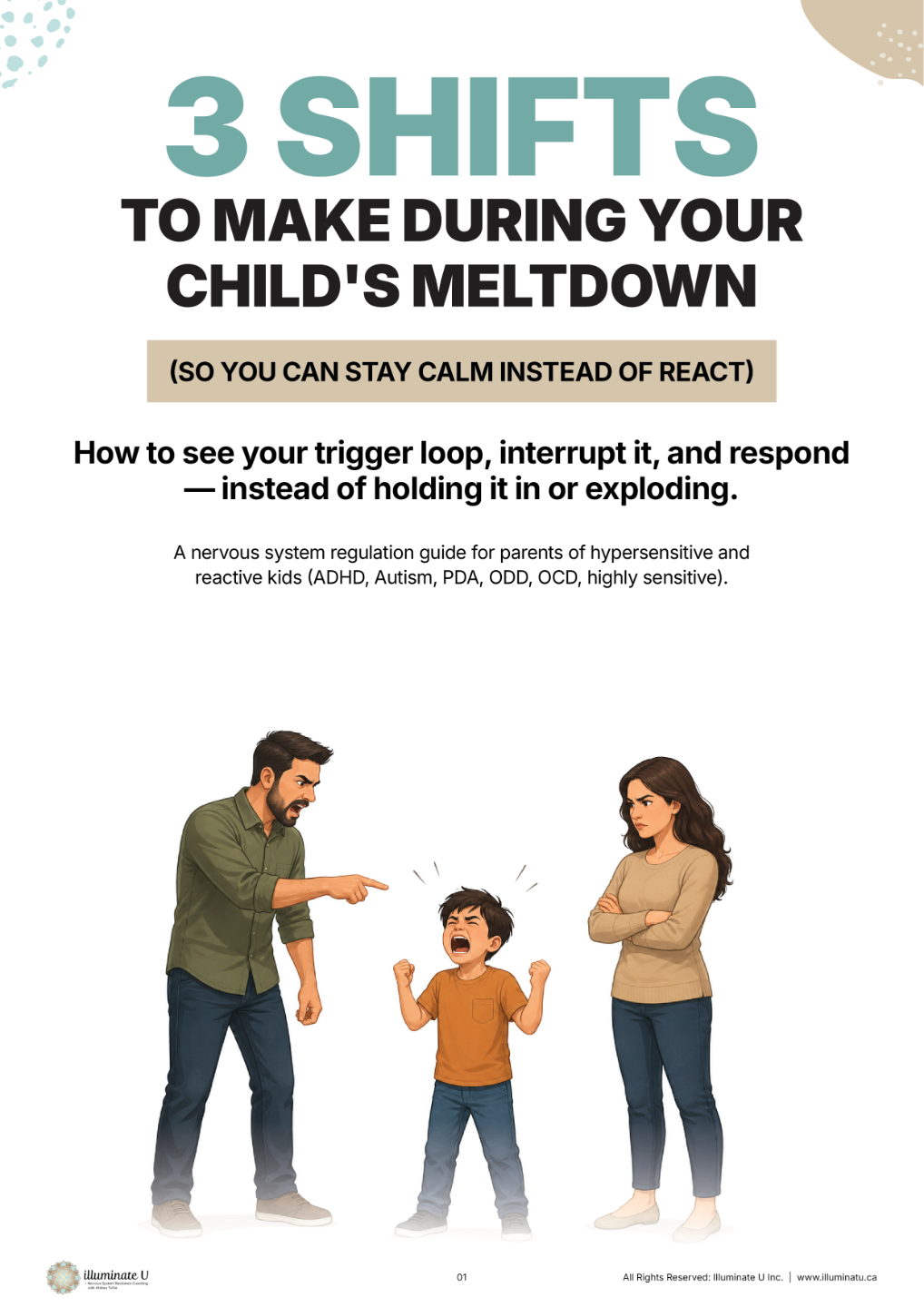
Free: The 3 Shifts Guide
The trigger loop and 3 patterns you get stuck in during meltdowns — and how to shift them so you can stay calm instead of react.
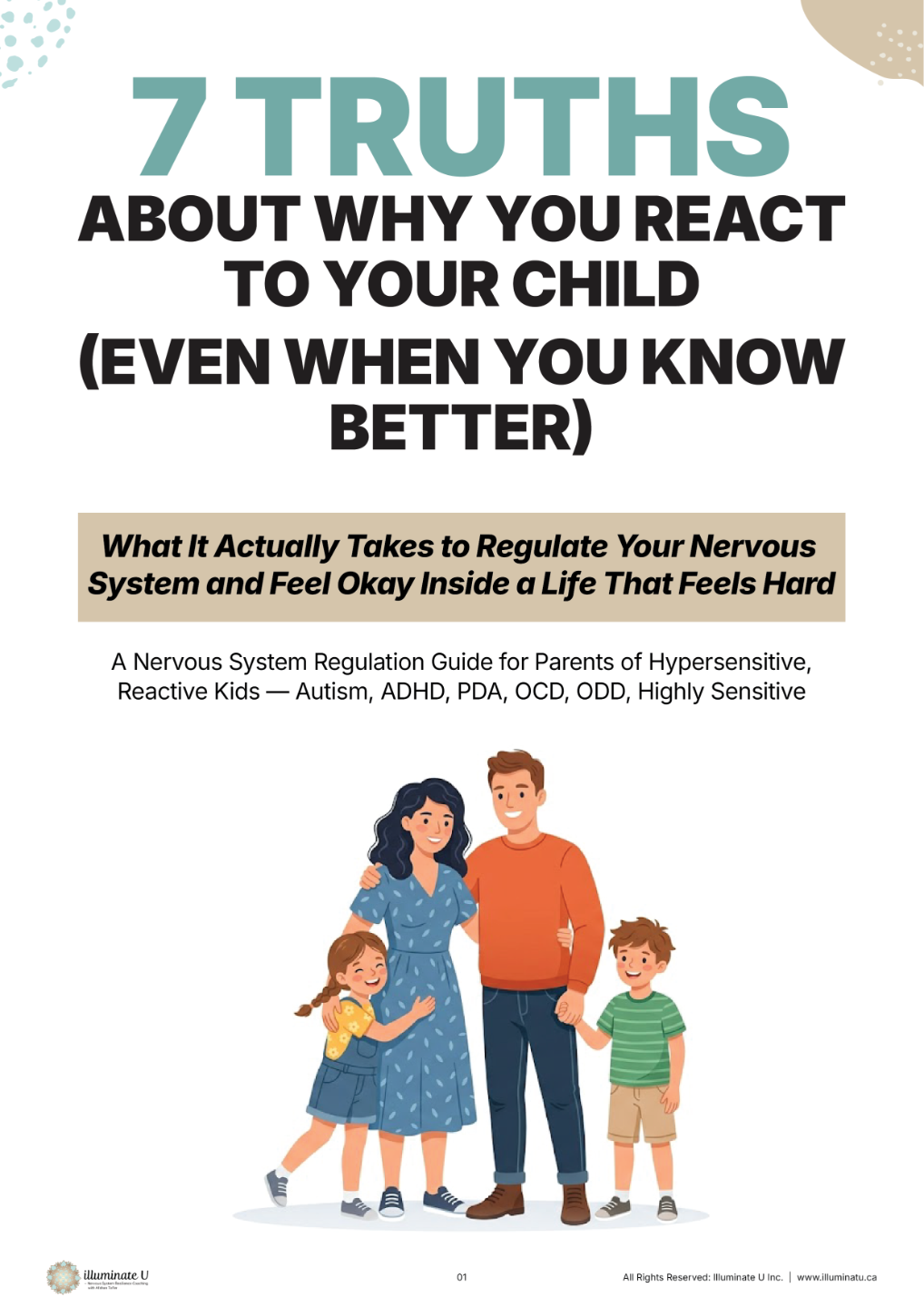
Free: 7 Truths About Why You React to Your Child Guide
Why you react even when you know better — the conditioning, nervous system states, hidden beliefs and patterns, and buried emotions running the show.

