
Why Staying Regulated With Your PDA Child Means Letting Go of “Shoulds”

When my son stopped going to school, it took me a long time to see that I wasn't just reacting to his behaviour. I was reacting to violated expectations. This post looks at how the shoulds we carry for our PDA, autistic or high-needs child fuel resistance, fear and shame, and how allowing what is helps us stay present.
You can also listen to this in audio format only on The Regulated Parent Podcast on Apple or Spotify. Look for Episode #36
When Everyday Expectations Turn Into Parenting Battles
Do you ever feel like you're constantly trying to help your PDA, autistic, or high-needs child meet what feel like basic daily life expectations…
only for them to push back?
Maybe it's going to school.
Maybe it's brushing their teeth.
Maybe it's homework, showering, being kind to a sibling, or simply cooperating with something that feels completely reasonable to you.
And when they resist…
you find yourself thinking something terrifying:
How will they ever function on their own in life if they can’t do these things now?
Because in our minds, there are certain things our kids simply have to do.
They have to go to school.
They have to learn.
They have to brush their teeth.
They have to shower.
They have to be kind.
They have to do their homework.
These don’t feel optional.
They feel like the basic requirements for becoming a capable adult.
So as parents, we feel completely responsible for making sure these things happen.
And when our child refuses, melts down, avoids, or escalates…
we push harder.
We explain.
We pressure.
We negotiate.
We try to stay calm.
We try consequences.
But the more we push…
the more they resist.
Until eventually the whole thing leaves you exhausted, dysregulated, and wondering:
What am I doing wrong?
What most parents don’t realize is that underneath all of this is something incredibly powerful driving the entire cycle.
Expectation.
Expectations that feel completely reasonable as a parent…
but can quietly trap both you and your child in a cycle of pressure, avoidance, escalation, and shame.
In this episode, you’ll understand why the expectations that feel necessary can actually keep both you and your child stuck in a cycle of dysregulation — and what begins to change when you learn the skill of dropping the expectation.
Let’s begin.
The Moment Everything Felt Like It Was Falling Apart
When my son stopped going to school, it felt like the ground disappeared beneath me.
School is not optional in our culture. It is the pathway to success, to independence, to safety, to belonging. It is how we measure whether a child is “on track.” So when he couldn’t walk through those doors anymore, my nervous system didn’t just react — it panicked.
I tried everything. Encouragement. Incentives. Gentle nudging. Firm nudging. Compassion. Consequences. Conversations about responsibility and the future.
Nothing worked.
Eventually, I pulled him out. But pulling him out didn’t mean I let go of the expectation. It only changed its form. If he wasn’t going to school, then he needed to learn another way. So I hired a tutor — because in my mind, it was not okay to not be learning.
The tutoring sessions became battles. He resisted. He shut down. He escalated. I grew increasingly frustrated, especially as the cost added up and the learning did not.
So I tried unschooling.
But if I’m honest, I wasn’t really unschooling. I was still pushing learning at every opportunity. The zoo became a lesson. The science center became curriculum. A nature walk became biology. Watching television became analysis.
I was constantly scanning for productivity.
And he felt it.
He escalated more. Soon he didn’t even want to read anymore. Every interaction seemed to end in the same place: me angry, him dysregulated, and a heavy belief settling into my chest:
I am failing him.
He is failing at life.
We are one big failing family.
And it took me a long time to see that I wasn’t just reacting to his behavior.
I was reacting to violated expectations.
The Old Lens: A World of “Should”
So let’s slow this down.
Because when I look back, school was only one expectation, and the most obvious one.
But when I became more honest with myself, I realized I was carrying dozens of expectations and these were the lenses through which I was seeing him.
He should go to school.
He should be learning.
He should be kind and share.
He should eat at the dinner table.
He should put his clothes in the hamper.
He should take a bath daily and brush his teeth twice a day.
He should pee in the toilet and not the planter.
He should respond when I call his name.
He should be responsible.
And maybe the most powerful one of all:
If he can do it sometimes, he should do it all the time.
Because I had seen him do these things before, my brain concluded that ability equals obligation. And whenever reality didn’t match that belief, something inside me tightened.
This wasn’t just about behavior. It was about conditioning.
I grew up in a world where meeting expectations meant safety. Performance meant belonging. Responsibility meant worth. So of course I carried that program into parenting. It had helped me survive. It had helped me succeed.
But now, that same program was dysregulating both of us.
Resistance: Fighting Reality as It Is
And this is where something crucial comes in.
I was completely attached to these expectations of how my child should be. And this makes sense. These are the same expectations that were pushed upon me, and my nervous system learned to create an entire identity around them — belief systems that adhering to these expectations makes you a successful, worthy, lovable human being.
So of course I was attached. These expectations helped me survive, and in some ways even thrive. And then, of course, my whole system went into resistance when the reality was that my son wanted nothing to do with these expectations.
When expectations collide with reality, resistance to that reality will almost always show up. And the moment resistance shows up, it takes us out of presence. It takes us out of accepting our children as they are, and out of seeing them clearly through the lens of truth.
Resistance is the internal fight with what is happening. It sounds like, “This shouldn’t be happening.” Or “This has to stop.” Or “This can’t be our life.”
Resistance is not neutral. It is charged.
And beneath resistance?
Fear.
If he doesn’t learn now, what happens later?
If he doesn’t go to school, will he ever catch up?
If he doesn’t calm down, is this what our life will always look like?
If he doesn’t succeed, what does this say about me?
Resistance is the nervous system trying to prevent a feared future.
It is protective.
But it is also dysregulating.
When we resist reality, the body mobilizes. Muscles tighten. Breath shortens. Urgency rises. Tone sharpens. We move into fight energy. We begin trying to do anything we can to control and change our child — and the situation.
And once we are in this fight response, presence disappears.
We leave the present moment and begin living from future fears.
Regulation becomes almost impossible.
And dysregulation becomes more and more of our reality.
The Sneaky Expectation: “If I Do It Right, They Should Calm Down”
The not-so-ironic part of this journey was that once I was on the path of learning nervous system regulation, I became aware of another common expectation hiding beneath the surface. My motivation to become regulated for my son was actually still driven by an attachment to an outcome — that he would calm down if I could regulate myself. And if he became calm, then he would be more able, and then he could meet all those expectations I was still attached to.
I laugh now because the survival system will do almost anything to change the outside world so that we can finally feel safe inside. But what I eventually realized was that the lack of safety I was feeling had much more to do with my attachment to the expectation itself — the belief that if I regulate, my son will regulate too.
So when my son became demand avoidant — or verbally combative, or physically aggressive — I worked very hard to regulate myself. I used my tools. I softened my voice. I validated. I stayed calm.
And underneath that effort was still a hidden expectation.
If I regulate, he should calm down.
If I do this right, the wave should pass quickly.
But nervous systems do not operate on our timelines.
When a child — especially a PDA nervous system — is in threat activation, it can take time for their system to ride the wave of activation and return to safety. And there were many moments when I was doing everything “right,” and he escalated anyway.
And when that happened, resistance returned.
Because my brain was still operating from a performance lens.
If I change me, you should change too.
But even that is an expectation in disguise.
True regulation is not regulating in order to control the outcome.
It is regulating in order to stay present.
It is regulating so we can remain connected to ourselves and to our child, even while the storm is happening.
It is allowing the wave to crest and fall in its own time.
Anything we do to change ourselves solely to change the child keeps us subtly fighting reality.
And fighting reality keeps the nervous system in threat.
The Hidden Expectations That Turn Into Shame
The thing about expectations is that if they stay invisible — if you don’t even realize you’re operating from them — they live in your system as “shoulds.”
And those shoulds feel like truth.
They don’t feel like expectations you’re attached to. They feel like reality.
After all, you could easily argue that a child should be learning.
A child should be going to school.
In your mind, this doesn’t feel like a flexible preference. It feels like a non-negotiable.
But when we see life through a lens of shoulds — “they should do this,” “they should be able to do that” — and then our child can’t meet those expectations, something painful happens inside the nervous system.
Shame gets activated.
Either we shame them.
Or we shame ourselves.
This is why it becomes so important to shine a light on the expectations and shoulds we are operating from.
Because when they stay hidden, they run the show.
As Brené Brown teaches, the fastest way for an expectation to turn into resentment or shame is for it to go unnoticed.
When we don’t name our expectations and shoulds, they don’t disappear — they harden.
They should know better.
They’re being lazy.
They’re disrespectful.
I’m not doing enough.
When those expectations are violated, we don’t just feel frustrated.
We feel ashamed.
Ashamed that our child isn’t measuring up.
Ashamed that we aren’t producing the outcome.
Ashamed that our family doesn’t look the way we imagined.
And shame fuels resistance.
And resistance fuels dysregulation.
Turning the Lens Inward
At some point, I had to turn the lens around.
Instead of asking, “Why won’t he?”
I had to start asking, “What am I expecting?”
And when I looked beneath those expectations, I found fear.
Fear that he wouldn’t be safe.
Fear that he wouldn’t belong.
Fear that he wouldn’t succeed.
Fear that I would be judged.
Fear that I wasn’t enough as a parent.
And beneath those fears were old beliefs about myself.
If he fails, I have failed.
If he struggles, I didn’t do enough.
If he doesn’t succeed, I am not enough.
This is where expectations fuse with identity.
And that is why they feel so intense.
Because they are no longer just about the child.
They become about our worth — as a parent, and as a person.
From Performance-Based Parenting to Relationship-Based Parenting
This is where the shift began.
Dropping expectations is not about lowering standards.
It is about changing the order of what comes first.
For years, I was operating from performance-based parenting: Do the thing. Meet the milestone. Show the progress. Prove you’re learning. Calm down now.
But development does not grow from pressure.
It grows from safety.
Our children — especially our PDA kiddos — can only access their abilities when they are feeling safe enough to engage their higher thinking brain. When the nervous system moves into survival mode, those abilities can temporarily disappear. Skills that were available yesterday may not be accessible today.
And sometimes this can be confusing, because from the outside it may look like the child is safe. But inside their nervous system, they may not feel safe at all.
Dr. Ross Greene reminds us that kids do well if they can. When they cannot meet an expectation, it is usually due to a lagging skill — not a lack of will.
More modern parenting approaches, along with nervous system neuroscience, also teach that behavior is communication. A dysregulated child is communicating something about their internal nervous system state. And many of the behaviors we label as “challenging” are actually signals that the child does not feel safe.
Across neurodivergent communities, one phrase captures this shift clearly:
Regulation comes before expectation.
A child in survival mode cannot access higher-level skills. No amount of lecturing, pressure, or perfect parenting techniques can override a nervous system that feels under threat.
So the shift I had to make was this:
From performance first to connected relationship first.
From outcome first to safety first.
From “prove yourself” to “you’re loved and enough as you are, now.”
The Practice of Allowing What Is
And this is where a new way of being needs to come in — if we want to be the regulated parent our kids need in order to access their abilities and skills.
This new way of being involves a practice I teach my clients and students that helps us shift from resisting what is happening to being able to stay present with what is here, right now, just as it is — without immediately turning it into a prediction that the future will always look this way.
Tara Brach calls this radical acceptance.
I call it allowing what is.
(I actually learned the distinction between allowing and accepting from RJ Spina, a metaphysical teacher and guide on becoming self-realized.)
Allowing means letting go of resistance to what is happening. It means stopping the internal argument with reality. It means saying:
This is here right now.
Not forever.
Not always.
Just now.
Allowing does not mean liking it.
It does not mean resigning.
It does not mean giving up on growth.
It means releasing the fight with the present moment.
And here is the deeper layer.
Allowing also means allowing your fear.
Allowing the part of you that believes, “If my child fails, I am failing.”
Allowing the part that fears judgment.
Allowing the grief for the path you once imagined.
Because those beliefs were formed long before your child arrived.
When we do not allow space for those fears, we clamp down on them and try to do whatever we can to avoid feeling them. And that urgency often becomes the pressure we unknowingly place on our children — and on ourselves.
But when we allow those fears to exist — gently, compassionately — something begins to shift.
Urgency decreases.
Resistance softens.
The nervous system begins to regulate.
And from that place of regulation, we can reconnect with the present moment.
We can connect with our child.
We can respond to what is actually needed right now, rather than reacting to the future our mind is trying to prevent.
And from regulation, we can connect and provide our kids with what they need in the here and now — and trust that when we continue to do that, it will add up to a greater outcome than our fear could ever imagine.
What Changed
When I truly dropped the expectation — not just intellectually, but in my body — and let go of my resistance to what was happening… when I allowed reality to be as it was, and allowed myself to hold space for my fear and grief, something shifted.
I remember breathing a deep sigh of relief.
The pressure wasn’t just off my son.
The pressure was off me too.
Of course, thoughts would still arise. Thoughts about what others might think. Thoughts about what the “experts” or authority figures in my son’s life — doctors, therapists, educators — might say.
What if I’m doing this wrong?
Those fears would come up.
But instead of letting them drive my actions, I learned to hold space for them. I allowed them to be there, recognizing that they were coming from years of conditioning — not necessarily from my deeper truth.
And as I continued allowing that space, something else naturally began to fall away.
I stopped scanning for productivity.
I stopped turning every moment into instruction.
I stopped regulating myself in order to force an outcome.
As a result, my presence increased.
My relationship with my son deepened.
His nervous system began to settle.
And slowly, learning re-emerged.
Not because I demanded it.
But because safety made it possible for him to access his skills and abilities — and to want to use them.
A New Way Forward
So if you are in it right now — whether it’s school refusal, aggression, homework battles, meltdowns, sharing struggles, cleaning conflicts, or something else entirely — pause.
Notice the expectation.
“My brain thinks they should…”
Notice the resistance.
“This shouldn’t be happening.”
Notice the fear beneath it.
“I’m afraid this means…”
And then allow it.
Let the expectation be here. Let the resistance to even letting it go be here.
Step into the curious observer of it.
Begin to see that these expectations — all the “shoulds,” and the resistance to what is happening in front of you with your child — are reflections of conditioning and programming that once taught you that this is how a human stays safe, lovable, belonging, and successful.
Recognize this as conditioning — not truth.
Because it may be one version of a truth. But it is not the version of truth that helps you and your child thrive in these moments.
You are the one living this life with your child.
And now, as the adult Self, you get to choose how you want to live it — what rules you want to follow, what expectations you want to hold, and what values will guide your family.
You don’t have to let your conditioned self run your life today.
Because if you want to be the regulated parent who can meet these challenges with unconditional love, stay connected, and bring safety to both yourself and your child, then some of that old conditioning will need to soften and wash away.
And in its place, a new truth can emerge — one that is more life-affirming for your whole family, including you.
And when that happens, something remarkable becomes possible.
You begin to free yourself from expectations and “shoulds” that you never consciously chose to carry in the first place.
And the freedom that comes with that feels like finally exhaling after holding your breath for years.
Questions Parents Ask
Why do I get so dysregulated when my PDA child won't do basic things?
When expectations collide with reality, resistance to that reality will almost always show up. Resistance is the internal fight with what is happening. It sounds like, "This shouldn't be happening." And beneath resistance is fear. When we resist reality, the body mobilizes, urgency rises, and we move into fight energy. Once we are in this fight response, presence disappears.
If my child can do it sometimes, why can't they do it all the time?
Our children, especially our PDA kiddos, can only access their abilities when they are feeling safe enough to engage their higher thinking brain. When the nervous system moves into survival mode, those abilities can temporarily disappear. Skills that were available yesterday may not be accessible today. Dr. Ross Greene reminds us that kids do well if they can.
If I stay regulated, shouldn't my child calm down?
Underneath that effort can be a hidden expectation: if I regulate, he should calm down. But nervous systems do not operate on our timelines. True regulation is not regulating in order to control the outcome. It is regulating in order to stay present, so we can remain connected to ourselves and to our child, even while the storm is happening.
Does dropping expectations for my PDA child mean lowering standards?
Dropping expectations is not about lowering standards. It is about changing the order of what comes first. Development does not grow from pressure. It grows from safety. Across neurodivergent communities, one phrase captures this shift clearly: regulation comes before expectation.
What does allowing what is mean for parents?
Tara Brach calls this radical acceptance. I call it allowing what is. Allowing means letting go of resistance to what is happening and saying, "This is here right now." Not forever. Just now. It does not mean liking it, resigning, or giving up on growth. It also means allowing your fear, gently and compassionately, so urgency decreases and the nervous system begins to regulate.
Why Your PDA, Autistic Child Needs More Flexibility
why flexibility feels so hard for you
Why Lowering Demands for Your PDA Child Can Make You Feel Like You're Falling Apart
what lowering demands stirs up in you
The Belief That Most Dysregulates Parents, Especially With PDA Children
the belief underneath your dysregulation
When Your PDA Child Hits Burnout and Your Fear About the Future Starts Growing
fear for the future during burnout
I have three free guides for parents of PDA, autistic and high-needs kids: the 3 Shifts guide for meltdowns, the 7 Truths guide on why you react even when you know better, and the Meaning guide for finding your way back to yourself. Pick whichever one fits where you are right now.
And if you want to go deeper with me, the Regulation Rebuild is my course for parents who want to rebuild their own nervous system capacity, step by step. Join the waitlist to hear first when the next round opens.
About the author: Afshan Tafler is a Nervous System Resilience Coach, host of The Regulated Parent podcast, and a parent raising a PDA autistic teen with high anxiety and OCD. She is trained in Internal Family Systems (Level 3), Havening, polyvagal-informed practice and EFT, and is completing her Somatic Experiencing training. She has guided hundreds of parents of ADHD, autistic and PDA kids from burnout and barely coping to steadier, more connected and more alive, within the life they are actually living.
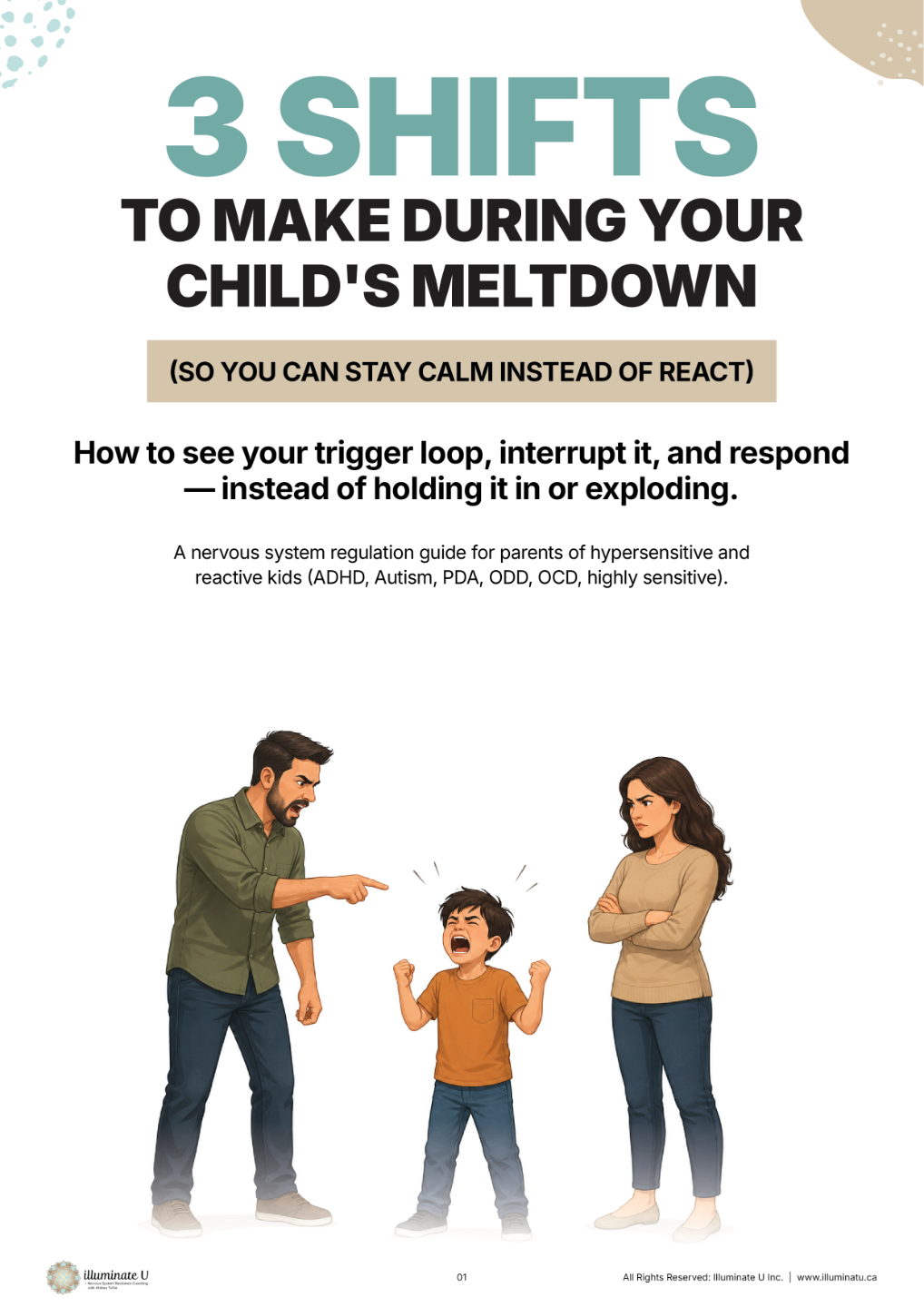
Free: The 3 Shifts Guide
The trigger loop and 3 patterns you get stuck in during meltdowns — and how to shift them so you can stay calm instead of react.
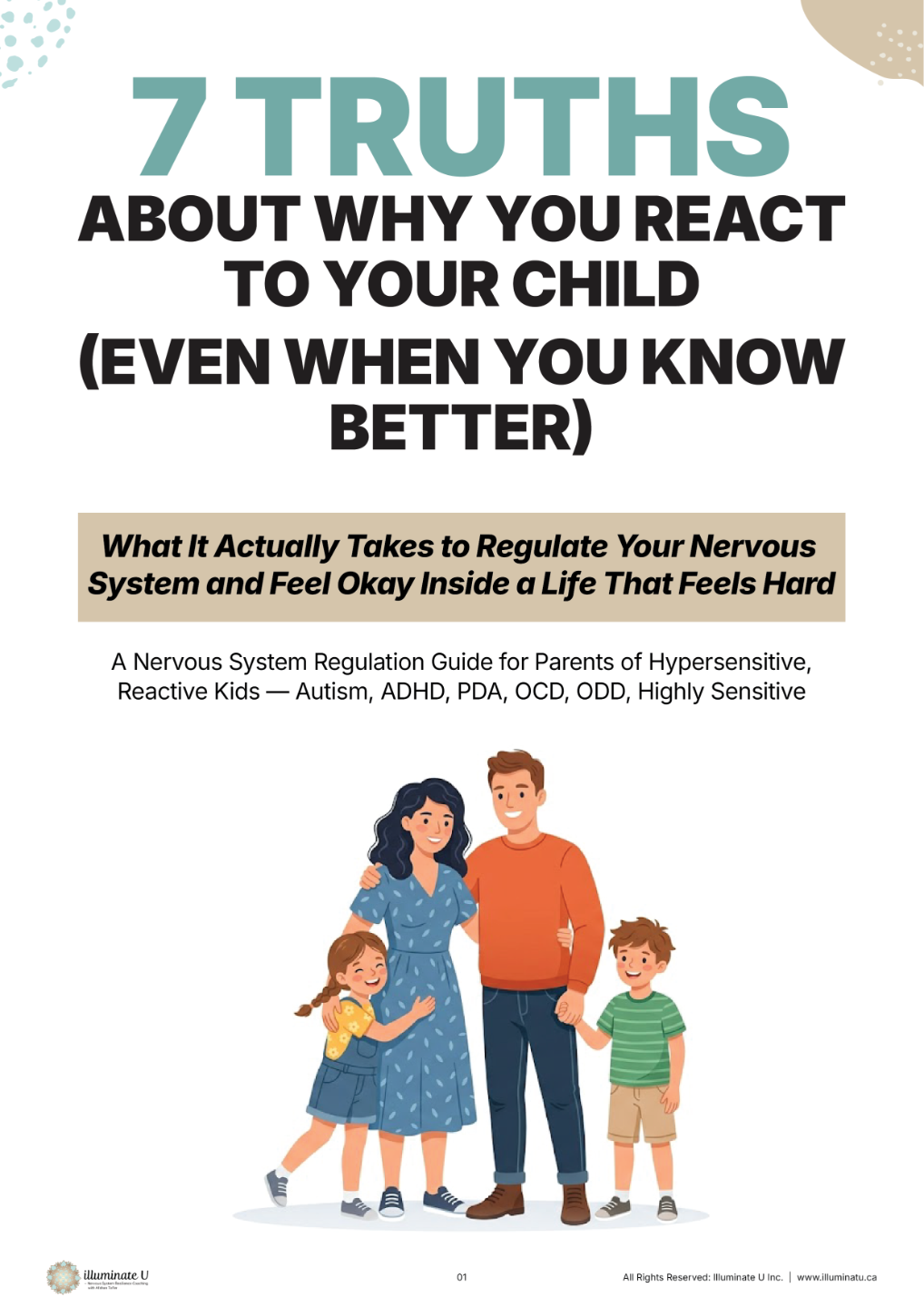
Free: 7 Truths About Why You React to Your Child Guide
Why you react even when you know better — the conditioning, nervous system states, hidden beliefs and patterns, and buried emotions running the show.

