
Why I Froze: Understanding the Fear, Rage, and Burnout Cycle in Parenting My High-Needs Child

After years of rages and sleepless nights with my PDA autistic son, I collapsed on my bedroom floor, completely shut down. This post explains the fear, rage and freeze loop I was caught in, using Peter Levine's Somatic Experiencing framework, and the practices that helped me meet freeze with compassion and discharge rage safely.
If you want to listen to a discussion of this blog article, then you can listen on The Regulated Parent Podcast, by Afshan Tafler on Apple or Spotify
Content note: This article contains a story that touches on suicidal thoughts during a moment of emotional collapse. If you're in a vulnerable state, please read with care and take breaks as needed. You are not alone.
The Night I Broke Down
It was the end of a brutal week.
My son—who is PDA autistic with OCD and lives with an intensely sensitive nervous system—hadn’t fallen asleep before 4 a.m. in days, keeping me up. Each night was a battleground of unmet needs, unpredictable meltdowns, obsessive fears, and agonizing anxiety.
During the day, there were hours-long rages. Screaming, sobbing, hitting, throwing, biting. It felt like every nerve in my body was raw, and I had no room to process my own rising panic or exhaustion.
And this had been going on for years.
My husband and I weren’t on the same page. We weren’t functioning as a team. We were each just surviving in our own silos, barely able to look each other in the eye or bickering about who had it worse.
And then, on that final night, something snapped.
My son—mid-rage—threw something across the room, and it hit me. Hard. I stumbled back. The pain surprised me, but what was worse was the sudden, unbearable surge of rage that flooded my body.
I couldn’t breathe.
I couldn’t think.
My chest burned. My hands shook. I wanted to scream.
But I had done that too many times before, only for it to end in a severe flood of shame.
So, instead, I ran.
I ran upstairs and collapsed on the bedroom floor.

I began whimpering uncontrollably, my body shaking, sobbing. And I said the words I never imagined I’d say out loud: “I don’t want to live anymore. I can’t do this.”
It wasn’t that I truly wanted my life to end. It was that my nervous system couldn’t see any way out. The pain, the fear, the endless pressure—it all became too much. And my body just… gave out.
My husband came into the room, trying to talk to me. But I couldn’t respond.
I was completely shut down—frozen in fear, grief, and despair. Curled in on myself like a wounded animal. I didn’t want comfort. I didn’t want anything. I just wanted it all to stop.
And then, through blurry eyes, I saw something that pierced through the fog:
My son was standing at the doorway.
He wasn’t screaming anymore.
He wasn’t angry.
He was just… watching me.
Frozen. Silent.
His face full of fear.
That moment still haunts me.
Because I know now—that was trauma for him.
And I couldn’t protect him from it, because I was deep in my own.
At the time, I didn’t understand what was happening in my body—
but now, looking back, I can clearly see that my nervous system was in survival mode.
The Fear–Immobility–Rage Loop (A Nervous System Perspective)
When my son’s behaviors intensified—violent rages, relentless anxiety, extreme demand avoidance – and went on for years —my own nervous system went into survival mode. But not in the way we usually think of survival.
What began to happen was this: I froze.
Not in a way that looked dramatic. But in subtle, creeping ways:
- I couldn’t feel my body.
- I started suppressing everything—my fear, my rage, my grief.
- I became tight, tense, and emotionally flat.
Every time I was terrified of his behavior… I froze.
Every time I felt rage building inside me… I froze.
Every time I wanted to scream or run away or collapse… I froze.
Because I didn’t feel safe to feel. Because I was afraid of what would happen if I let anything escape.
But sometimes, I couldn’t hold it in.
And when I exploded in rage, the shame afterward was unbearable.
So I tried harder to be calm.
To control myself.
To “regulate.”
But I was regulating by suppressing—not by coming back into safety, but by locking everything down.
Peter Levine’s Framework Helped Me Understand Why I Was Stuck
In Somatic Experiencing, Peter Levine teaches that trauma happens when a survival response—like fight, flight, or freeze—gets stuck in the body and cannot complete.
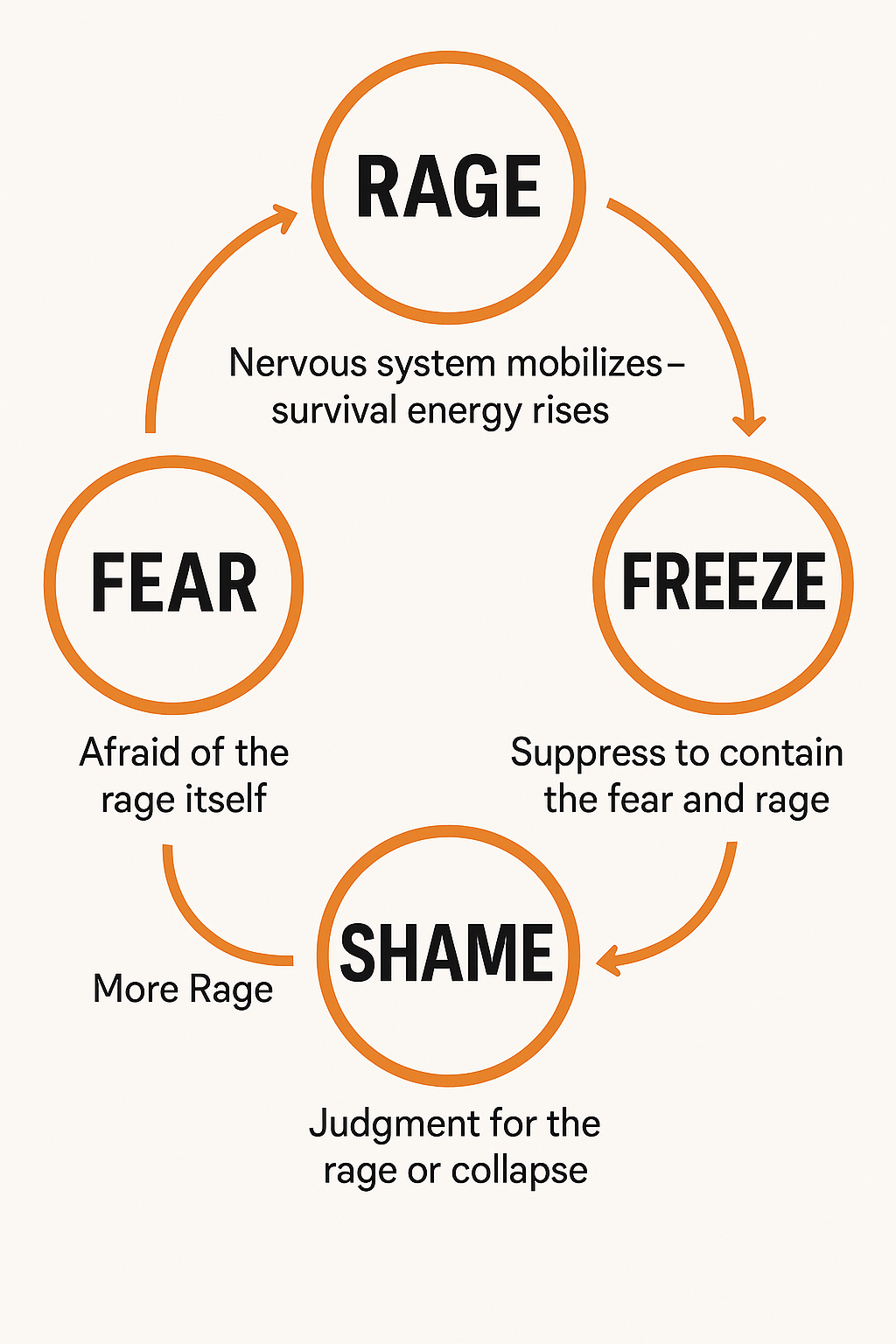
And when rage (fight) is followed by fear, and then suppressed through immobility (freeze/shutdown), the nervous system becomes trapped in a loop:
Rage → Fear → Freeze → Shame → More Rage → More Freeze
Here is how this loop plays out:
- Rage (Fight)
⚡ The nervous system mobilizes—survival energy rises.
There’s an urge to act, protect, lash out, or escape the intolerable.
🔀 Leads to → Fear of the rage itself. - Fear
😨 “If I let this out, I’ll hurt someone, lose control, or be rejected.”
Fear of consequences, of being too much, or of one’s own intensity.
🔀 Leads to → Freeze to suppress that fear and rage. - Freeze / Shutdown
🧨 The system locks down to contain it all.
You feel numb, detached, collapsed, fatigued.
🔀 Leads to → Shame - Shame
😞 “What’s wrong with me? Why can’t I handle this?”
Deep self-judgment for the rage or the collapse.
🔀 Reignites → More Rage
Rage at the situation, at yourself, or at how stuck you feel.
🔀 Which again leads to Fear, and the cycle starts over.
This loop explained everything.
- I was afraid of my rage—what it would do to my son, what it meant about me.
- I was afraid of my collapse—because it felt like failure, or worse, weakness.
- And I was afraid of the freeze itself—because it made me feel like I had disappeared.
And that fear just kept reinforcing the trauma.
Over time, I lost access to joy, pleasure, perspective.
My thoughts became darker.
I had suicidal ideation.
My body was tight, heavy, and unreachable.
I was caught between hypervigilance and collapse—wired but tired, bracing for the next explosion while slowly fading away inside.
If you are having thoughts of suicide or of not wanting to be here, please reach out for support right now. You do not have to carry this alone.
Canada: call or text 9-8-8, the Suicide Crisis Helpline, any time, day or night.
United States: call or text 988, the Suicide & Crisis Lifeline, or chat at 988lifeline.org.
If you are in immediate danger, call 911.
The Turning Point: Meeting Freeze with Compassion
What began to loosen the loop wasn’t forcing myself to “snap out of it.”
It was learning to feel my survival responses—especially freeze—without fear.
One practice that helped me gently thaw:
- I would pause, bring attention to the part of my body that felt frozen or numb—often my legs or my chest.
- I’d name it softly: “This is my freeze. This is how my body protected me.”
- I’d place a hand there, breathe slowly, and whisper: “It’s okay. I’m here now. You don’t have to go away.”
This practice helped me uncouple fear from immobility.
It made the freeze feel less threatening.
It allowed space for movement, softness, even tears to return.

Discharging Rage Safely
I also had to find a way to let rage move through my body without harming anyone—and without silencing it.
A practice that became essential for me:
- After intense events with my son, I would use Peter Levine’s Voo sound:
- A long, deep “vooooooo…” exhale that vibrates through the chest and belly.
- I’d repeat it several times, feeling the trembling or burning in my body shift just a little.
You can watch Dr. Levine himself demonstrate this practice here:
The Voo Sound for Healing Trauma by Peter Levine
- I’d then shake out my arms, legs, and spine like an animal releasing stress.
These discharges are how the body completes the fight response.
Not by yelling or blaming, but by moving the energy out of the system.
Each time, I felt a bit more space, a bit less shame, a bit more myself.
This Is What I See in So Many Mothers I Work With
Some of the mothers I work with cycle just like I did—trying to hold it all in to stay functional, to keep the peace, to protect their child…but eventually reaching a breaking point where the rage spills out in ways that feel unbearable afterward.
Then the shame hits.
And the freeze deepens.
Others live mostly in the shutdown—frozen, dissociated, burned out—barely able to connect with their own emotions anymore.
But both are caught in the same nervous system loop.
What they need isn’t more self-control.
They need nervous system safety.
They need permission to feel their rage, their freeze, their overwhelm—with compassion and without fear.
Because rage is survival energy.
Freeze is protection.
Collapse is the body saying, “I’ve reached my edge.”
When we stop being afraid of these states, we can begin to loosen the trauma.
As Peter Levine says:
“When the fear is uncoupled from immobility, the trauma loses its grip—and equilibrium is restored.”
You’re Not Broken. You’re in a Loop That Can Be Loosened.
If any part of this story feels like yours, I want you to know:
You are not broken. Your nervous system is not the enemy.
You are surviving the best way you know how, in an environment that demands superhuman strength every single day.
There is another way—one that doesn’t bypass the hard, but meets it with nervous system wisdom, compassion, and slow, embodied healing.
And the first step is not fixing anything.
It’s simply understanding what’s happening inside you—
and knowing that your responses are not signs of failure,
but signs of a body that has been trying to protect you for a very long time.
May this knowing be a soft place to land.
May it loosen something inside you.
May it be the beginning of returning to yourself.
Questions Parents Ask
Why do I freeze when my high-needs child is raging?
When my son's behaviours went on for years, my nervous system went into survival mode, and I froze. Not in a way that looked dramatic, but in subtle, creeping ways. I couldn't feel my body. I started suppressing my fear, my rage, my grief. Because I didn't feel safe to feel, and I was afraid of what would happen if I let anything escape.
What is the fear, rage and freeze cycle in parents?
In Somatic Experiencing, Peter Levine teaches that trauma happens when a survival response gets stuck in the body and cannot complete. When rage is followed by fear, and then suppressed through freeze or shutdown, the nervous system becomes trapped in a loop: rage, fear, freeze, shame, more rage, more freeze.
How do I come out of freeze as a parent?
What began to loosen the loop wasn't forcing myself to snap out of it. It was learning to feel my survival responses, especially freeze, without fear. I would bring attention to the part of my body that felt frozen, name it softly, "This is my freeze. This is how my body protected me," place a hand there, breathe slowly, and say, "It's okay. I'm here now."
How can I release rage safely after a hard moment with my child?
After intense events with my son, I would use Peter Levine's Voo sound: a long, deep "vooooooo" exhale that vibrates through the chest and belly, repeated several times. Then I'd shake out my arms, legs and spine like an animal releasing stress. These discharges are how the body completes the fight response, not by yelling or blaming, but by moving the energy out.
Breaking the Anger and Rage Cycle in PDA & Autistic Parenting
how to break the rage cycle
Why "Holding It Together" Is Burning You Out
functional freeze and why suppression burns you out
When You Feel Like You're Being Abused by Your Child
the trauma of living with your child's violence
Why You Can't Stay Calm When Your PDA or Autistic Child Is Hitting You
what happens in you when your child hits
Rupture Isn't Failure: It's the Path to Healing
letting go of shame after you lose it
I have three free guides for parents of PDA, autistic and high-needs kids: the 3 Shifts guide for meltdowns, the 7 Truths guide on why you react even when you know better, and the Meaning guide for finding your way back to yourself. Pick whichever one fits where you are right now.
And if you want to go deeper with me, the Regulation Rebuild is my course for parents who want to rebuild their own nervous system capacity, step by step. Join the waitlist to hear first when the next round opens.
About the author: Afshan Tafler is a Nervous System Resilience Coach, host of The Regulated Parent podcast, and a parent raising a PDA autistic teen with high anxiety and OCD. She is trained in Internal Family Systems (Level 3), Havening, polyvagal-informed practice and EFT, and is completing her Somatic Experiencing training. She has guided hundreds of parents of ADHD, autistic and PDA kids from burnout and barely coping to steadier, more connected and more alive, within the life they are actually living.
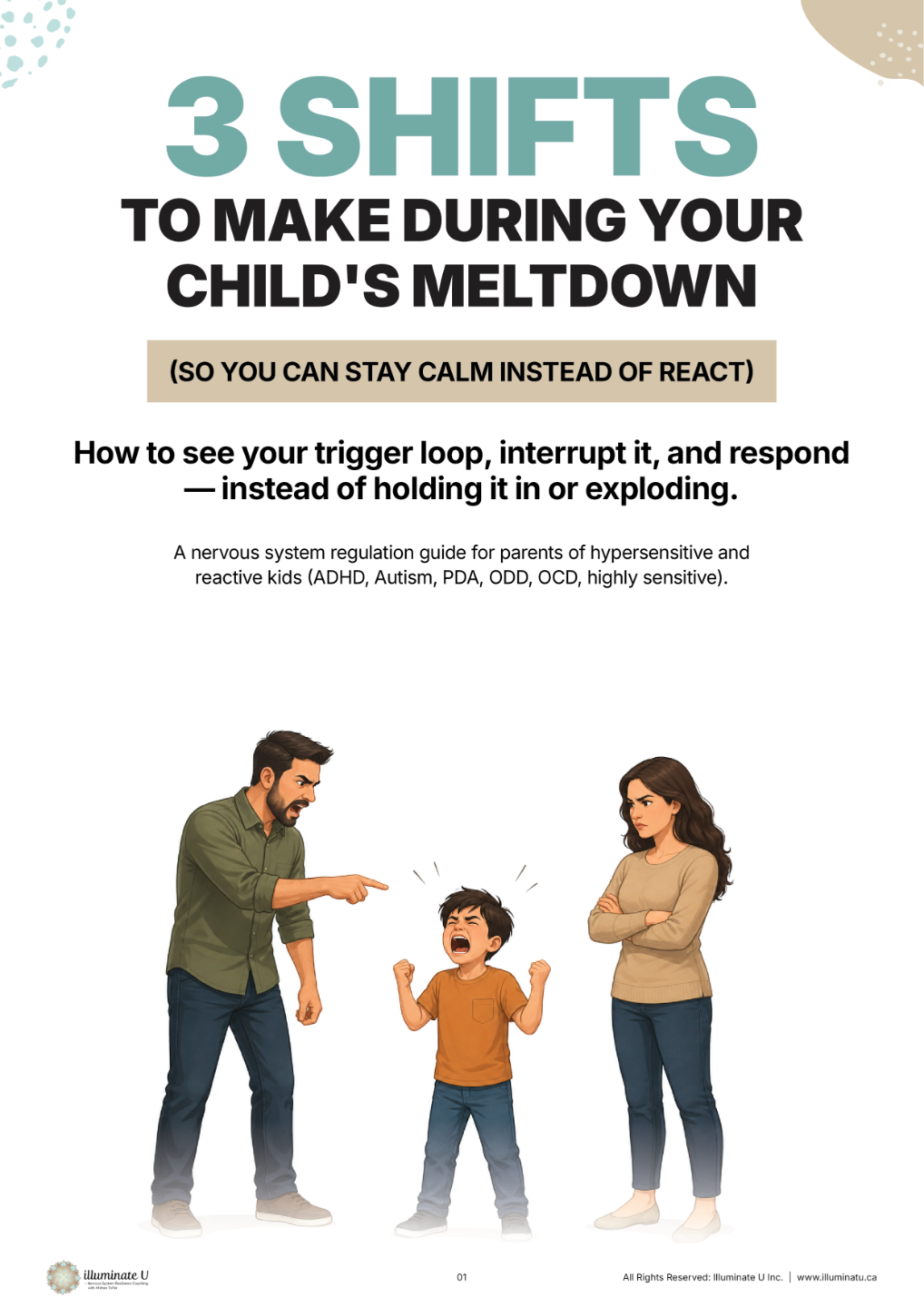
Free: The 3 Shifts Guide
The trigger loop and 3 patterns you get stuck in during meltdowns — and how to shift them so you can stay calm instead of react.
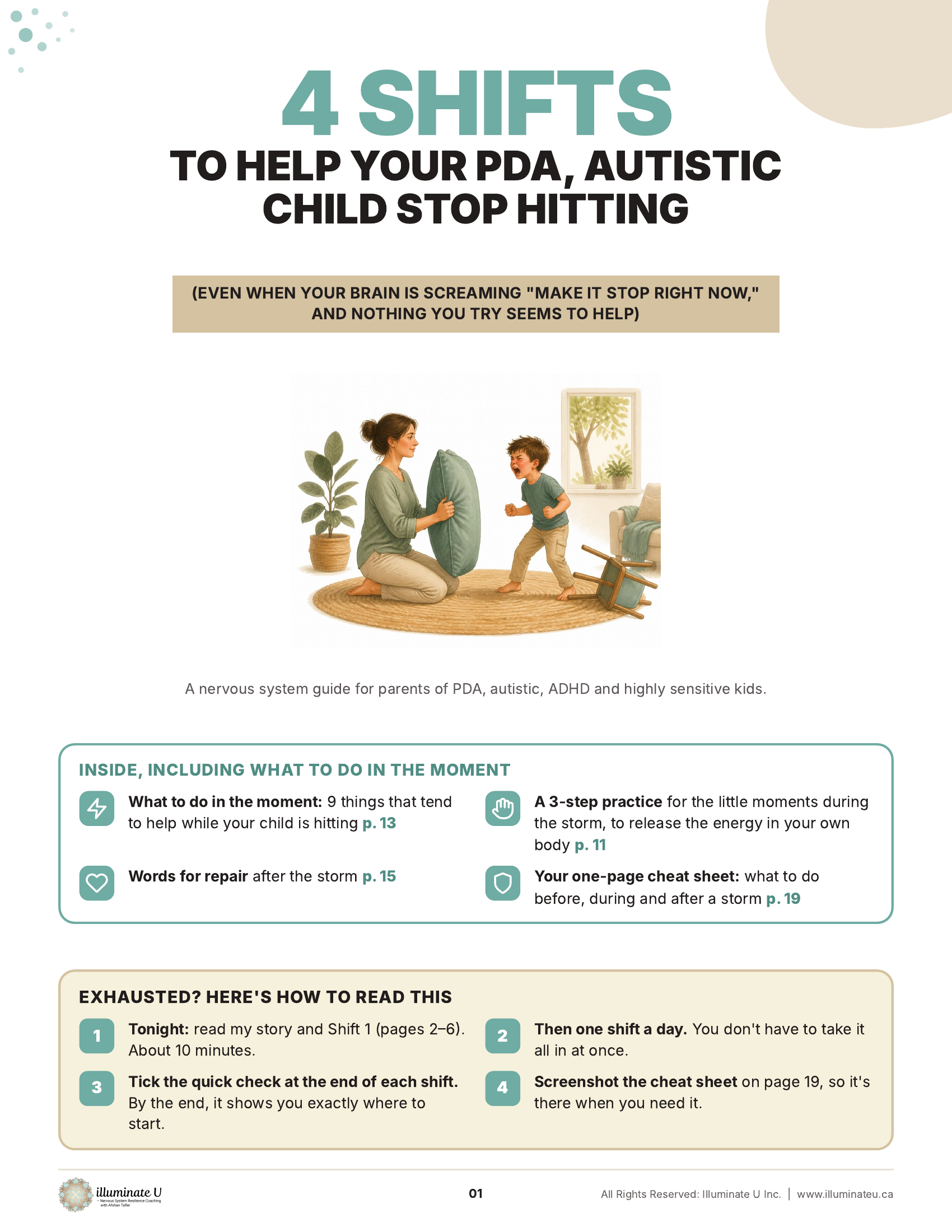
Free: 4 Shifts to Help Your PDA, Autistic Child Stop Hitting
What to do in the moment your child is hitting you, a one-page cheat sheet to keep on your phone, and the 4 shifts that changed things in our home.
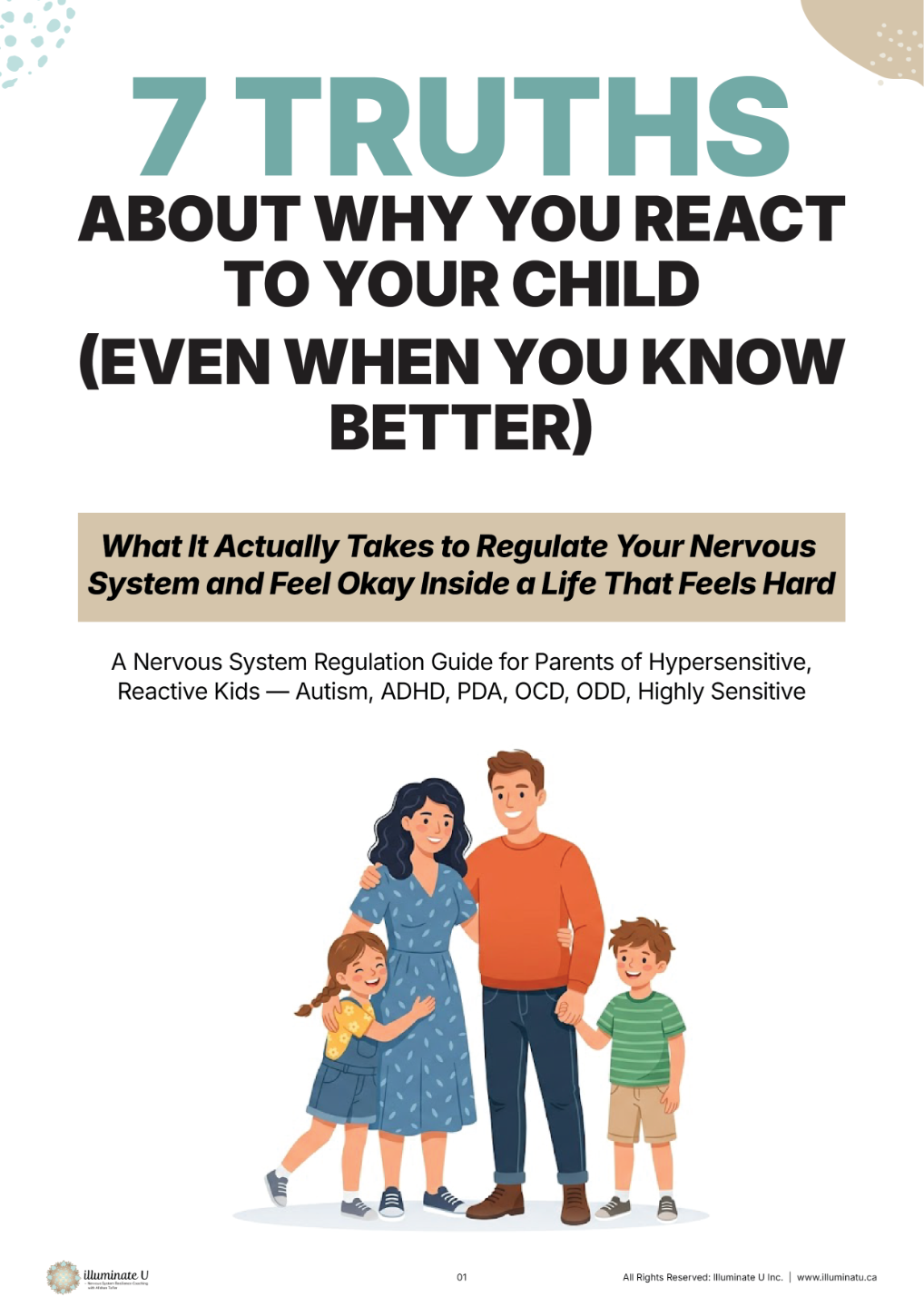
Free: 7 Truths About Why You React to Your Child Guide
Why you react even when you know better — the conditioning, nervous system states, hidden beliefs and patterns, and buried emotions running the show.
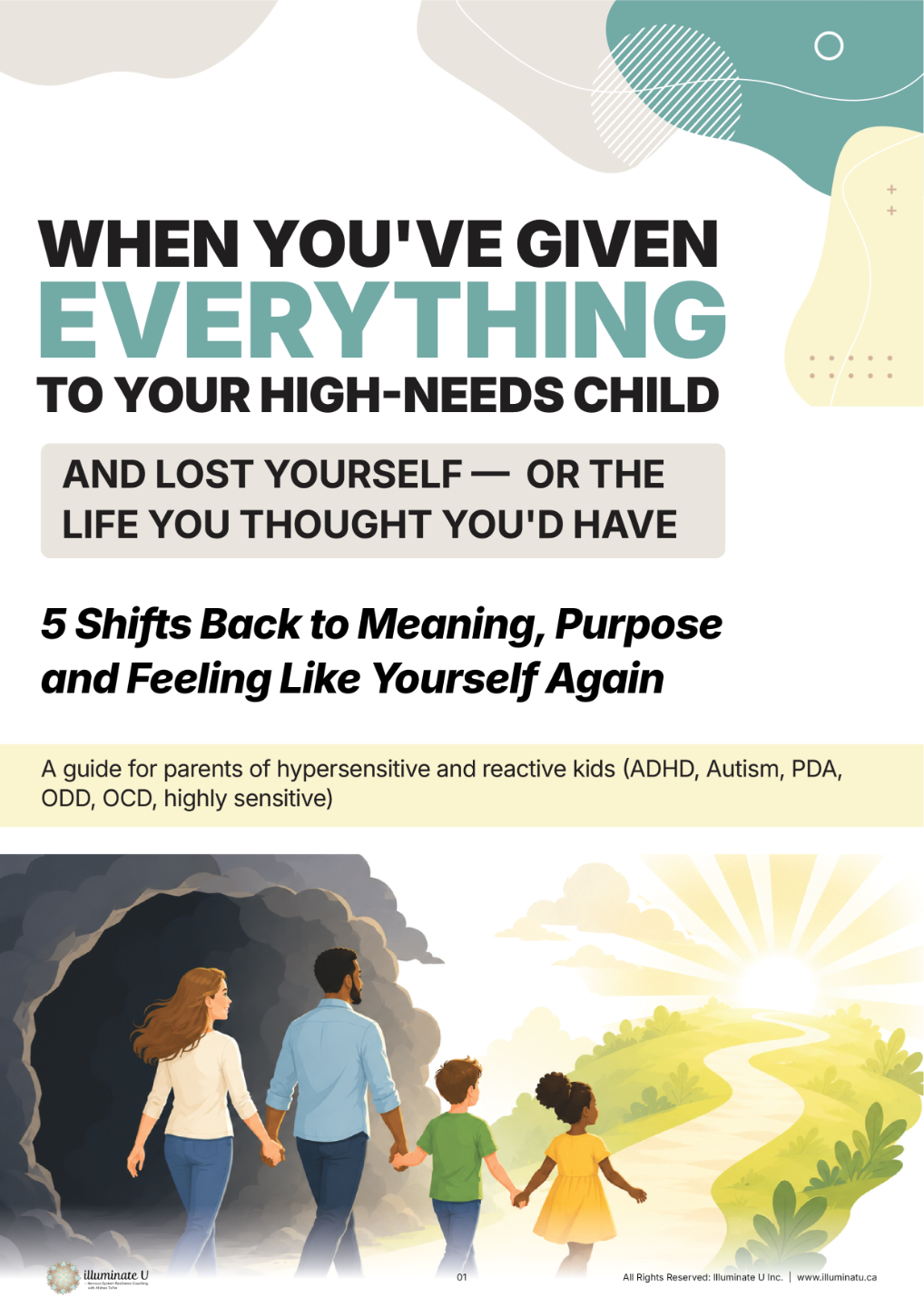
Free: 5 Shifts Back to Meaning Guide
For when you've given everything to your high-needs child and lost yourself — 5 shifts back to meaning, purpose and feeling like you again.

