FREE PARENT BURNOUT TRAINING
The Perfect StormWhy Parenting Your PDA or Autistic Child Feels So Hard on Your Nervous System, and the 12 Shifts That Help You Feel Okay Again
(whether you're snapping at your child and drowning in guilt, or holding it all together and quietly falling apart or burning out)
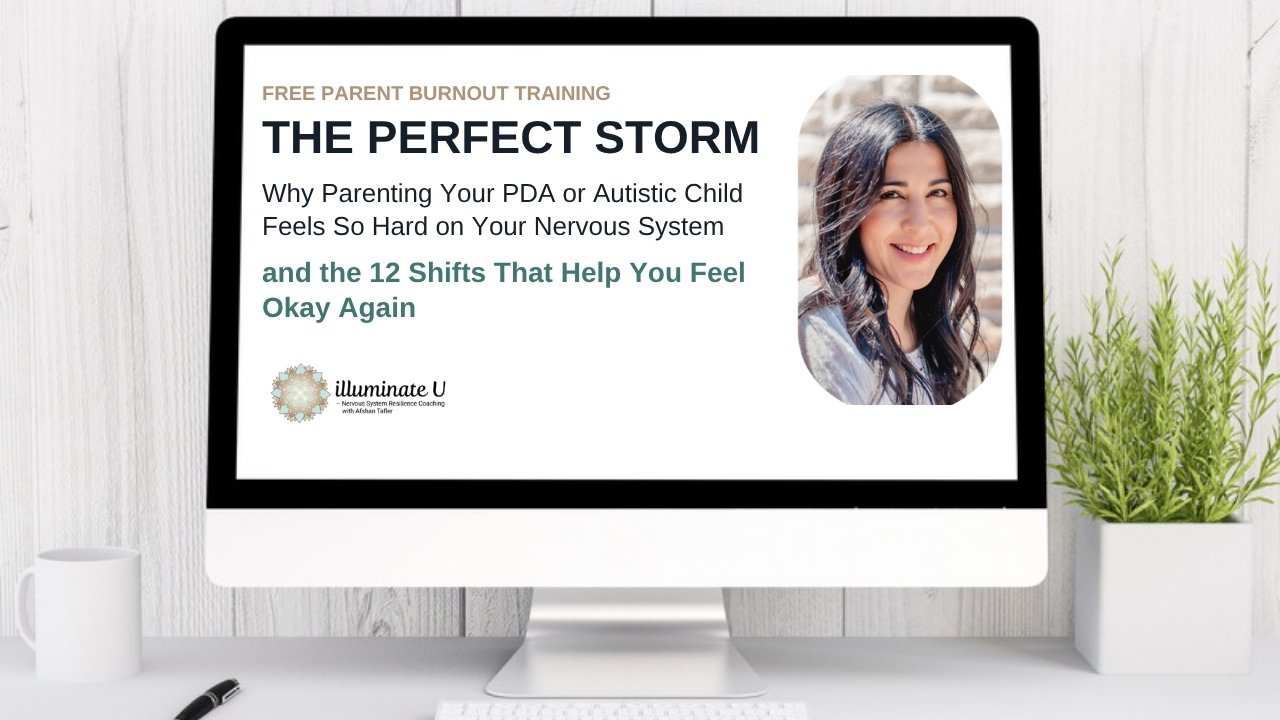
In this free parent burnout training, I walk you through:
- Why parenting a child like ours drains so much of your capacity, because your body gets triggered again and again, all day long, while you give everything you have to your child
- Where parent burnout really comes from, and why knowing better doesn't stop the reactions
- The 12 nervous system shifts that help you feel okay inside the life you're actually living, even when it's still hard
 Plus The 12 Shifts Pattern Finder, a printable handout to find the patterns adding to your stress load, and the skills you're missing
For parents of PDA, autistic, ADHD and high-needs kids. About 60 minutes. Watch it whenever you can, even a few minutes at a time.
Watch it right away. About 60 minutes. No login or password needed.
You'll also get my emails about parenting from your own nervous system. Unsubscribe anytime in one click. Privacy policy
MELTDOWNS IN OUR HOME WENT FROM
5 hours a day → about 30 minutes, once a week
These are the shifts that changed things for me, and for my son. It wasn't that he got better first and then I could finally feel okay. It was the other way around. When I learned to feel okay and safe enough with him, with all of his challenges and this life, things started to change for us. It took time, and it started with small shifts I could practice inside the life we had.
The Regulation Rebuild course helped me stop tensing and bracing to get through the day — wondering when the next catastrophe would take place. I now feel more hopeful and have more energy during the day. The program helped me find those little ways of rebuilding my regulation in the moment — so I could stay more present and help my children's nervous system become more regulated. I also am able to be kinder to myself and my children.
Gina S.
Of the parents in my most recent Regulation Rebuild course, 95% said they'd recommend it to a friend parenting a high-needs child.
Notice yourself in this?
When your child melts down many times a day, you're triggered all day long. Even when you finally get a moment, you can't relax, because another meltdown could come at any time.
Why your body can't switch off after months or years of being on high alert, and how to help it feel safe enough to rest.
You hold it together and look calm through your child's meltdown. Inside, you're clamped down and bracing. After, you're so drained you can barely function.
Why holding it in to look calm wears you out so much, and how to find a calm that's real, one your child may be able to feel too.
You brace the moment your child walks into the room. You jump at the sound of their voice or their footsteps on the stairs, and it gets hard to see anything but what's going wrong.
Why, after so much stress, your brain starts to see your child as a cue of danger, why that isn't your fault, and how to help it see the goodness in them, and in you, again.
You feel so overwhelmed by how much you have to do for your child, and how much you have to be there for them. Some days you're so burnt out your nervous system just can't anymore, and then you're hard on yourself for not doing enough.
Why your body shuts down when it's carrying too much, why that isn't weakness, and how to help yourself out of that state and be kinder to yourself.
When your child needs so much control over you, over every move you make, and can't be apart from you, you feel trapped, like there are no good choices. Then you feel guilty for feeling that way.
Why it makes so much sense that your nervous system drops into feeling trapped when there are no good choices, and how working with your urges to say no or to get away for a break helps you feel more choice again, even when the choices are hard.
You know it's not their fault. You tell yourself you'll stay calm this time. Then you get frustrated and end up yelling anyway.
Why knowing better doesn't stop you reacting in the moment, and why the shift starts with helping your body feel safe first.
After you snap, the guilt and shame flood in: "I lost it on my child again. I'm failing them."
Why this makes so much sense, and how to come back and repair faster, without beating yourself up.
After every hard moment, when it's finally quiet, your mind races to the future: "Will this ever change? What will happen to them? If they're not okay in life, I've failed as a parent."
Why these fears often come from old programming about what a successful life has to look like, for your child and for you, which keeps them running on repeat, and how to calm that fear in your body and work with the meanings underneath it.
Your child may be doing better with all the accommodations you're giving. But you're quietly falling apart, burning out and losing yourself.
Why burnout so often hits just as things start to settle, and how to find your way back to you.
If this is you, you're not alone, and it doesn't mean you're failing your child.
I saw somewhere between 15 and 20 therapists over the years.
They kept telling me how hard and how extreme our situation was, and that usually the answer was to change your circumstances.
But I couldn't change my circumstances. I wasn't going to leave my child.
So I went searching for what I could change inside of me.
I learned to hold survival and safety at the same time: to bring safety into my body while the stress was still there, so I could stay present with my son instead of exploding or shutting down.
I learned to work with the meanings underneath, the ones my mind was making about him and about me as a parent.
As those meanings changed, the stress in my body lessened so much that I wasn't getting as triggered.
And when I did get triggered, I knew how to bring safety back on board.
That's exactly what this training walks you through.

Taught by Afshan Tafler, a trauma-informed and neuroscience-informed Nervous System Resilience Coach, host of The Regulated Parent podcast, and a parent raising an autistic, PDA son with high anxiety and OCD.
After years of holding it in, then exploding, then falling into shame and burnout, she learned to work with her own nervous system, and her son's five hours of daily meltdowns came down to about 30 minutes once a week.
She has guided hundreds of parents of PDA, autistic, ADHD and high-needs kids from survival mode back to feeling safe enough and capable.
Worked With
And Featured in:

What Other Parents Say
I am able to see myself and my son differently. I find that the more I heal by using the tools, and growing my capacity and finding more compassion for myself, he regulates better too.
Parent of an ND child
I thought I needed to stay perfectly calm to be a good parent… But it wasn't working for my kids, because they could immediately sense this 'fake calm.' And it wasn't working for me, because it was absolutely exhausting… I have already noticed positive shifts in my kids' regulation, my sense of self compassion, and even my relationship with my husband.
Aly
The relationship to my child changed the more I was able to be truly calm and regulated. Our relationship is changing and trust is coming back. There are still many challenges but I know better how to communicate them and I don't feel like I have to carry everything alone.
Parent of an ND child
Now I can recognize my own dysregulation, respond differently, and repair faster. Afshan helped me understand a whole new perspective of my kids, husband, and really the world around me… The whole family benefited.
Kate
I went from feeling bewildered and burnt out to competent and curious. This should be part of a user's manual for being human.
Lindsey
Afshan has created a trail guide for those of us who are lost in the thickets of parenting to compassionately guide us back to sanity. I use the tools multiple times throughout the day, and things have changed immensely. Our friends and family have noticed.
D.G.
WHAT PARENTS SAID LIVE
What's Inside the Free Parent Burnout Training
- Where burnout really comes from: the perfect storm your nervous system lives in every day, and why survival energy with nowhere to go either boils over into rage or freezes shut into exhaustion.
- Why knowing better doesn't stop the reactions: what's running underneath when you react, and why your body leads before your thinking brain gets a say.
- The skill nobody taught us: how to hold survival and safety at the same time, so you can feel safe enough and capable enough while the stress is still in your body, and while life is still hard.
- The 12 nervous system shifts: each one shown as a pattern you may recognize in yourself, whether you snap or hold it all in, or worry a lot, and the skill that helps you through it.
- The 12 Shifts Pattern Finder: a printable handout to find the patterns adding to your stress load, and the skills you're missing, so you know exactly where to start.
Questions Parents Ask
What is parent burnout when you're raising a PDA or autistic child?
When your child melts down many times a day, you're triggered all day long, and after months or years of being on high alert, your body can't switch off. Survival energy with nowhere to go either boils over into rage or freezes shut into exhaustion. That's the perfect storm your nervous system lives in every day, and it's where parent burnout really comes from.
Why do I keep snapping at my child even when I know better?
Because your body leads before your thinking brain gets a say. You know it's not their fault, and you tell yourself you'll stay calm this time, but knowing better doesn't stop you reacting in the moment. The shift starts with helping your body feel safe first.
Why am I so exhausted when I stay calm through my child's meltdowns?
When you hold it together and look calm, inside you're often clamped down and bracing, and holding it in wears you out. That's why, after the meltdown, you can be so drained you can barely function. The training shows you how to find a calm that's real, one your child may be able to feel too.
Can I feel better if my child's challenges don't change?
Yes. In our home, it wasn't that my son got better first and then I could finally feel okay. It was the other way around. I learned to hold survival and safety at the same time, to bring safety into my body while the stress was still there. It took time, and it started with small shifts I could practice inside the life we had.
Who is The Perfect Storm training for, and how long is it?
It's a free parent burnout training for parents of PDA, autistic, ADHD and high-needs kids, taught by Afshan Tafler, a Nervous System Resilience Coach and host of The Regulated Parent podcast. It's about 60 minutes, you can watch it right away with no login, and it comes with The 12 Shifts Pattern Finder, a printable handout.
You don't need to wait until the storm is over
to begin rebuilding your capacity to live inside it.
Watch it right away. No login or password needed.
You'll also get my emails about parenting from your own nervous system. Unsubscribe anytime in one click. Privacy policy