

FREE GUIDE
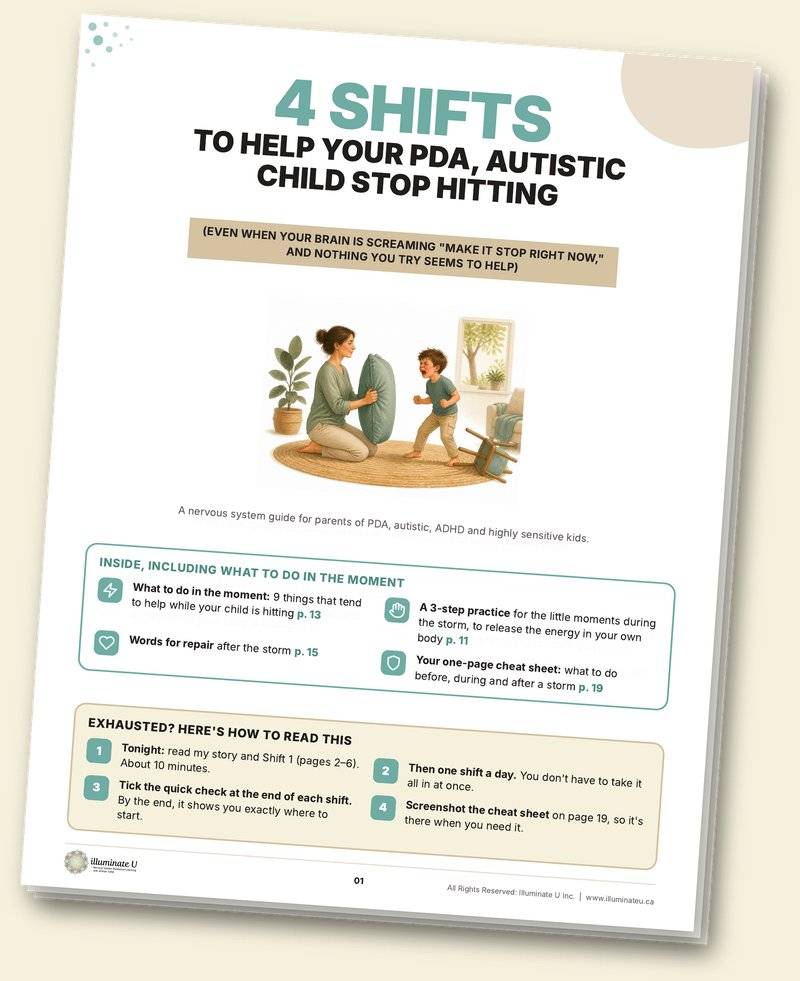
4 Shifts to Help Your PDA, Autistic Child Stop Hitting
(even when your brain is screaming "make it stop RIGHT NOW," and nothing you try seems to help)
What to do in the moment your child is hitting, a one-page cheat sheet to keep on your phone, and the 4 shifts that changed things in our home.
For parents of PDA, autistic, ADHD and highly sensitive kids. Start with Shift 1 tonight, in about 10 minutes.
You'll also get my emails about parenting from your own nervous system. Unsubscribe anytime in one click.
Hitting, aggression and meltdowns went from
5 hours a day → about 30 minutes, once a week
These are the 4 shifts that changed things in our home. My son’s storms of hitting, breaking things and meltdowns went from five hours a day to about 30 minutes, maybe once a week. It took time, and what changed things was never one tool, but a different way of being in the storm that we built little by little.
“
I am able to see myself and my son differently. I find that the more I heal by using the tools, and growing my capacity and finding more compassion for myself, he regulates better too.
Parent of a PDA, AuDHD child
Notice yourself in this?

You move toward them to stop it, and they escalate. You move away, and things get broken. → How to find a choice when every option feels wrong, so you're not left feeling trapped.

You explain, you warn, you say "No hitting, hitting hurts," and the storm only gets bigger. → Why the words may not be landing in that moment, and what tends to help instead.
You look calm on the outside while your body is a pressure cooker, until you snap. → A simple practice for the little moments you can find during the storm, even while you’re being hit, so the anger and fear in your body can move instead of building until you blow up.

You take something away later so they learn, and it escalates even more. → Why a consequence in the storm can land as more threat, and when the teaching actually happens.

You lie awake afraid of who your child will become. → The truer meaning that helps you see the overwhelmed child underneath the hitting, and why today isn't a prediction.

You've started to feel afraid of your own child, and ashamed of that. → Why that makes sense, and how to meet your own fear so you can feel safe enough again.
If this is you, you're not alone, and it doesn't mean you're failing your child. I looked for years for the tool that would make the hitting stop in the moment, and I don't believe it exists. What changed things in our home was a different way of being in the storm, built little by little. That's exactly what this guide gives you.
You'll also get my emails about parenting from your own nervous system. Unsubscribe anytime in one click.

Taught by Afshan Tafler, a trauma-informed, neuroscience-based Nervous System Resilience Coach, host of The Regulated Parent podcast, and a parent raising an autistic, PDA son. For years our days held hours of meltdowns, hitting and broken things. Today the storms last about 30 minutes, maybe once a week. She has guided hundreds of parents of PDA, autistic, ADHD and high-needs kids from survival mode back to feeling safe enough and capable.
Worked With
And Featured in:

What Other Parents Say
"The program helped me find those little ways of rebuilding my regulation in the moment — so I could stay more present and help my children's nervous system become more regulated. I also am able to be kinder to myself and my children."
"The relationship to my child changed the more I was able to be truly calm and regulated. Our relationship is changing and trust is coming back. There are still many challenges but I know better how to communicate them and I don't feel like I have to carry everything alone."
"I have been able to internalize/use some of the tools in the heat of the moment so I guess that means I'm learning to stay calmer. I would sometimes have outbursts in front of my kid but I do that a lot less now."
"I have a plan now and my days are not easy, but the sun is shining into our family and we are all doing better."
What's Inside:

What to do in the moment while your child is hitting — 9 things that tend to help, and the one question to ask yourself before you say a word.

A 3-step body-mind practice — to use in the little moments you can find during the storm, even while you’re being hit, so your own anger and fear can move through you instead of building until you explode, and you can get through it with more ease.
From "this is wrong, nothing works, I'm trapped" to "I know what's happening, and I can handle this" — even while it's still hard.
Why "make it stop" keeps backfiring — what your child's nervous system may be reading in the things most of us reach for, and what we tried instead.
A quick self-check after each shift — so this isn't just a guide you read. It helps you see your own patterns in the storm and know what to work on first to create real change.
A one-page cheat sheet, and what to say after — what to do before, during and after a storm, on one page you can screenshot and keep on your phone, plus the words for repair.
You don't have to be calm.
You just have to be safe enough.
You'll also get my emails about parenting from your own nervous system. Unsubscribe anytime in one click.
