
Why Your PDA, Autistic Child Needs More Flexibility — And Why That Feels So Hard for Your Nervous System
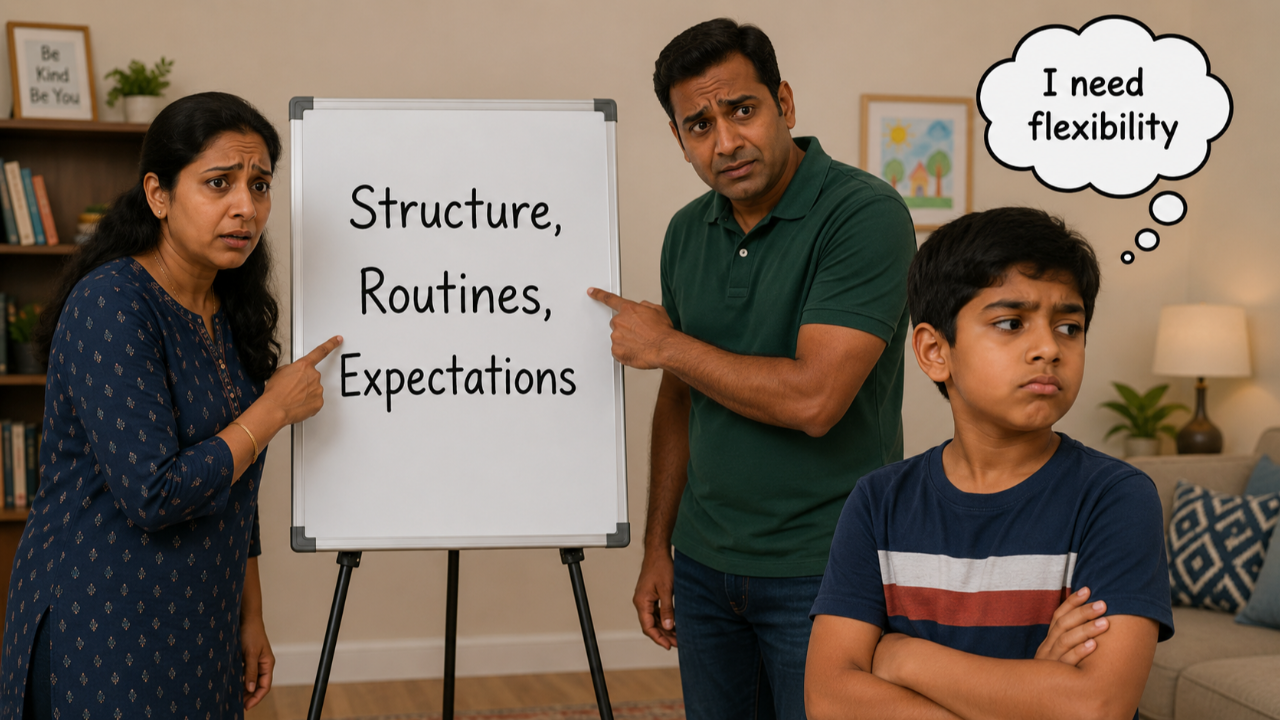
When my son's PDA became more externalized, the routines I thought were healthy became sources of distress for him. This post looks at why your PDA, autistic child may need more flexibility, why that can feel so destabilizing for your own nervous system, and how to move from rule-based safety to relationship-based safety.
You can also listen to this in audio format only on The Regulated Parent Podcast on Apple or Spotify. Look for Episode #48
When Your Child’s Needs Challenge Everything You Learned About Safety
Some kids don’t need stricter parenting.
They need less pressure.
Less control.
Less rigidity.
Less pushing.
Less constant expectation.
They need more flexibility.
More responsiveness.
More autonomy.
More room to breathe inside their nervous systems.
And when you begin realizing this about your PDA, autistic, ADHD, or hypersensitive child… something unexpected often happens.
Your own nervous system starts reacting.
Because many of us were raised inside systems built on pressure, performance, predictability, routines, compliance, and pushing through discomfort.
We learned:
This is how you succeed.
This is how you become responsible.
This is how you become safe.
This is how you become good enough.
So when your child cannot thrive inside those same systems…
when structure creates distress instead of safety…
when flexibility works better than pressure…
it doesn’t just challenge your parenting.
It challenges the very things your nervous system learned to depend on for safety.
And that can feel deeply destabilizing.
Especially if your nervous system learned to survive through predictability, perfectionism, over-functioning, hypervigilance, or control.
So today I want to talk about why flexibility can feel so emotionally and neurologically hard for parents…
why so many of us resist it even when we intellectually understand our child needs it so much…
and why parenting these children often becomes an invitation into rebuilding our own nervous systems too.
When Everything Started Colliding
When my son first moved from a more internalized PDA (Pathological Demand Avoidance) autistic presentation into a more externalized expression of PDA, things in our home started changing rapidly.
His nervous system was carrying so much cumulative stress and activation, and suddenly many of the structures and routines I thought were healthy started becoming sources of distress for him.
At the time, I didn’t understand what was happening.
I had learned — both culturally and through so much health and parenting information — that routines were important.
Regular meals.
Consistent bedtimes.
Structure.
Predictability.
Schedules.
And to be fair, for many nervous systems, structure does create safety. The nervous system often feels calmer when life feels predictable and organized.
But what I didn’t understand yet was this:
When a nervous system experiences pressure, demands, lack of autonomy, or control as threat…then flexibility can become more important for safety than structure itself.
And that completely challenged everything I thought I knew about parenting.
It started with dinner. My son no longer wanted to eat at the table with us. He wanted to eat later, on the couch, in front of the TV.
At first, I resisted it hard because in my mind this was creating “bad habits.”
I thought:
This isn’t healthy.
This isn’t good parenting.
Kids need routines.
Kids need structure.
I need to hold the boundary.
But the more I pushed, the more his nervous system pushed back and would not eat.
And then came sleep. This one was especially hard for me because nighttime had become the only time I had to myself. Sleep was my master regulator. I desperately needed those hours at night to recover.
And I was terrified that if he stayed up too late, his dysregulation would be even worse the next day.
So I kept trying to force sleep.
And instead, I often ended up awake until 1 a.m. inside aggression, destruction, screaming, chaos, and total nervous system despair.
I remember standing in the hallway some nights feeling my whole body tighten as the hours got later and later.
I could feel panic rising in my chest while my thoughts spiraled:
“He’s going to be exhausted tomorrow.”
“This is so unhealthy.”
“I can’t keep living like this.”
“What are we doing wrong?”
“How is this sustainable?”
And underneath all of it was this desperate need to regain control because control felt like the only thing standing between us and complete chaos.
Then school became another collision point.
When he stopped going, I tried to recreate structure through homeschooling. I told myself:
“If we can just do one or two hours a day, then I can feel okay about the rest of the day.”
Even hearing that now, I can hear how much my own nervous system needed productivity and structure to feel emotionally safe.
I even hired a play-based tutor.
But my son felt the pressure underneath it all.
And eventually he stopped wanting to learn altogether for years.
At the time, I thought flexibility meant:
giving up,
being permissive,
failing,
letting things fall apart.
What I didn’t understand was that my son’s nervous system was not resisting safety.
It was resisting pressure.
And underneath all of this… was my own nervous system. Because the truth is, I didn’t only struggle giving flexibility to him. I struggled giving flexibility to myself too.
Every time I learned about something healthy for my body, or needed to get something done, I turned it into another rigid demand.
Another thing I had to do correctly and within a certain timeline.
Another way to succeed at being human.
Even when I was exhausted.
Even when my body wanted rest.
Even when I didn’t have capacity.
My mind would override my nervous system saying:
“This is what successful people do.”
“If I don’t do this, I’m failing again”
And I now see so many parents living this exact way with themselves and their children.
Constantly overriding their bodies.
Constantly pressuring themselves.
Constantly trying to force routines, structures, and expectations that their child’s nervous system cannot tolerate.
While underneath it all lives this deep fear:
“If I stop pushing… everything will fall apart.”
When Flexibility Feels Unsafe
And I think this is where things get much deeper than parenting strategies.
Because for many parents, flexibility doesn’t just feel emotionally uncomfortable.
It feels neurologically destabilizing.
Many of us have nervous systems that learned to survive through:
predictability,
certainty,
control,
structure,
over-functioning,
pressure,
and rigid internal rules.
Structure became associated with safety.
Predictability became associated with survival.
Control became associated with reducing danger.
So when parenting starts requiring flexibility instead of rigidity, your nervous system can interpret that shift as threat to what helped you be a safe, lovable, belonging and successful human.
And this is not just intellectual or living in the mind alone. This is biological and wired into the nervous system as patterns we launch into when what we know as safety is threatened.
And this is such an important layer to understand compassionately.
Because many parents listening are not simply “bad at flexibility.”
Their nervous systems genuinely experience uncertainty as unsafe.
Especially:
- traumatized nervous systems
- hypervigilant nervous systems
- perfectionistic nervous systems
- highly anxious nervous systems
- autistic nervous systems
- ADHD nervous systems
- attachment-injured nervous systems
- nervous systems shaped by over-control, criticism, unpredictability, or chronic stress
For many people, rigidity became protective.
Rules reduced anxiety.
Predictability reduced overwhelm.
Over-functioning reduced vulnerability.
Control reduced fear.
So when your child suddenly says they don’t want to go to an activity you already committed to, or they can’t tolerate the bedtime routine, or they refuse the plan you carefully organized, your body may react before your mind even has time to process what’s happening.
You may feel your chest tighten immediately. Your thoughts start racing:
“We already paid for this.”
“They can’t just quit.”
“They need to learn commitment.”
“This is not how life works.”
“What will people think?”
“They can’t avoid everything forever.”
And suddenly there’s urgency in your body to regain control of the situation. Not because you’re trying to be controlling. But because unpredictability itself is making your nervous system feel unsafe.
And when you start seeing this through a nervous system lens instead of a moral lens, something often begins softening. Because maybe you were never simply “too controlling.”
Maybe your nervous system learned to survive through certainty.
Maybe rigidity became the way your body learned to reduce fear.
Maybe over-functioning became the way you tried to create safety.
Maybe pushing through became the way you learned to stay loved, accepted, successful, or enough.
And suddenly this stops becoming a conversation about good parenting versus bad parenting.
And becomes a conversation about nervous systems trying to feel safe.
The Collision Between Their Nervous System and Yours
And this is where parenting PDA, autistic, or hypersensitive children can feel so incredibly hard.
Because your child may genuinely need:
more flexibility,
more autonomy,
more responsiveness,
less pressure,
less control,
and more room to move between nervous system states safely.
But many of us were conditioned around:
compliance,
productivity,
pushing through,
performance,
and “doing it anyway.”
So parenting these children creates a collision between their nervous system needs and the survival patterns your nervous system learned to depend on.
Part of you understands your child.
But another part panics.
You may genuinely want to accommodate more and be more flexible to let them watch an extra show tonight… and then suddenly feel overwhelmed by fear and self judgment afterward.
You say yes to your child eating on the couch instead of the table… and then spend the next hour spiraling:
“Am I creating bad habits?”
“What if this never changes?”
“Am I failing to parent properly?”
Or maybe you let go of forcing school temporarily because your child is clearly in burnout… but then your body feels flooded all day with anxiety and catastrophic thinking about the future.
“What if they never recover?”
“What if they never go back?”
“What if I’m ruining their future?”
And this is why I think so many parents feel exhausted living inside this work.
Because we are not only supporting a highly stressed child nervous system.
We are also constantly trying to regulate the fear and uncertainty that gets triggered with letting go of the old programs, conditioning and control inside our own nervous systems at the same time.
The Difference Between Rule-Based Safety and Nervous System Safety
And I want to be really clear here.
Structure itself is not bad.
Routines are not bad.
Predictability is not bad.
Many nervous systems genuinely thrive with them.
The deeper issue is what happens when structure becomes rigid and disconnected from nervous system reality.
Because many of us were taught:
good parenting = consistency no matter what.
But responsive nervous systems work differently.
For many PDA, autistic, and hypersensitive children, flexibility creates safety because autonomy creates safety.
So instead of:
“Bedtime is 8 p.m. no matter what.”
the nervous system may need:
“I can see your body is still highly activated right now. Let’s help your nervous system settle first.”
Instead of:
“You must sit at the table.”
the nervous system may need:
“Your body feels safer eating somewhere else right now.”
Instead of:
“You need to push through school.”
the nervous system may need:
“Your nervous system is overloaded and needs recovery before capacity can rebuild.”
And this can feel deeply destabilizing for parents because many of us were conditioned to believe:
Consistency = good parenting
Adaptation to what your system needs = failure because it’s not following normative standards
Flexibility = permissiveness
Control = responsibility
And on top of this, being flexible requires us to tolerate uncertainty — especially the fear that comes with not knowing where these changes will lead our child.
Will this help them?
Will it hinder them?
Are we doing the right thing?
Learning how to work with this fear, and helping your nervous system tolerate uncertainty, becomes a huge part of feeling safe enough to be more flexible with your child.
So if we want to give our kids what they need, which is more flexibility, then what is being asked of us is this:
- Shifting from rule-based safety to relationship-based safety.
- From rigidity to responsiveness.
- From control to co-regulation.
And honestly, I think this is where many of us begin realizing something much deeper underneath all of this…
That some of what we learned was “safety” was actually survival.
Because true regulation has flexibility built into it.
A truly regulated nervous system can adapt when life changes.
It can tolerate uncertainty and when things don’t go the way we imagined.
It can bend without completely collapsing.
It can recover after disruption.
But many of us were taught forms of safety that depended on control.
Things had to go a certain way.
We had to perform a certain way.
Our children had to behave a certain way.
Life had to look a certain way.
And when it didn’t, our nervous systems reacted as though something dangerous was happening.
You can even feel this in everyday moments with our kids.
Maybe your child suddenly can’t tolerate a family event you committed to.
And immediately your nervous system reacts:
“We can’t cancel.”
“This is not okay.”
“This is becoming too much.”
“They need to learn.”
“We can’t live like this.”
Or maybe your child needs a slower day after several hard nervous system days, but your body starts reacting to the lack of productivity or structure.
You find yourself feeling restless, anxious, guilty, or emotionally unsafe doing “nothing.”
Not because rest is actually dangerous.
But because your nervous system learned to associate productivity, structure, and performance with safety, worth, success, or lovability.
And I think this understanding creates so much compassion.
Because many of us were never taught true nervous system regulation.
We were taught survival-based forms of safety.
We learned:
certainty = safety
control = safety
predictability = safety
performance = safety
external approval = safety
But true regulation is deeper than that.
True regulation does not require life to stay rigid in order for us to remain connected to ourselves and feel ok in our daily existence.
It has flexibility built into it.
And I honestly think our children challenge us into rebuilding that kind of flexibility from the inside out.
How Survival Patterns Can Become Cognitive Rigidity
And I think this is also where something psychologists sometimes call cognitive rigidity can begin showing up in many of us.
Cognitive rigidity is essentially difficulty adapting to change, shifting perspectives, tolerating uncertainty, or letting go of fixed expectations when things are not going the way we imagined or planned.
And often, we think of rigidity as simply a personality trait or thinking problem.
But I think for many nervous systems, it goes much deeper than that.
Because nervous systems that spend years organizing around certainty, control, pressure, predictability, or performance can eventually struggle to tolerate flexibility, uncertainty, or changes to expectation.
In other words, rigidity is often not just a mindset.
It can become a nervous system survival strategy.
Especially if you grew up around:
criticism,
high expectations,
unpredictability,
conditional love,
pressure,
or environments where mistakes didn’t feel emotionally safe.
Over time, the nervous system can begin attaching safety to:
having a plan,
knowing what’s happening,
things going the “right” way,
or life staying predictable.
And you can feel this show up in very ordinary parenting moments.
Maybe you spend hours preparing your child for an outing.
You mentally rehearse the whole day.
You pack snacks.
You organize the timing carefully.
You finally get yourself emotionally ready.
And then five minutes before leaving, your child suddenly says:
“I’m not going.”
And your body reacts before your mind even catches up.
You feel heat rise in your chest.
Your jaw tightens.
Your thoughts immediately move toward:
“We can’t keep doing this.”
“This is ridiculous.”
“They can’t control everything.”
Or you drop into despair and hopelessness.
Not because you’re a bad parent.
But because your nervous system had emotionally attached safety to the plan staying predictable.
And when the predictability disappears, your nervous system experiences threat.
And again, I think this understanding creates so much compassion.
Because it helps us stop seeing ourselves as failing, and start understanding the deeper nervous system patterns underneath our reactions.
Learning Safety Beyond Control
So how do we let go of control, embrace flexibility, and trust what the nervous system needs without going into threat, future fears, or feeling like we are failing our child in some way?
I think, overall, the shift we are trying to make is this:
Moving from being rigidly attached to expectations about how things should go…
toward becoming more responsive to what the nervous system actually needs in the moment or on that particular day.
We want to prioritize staying connected rather than needing to control it all.
But in order to do this, we first have to become aware of the conditioning, programming, expectations, fears, and emotional meanings driving our reactions.
Because often, when our child pushes back against structure, routines, demands, or expectations, it doesn’t only trigger frustration.
It triggers fear.
Fear about the future.
Fear they won’t be okay.
Fear they won’t succeed.
Fear that we are failing them somehow.
And sometimes grief gets triggered too.
Grief that life looks so different than what we imagined.
Grief that the parenting approaches we thought would work… don’t.
Grief that certainty and predictability no longer feel available in the same way.
So the work is not simply:
“be more flexible.”
The work is learning how to support what gets triggered inside of us when flexibility is required.
Because when you can support the fear, the uncertainty, the grief, and the conditioning that gets activated…
your nervous system can come back into regulation.
And from regulation, we gain access to:
more clarity,
more perspective,
more understanding,
and more flexibility.
We do not force ourselves into flexibility.
We build capacity for it by continuing to help ourselves feel safe in the face of change, uncertainty, and nervous system discomfort.
And often the first step is awareness.
Beginning to notice the patterns of reaction inside your own nervous system when your child cannot handle a demand, pushes back against structure, or doesn’t have capacity for what is being asked.
What automatically happens inside your body?
Do you tense up immediately?
Feel panic?
Urgency?
Pressure?
A need to convince, control, or force a different outcome?
Does your mind automatically move into:
“They need structure.”
“They need consistency.”
“They’ll be worse tomorrow if they don’t sleep.”
“They need to learn.”
“We can’t keep doing this.”
Or does your brain immediately interpret the behavior as intentional rather than seeing:
“My child’s nervous system does not have capacity or enough felt safety for this expectation right now.”
And instead of immediately judging yourself for these reactions, you begin getting curious about them.
You begin asking:
“What is my nervous system afraid will happen here?”
Because underneath rigidity are often very deep fears:
“If I don’t push, they’ll fail.”
“If I let go, everything will collapse.”
“If I stop controlling this, I’m failing as a parent.”
“If things don’t look normal, they won’t be okay.”
And these beliefs often carry survival-level emotional meaning.
They usually come from family systems, school systems, attachment wounds, trauma, perfectionism, culture, or chronic stress.
Many of us inherited nervous systems shaped around pressure and performance.
And where there is conditioning, there will almost always be fear.
So a huge part of this work becomes learning how to support and regulate the fear instead of automatically obeying it.
To notice the fear.
Name the fear.
Feel where it lives in the body.
And help your nervous system come back to safety and the present moment through body-based regulation first, because that is often the fastest pathway back into regulation.
So this work is not about shaming yourself for struggling with flexibility.
It’s about slowly helping your nervous system experience something new.
That safety can exist even when things are not fully predictable.
That flexibility is not failure.
And that responsiveness is not weakness.
What These Children May Actually Be Teaching Us
And honestly, I think these children are teaching many of us something profound.
Not just about parenting.
But about being human.
Because many of us were never taught how to live with flexibility, responsiveness, nervous system attunement, or self-compassion.
We were taught:
push through,
perform,
override,
comply,
hold it together,
keep going no matter what.
And many of us became deeply disconnected from our own bodies in the process.
But flexibility changes that.
Flexibility asks:
“What does this nervous system need right now?”
Not:
“What should this nervous system be able to do?”
And over time, that question doesn’t only begin changing how you parent your child.
It starts changing how you relate to yourself too.
You may begin noticing:
you rest more,
push less,
adapt more easily,
judge yourself less harshly,
and slowly release some of the relentless pressure you’ve carried for years.
Because maybe your child is not only asking you to rethink parenting.
Maybe they are asking you to rethink what safety, success, strength, and regulation actually mean.
Maybe they are inviting you to build a nervous system that no longer depends on control, pressure, performance, or certainty in order to feel okay.
A nervous system that can stay connected to itself even when life feels uncertain, messy, different, or unpredictable.
And maybe that is part of the deeper healing inside all of this.
Not just helping our children feel safer being who they are…
but slowly learning how to feel safer being human ourselves.
The Regulation Rebuild course
Questions Parents Ask
Why does my PDA child need flexibility instead of structure?
When a nervous system experiences pressure, demands, lack of autonomy, or control as threat, flexibility can become more important for safety than structure itself. For many PDA, autistic, and hypersensitive children, flexibility creates safety because autonomy creates safety. Structure itself is not bad. The deeper issue is what happens when structure becomes rigid and disconnected from nervous system reality.
Why does being flexible with my child make me so anxious?
Many of us have nervous systems that learned to survive through predictability, certainty, control, structure and over-functioning. So when parenting starts requiring flexibility instead of rigidity, your nervous system can interpret that shift as threat. And suddenly there's urgency in your body to regain control. Not because you're trying to be controlling, but because unpredictability itself is making your nervous system feel unsafe.
Is being flexible with my PDA child the same as being permissive?
At the time, I thought flexibility meant giving up, being permissive, failing, letting things fall apart. What I didn't understand was that my son's nervous system was not resisting safety. It was resisting pressure. Slowly, your nervous system can experience something new: that safety can exist even when things are not fully predictable, that flexibility is not failure, and that responsiveness is not weakness.
What is cognitive rigidity in parents?
Cognitive rigidity is essentially difficulty adapting to change, shifting perspectives, tolerating uncertainty, or letting go of fixed expectations when things are not going the way we imagined or planned. We often think of rigidity as simply a personality trait or thinking problem. But rigidity is often not just a mindset. It can become a nervous system survival strategy.
How can I be more flexible with my child without feeling like I'm failing?
We do not force ourselves into flexibility. We build capacity for it by continuing to help ourselves feel safe in the face of change, uncertainty, and nervous system discomfort. Often the first step is awareness, getting curious and asking, "What is my nervous system afraid will happen here?" Then notice the fear, name it, feel where it lives in the body, and help your nervous system come back to safety through body-based regulation first.
How to Accommodate Your PDA, Autistic Child Without Fear, Burnout, or Losing Yourself
accommodating your child while caring for yourself
Why Lowering Demands for Your PDA Child Can Make You Feel Like You're Falling Apart
what lowering demands stirs up in you
Why Parenting a PDA or High-Needs Child Requires Letting Go of Control
why control feels like safety for parents
Why Staying Regulated With Your PDA Child Means Letting Go of "Shoulds"
how shoulds keep your nervous system on alert
I have three free guides for parents of PDA, autistic and high-needs kids: the 3 Shifts guide for meltdowns, the 7 Truths guide on why you react even when you know better, and the Meaning guide for finding your way back to yourself. Pick whichever one fits where you are right now.
And if you want to go deeper with me, the Regulation Rebuild is my course for parents who want to rebuild their own nervous system capacity, step by step. Join the waitlist to hear first when the next round opens.
About the author: Afshan Tafler is a Nervous System Resilience Coach, host of The Regulated Parent podcast, and a parent raising a PDA autistic teen with high anxiety and OCD. She is trained in Internal Family Systems (Level 3), Havening, polyvagal-informed practice and EFT, and is completing her Somatic Experiencing training. She has guided hundreds of parents of ADHD, autistic and PDA kids from burnout and barely coping to steadier, more connected and more alive, within the life they are actually living.
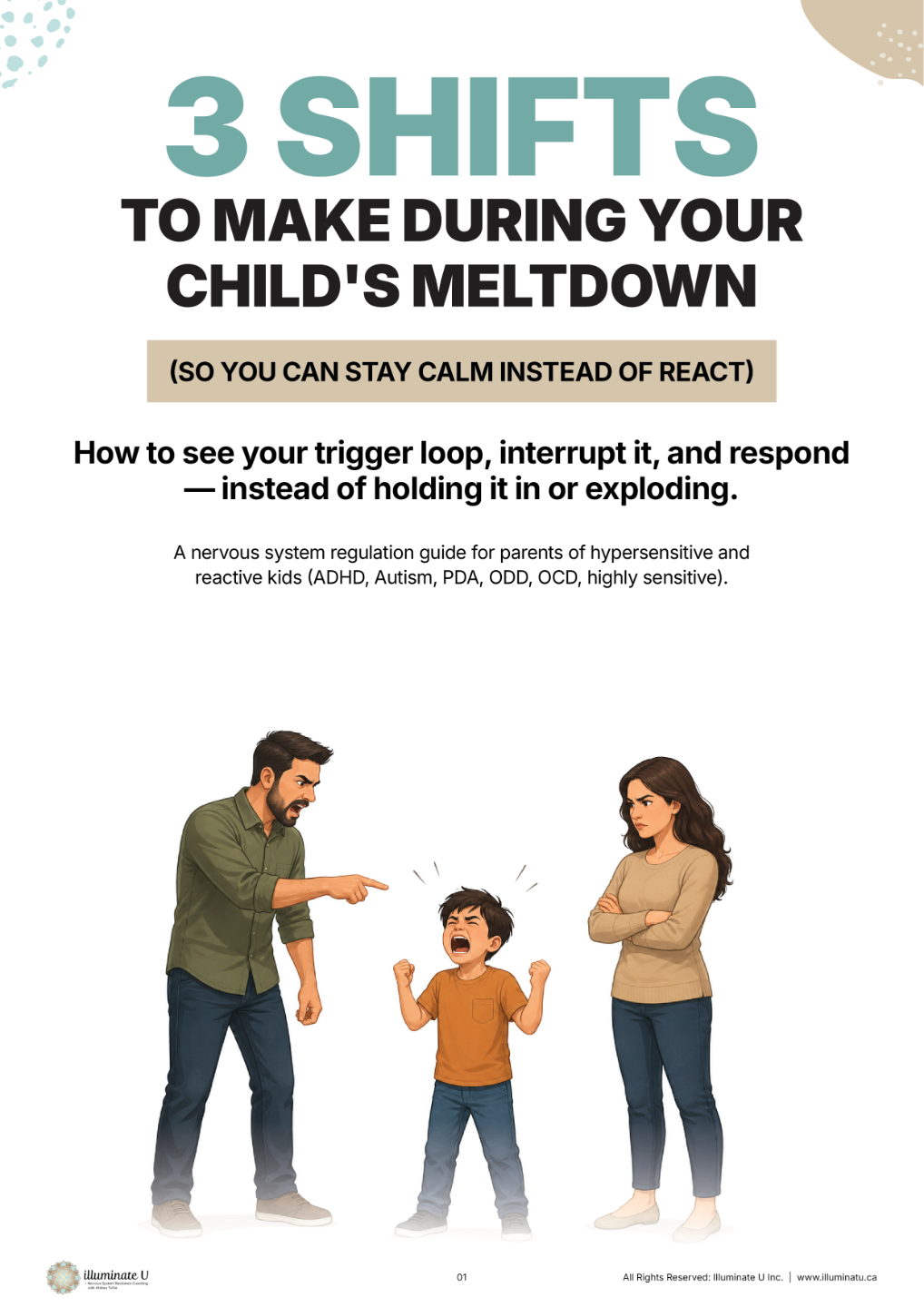
Free: The 3 Shifts Guide
The trigger loop and 3 patterns you get stuck in during meltdowns — and how to shift them so you can stay calm instead of react.
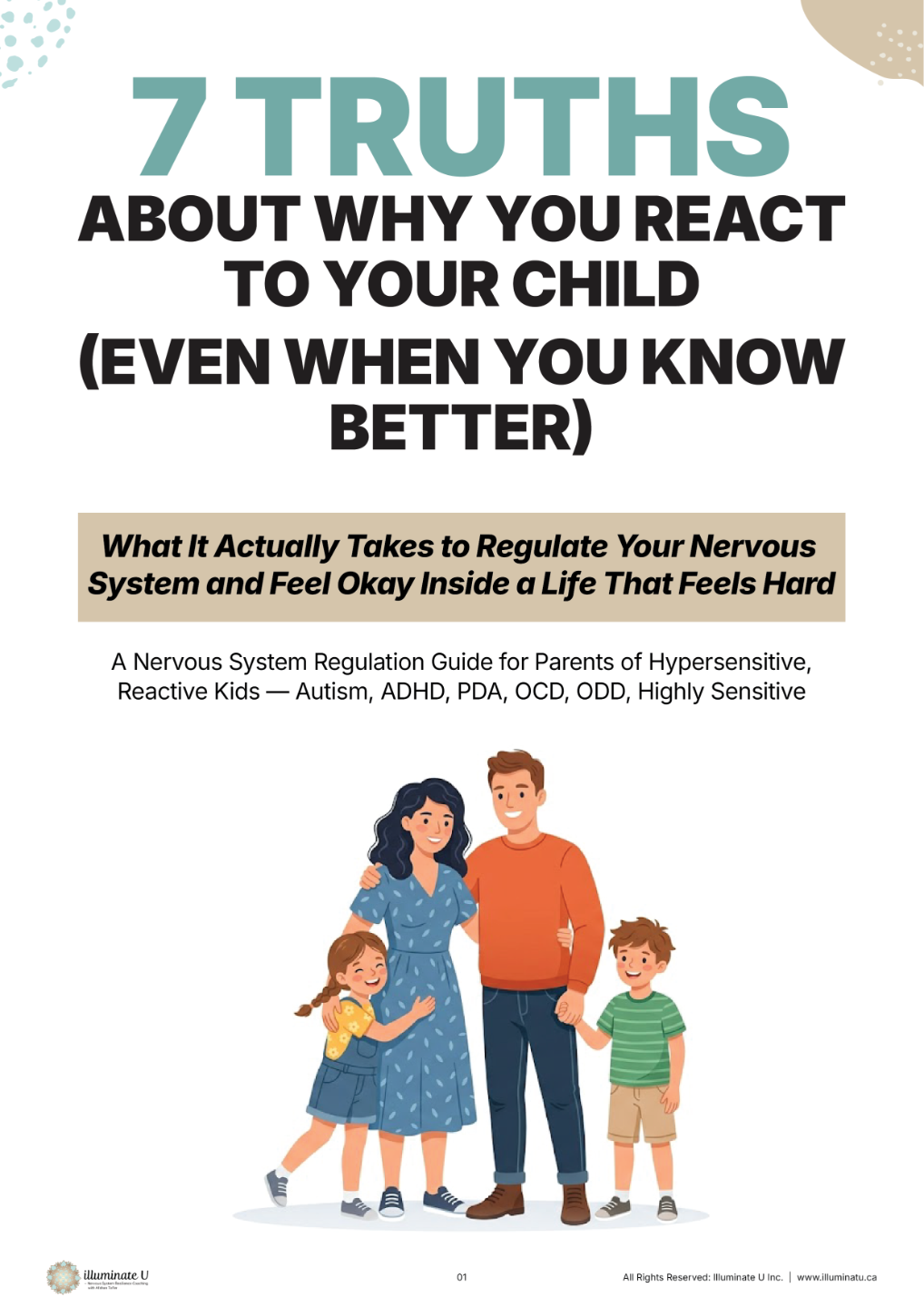
Free: 7 Truths About Why You React to Your Child Guide
Why you react even when you know better — the conditioning, nervous system states, hidden beliefs and patterns, and buried emotions running the show.

