
Why Parenting a PDA or High-Needs Child Requires Letting Go of Control

When my son's behaviour was at its most intense, my home looked like it had survived a tornado, and I cleaned and fixed constantly. This post explains why control is a nervous system safety strategy, why PDA parenting asks us to let go of it, and how to begin releasing control without feeling like you're giving up.
You can also listen to this in audio format only on The Regulated Parent Podcast on Apple or Spotify. Look for Episode #25
Releasing Control Without Letting Go of Yourself
“Everything feels so out of control!” - This is one of the most common things I hear from moms of PDA or high needs kids. If you’re parenting a PDA or high-needs child, you already know there is nothing that exposes your relationship with control quite like this path. You may have started this journey thinking you were a fairly flexible, patient, open-hearted person… and then you found yourself face-to-face with chaos, unpredictability, constant refusals, meltdowns, school avoidance, hygiene battles, sensory overload, and explosive reactions to even the smallest requests. And suddenly, you’re clinging to control in ways you didn’t even know were inside you.
Maybe you’ve asked yourself, Why does this mess bother me so much? Why do I feel like I’m losing myself? Why can’t I just stay calm? Why does letting go or “surrendering” feel like I’m giving up or falling apart?
It’s not because you’re failing. It’s because control has been your nervous system’s safety strategy for most of your life. And PDA parenting asks you to let go in ways that most parents will never have to face — not because your child is difficult, but because their neurology doesn’t respond to pressure, structure, timelines, or expectations the way the world taught us it should.
Today, I’m sharing a personal story — really, two layers of the same story — that forced me to confront control at its roots. We’re going to talk about why losing control feels so threatening, why your body reacts so strongly to chaos or unpredictability, why letting go is such an essential part of this journey, and how to begin releasing control without feeling like you’re giving up.
If letting go feels terrifying…
If you’re exhausted from trying to keep everything together…
If you feel ashamed for how strongly mess, chaos, or your child’s resistance or lack of compliance affects you…
This episode is going to help you understand yourself with compassion — and find a different way forward.
Let’s begin.
When My Son’s Behaviour Was at Its Most Intense
A few years ago, when my son’s behaviour was at its most intense, my home didn’t look like a home. It looked like it had survived a storm - or more like a tornado. Walls dented, doors damaged, objects scattered, drawers emptied, and piles of belongings dumped down the stairs or across rooms faster than I could comprehend. The chaos didn’t feel like clutter — it felt like a physical representation of how chaotic my life had become inside.
Back then, I cleaned constantly. I fixed constantly. I repainted walls, repaired furniture, organized rooms, and tried to create some sense of order out of the daily destruction. Not because I cared deeply about perfection, but because chaos felt like danger. When your nervous system is already stretched thin because you’ve been under chronic stress for so long, mess and unpredictability don’t register as neutral — they register as threat.
I didn’t have the language for it at the time, but I can name it now:
my nervous system was trying to regulate itself through external control.
And then, years later — long after I thought I had made peace with a certain level of chaos — it happened again. My son’s OCD tendencies intensified, where making a mess became a daily ritual. Everything from drawers, cupboards, and closets would end up in massive piles down the stairs daily. Two hours of cleaning could disappear in thirty seconds.
One night, I walked into my bathroom and found the bathtub filled with random objects — topped with a toilet brush and a toilet plunger. That part of me that hates bacteria, that craves cleanliness, that needs things to be where they belong… froze.
My jaw clenched.
My chest tightened.
My breath stopped.
My whole body screamed, “Make this stop. Fix this. Control this.”
It was a visceral, full-body reaction — one that took me straight back to those early years of chaos and helplessness.
Every ounce of my survival system wanted to go downstairs and yell and scream at my son to STOP THIS MADNESS!
And in that moment, I realized something profound:
I wasn’t being asked to tolerate mess.
I was being invited to surrender another layer of control — a layer I didn’t even know I was still gripping.
This wasn’t about the bathtub.
It wasn’t about the pile of objects.
And it wasn’t even about my son.
It was about how deeply my sense of safety had become tied to control and expectation of things being a certain way— and how letting go of control and expectations would require me to once again connect to the deeper learning that was waiting here for me in this experience.
Why Control Becomes a Survival Strategy
Before we talk about surrender and stepping into allowing all that is as part of the solution to these triggering moments that come up, we need to understand what control really is.
Control isn’t about perfection.
Control isn’t about discipline.
Control isn’t about being organized.
Control is about safety.
It is a nervous system response — a way the body tries to find stability when it feels overwhelmed, scared, or unsure.
Control says:
“If I can make the environment predictable, I can feel okay.”
“If I can keep things together, I won’t fall apart.”
“If I can stop the chaos outside, I can avoid the chaos within.”
When you’re parenting a PDA child, chaos becomes a daily reality. Transitions explode. Simple requests trigger meltdowns. School becomes impossible. Hygiene becomes a battle. And suddenly your nervous system is clinging to anything that feels like predictability, scaffolding, or structure.
You grip because you’re scared.
You insist because you’re overwhelmed.
You correct because you fear the future.
You cling because letting go feels like losing yourself.
Control is not a character flaw.
It is your body trying to protect you…and this makes sense from a nervous system perspective, because we are designed to feel safer when we have control and when the outer world matches our inner expectations of how things “should be”.
This is why letting go feels like danger — even when your mind understands your high needs or PDA child’s neurology. Your body still remembers a lifetime of relying on control as its primary way of coping.
Why Letting Go of Control Is Required in PDA Parenting
Most parenting models assume that control is a normal part of raising children. Control their schedule. Control their behaviour. Control their routines. Control their hygiene. Control their learning. Control their sleep. Control their outcomes.
But PDA neurology turns all of this upside down.
Your child’s nervous system interprets demands — even gentle ones — as threat. Attempts to control them, even with love, can escalate their fear, resistance, shutdown, or explosive reactions.
This means that parenting a PDA child requires letting go of control in ways that most parents never face.
You may be asked to let go of:
School attendance.
Traditional learning.
Hygiene battles.
Toothbrushing fights.
Structured routines.
Morning timelines.
Bedtime expectations.
Chores.
“Respectful” behaviour.
Being on schedule.
Social participation.
Family outings.
Screen limits.
Meal expectations.
The entire cultural script of “how children should be.”
And each “letting go” triggers something different in your body.
Because letting go of control in PDA parenting is not about lowering your standards — it is about recognizing that external control will never create safety for a child whose nervous system panics when pressured.
The more you control, the less safety they feel.
The more you insist, the more they resist.
The more you push, the more they collapse or explode.
Letting go of control and expectations is not giving up.
It is choosing the path that actually leads to regulation and connection.
But it comes at a cost: your nervous system must relearn what safety feels like — not through the external environment, order, or compliance — but through presence, regulation, and internal anchoring that comes with helping yourself feel safer when things are not according to how your conditioned brain says they should be.
Why Letting Go Is So Hard: Conditioning, Identity, and the Fear Underneath
Letting go of control is not difficult because you’re rigid or stubborn.
It’s difficult because it goes against everything you were conditioned to believe about what makes you a good parent and a successful human.
Most of us grew up with the message that good parents have control over their children.
We were taught that:
Good children obey.
Good parents enforce.
Respect comes from compliance.
Structure produces responsibility.
A calm, well-behaved child reflects well on the parent and means you’re doing a good job.
A dysregulated child means the parent isn’t doing enough and must be doing something wrong.
These weren’t abstract concepts — they were the unspoken rules that shaped our childhoods. They were reinforced in school, at family gatherings, in cultural expectations, and at every stage of our development. Control wasn’t just a strategy — it was a moral measure of whether you were doing parenting “right.”
But beneath those messages was another layer — the conditioning around what it means to be a good, successful human.
We absorbed the beliefs that:
Responsible people are organized.
Respectable people have order.
Worthy people achieve.
Successful people follow timelines.
Good humans are productive, disciplined, and consistent.
Mature adults “hold it together.”
So when PDA parenting asks you to let go of routines, expectations, progress charts, and the picture of a “normal” life — your nervous system reacts as if your identity is being threatened.
Because it is.
Letting go means challenging the very definitions of success, responsibility, and worth that shaped your childhood and your self-concept. It means grieving the life you imagined. It means facing the fear that if you aren’t controlling things, you might be failing.
Your nervous system isn’t reacting to the moment in front of you —
it’s reacting to a lifetime of messages that never applied to a child like yours – and maybe, not even you.
No wonder letting go feels terrifying.
No wonder surrender feels like you’re giving up.
No wonder mess brings up shame and fear.
You’re not just losing control.
You’re losing the version of yourself you were conditioned to be.
What Spiritual Teachers Say About Control and Surrender
This is where the teachings of spiritual leaders become not abstract wisdom — but lifelines.
Tara Brach teaches that surrender is not resignation. It’s the moment we stop fighting reality long enough to see what’s actually here. Control is the fight. Surrender is the softening. When we stop arguing with life, our nervous system finds a new kind of ease.
Eckhart Tolle teaches that suffering comes from resisting the present moment. Not because the moment is easy, but because our mind insists it should be different. PDA parenting is full of moments that don’t match the picture we imagined. Letting go is not approving of those moments — it’s stepping out of the war with them.
Pema Chödrön teaches that certainty is an illusion, and the attempt to control life is what keeps us trapped. Freedom comes from learning to stay with discomfort without abandoning ourselves. PDA parenting asks this of you every day.
Jack Kornfield teaches about releasing the “small self” — the part of us that clings, resists, demands, and insists that life match our expectations. When we soften that grip, we meet a deeper, wiser self — one capable of compassion even in chaos.
These teachings are not lofty ideals.
They are practical guidance for a life like yours — a life where surrender is not optional but necessary.
How Parents Can Begin Letting Go Without Feeling Like They’re Giving Up
Letting go of control doesn’t mean letting go of your values.
It means shifting them.
From external order to internal presence.
From compliance to connection.
From timelines to trust.
From forcing outcomes to supporting nervous systems.
From external safety cues to internal ones.
You can begin letting go by gently asking yourself:
“What part of me is scared right now?”
“Whose expectations am I carrying?”
“What am I afraid will happen if I release this control?”
“What value matters more to me than this moment looking the way I want it to?”
“What is this moment teaching me?”
Letting go becomes easier when you anchor into values like:
Connection.
Safety.
Compassion.
Presence.
Trust.
Internal stability.
You don’t need to like the chaos.
You don’t need to enjoy the uncertainty.
You don’t need to feel calm to let go.
You just need to stay with yourself long enough to recognize the fear underneath the gripping — and offer yourself compassion instead of tightening the reins.
A practice that I use a lot is Allowing all that is…Allowing this experience to be here too. I often say to myself “this too belongs” which I learned from Tara Brach. The practice of allowing all that is requires you to be able to hold the fear getting triggered inside and bring cues of safety to it. It also requires becoming the Awareness (the curious observer) of the conditioning and programming that is getting triggered underneath, and helping yourself understand deeply that this conditioning is causing you suffering and creates so much resistance and stress to what is here.
I also want to say that letting go of control and expectations is not giving up on your child either. It is instead choosing the only path that truly works for their nervous system — and yours.
A New Way to See Yourself
Letting go of control is not a collapse.
It’s not weakness.
It’s not passivity.
It’s not giving in to chaos.
Letting go is the moment you shift from fighting life to meeting life.
It is the moment you choose presence over pressure.
Compassion over fear.
Internal safety over external order.
Letting go is not the end of your power — it is the beginning of it.
Because the more you soften your grip on the outside world, the more you strengthen your inner world.
You stop trying to create safety through your child’s behaviour and start creating safety through your own presence.
You stop trying to force predictability and start becoming the predictability your child needs.
You stop trying to hold everything together and start learning how to hold yourself.
You are not failing.
You are transforming.
You are not losing control.
You are learning the deeper truth about it.
You are becoming the parent your child needs —
and the parent your younger self always deserved.
And if you are here — reading this, breathing through the discomfort, questioning your conditioning, grieving the life you imagined, softening into the life you have — then you are already on the path.
The path of surrender.
The path of compassion.
The path of truth.
The path of inner safety.
The path of becoming.
You are not falling apart.
You are awakening.
Questions Parents Ask
Why does mess and chaos trigger me so much as a parent of a PDA child?
When your nervous system is already stretched thin because you've been under chronic stress for so long, mess and unpredictability don't register as neutral. They register as threat. Control isn't about perfection or being organized. Control is about safety. It is a nervous system response, a way the body tries to find stability when it feels overwhelmed, scared or unsure.
Why does PDA parenting require letting go of control?
Your child's nervous system interprets demands, even gentle ones, as threat. Attempts to control them, even with love, can escalate their fear, resistance, shutdown or explosive reactions. Letting go of control in PDA parenting is not about lowering your standards. It is about recognizing that external control will never create safety for a child whose nervous system panics when pressured.
Why is letting go of control so hard for parents?
It's not because you're rigid or stubborn. It goes against everything you were conditioned to believe about what makes you a good parent and a successful human. Many of us grew up with the message that good parents have control over their children. So when PDA parenting asks you to let go, your nervous system reacts as if your identity is being threatened.
Does letting go of control mean giving up on my child?
Letting go of control and expectations is not giving up on your child. It is instead choosing the only path that truly works for their nervous system, and yours. Letting go of control doesn't mean letting go of your values. It means shifting them, from compliance to connection, from timelines to trust, and from external order to internal presence.
How can I start letting go of control without falling apart?
You can begin by gently asking yourself, "What part of me is scared right now?" and "What am I afraid will happen if I release this control?" A practice I use a lot is allowing all that is. I often say to myself "this too belongs," which I learned from Tara Brach. It requires holding the fear getting triggered inside and bringing cues of safety to it.
Why a PDA Child's Need for Control Can Feel So Dysregulating for Parents
when your child's control activates your own
Why Staying Regulated With Your PDA Child Means Letting Go of "Shoulds"
loosening the shoulds that keep you stuck
Why Lowering Demands for Your PDA Child Can Make You Feel Like You're Falling Apart
what lowering demands stirs up in you
Why Your PDA, Autistic Child Needs More Flexibility
why flexibility feels so hard for parents
I have three free guides for parents of PDA, autistic and high-needs kids: the 3 Shifts guide for meltdowns, the 7 Truths guide on why you react even when you know better, and the Meaning guide for finding your way back to yourself. Pick whichever one fits where you are right now.
And if you want to go deeper with me, the Regulation Rebuild is my course for parents who want to rebuild their own nervous system capacity, step by step. Join the waitlist to hear first when the next round opens.
About the author: Afshan Tafler is a Nervous System Resilience Coach, host of The Regulated Parent podcast, and a parent raising a PDA autistic teen with high anxiety and OCD. She is trained in Internal Family Systems (Level 3), Havening, polyvagal-informed practice and EFT, and is completing her Somatic Experiencing training. She has guided hundreds of parents of ADHD, autistic and PDA kids from burnout and barely coping to steadier, more connected and more alive, within the life they are actually living.
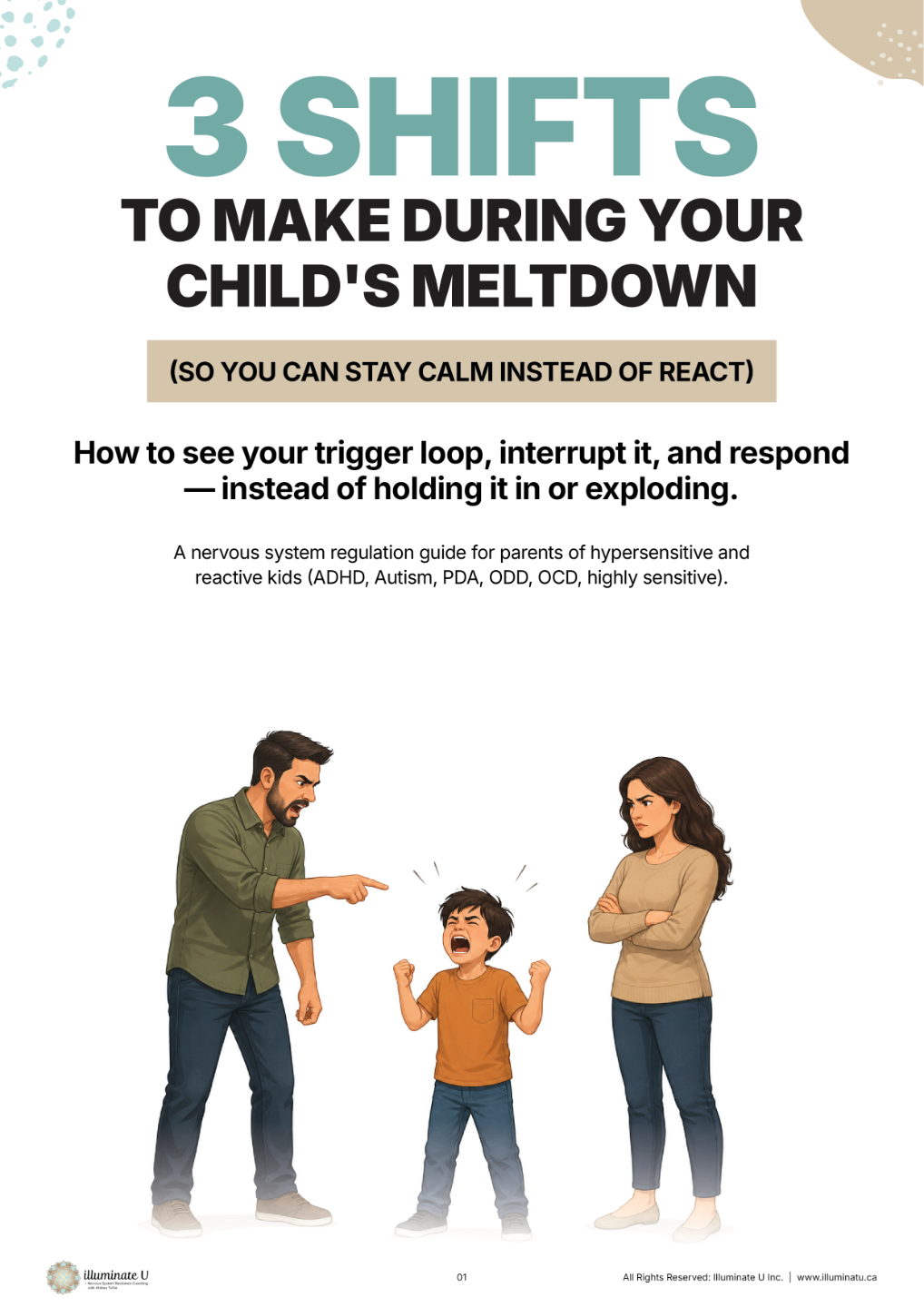
Free: The 3 Shifts Guide
The trigger loop and 3 patterns you get stuck in during meltdowns — and how to shift them so you can stay calm instead of react.
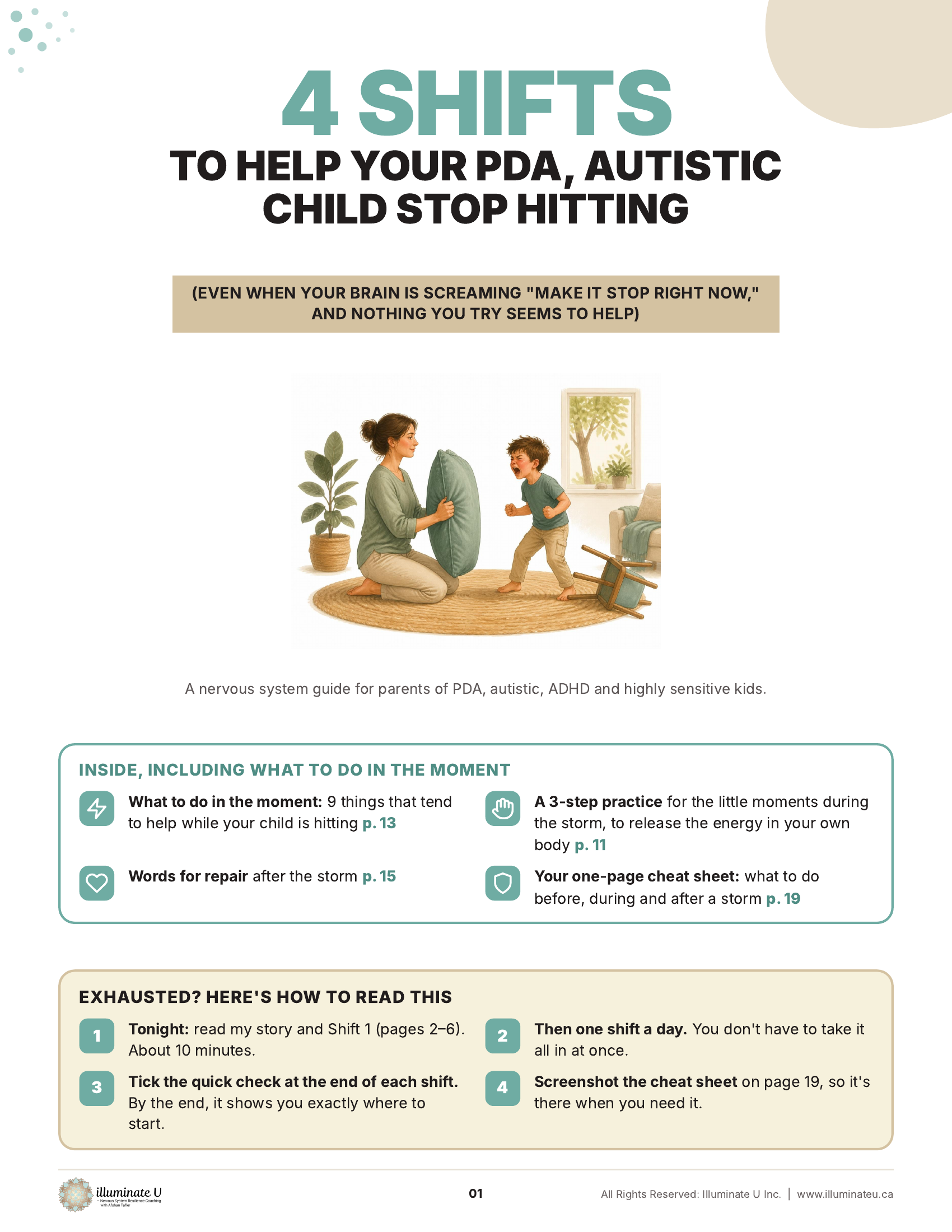
Free: 4 Shifts to Help Your PDA, Autistic Child Stop Hitting
What to do in the moment your child is hitting you, a one-page cheat sheet to keep on your phone, and the 4 shifts that changed things in our home.
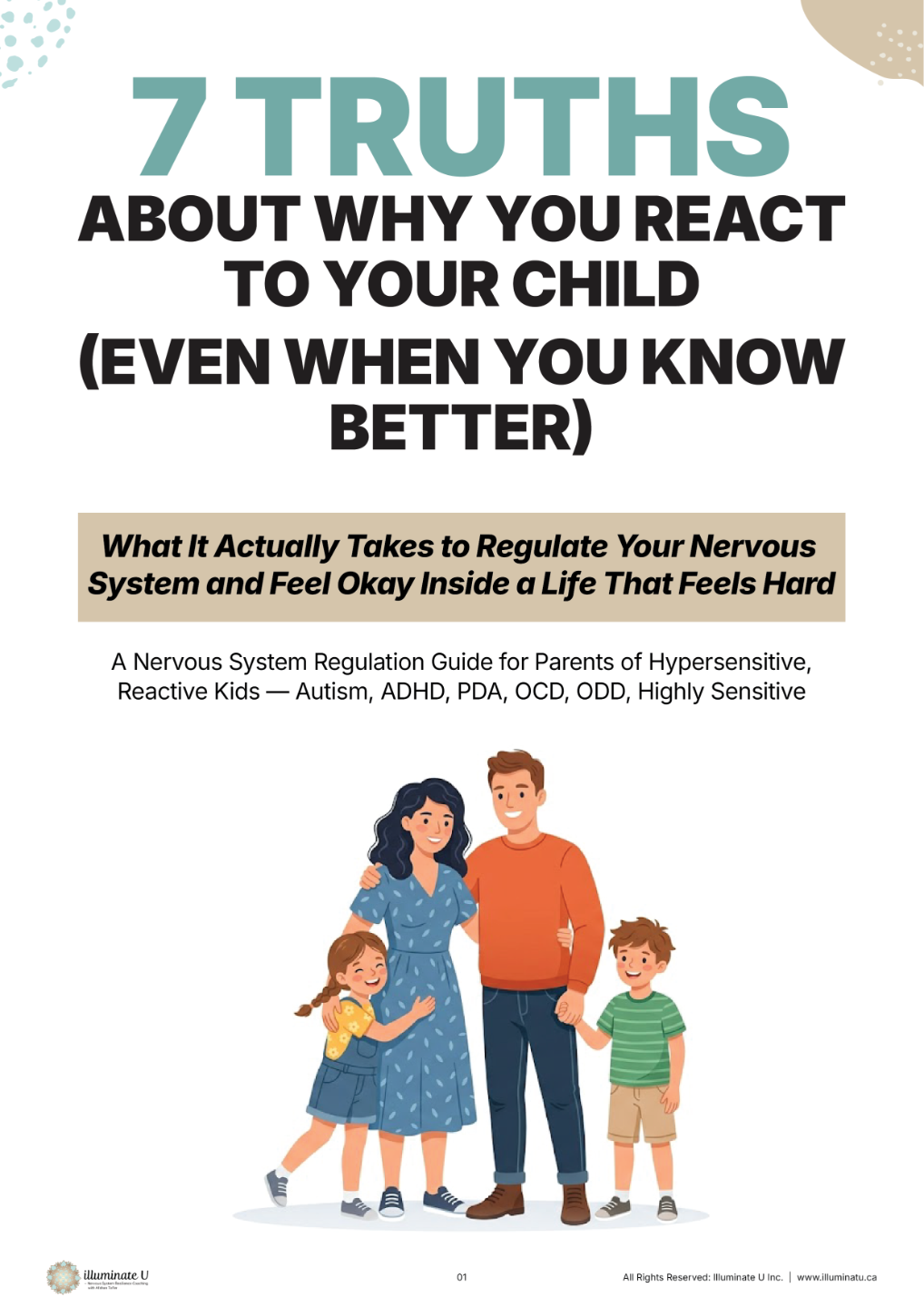
Free: 7 Truths About Why You React to Your Child Guide
Why you react even when you know better — the conditioning, nervous system states, hidden beliefs and patterns, and buried emotions running the show.
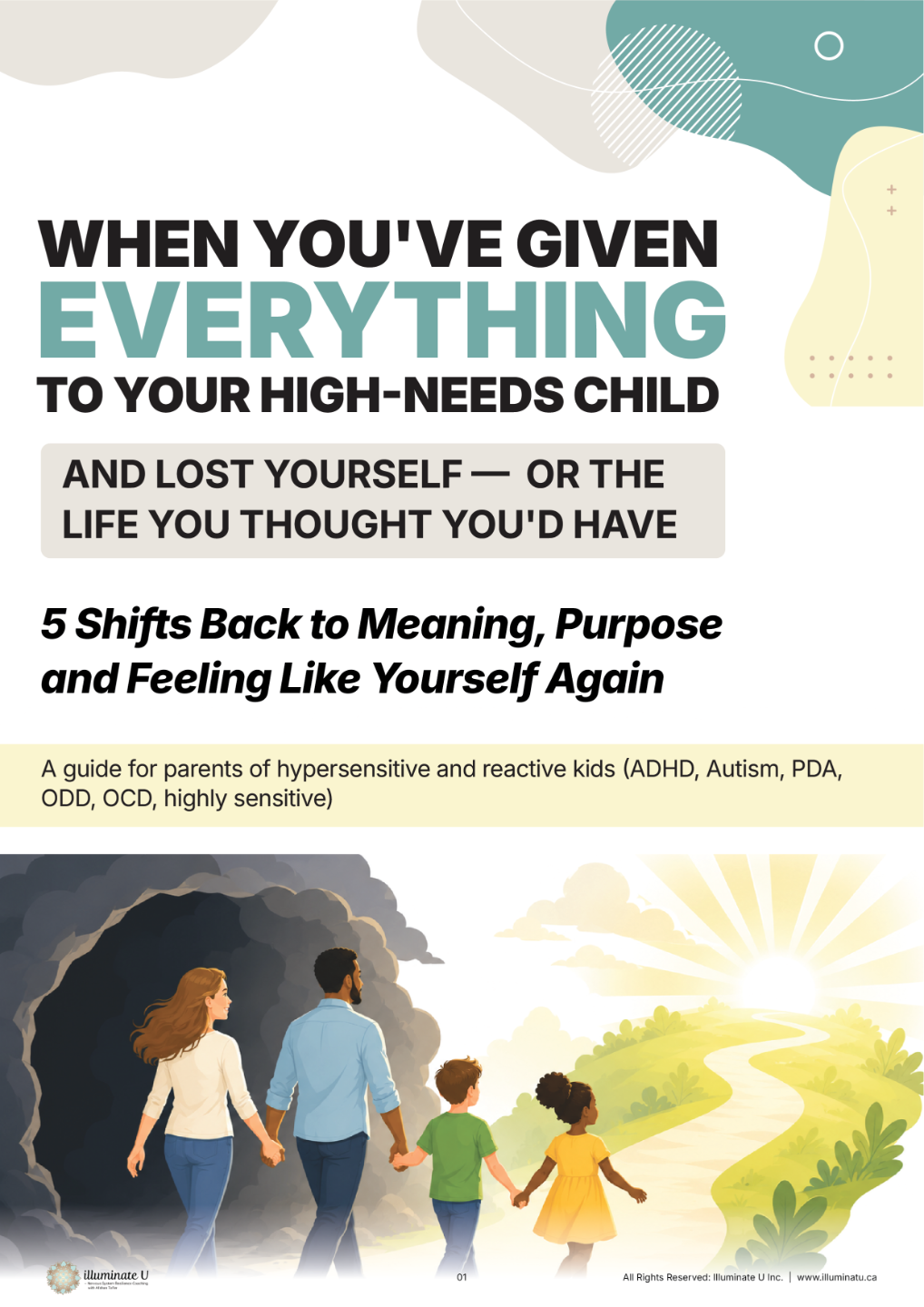
Free: 5 Shifts Back to Meaning Guide
For when you've given everything to your high-needs child and lost yourself — 5 shifts back to meaning, purpose and feeling like you again.

