
Why It Feels So Hard to Stay Calm When Your PDA Child Is Melting Down

Staying calm when your PDA or high-needs child is melting down isn't something you should just know how to do. Regulation is not a personality trait. It is a set of human capacities many of us were never taught. I walk through 15 skills, from awareness and interoception to allowing, containment, rest and slowing down.
You can also listen to this in audio format only on The Regulated Parent Podcast on Apple or Spotify. Look for Episode #24
You’re not failing — you’re rebuilding the human skills you were never taught.
Why is it so hard to stay calm when your PDA or high-needs child is melting down or being aggressive or severely controlling?
You’ve probably heard people say things like: “Just stay calm.” “Just breathe.” “Just don’t react.”
But no one talks about why staying calm feels nearly impossible in the moments when you need it most.
Many people think that regulation is something you “should just know how to do.”
No one explains that there are skills that we need to actively rebuild or even build for the first time in our life. Skills that many of us were never taught, or many that life conditioned out of us, and many that trauma shut down long before we even became a parent.
Regulation is not a personality trait.
It’s a set of human capacities that allow you to stay present, grounded, connected, and flexible in the moments when everything in your body screams for you to fight, flee, or shut down.
And the truth is this:
If these moments feel hard, overwhelming, or impossible…that doesn’t mean you’re failing.
It means you’re needing to learn skills that you were never given.
Today we are going to take a deeper look at these 15 essential skills — yes 15!!! – not as quick tips or techniques, but as internal abilities that need to be developed and cultivated if you want to show up differently when your hypersensitive child needs you most.
1. Awareness: Returning to Your True Self
Awareness is the foundation of regulation.
It’s the ability to notice what’s happening inside you as it unfolds — your heartbeat shifting, your muscles tightening, your thoughts speeding up, your impulse to yell or shut down rising.
For many of us, this skill was never nurtured. We grew up believing our thoughts were us, our coping patterns were our identity, and our emotional reactions defined us. We weren’t taught to observe our experience; we were taught to be fused with it. We were taught that we are this mind and body and survival system – but you’re not – you’re more than this nervous system…You’re the awareness of it. When stress, trauma, or urgency floods in, most people lose access to awareness entirely — because survival mode doesn’t allow space for noticing.
Rebuilding awareness means reclaiming the part of you that can witness without drowning – I call this the True Self – who can be the curious observer or watcher of what is happening inside of you. It’s the moment you can say, “I notice what’s happening inside me,” and suddenly you have choice again.
This awareness is the doorway back to your true self — the steady part of you underneath the overwhelm who can BE WITH the survival reaction instead of taken over by it. The ability to be with instead of taken over by the reaction is what helps create the pause between the trigger and the response and allows you to respond instead of react.
2. Interoception: Feeling What’s Actually Going On in Your Body
Interoception is the skill of sensing your inner world — your tension, breath, heat, tightness, pulse, energy, or collapse. It is one of the most important foundations of regulation, because you cannot shift a state you cannot feel.
Yet for countless parents, interoception is painfully difficult. Many learned early in life that sensations felt unsafe, overwhelming, or “too much,” and so the brain adapted by numbing, dissociating, or disconnecting from the body’s messages. And if you’re neurodivergent or autistic, this becomes even more layered — your nervous system may naturally defend against overwhelming sensory input, making sensations feel too loud, too sudden, or too intense. Over time, the body learns to mute or distort sensation as a form of protection.
Rebuilding interoception teaches your system: “It’s safe to feel. I can be here now.” And when you strengthen interoception, you also strengthen a part of the brain called the insula — the hub that links bodily sensations with emotional awareness, intuitive decision-making, empathy, and your core sense of self. A stronger insula gives you clearer emotional signals, a more accurate “gut sense,” a steadier inner world, and a deeper capacity for regulation and connection.
This is why interoception isn’t just a supportive skill — it’s a biological foundation for emotional resilience, nervous system stability, and feeling at home in your own body.
3. Allowing: Softening Into What Is — Inside and Outside
Allowing means letting the moment be what it is without fighting yourself or your child. For many of us, this skill was conditioned out of us. We heard messages like “stop crying,” “calm down,” “don’t be sensitive,” “perform better,” or “keep it together.” Our systems learned to clamp down — on sensations, emotions, impulses, and needs. No one ever said “it’s ok you’re angry, that’s a natural human emotion and let me help you get it out in a safe way.”
In meltdown moments, we unconsciously fight what’s happening, especially if it feels like intense anger or aggression: We tighten. We brace. We rush to fix or control. We try to stop the behavior. We try to stop our own feelings.
But allowing is the opposite of controlling, fixing or collapsing.
It’s the softening that creates enough space for regulation to begin.
Allowing inside means you let the sensation rise without resisting it or pushing it down. Allowing outside means you let your child’s distress exist without immediately trying to control or fix it.
This is not permissiveness or condoning — it’s nervous system truth.
The body cannot regulate what it is resisting. Softening and allowing what is here (because it is here afterall) is what opens the door to change.
It’s important to understand that allowing “all that is” is not the same as collapsing, giving up, or slipping into a fawn response — even though it can feel similar if you grew up needing to appease or stay small. Allowing is simply acknowledging the reality of this moment as it is, without fighting it or abandoning yourself. When you let yourself and your child be where you are, you’re not saying “this is how it will always be.” You’re saying, “This is what’s here right now, and I can meet it.” Paradoxically, it’s this very acceptance that opens the doorway to change. When the nervous system stops resisting the moment, it gains the capacity to choose a new direction. You can allow what’s here now while still holding the deeper knowing that this reality is not permanent — and that it can shift.
4. Self-Compassion: The Balm That Softens the Threat Response
Self-compassion is not weakness. It’s not letting yourself off the hook. It’s a biological force that helps deactivate the stress response. When you meet yourself with kindness in a hard moment, your brain receives the message: “I am safe. I am not alone. I am not failing.”
For many parents, compassion was never modeled. You may have grown up with pressure, criticism, shame, or comparison. So now, when you feel yourself struggling, your inner critic speaks first.
Rebuilding compassion rewires your stress response. It opens space in moments that would otherwise close you down. It softens your system enough for regulation to happen and it is especially powerful to help you regenerate and rebuild capacity after a big challenge.
5. Tolerance: Staying With What You Feel — Especially the Vulnerable Emotions
Tolerance is the ability to be with discomfort — the frustration, fear, sadness, anger, shame — without getting swept away or shutting down.
Many of us never learned this skill because no one taught us that feelings were safe. If your caregivers couldn’t tolerate your vulnerable or intense emotions, then you learned that those emotions were too much, too dangerous, or too inconvenient. You learned to bury them, explode with them (because you couldn’t hold them in anymore), or avoid them entirely.
This is why your child’s big emotions feel so overwhelming — because their emotions ignite the emotions you never learned to tolerate in yourself.
Rebuilding tolerance is like strengthening an emotional core. It says:
“I can be with this emotion. I don’t have to fix it, hide it, or escape it.”
And tolerance allows your child to have their emotions without triggering yours. This is one of the most powerful forms of generational healing. When we think about how often we were taught — directly or indirectly — that emotions were “bad,” “too much,” or something to hide, it becomes clear why tolerance is such profound generational work. Simply staying present with big emotions, instead of collapsing or suppressing them, is one of the most powerful acts of healing you can offer yourself and your child. Every moment you tolerate an emotion without shaming it or shutting it down, you’re unwinding a massive inherited pattern. You’re clearing emotional burdens that generations before you carried silently. And in doing so, you’re creating a future where your child — and generations to come — can feel safer in their own emotional world.
6. Containment: Holding Your Activation Instead of Clamping Down
Containment is often misunderstood. It’s not suppression. Suppression clamps down, tightens, forces the emotion or sensation to disappear. It’s the internal bracing that says, “Shove this down now.” We all learned to clamp down — because our caregivers did, and society taught us that emotional composure equals strength.
Containment is different. Containment is the ability to gently hold your activation inside a “blanket of safety” so it doesn’t leak out as rage or implode inward as shutdown. It’s the skill of creating internal boundaries around your sensations so they have a container — not a prison.
When you can contain instead of clamp, you can stay online in moments that would otherwise overwhelm you. Your activation has space to exist (within a safe container) without taking over.
We can understand the power of containment by remembering what a distressed baby needs. When a baby is overwhelmed, they don’t need someone to silence their emotions — they need holding, steadiness, and the felt sense of, “I’ve got you; you’re not alone; you’re safe with me.” That sense of support is containment. And even as adults, our nervous systems still need this same kind of holding — especially if we never received it consistently growing up. This is why containment is so essential for parents of high-needs children who often don’t feel supported themselves. Through the skill of containment, we learn to give ourselves what we once needed: the internal reassurance that “I can hold this; I can support myself through this storm.” It’s the adult version of being held — a way of offering ourselves safety from the inside out.
7. Presence: Coming Back to the Moment Where Choice Lives
Presence is the art of being here — not spiraling into the past, not bracing for the future. Chronic stress and trauma makes presence difficult because your nervous system learned that the present moment is not safe. So you live in anticipation, hypervigilance, scanning, waiting or numbed out, distracted, dissociated.
But presence is what gives you access to the qualities that make parenting possible:
Creativity. Problem-solving. Flexibility. Humor. Connection. Intuition. Perspective.
If you could stay present in hard moments, your system could access the very capacities that would help you navigate them. Presence is the state where the best version of you comes online.
Rebuilding presence is not about meditation or stillness — it’s about teaching your nervous system that this moment is safe enough to be with right now, as it is.
8. Titration & Pendulation: Rebuilding the Nervous System’s Natural Rhythm
Your nervous system is designed to oscillate naturally between activation and safety. This rhythm of moving in and out — pendulation — is how humans process stress and return to balance.
But chronic stress, trauma, and decades of bracing disrupt this rhythm. Instead of oscillating, your system gets stuck:
- stuck on (sympathetic)
- stuck off (dorsal)
- or stuck oscillating too rapidly without rest
Titration is the skill of touching activation in tiny doses, rather than all at once. Pendulation is the movement between activation and safety.
These skills restore your natural rhythm — the biological rhythm that makes regulation possible. You’re teaching your system:
“I can go into the feeling…and I can come back out. I am not trapped.”
You’re also teaching your system that stress and safety can co-exist together.
This rhythm is at the heart of healing.
9. Resourcing: Rebuilding Your Sense of Support
A resource is anything — internal or external — that brings a sense of support, safety, steadiness, comfort, or connection. It can be:
- a hand on your heart
- the ground under your feet
- a supportive thought
- the memory of someone who cared
- a warm blanket
- nature
- movement
- a glimmer of beauty
- a calming voice
- music
- your own compassion
Most parents try to regulate with their mind — by trying to “stay calm.” But the nervous system doesn’t respond to thoughts alone. It responds to felt safety.
Resourcing is how we bring that felt safety to ourselves, even when no one else is there to offer it. Many parents feel deeply alone — especially when raising a PDA or high-needs child — and resourcing rebuilds the felt sense of “I’m supported. I’m not doing this alone” as well as “safety is here, even during this stressful challenge.”
Resources are not luxuries. They are biological needs. And we often forget to turn to them when chronically stressed. Turning towards and taking in the felt sense of resources can help immensely to build the felt sense of safety back into daily life.
10. Curiosity: Reopening the Prefrontal Cortex & Softening the Threat Response
Curiosity is one of the most underrated regulation skills.
When your system goes into survival mode, curiosity shuts down instantly. The brain narrows into threat, urgency, defensiveness, and black-and-white thinking.
But when you become even slightly curious
“What else might be happening here?”
“What is my child trying to communicate?”
“What’s happening in my body right now?” …
…your prefrontal cortex comes back online, and your amygdala’s threat response begins to down-regulate.
Curiosity literally brings your higher brain back into the conversation. It creates space for flexibility, problem-solving, compassion, and creativity. It’s the shift from “I must survive this moment” to “I can understand this moment.”
Curiosity turns threat into possibility.
11. Stress Release Awareness: Letting Your Body Complete What Stress Started
Stress doesn’t simply disappear after a hard moment or a meltdown — it stays in the nervous system unless it has a way out. One of the biggest misunderstandings in our culture is the belief that “time passing” means “stress resolved.” In reality, most of us carry years of incomplete stress cycles in our bodies: fight impulses we swallowed, fear that had nowhere to go, tears we pushed down, freeze states that never fully thawed. All of it remains stored when the cycle is interrupted.
This interruption happens constantly in parenting. Your child escalates, your system ramps into survival — and instead of allowing your body to release and come all the way down afterward, you tighten, stay busy, or brace for what’s next. You stay “on” until your body can’t hold anymore and crashes “off.” Over time, this erodes your capacity, making each meltdown feel harder than the last.
Rebuilding stress-release awareness means allowing your nervous system to complete its cycle after a stressful moment. Instead of rushing into the next task, you let yourself soften, breathe, shake, cry, or simply feel your body return to safety. You allow the excess activation to move out of your system.
When this release is allowed, your nervous system repairs and regenerates. Instead of accumulating stress, you restore your baseline. This is how you grow capacity — moment by moment — so you can meet the next challenge with more ease rather than less.
This skill is not indulgent — it is essential hygiene for your nervous system. Without it, you’re trying to regulate on top of an internal mountain of unresolved activation. With it, you build resilience from the inside out.
12. Rest & Real Relaxation: Relearning How to Let Your Body Come Down
Rest is one of the most misunderstood nervous system skills. Many people mistake collapse for rest — but collapse is when the system gives up, shuts down, and disconnects. Real rest is something entirely different: it’s what happens when the body actually feels safe enough to soften, release tension, breathe more deeply, and restore its depleted reserves.
For many parents — especially those who grew up in environments that required hypervigilance, productivity, or “being good” — true rest never felt safe. Resting meant you might be judged. Resting meant you weren’t doing enough. Resting meant you would fall behind. Resting meant someone could get angry. So you learned to go, go, go — until stopping felt unbearable. When you did stop, your nervous system didn’t feel safe enough to relax, so it dropped into shutdown instead.
This is why so many parents say, “I can’t relax, even when I’m exhausted,” or “I collapse at night but never feel restored.” Your system doesn’t trust that it’s safe to let go.
Rebuilding the skill of rest teaches your nervous system the opposite message:
“You can soften. Nothing bad will happen. You’re allowed to come down.”
This softening is crucial because a nervous system that never rests stays stuck in survival mode. And survival mode makes everything harder — especially parenting a high-needs child whose nervous system is constantly signaling danger.
When you relearn rest, you rebuild your capacity. You refill the well. You give your system the bandwidth to respond instead of react. Rest isn’t a luxury; it’s the bedrock of resilience. It’s how you mother yourself so you can mother your child.
13. Positivity Noticing: Rewiring Your Brain to Register Safety Again
For parents living inside chronic stress, especially those raising PDA or highly reactive children, the brain becomes trained to scan for threat. Not because you’re negative — but because your nervous system is constantly trying to protect you. Over time, this threat-bias becomes automatic. Your brain registers every scream, argument, sound, or shift in energy as danger, and it overlooks the tiny signs of ease, connection, or progress.
This is why parents often say: “Nothing is getting better,” even when small shifts are happening. Their brain simply isn’t encoding them. Many of us grew up in environments where the positives were rarely acknowledged, where praise was conditional, and where loveliness, beauty, or safety were overshadowed by stress. So we lost the skill of “taking in the good” — of letting warmth, connection, or quiet moments land in the body.
Positivity noticing is not toxic positivity. It’s not pretending everything is fine or forcing yourself to feel grateful. It’s the gentle skill of allowing your brain to register the small moments of goodness that are already present — the glimmers, the pauses, the micro-moments of peace. This might be noticing your child softening for three seconds, or the warmth of sunlight on your face, or taking in the beautiful blue sky.
Every time you notice a cue of safety, your nervous system shifts. The brain learns: “There is something good here. I am not always in danger.” These tiny shifts accumulate, creating a new internal baseline. Over time, positivity noticing rewires your nervous system to see the full truth of your life — not just the stress, but the humanity, the connection, the growth.
This skill rebuilds hope. And hope fuels healing.
14. Discernment: Knowing the Difference Between the Past and the Present
Discernment is the skill of sensing whether your reaction belongs to this moment or to another moment from long ago. It is often said in the trauma and neuroscience world that most of our emotional reactions come from past wiring—because the brain interprets the present through predictions shaped by old experiences about what kept us safe, loved, or in belonging. So when your child yells, refuses, or melts down, your nervous system isn’t just reacting to them—it’s reacting to every old pattern you learned about what intensity meant.
When you grew up in environments where emotions were inconvenient, success mattered more than connection, obedience was equated with goodness, or where big feelings led to criticism or chaos, your nervous system learned to treat intensity as threat. So today, when your child becomes dysregulated, the mind jumps to meanings formed long ago: “If my child is aggressive, I need more control—or I’m a bad parent. If they can’t settle, it means they won’t be accepted in this world. If they melt down, it means something is wrong with me or with them.” These interpretations reflect old conditioning—not the truth of your child’s nervous system in this moment.
Discernment allows you to pause and separate programming from reality. Programming says: “A good child is obedient; if mine isn’t, something is wrong.”
Truth says: “My child is overwhelmed because their nervous system doesn’t feel safe. This is not about my worth.”
Rebuilding discernment gives you the space to respond from clarity rather than from history. It allows you to see your child’s distress for what it truly is: a nervous system communication, not a reflection of your competence. And it interrupts generational patterns at the root—at the level of perception—so you can meet the moment with presence, not past pain.
15. Slowing Down: Interrupting the Speed of Survival
Slowing down is one of the most deceptively difficult nervous system skills. Survival mode is fast — fast thinking, fast reacting, fast bracing, fast shutting down. It’s the body’s way of outrunning pain, threat, conflict, or emotional overwhelm. For many of us, speed became a lifelong coping strategy: if I move fast enough, maybe I won’t feel it. Maybe I’ll stay in control. Maybe nothing bad will happen.
But regulation lives in slowness.
Presence lives in slowness.
Healing lives in slowness.
Connection lives in slowness.
When you slow down — even by 5% — you shift your nervous system from threat to awareness. You go from reacting to choosing. You go from bracing to sensing. You go from spiraling to grounding. Slowing down opens the door to every other skill you’re rebuilding. Awareness requires slowness. Interoception requires slowness. Allowing requires slowness. Curiosity requires slowness. You cannot practice these skills at the speed of survival.
Many parents struggle with slowing down because slowing down once felt dangerous. It may have exposed you to criticism, conflict, or vulnerability. So your system learned to stay ahead of the moment — to outrun your own inner world.
Rebuilding this skill teaches your nervous system:
“There is no emergency here. I can take my time.”
This one shift — slowing your breath, slowing your steps, slowing your words, slowing your expectations — changes everything. It creates space for wisdom to emerge, for your prefrontal cortex to come online, for your true self to lead. Slowing down transforms the entire landscape of parenting a high-needs child.
Why All These Skills Were Lost — and How Generational Trauma Shaped Us
For generations, families lived inside cultural conditioning that discouraged emotional expression and punished sensitivity. Parenting models emphasized compliance, obedience, behaviorism, emotional suppression, “good behavior,” and looking good to others. Children were taught not to talk back, not to show anger, and never to show vulnerability. Emotions became dangerous, inconvenient, or embarrassing. Most parents today grew up being silenced, shamed, dismissed, or disciplined simply for being human.
This conditioning didn’t vanish — it lives in your nervous system.
You inherited your family’s survival patterns, fears, coping strategies, emotional avoidance, rigidity, beliefs about what emotions mean, and their lack of psychological safety.
And now you are raising children whose sensitivity, intensity, and dysregulation expose all of this conditioning — not to break you, but to awaken you.
Your child isn’t here to destroy you.
They are here to break the pattern.
They’re pulling you toward emotional literacy, compassion, presence, authenticity, truth, nervous system awareness, connection, flexibility, and boundaries without shame.
This work is not small.
It is generational.
It is evolutionary.
You are being called into a different way of parenting — one rooted in truth, humanity, and nervous system understanding, not fear, compliance, or performance. This is the work that reshapes the future, not just for your child but for every generation that follows.
And it begins with rebuilding the skills you were never taught. When you do this, you don’t just change your own experience of life — you create a ripple effect that shifts your family, your community, and the generations ahead.
Why “Just Calm Down” Has Never Worked
This is why staying calm in the heat of the moment has never been as simple as taking a breath, counting to ten, or “trying harder.” Regulation isn’t a switch you flip — it’s the outcome of rebuilding fifteen complex nervous system skills that most of us were never given the chance to develop.
You can’t stay calm if you can’t feel your body. You can’t stay calm if you’re fighting your feelings. You can’t stay calm if you’re flooded with past wiring. You can’t stay calm if your stress cycle never completes. You can’t stay calm if you’ve never truly felt safe.
Calm is not a strategy.
Calm is a capacity — and that capacity grows only when you restore the skills that stress, trauma, and conditioning took from you.
So if you’ve ever wondered, “Why is it so hard to stay regulated?”
This is why.
It’s not because you’re weak. It’s not because you’re failing. It’s because no one ever taught you the skills regulation depends on.
But you are learning them now. You are rebuilding what was never modeled for you. You are becoming the parent your child needs — and the version of yourself you were always meant to be.
And that’s why this work matters.
Not because it makes you “calm,”
but because it makes you whole.
Questions Parents Ask
Why is it so hard to stay calm when my PDA child melts down?
Staying calm in the heat of the moment has never been as simple as taking a breath, counting to ten, or trying harder. Regulation isn't a switch you flip. It's the outcome of rebuilding nervous system skills that most of us were never given the chance to develop. It's not because you're weak or failing. It's because no one ever taught you the skills regulation depends on.
What is interoception and why does it matter for parents?
Interoception is the skill of sensing your inner world: your tension, breath, heat, tightness, pulse, energy, or collapse. It is one of the most important foundations of regulation, because you cannot shift a state you cannot feel. Many parents learned early in life that sensations felt unsafe or too much. Rebuilding interoception teaches your system, "It's safe to feel. I can be here now."
Does allowing my child's meltdown mean being permissive?
Allowing outside means you let your child's distress exist without immediately trying to control or fix it. This is not permissiveness or condoning. It's nervous system truth. The body cannot regulate what it is resisting. Allowing is also not collapsing, giving up, or slipping into a fawn response. It's saying, "This is what's here right now, and I can meet it."
What's the difference between containing and suppressing my emotions?
Suppression clamps down, tightens, and forces the emotion or sensation to disappear. Containment is the ability to gently hold your activation inside a "blanket of safety" so it doesn't leak out as rage or implode inward as shutdown. It's the skill of creating internal boundaries around your sensations so they have a container, not a prison.
How do I recover after my child's meltdown?
Stress doesn't simply disappear after a hard moment or a meltdown. It stays in the nervous system unless it has a way out. Instead of rushing into the next task, let yourself soften, breathe, shake, cry, or simply feel your body return to safety. When this release is allowed, your nervous system repairs and regenerates, and you restore your baseline.
How to Pause Instead of React to Your High-Needs Child
building the pause before you react
The Key to Handling Your Child's Big Emotions: Learn to Feel Your Own
why tolerating your feelings helps your child
Why You Can't Relax, and How to Teach Your Nervous System That It's Safe
relearning real rest as a parent
You Are Not Your Activation: Becoming the Awareness Behind Your Mind and Body
the awareness underneath your reactions
I have three free guides for parents of PDA, autistic and high-needs kids: the 3 Shifts guide for meltdowns, the 7 Truths guide on why you react even when you know better, and the Meaning guide for finding your way back to yourself. Pick whichever one fits where you are right now.
And if you want to go deeper with me, the Regulation Rebuild is my course for parents who want to rebuild their own nervous system capacity, step by step. Join the waitlist to hear first when the next round opens.
About the author: Afshan Tafler is a Nervous System Resilience Coach, host of The Regulated Parent podcast, and a parent raising a PDA autistic teen with high anxiety and OCD. She is trained in Internal Family Systems (Level 3), Havening, polyvagal-informed practice and EFT, and is completing her Somatic Experiencing training. She has guided hundreds of parents of ADHD, autistic and PDA kids from burnout and barely coping to steadier, more connected and more alive, within the life they are actually living.
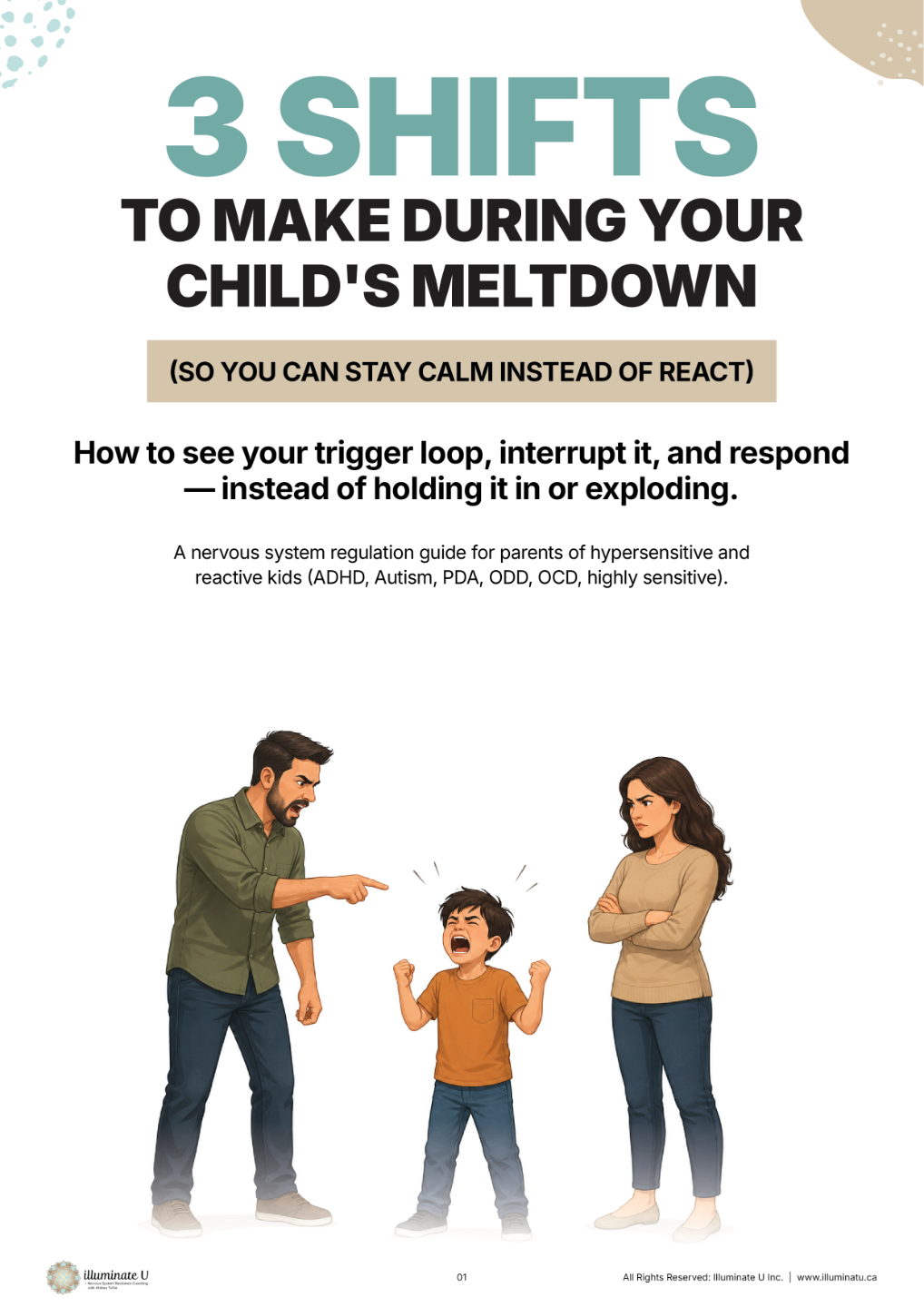
Free: The 3 Shifts Guide
The trigger loop and 3 patterns you get stuck in during meltdowns — and how to shift them so you can stay calm instead of react.
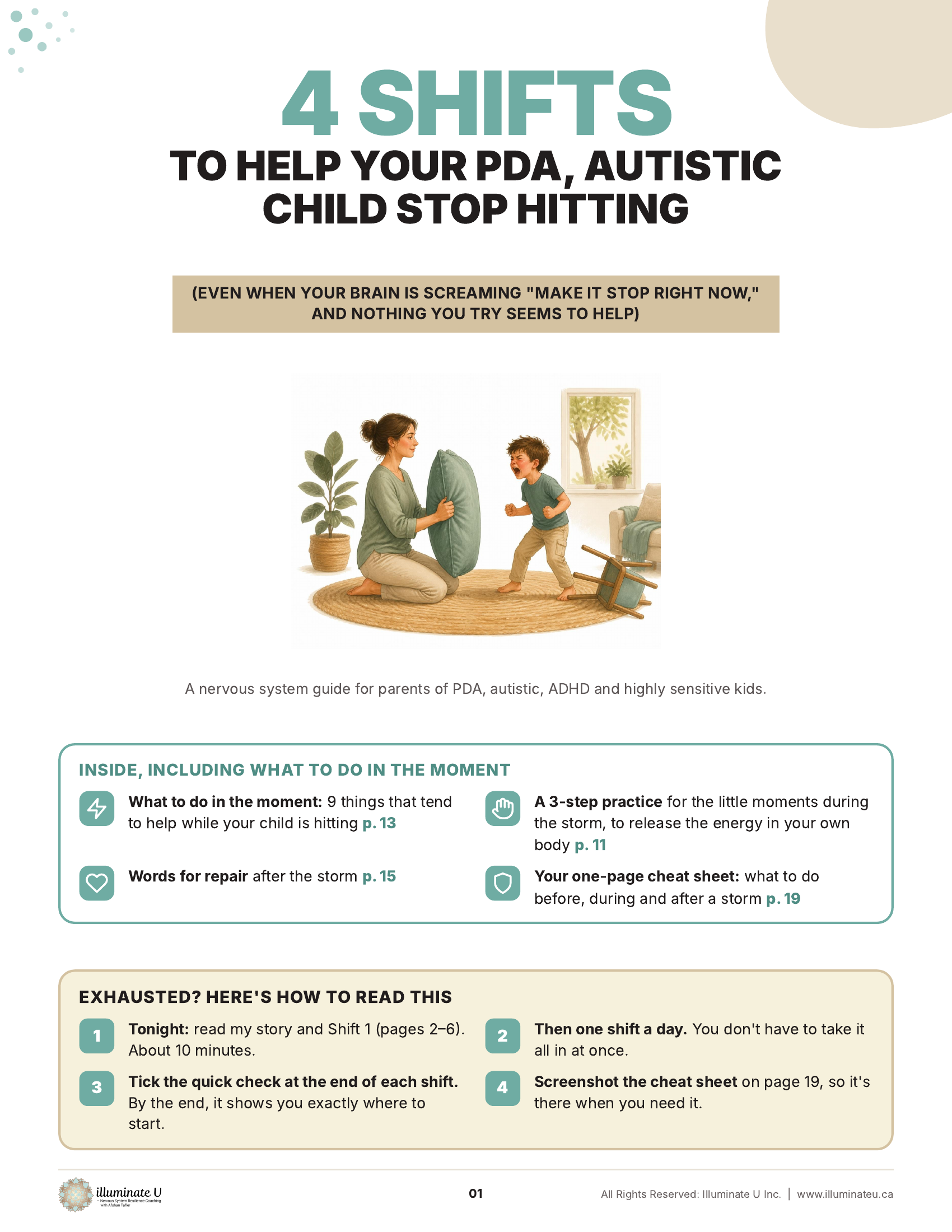
Free: 4 Shifts to Help Your PDA, Autistic Child Stop Hitting
What to do in the moment your child is hitting you, a one-page cheat sheet to keep on your phone, and the 4 shifts that changed things in our home.
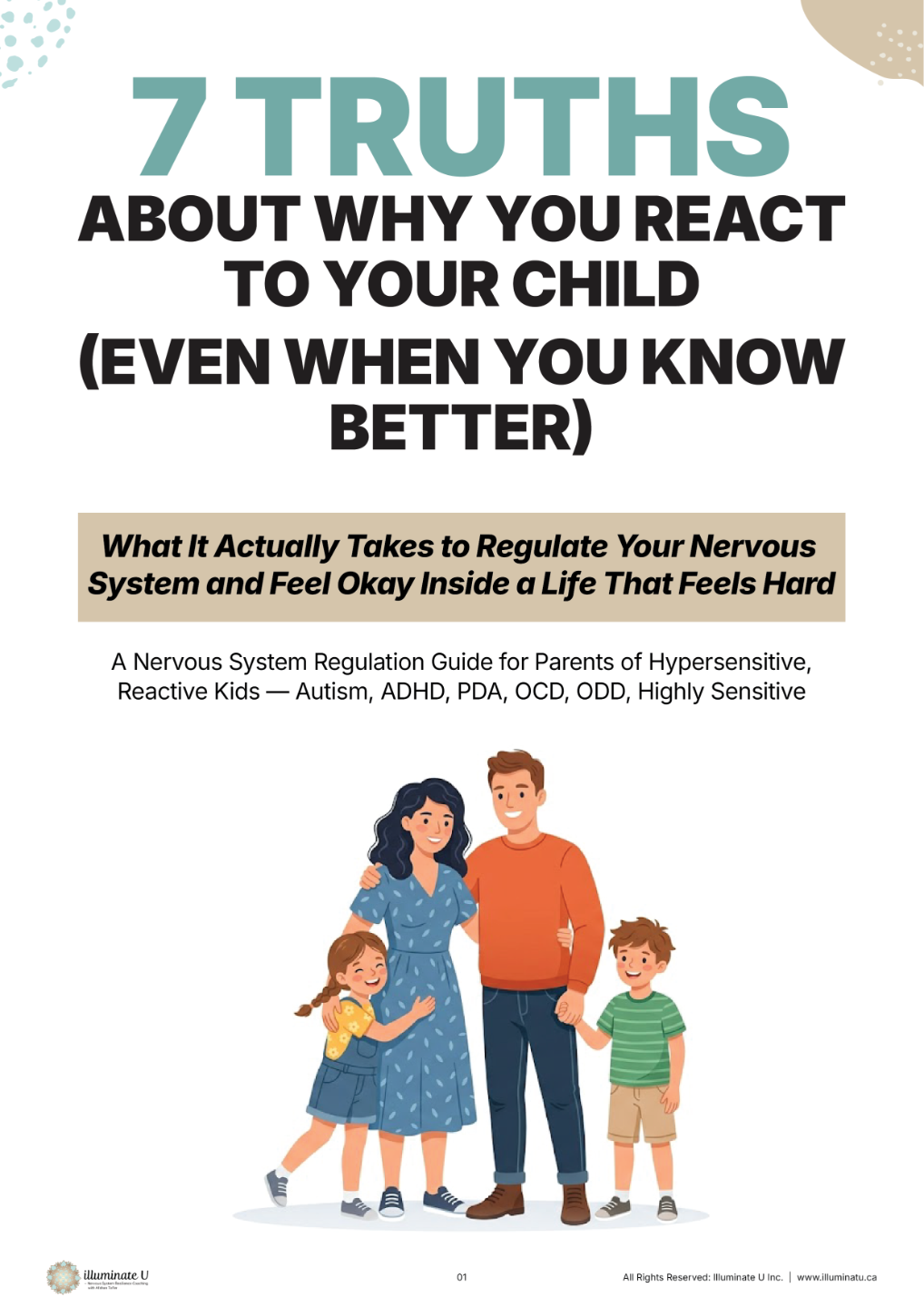
Free: 7 Truths About Why You React to Your Child Guide
Why you react even when you know better — the conditioning, nervous system states, hidden beliefs and patterns, and buried emotions running the show.
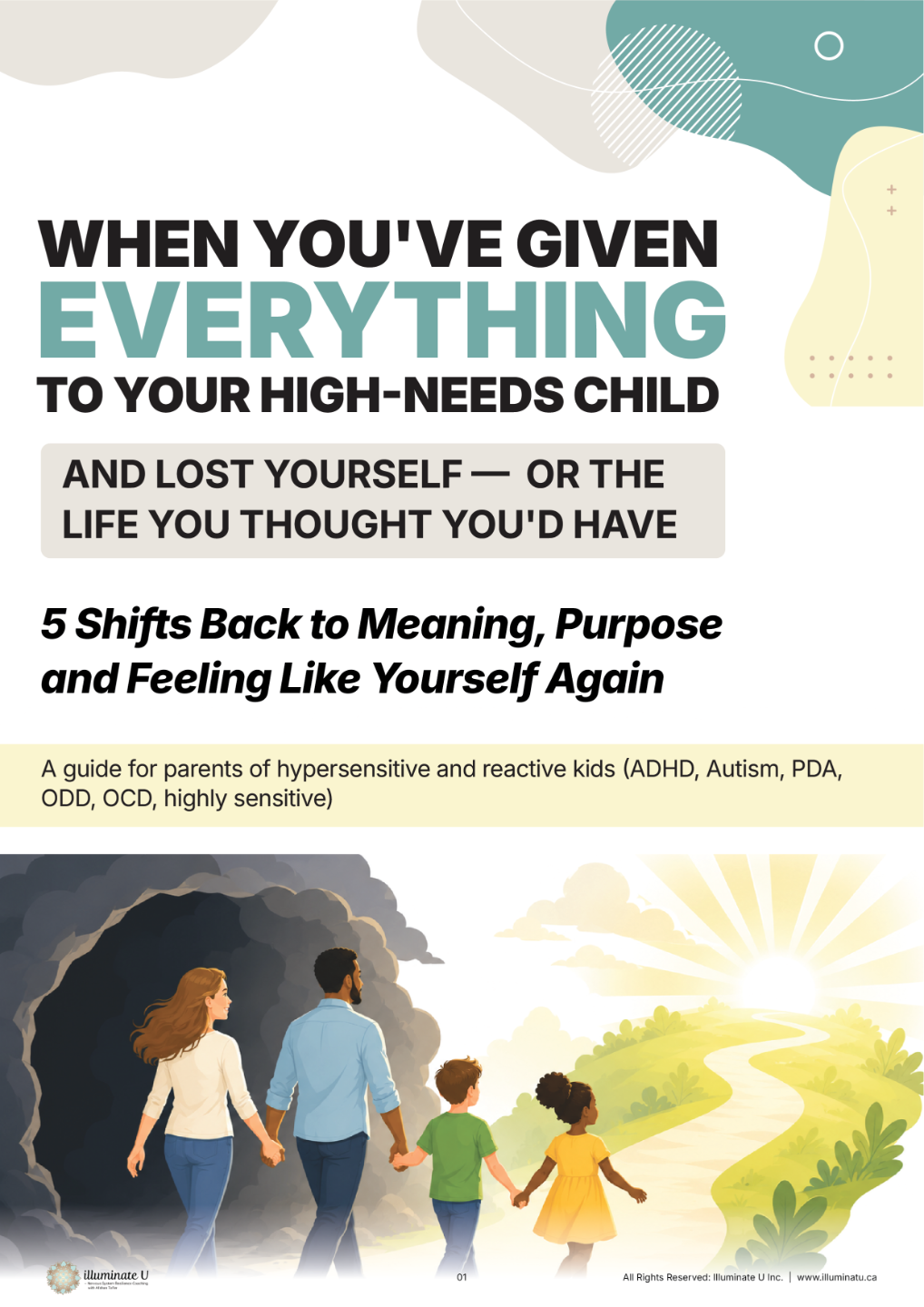
Free: 5 Shifts Back to Meaning Guide
For when you've given everything to your high-needs child and lost yourself — 5 shifts back to meaning, purpose and feeling like you again.

