
Why Bedtime Is So Triggering for Parents of PDA & High-Needs Kids

Bedtime can feel like the moment that breaks us. This post explains why PDA and high-needs kids struggle with the transition and separation of sleep, why parents running on empty get so triggered, and small shifts that help both nervous systems feel safer, like catching when you rev up, loosening the plan and pointing to the next moment of togetherness.
You can also listen to this in audio format only on The Regulated Parent Podcast on Apple or Spotify. Look for Episode #26
When Bedtime Becomes the Breaking Point
Why is it that bedtime — of all the moments in the day — can feel like the one that breaks us?
Maybe you know this feeling:
You’ve held it together all day.
You’ve pushed through meltdowns, demands, decisions, sensory chaos, and the constant emotional labor of parenting a PDA or high-needs child.
And by the time bedtime comes around… your body is just done.
You’re thinking, “If I can just get them to sleep, I can finally breathe.”
But instead of winding down, your child ramps up.
They get silly, hyper, clingy, chaotic, resistant — or completely shut down.
They feel you pulling away inside — even if you’re trying to hide it — and their system grabs on tighter.
And suddenly you’re in that familiar spiral…
The rushing.
The pressure.
The time urgency.
The guilt for wanting space.
The shame for getting triggered.
The exhaustion of feeling like every night is a battle you never wanted to have.
If this is you, you’re not alone — and you’re not failing.
In today’s episode, we’re going to talk about why bedtime is so triggering — not just for your child, but for your nervous system too.
We’ll explore:
- why PDA and high-needs kids struggle so much with the separation of sleep
- what happens inside your nervous system that makes bedtime the hardest moment of the day
- and the small shifts that help both of your nervous systems feel safer, softer, and more connected at night
By the end of this episode, you’ll understand bedtime in a totally new way — one that brings compassion, clarity, and a lot more possibility for peaceful evenings.
Let’s dive in.
When Bedtime Became a Battle I Dreaded
I remember a time where I dreaded bedtime. We had mostly gotten my son to sleep on his own by first lying beside him as he fell asleep and then being able to leave the room. But things were changing in his system... he had a trauma at school that felt like he was being bullied, OCD started to develop, there were challenges at home with his Dad's health, and before we knew it we were back to co-sleeping with him.
But bedtime was also getting later and later and it was getting harder to get him to go to sleep, which meant I didn't get my downtime I desperately needed at night to regenerate.
I would push hard all day to get all the things done, then evening would come around and I would start to go into anticipation of how the night will go and worries started mounting.
How will I get him to go to sleep earlier? How will I get the sleep I desperately need to feel ok managing all the challenges the next day?
I already knew my nervous system needs a lot of sleep to feel regulated and so there were worries also of how I could stay regulated too. Sleep was a master regulator for me.
So I would begin mounting stress load before the bedtime process even started. My son could feel this but he wasn't reacting yet. But as the bedtime routine went on, I would find myself speeding up a bit, trying to get through all the steps. He could feel I wasn't present and was thinking of just getting through this and he would activate... start to do silly things to get me back to presence, but all I could think of was how I wanted my space to rest now because I felt done for the day.
So he activated even more.
Then I would try to hold in my frustration, but he felt me clamping down on it. He would activate even more and throw something or start running around banging things. I would feel this drop of exasperation and desperateness, “How am I going to get this child to bed?” but I would try to hold it in, acting like I was calm, meanwhile it was all building inside getting ready to erupt.
When he threw a soap bottle that made a mess that I now had to clean up, my system just erupted — I started yelling and screaming and frantically cleaning up the soapy mess so he wouldn't slip and hurt himself and this felt like the last straw for me that night. I was so tired, I had pushed through all day, and now I had to clean up a big mess.
Once I reacted my son went into a bigger reaction and suffice it to say, that night was a disaster with me going to sleep at 1am. I can't tell you how many nights like that we had.
Why was bedtime such a huge battle?
When we zoom out and look at bedtime through a nervous system lens — for both the PDA/high-needs child and the parent — it becomes much clearer.
Why PDA & High-Needs Kids Struggle at Bedtime
You probably already know a lot of this from lived experience, but it’s powerful to name it clearly. When we can see what’s happening in their nervous system, we bring in context which is what the nervous system needs to feel safer, and we can hold more compassion for what shows up on the surface.
1. Transitions are hard
Transitioning from being awake and active to resting and sleeping is a big nervous system shift. PDA, autistic, and highly sensitive kids often have a harder time with state changes in general. Their systems don’t glide between “on” and “off” — it can feel more like slamming on the brakes.
So even if bedtime looks simple on the outside — pajamas, brushing teeth, story, lights out — internally it’s a massive transition, and transitions tend to activate their survival system.
2. Bedtime is separation — and separation activates the internal alarm system
Gordon Neufeld (who is a child development and attachment expert) talks about how separation from the caregiver is the greatest cause of alarm and anxiety in children. Bedtime is a form of separation:
- separation from you
- separation into the dark
- separation into sleep — an unknown state
- separation from the safety of your nervous system
For PDA/high-needs kids, whose systems often need constant nervous system scaffolding and another regulated human nearby to feel safe, this separation can feel especially threatening.
And it’s not about their age. It’s about how developed their nervous system and emotional regulation capacity are. Many of us end up still sleeping with our kids at tween or teen ages (I did), and there is no shame in this, even though our conditioning may tell us there is something “wrong” with it.
3. Coming down into rest can trigger the release of bottled-up stress
Throughout the day, many kids hold in a lot of stress — especially in school or demanding environments where they’re masking, coping, or just trying to get through. But also for those of our kids who stay home and may be on devices a lot or have to share your attention with their siblings in the evenings when they are back from school, or mount sensory overload activation from interactions with siblings.
Then at night, when the body starts to slow and the environment is quieter, the nervous system may finally feel safe enough to let go from the holding of the day.
That “letting go” often doesn’t look calm because it’s trapped sympathetic stress energy that needs to be released. It can look like:
- getting hyper
- becoming silly or wild
- picking fights
- bouncing off the walls
This is the body trying to release sympathetic activation that was bottled up all day. It’s not them “trying to be difficult” — it’s a nervous system offloading stress.
4. They sense your need for space — and it feels like a threat
Even if you don’t say it out loud, your child can feel when:
- you’re done for the day
- you just want it to be over
- your mind is already in “my time”
- you’re worried about tomorrow’s functioning
PDA and sensitive kids are often deeply attuned to our energy and can read our nervous systems. When they feel us pulling away — even just in our thoughts — their nervous system can interpret this as danger: “My safe person is leaving. I’m not safe.”
So they cling more. They push more. They escalate. Not because they want to make it harder — but because their body is fighting separation.
5. Bedtime is a series of demands that can trigger a PDA threat response
“Time to brush your teeth.”
“Put your pajamas on.”
“Come to bed.”
“Lights out now.”
Every step is a demand. For a PDA nervous system that is wired to resist perceived control or pressure as a survival response, bedtime can feel like a constant stream of demands. This can trigger:
- fight (arguing, yelling, refusing)
- flight (running away, hiding)
- freeze (shutting down, going blank, not listening, can’t hear you)
- Chaos (silliness, wild behavior, more resistance) - which is fight/flight energy
Again, this is nervous system survival, not willful disobedience.
Why Parents Struggle So Much at Bedtime
We also need to talk about what’s happening inside you, because bedtime is not just about your child’s capacity — it’s also about yours.
1. By the end of the day, you’re already running on empty
Bedtime is often happening after an entire day of:
- managing meltdowns and challenges
- navigating school, appointments, or therapies
- holding everyone’s emotions
- trying to keep the house functional and getting a lot of stuff done
By evening, your nervous system is understandably tired, overstimulated, and depleted. So you start moving toward the “finish line” — that moment you finally get to stop.
Your system speeds up a bit:
- “Okay, let’s just get this done.”
- “If I can get them to sleep by 9, I’ll have an hour to myself.”
Your child feels this time pressure and urgency in your body. Even if you’re smiling and saying all the right things, your internal state is rushing — and that is what their nervous system responds to.
2. You’ve been overriding your own nervous system all day
Most parents of high-needs kids spend the day in some mix of:
- pushing past tired
- stuffing down tears or anger
- trying not to “lose it”
- constantly problem-solving
- holding it together
Overriding is a form of what’s called functional freeze — where you look outwardly calm but inside you’re bracing, tight, stressed…but you may not be aware of the activation/stress underneath because there is a layer of numbness to it on top. This state burns a lot of energy and builds a lot of stress load, filling up that “bathtub” so it’s ready to overflow.
So by bedtime:
- you’ve already built up a big stress load (bathtub is full)
- your body has been in survival mode for hours with no rest breaks to let off steam and stress
- you’re trying to “hold it together” one more time
Your child feels that you’re not truly present — that you’re holding yourself together by a thread — and they don’t feel fully safe in that energy. Their nervous system activates and pushes back, trying to get your real presence.
3. Controlling energy comes in — and that’s a sign you’re not regulated
When things feel out of control, it’s normal to move into controlling energy. You might notice thoughts like:
- “This needs to go a certain way.”
- “He has to be asleep by this time.”
- “If I don’t get this right, tomorrow will be a disaster.”
This controlling energy is a sign your nervous system is in sympathetic fight/flight, not true regulation.
From the outside, controlling energy can look like:
- tightening or deepening your voice (sounding more serious)
- getting more rigid with routines
- bargaining, threatening, or pleading
- trying to force calm or compliance
And your PDA child’s nervous system mirrors that threat energy back — which is why the more we try to control, the more they often escalate.
4. Bedtime can trigger the deeper wound: “My needs don’t matter”
After a whole day of tending to everyone else, bedtime often becomes the moment your nervous system realizes: “I haven’t had a second to myself.”
This can stir up deeper layers of pain:
- “No one cares that I’m exhausted.”
- “I never get a break.”
- “My needs always come last.”
These aren’t just thoughts — they’re often echoes of old childhood experiences where your needs weren’t seen or prioritized. It’s hard to be with that raw vulnerability, so instead it can trigger a protective response:
- anger
- impatience
- wanting to shut down or run away
So now bedtime isn’t just about getting your child to sleep — it’s also touching deep emotional wounds of the past inside you.
5. Your frontal lobe is tired and has less access to regulation
Research shows that our prefrontal cortex — the part of the brain that helps us reason, empathize, and regulate — is less available when we’re tired.
By evening:
- your thinking brain is offline more easily
- your survival brain (amygdala, limbic system) is louder and can take over more easily
- it’s harder to pause, reframe, or access your tools
So when your child throws the soap bottle or starts running around, your system doesn’t have as much capacity to say: “Okay, this is a stress response.” You don’t have as much frontal lobe capacity to downgrade the survival activation, so you can be taken over by the survival system which can make everything feel more urgent and overwhelming, because your brain is already exhausted.
6. Your nervous system and your child’s nervous system need opposite things
At bedtime, your nervous system often wants:
- quiet
- solitude
- disconnection
- rest
For many of us, this pattern of withdrawing at night may go back to our own childhood — maybe nighttime was a time we felt alone, so we learned to withdraw, numb out, because it was too hard to be with the emotions surfacing from the day. Our brain is predictive and goes into these predictive patterns automatically without our conscious awareness.
Your child’s nervous system, especially if they are PDA, autistic, or highly sensitive, senses this withdrawing, but they often need:
- more connection
- more co-regulation
- more proximity
- reassurance that they are safe and not alone
So the moment that you are instinctively pulling away is the exact moment they are reaching for you. Two very real, very valid nervous system needs collide.
No wonder it feels so big.
Understanding all of this gives us a clearer picture of why bedtime feels so overwhelming. And once we can see the patterns for what they are, we can begin to support ourselves in ways that shift the whole experience.
What You Can Do to Support Both Nervous Systems
So the real question is: how do you care for your nervous system so you have the capacity to support your child’s? I want to walk you through the practices that have helped me, and that I’ve seen help so many other parents make bedtime feel lighter, safer, and more connected.
These aren’t “fixes” or perfect solutions. They’re gentle practices that increase awareness, reduce stress load, and create more possibilities for connection.
1. Build awareness of how you push through your day
If you go all day without noticing your own state, bedtime will feel like hitting a wall.
See if you can start to notice earlier in your day when you are mounting stress load and overriding and pushing through. Some signs can be:
- Your body is mounting a lot of tension and getting tighter as the day goes on.
- When you feel tired, but your mind says “oh just get this next thing done”, or when you find yourself constantly doing, rushing, without any breaks (this is often overriding small cues of rest that are needed to help with releasing stress load and regenerating for the next challenge)
- When you feel like you’re forcing yourself to do things even when you feel some need for rest
Then experiment with 2–5 minute micro-breaks throughout the day to:
- come out of your head and into your body
- feel your feet on the ground
- unclench your jaw or shoulders
- take a few slow longer exhales
- let your body register, “I’m allowed to pause.”
These tiny resets help prevent stress from stacking so high that it spills over at bedtime.
2. Catch the moment you start to “rev up” about bedtime
Notice when your inner clock turns on:
- “It’s already 7:30…”
- “We’re behind schedule…”
- “If they don’t sleep soon, tomorrow will be awful…”
This is often the moment your nervous system shifts into future-focused anxiety and pressure.
When you catch it, gently bring yourself back to the present with regulation tools like:
- Grounding: feel your feet on the ground, feel your sit bones in the chair to help your brain feel presence
- Orienting: look around the room, and slowly name 5–10 things you see
- Breath: do a couple of minutes of breathing where you have a longer exhale than inhale to stimulate relaxation
You’re reminding your body: “I am here now. This moment is what I can be with.”
From here, you can meet your child, not your fears about tomorrow.
3. Tend to the deeper wound of “nobody cares about my needs”
When bedtime stretches on and on, it can trigger that very young part that believes: “My needs don’t matter.”
Instead of abandoning yourself in that moment, see if you can:
- acknowledge it: “Of course I feel this way. I’ve been giving all day.”
- practice micro-moments of self-care right where you are:
- drink water if you’re thirsty
- go to the bathroom when you need to
- put a hand on your heart or give yourself a gentle hug
- use self-compassionate talk and silently tell yourself, “I see you. Your needs matter too.”
A big part of this journey is learning to meet our needs in small, doable ways in the middle of our life, not only in escape or separation.
4. Loosen your attachment to how the evening “should” go
If there is a rigid plan in your mind — a specific time, a specific sequence of events or emotional outcome, a specific behavior — your PDA child will feel that pressure.
Ask yourself:
- “Can I hold this routine a bit more loosely?”
- “Can I be flexible with the order or timing?”
- “Can I focus more on connection than on completion?”
I’ve often found that when I have no agenda and am more genuinely present, bedtime flows much more easily. When I’m clinging to how it should go or to timing, my child’s nervous system reads that energy and activates.
5. Make bedtime about connection — and help with separation by pointing to the next moment of togetherness
Because bedtime is a separation, you can help your child’s brain and body feel safer by orienting them to the next point of connection, instead of leaving them alone with the fear of “apart.”
You might say things like:
- “I will dream about you tonight.”
- “I’ll come check on you while you’re sleeping.”
- “In the morning, I can’t wait for us to play that game together.”
- “When you wake up, I’ll be right here.”
This helps their nervous system shift focus from loss to reunion — from, “You’re leaving me” to “We’ll be together again soon” or “I’m always connected to you.”
At the same time, remember that your child may need to release some pent-up stress before they can settle:
- a bit of silly play
- some movement
- some tears or big feelings
You can support that release and then slowly guide them into rest.
And if you notice yourself getting pulled into stress again, the practice is to keep coming back to the present moment — to your body, your breath, and the felt sense of connection between you. Let connection nourish you as much as it nourishes your child.
6. After your child is asleep, regulate before you numb out
Once your child is finally in bed, it’s so natural to want to scroll, watch Netflix, or mentally check out. There’s no shame in that — numbing is also a survival strategy so we don’t have to feel the stress or emotions beneath the surface.
But if you can, try offering your nervous system a few minutes of intentional regulation first, so it can come out of survival mode:
- notice your state: “Am I wired? Collapsed? Numb? Overwhelmed?”
- do one small thing to support yourself:
- a few slow breaths
- some stretching or gentle shake-out of your body
- a self-hug
- lying down and really feeling the support beneath you (this helps signal safety to your brain)
These small practices can:
- help you release excess stress energy
- help you sleep more deeply
- signal to your body that it’s finally safe to rest
- build capacity over time for the next day
Instead of carrying all of the evening’s stress into the night, you’re slowly teaching your system: “I can release. I can repair. I can start again.”
A New Way to See Bedtime
If bedtime is a minefield in your home, it doesn’t mean you’re a bad parent or your child is “too much.” It means two nervous systems — both carrying a lot, both wired for survival in their own ways — are crashing into each other at the end of a long day.
Your child isn’t trying to make life harder.
You’re not weak or failing because you’re triggered.
You’re both doing the best you can with the capacity you have.
As you begin to understand what’s really happening under the surface — in your body and in theirs — bedtime can slowly shift from a nightly battleground into a place where:
- you see the patterns with more compassion
- you support yourself earlier in the day
- you soften your expectations
- you orient both of you toward connection and safety
One bedtime at a time, you’re not just surviving the night — you’re quietly rewiring how both of your nervous systems experience separation, connection, and rest.
Questions Parents Ask
Why does my PDA child get hyper and silly at bedtime?
At night, when the body starts to slow and the environment is quieter, the nervous system may finally feel safe enough to let go from the holding of the day. That letting go often doesn't look calm, because it's trapped stress energy that needs to be released. It's not them trying to be difficult. It's a nervous system offloading stress.
Why does my child fight bedtime and need me to stay with them?
Bedtime is a form of separation: from you, into the dark, into sleep. Gordon Neufeld talks about how separation from the caregiver is the greatest cause of alarm and anxiety in children. For PDA and high-needs kids, whose systems often need another regulated human nearby to feel safe, this separation can feel especially threatening. And it's not about their age.
Why do I get so triggered at bedtime with my high-needs child?
By evening, you've often been overriding your own nervous system all day, and your stress load is already full. Your thinking brain is tired, so your survival brain can take over more easily. At bedtime your nervous system often wants quiet and rest, while your child needs more connection. Two very real, very valid nervous system needs collide.
How can I make bedtime easier with my PDA child?
Catch the moment you start to rev up about bedtime and bring yourself back to the present with grounding, orienting and longer exhales. Ask yourself if you can hold the routine a bit more loosely and focus more on connection than on completion. Then point to the next moment of togetherness, like "When you wake up, I'll be right here."
Is it okay to still co-sleep with my tween or teen?
It's not about their age. It's about how developed their nervous system and emotional regulation capacity are. Many of us end up still sleeping with our kids at tween or teen ages, and there is no shame in this, even though our conditioning may tell us there is something wrong with it.
When Your PDA, Autistic Child Can't Separate and You Just Want a Break (Part 1)
why separation is so hard for you both
The 7 Moves That Make Co-Regulating Your PDA, Autistic Child Easier (Part 2)
practical moves for a child who can't leave your side
Why "Holding It Together" Is Burning You Out as a Parent of a PDA/Autistic Child
how overriding all day builds stress load
7 Ways to Support Your Nervous System When You're With Your PDA Child All Day
small ways to care for yourself all day
I have three free guides for parents of PDA, autistic and high-needs kids: the 3 Shifts guide for meltdowns, the 7 Truths guide on why you react even when you know better, and the Meaning guide for finding your way back to yourself. Pick whichever one fits where you are right now.
And if you want to go deeper with me, the Regulation Rebuild is my course for parents who want to rebuild their own nervous system capacity, step by step. Join the waitlist to hear first when the next round opens.
About the author: Afshan Tafler is a Nervous System Resilience Coach, host of The Regulated Parent podcast, and a parent raising a PDA autistic teen with high anxiety and OCD. She is trained in Internal Family Systems (Level 3), Havening, polyvagal-informed practice and EFT, and is completing her Somatic Experiencing training. She has guided hundreds of parents of ADHD, autistic and PDA kids from burnout and barely coping to steadier, more connected and more alive, within the life they are actually living.
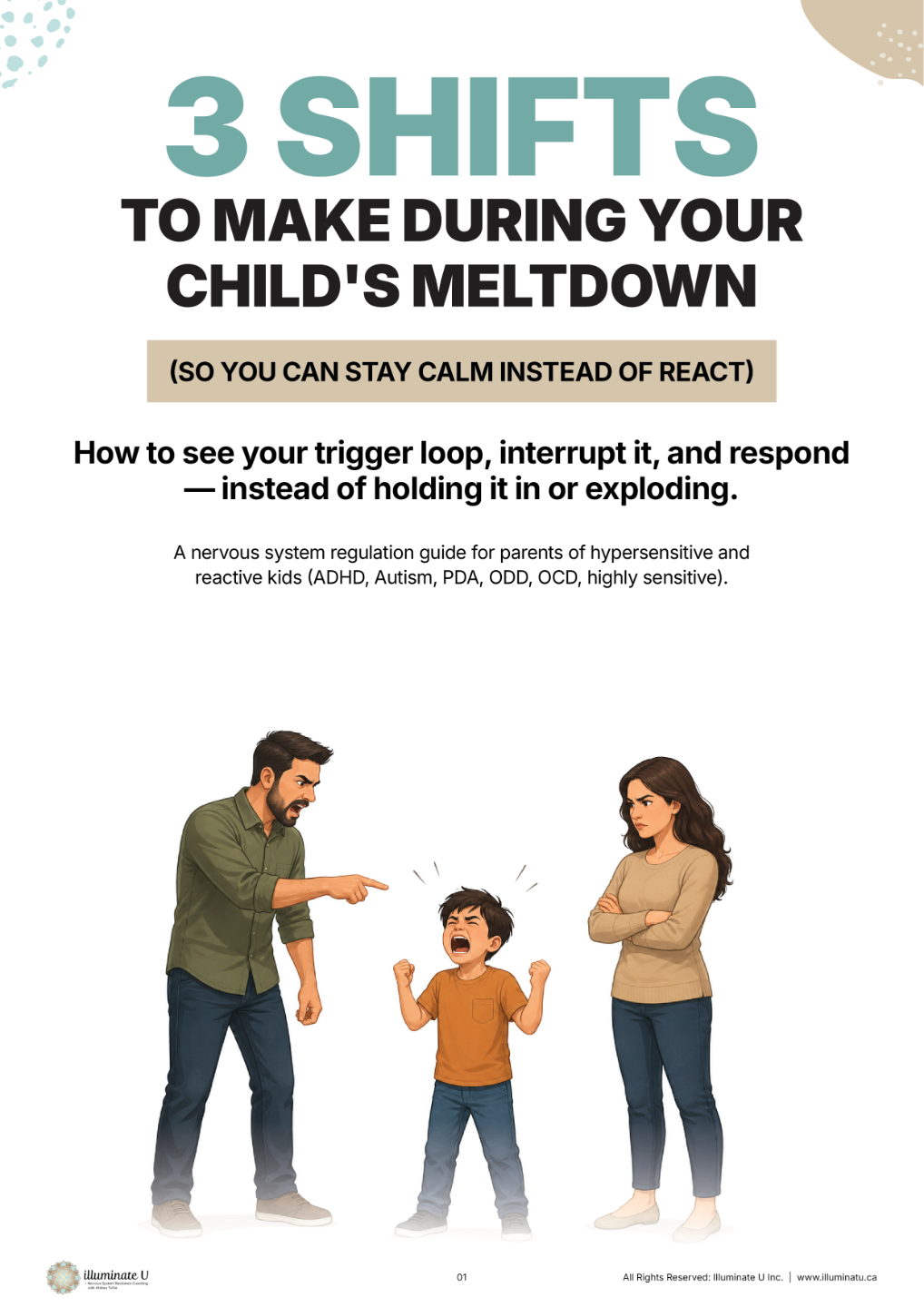
Free: The 3 Shifts Guide
The trigger loop and 3 patterns you get stuck in during meltdowns — and how to shift them so you can stay calm instead of react.
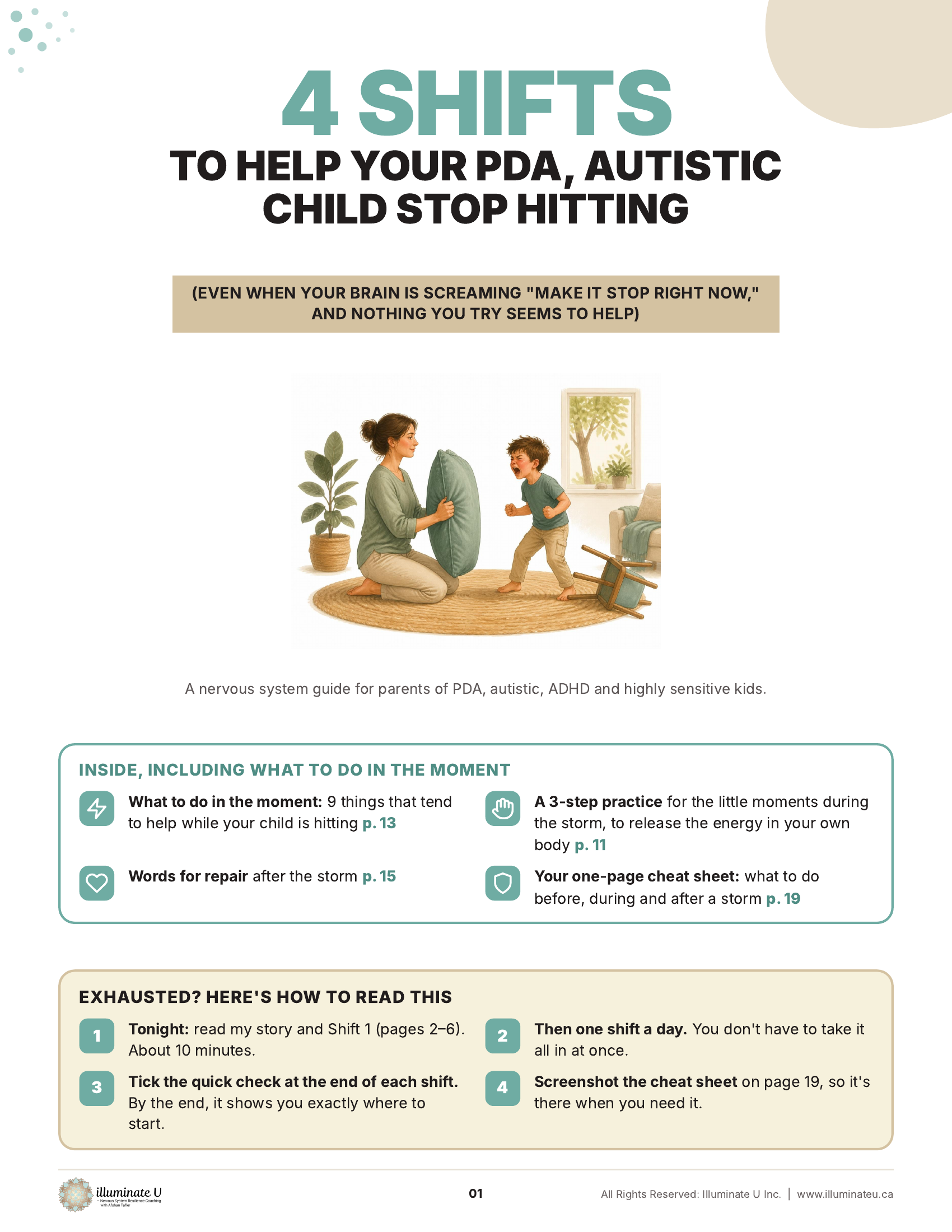
Free: 4 Shifts to Help Your PDA, Autistic Child Stop Hitting
What to do in the moment your child is hitting you, a one-page cheat sheet to keep on your phone, and the 4 shifts that changed things in our home.
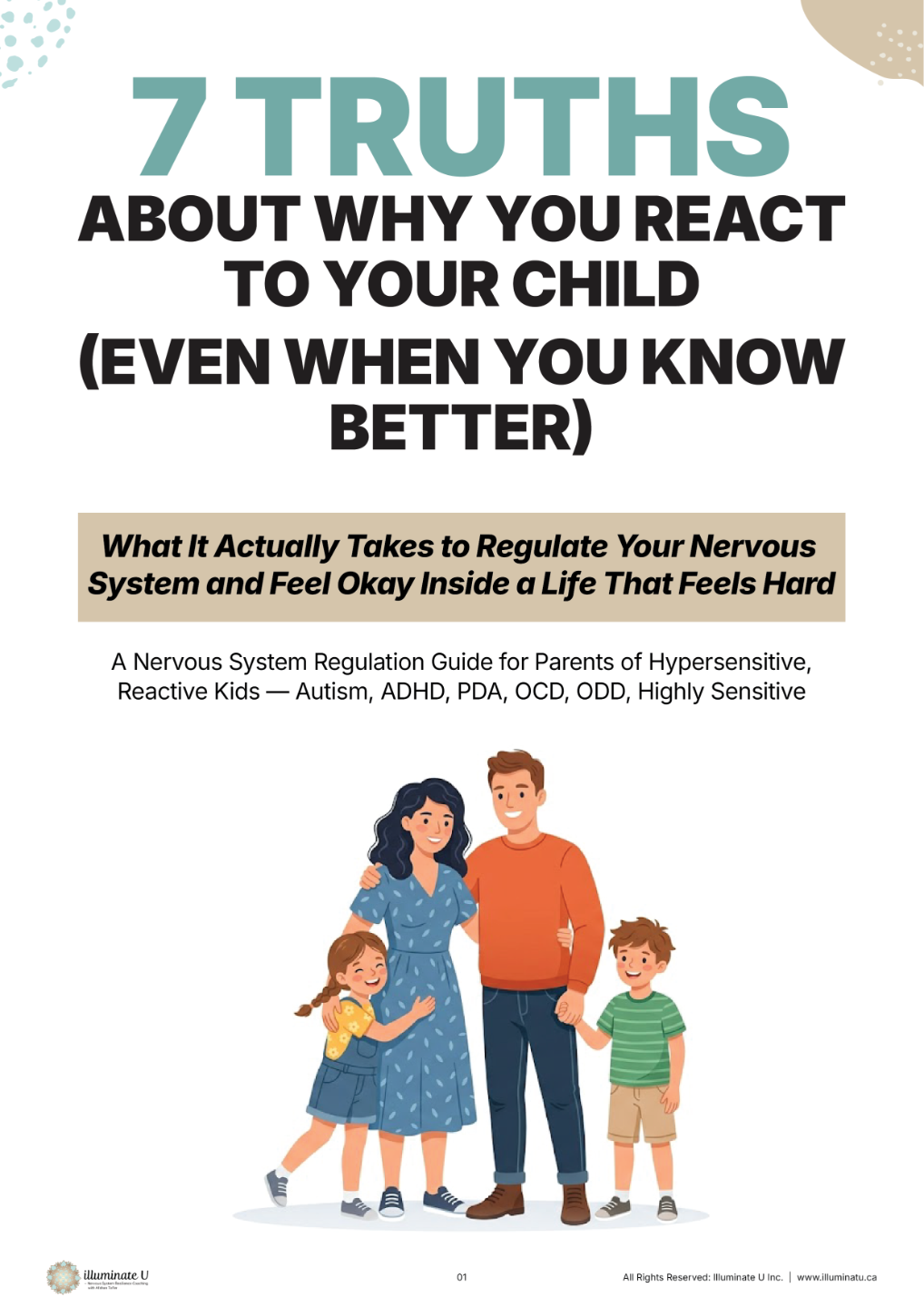
Free: 7 Truths About Why You React to Your Child Guide
Why you react even when you know better — the conditioning, nervous system states, hidden beliefs and patterns, and buried emotions running the show.
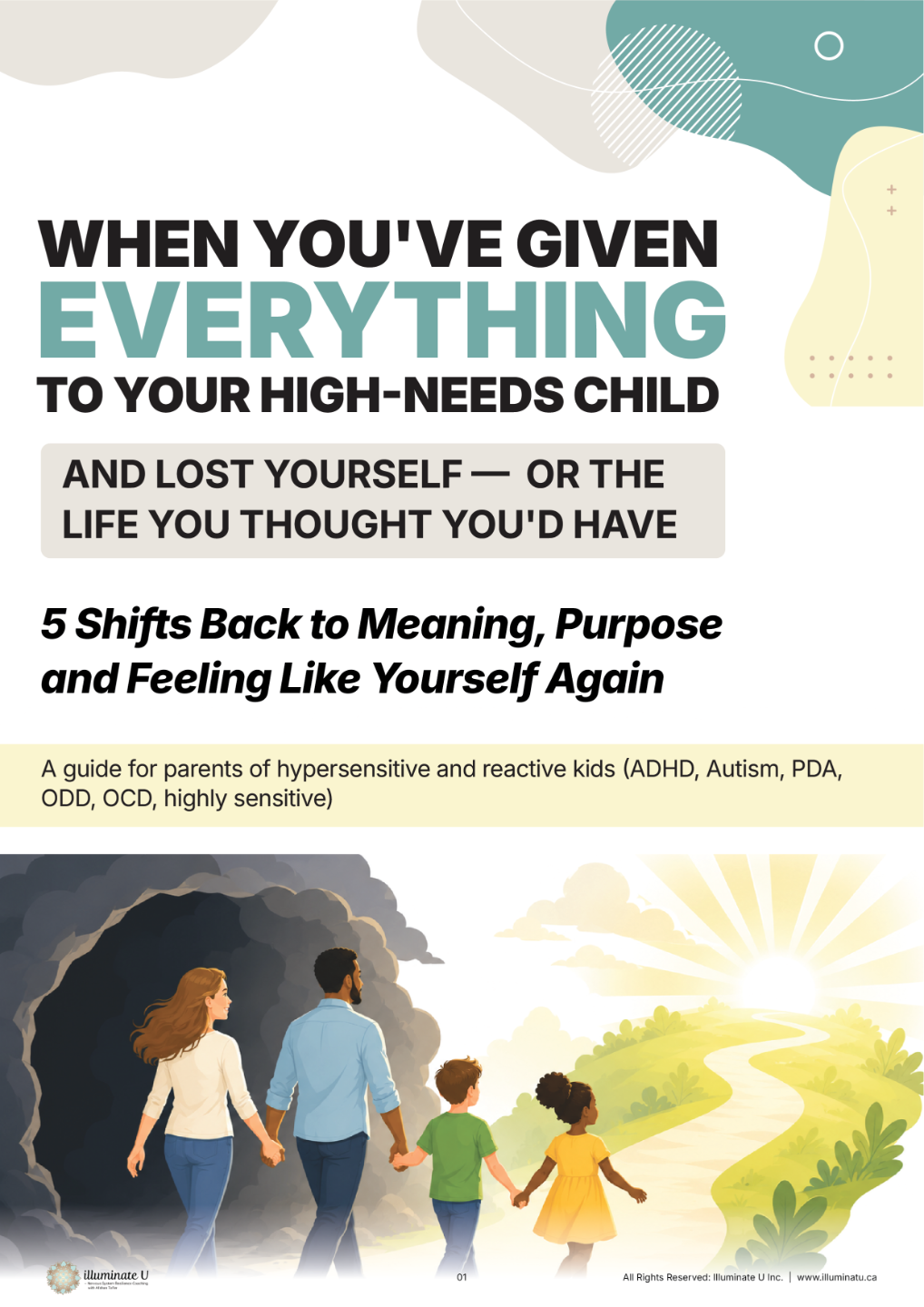
Free: 5 Shifts Back to Meaning Guide
For when you've given everything to your high-needs child and lost yourself — 5 shifts back to meaning, purpose and feeling like you again.

