
When You Want to Feel Hope With Your PDA, Autistic Child… But Can’t

When my son was hospitalized, I lost hope for this life, and even later, small improvements kept slipping away again. This post explains why hope can feel out of reach or too risky for parents of PDA, autistic kids, and how safety, glimmers, believable futures, agency and updated meaning help hope come back online.
You can also listen to this in audio format only on The Regulated Parent Podcast on Apple or Spotify. Look for Episode #42
When Hope Feels Out of Reach… or Too Risky to Feel
Have you ever felt like you want to feel hope again…
But you just can’t?
Like no matter how much you try…
It feels out of reach.
Flat.
Like something inside of you has shut that door.
Or maybe…
Hope is there—but it doesn’t feel safe to touch.
Because every time you let yourself feel a little bit hopeful…
It feels like life takes it away again.
You see a small shift in your child.
A moment of calm.
A glimpse of things getting better.
And for a moment… you let yourself feel it.
Relief.
Maybe even happiness.
And then something happens.
The behaviors come back.
The regression hits.
And you find yourself right back where you started.
And that drop… that emotional crash…
It’s so hard to be with.
So over time, something starts to shift inside of you.
You don’t stop wanting hope.
But either you can’t access it anymore…
Or you stop letting yourself feel it.
Because it feels too risky.
Too unpredictable.
Too painful to lose.
And if you’re parenting a hypersensitive, high-needs, PDA/autistic child…
This can become your reality.
This constant push and pull between:
Wanting to believe things can get better…
And protecting yourself from the pain of it not lasting.
And what I want to share with you today is this:
There is nothing wrong with you for feeling this way.
Because hope is not just something you choose.
It’s something your nervous system either has access to…
Or is protecting you from.
And today, we’re going to talk about why hope can feel so hard to access…
And how it can begin to come back.
When I Lost Hope
There was a period of time when things were so hard that I really lost hope for this life.
I kept finding myself saying:
“It wasn’t supposed to be this way…”
We had made the decision to hospitalize my son.
He was experiencing severe aggression and rages, head banging, and intense OCD that revolved around controlling even our most basic needs. It was the hardest decision I have ever had to make.
And to this day—even after doing trauma reprocessing work around that time—I can still feel the emotions underneath it.
For me, choosing to hospitalize him was a last-ditch attempt to find some hope.
Because for years leading up to that moment, with the intensity of the challenges mounting and living in chronic stress every single day…
I was losing hope.
I would wake up in the morning not wanting to wake up to this life.
Not wanting this life.
Wishing, dreaming that we could just have a “normal” life.
It was so hard. Every single day.
I would drag myself out of bed and force myself through a morning routine—moving my body just to stay somewhat regulated… just to stay sane.
And then the day would begin.
Hours of meltdowns and rages.
Property destruction.
Sleepless nights.
Basic needs not being met.
And all the while, my mind kept repeating:
“It’s not supposed to be this way.”
Fear about the future was constant.
What does this mean for my son’s life?
Is he going to end up in an institution?
He was hospitalized for five weeks.
And during that time, all I could think was:
This is it.
This life as I knew it is over.
He’s going to end up in an institution.
And if that happens… my life is over too.
I felt like life was working against us.
Like I was being punished in some way.
Like no matter what I did—no matter how hard I tried to help—nothing worked.
I felt completely powerless.
Helpless to create any change for my son’s life.
And underneath it all was this deep belief:
If he ends up in an institution, I have failed him. Completely.
And if that were true…
I didn’t want this life.
We had already been living for years with him out of school, watching things decline, not improve.
All I could see was evidence that things were getting worse.
There was nothing in my experience at that time that showed me this could change.
And even later…
Even after we came out of that traumatic storm of hospitalization…
Even when things did start to shift…
There were still moments where the lack of hope would creep back in.
Because I would see small improvements…
And then I would see him go backwards again.
The Reality So Many Parents Are Living
And this is what I see for so many parents—especially those parenting PDA, autistic, or highly sensitive, high-needs children.
The growth is not linear.
It doesn’t move in a straight line.
It can stall for months… even years.
It can improve… and then fall apart again.
And what happens over time is something really painful:
You start to feel afraid to hope.
Because hope starts to feel dangerous.
So many parents tell me:
“I don’t want to feel hopeful anymore… because every time I do, I get crushed again.”
And that crash—the fall back down—that emotional drop…
It’s so hard to be with.
So what do we do?
We inadvertently start blocking hope.
Not consciously. But protectively.
Because the rollercoaster of:
- feeling hopeful
- seeing progress
- and then losing it again
…becomes too much for the nervous system to handle.
So we shut it down.
This is the conundrum of this kind of parenting.
You want to feel hope.
But at the same time…You’re protecting yourself from it.
Because it hurts too much to lose it again.
And over time, it can start to feel like:
This is all a cruel joke being played on me.
It’s exhausting.
What Hope Actually Is (And Why It Feels So Out of Reach)
When parents come to me, so many of them say:
“I just want to feel hope again.”
And what I want you to understand is this:
👉 You are not broken for not feeling hope
👉 You are not doing something wrong
Because hope is not just a mindset.
Hope is a neurocognitive and nervous system process.
Psychologist C. R. Snyder defined hope as the combination of 3 things:
- having a desired future
- believing there are pathways to get there
- and feeling a sense of agency—I can influence this
So hope isn’t blind optimism.
It’s:
👉 future + possibility + capacity
And from a trauma-informed lens:
Hope is the belief that your future can be better…
and that you have a role in making it so.
Why Hope Disappears
1. Your brain is wired against hope under stress
The brain has a negativity bias. It is constantly scanning for threat.
And when stress is high, it prioritizes:
- what’s going wrong
- what could go wrong
- what has gone wrong
Not possibility. Not growth. Not hope.
So when you feel like all you can see is decline…
That’s not you being negative. That’s your brain trying to protect you.
2. Hope requires uncertainty (and trauma hates uncertainty)
This is one of the most important things to understand:
👉 Hope is the only positive emotion that requires uncertainty
If you knew everything would be okay, you wouldn’t need hope.
But trauma and chronic stress make uncertainty feel unsafe.
So the brain tries to create certainty.
Even if that certainty is:
“This will never change.”
Because that feels more stable than the unknown.
3. Your nervous system state determines whether hope is even accessible
Using a nervous system lens:
- In ventral vagal (safety, social engagement state) → you can feel openness, connection, possibility, hope
- In sympathetic (fight/flight, danger state) → the future feels urgent, overwhelming, threatening
- In dorsal (freeze/shutdown or life threat state) → you feel numb, collapsed, “what’s the point”
👉 Hope is not just cognitive.
👉 It is state-dependent.
When your body doesn’t feel safe…
It cannot access hope.
4. Trauma reshapes how you see the future
When you’ve lived through repeated overwhelm, stress, and powerlessness…
The brain starts to predict:
“The future will feel like the past.”
So hope gets blocked by:
- learned helplessness
- chronic stress loops
- repeated unmet expectations
5. The mental models you’re holding may be quietly destroying hope
Hope depends on having goals that feel:
- believable
- reachable
But if your internal mental model says:
- “A good life should look like this”
- “My child should be like this”
- “Success means this”
…and your reality doesn’t match…
The brain doesn’t say:
“Let’s update the model.”
It says:
“This is hopeless.”
The Reframe
Here is the most important thing I want you to take from this:
Hope is not something you have or don’t have.
It is something your nervous system either has access to…
or is temporarily protecting you from.
What Actually Builds Hope
And this is where most advice gets it wrong.
Hope is not built by:
- forcing positive thinking
- telling yourself “everything will be okay”
- trying to override your reality
Hope is built through:
1. Safety first (bottom-up)
You cannot think your way into hope if your body feels unsafe.
It starts with:
- regulation
- co-regulation
- small moments of safety
Because safety is what allows your system to access:
- connection
- creativity
- possibility
- perspective
2. Expanding perception (not forcing positivity)
Hope grows when you begin to gently expand what you can see.
This is about helping your brain to move out of chronic negativity bias and help it see what is positive or working or what feels safe in this moment.
It’s not about ignoring what’s hard…
But more about allowing small moments of:
- Noticing something working
- Seeing something shifting
- Noticing something okay in the here and now
This is where practices like noticing glimmers matter.
Glimmers are small, subtle moments of safety, connection, or neutrality that your nervous system can register as “okay” or “safe enough.”
They are not big wins.
They are not life-changing moments.
They are things like:
- a brief moment of calm in your body
- a small connection with your child
- quietly sipping your favourite drink
- taking in the sunshine or blue sky or something beautiful in nature
- a moment where nothing is going wrong
And the practice is simple—but powerful:
👉 Pause and notice the moment.
👉 Stay with it for a few seconds longer than you normally would - at least 30 seconds. Feel the appreciation or goodness of it.
👉 Let your body register it.
Because what you’re doing is teaching your brain:
“This exists too.” Safety exists too, goodness exists too.
Over time, this gently begins to shift your perception—not by forcing positivity, but by expanding what your nervous system is able to take in.
3. Creating believable futures
Hope dies when the future your brain has in mind feels too far away.
So instead of:
“Everything will be okay”
It becomes:
👉 “Maybe this moment can feel 5% easier”
👉 “Maybe I can support myself differently today”
And this is where staying in the present moment and also bringing safety to your fear becomes so important.
Because when your system is focused on the future, especially from a dysregulated state, it will almost always predict worst-case outcomes and produce fear.
But when you bring your focus back to:
👉 How can I support myself right now?
👉 How can I shift my state, even slightly, in this moment? How can I help myself feel safe with this fear?
You begin to create change in the present.
And this matters more than it seems.
Because every time you support your fear and shift your state—even slightly—you are giving your brain new information.
You are updating its predictive models.
So while it may feel like you are “just” supporting yourself in the moment…
What you are actually doing is changing how your brain begins to see the future.
And from there, a more believable—and more hopeful—future starts to emerge.
4. Rebuilding agency
This is huge.
Hope requires the feeling:
“I can influence something.”
Even if that something is small.
And this is not about controlling the future. Most of us are thinking about how we can influence the future.
But instead we need to be more focused on influencing today – this moment.
It’s about recognizing:
👉 I can influence how I support my fear, grief, or anger
👉 I can influence how I meet myself in this moment
👉I can choose to interrupt this stress pattern and bring in a cue of safety
What does this actually look like?
It can look like:
- pausing instead of reacting immediately
- taking a breath and orienting to your environment
- placing a hand on your body for support and grounding
- giving yourself compassion instead of criticism
- stepping away for a moment to regulate
- choosing to soften instead of push
- being kinder and more compassionate with yourself
These are small moments of choice.
And although they seem simple…
They are profound.
Because every time you do this, you are teaching your system:
“I am not completely powerless here” and “I have choice in how I can help myself.”
And that begins to rebuild agency.
And as your sense of agency grows…
So does your capacity for hope.
5. Updating meaning
Hope is deeply tied to meaning.
When meaning is stuck in:
“This shouldn’t be happening”
“There is something wrong with how things are”
“There is something wrong with my child… and with me as a parent”
“We are failing”
Hope cannot survive there.
So part of this work is gently beginning to shift into:
👉 “What is the gain here… not just the loss?”
👉 “What am I learning?”
👉 “How am I growing through this challenge?”
👉 “What is this teaching me that I would have never learned otherwise?”
This doesn’t mean bypassing the pain.
It doesn’t mean pretending things are okay.
It means allowing a more expanded meaning to exist alongside the difficulty.
And when meaning expands…
Hope has somewhere to land again.
Where Hope Came Back for Me
What I want you to know is this:
Hope did not come back for me when my life suddenly changed.
It didn’t come back when everything got easier.
It came back when I started to rebuild:
- my sense of agency
- my ability to influence my internal state
- and the meaning I was making about our life
And this is the work I now teach inside my course:
The Regulation Rebuild
Because what so many parents discover is this:
👉 Hope doesn’t come from changing your circumstances first
👉 It comes from changing your relationship to your internal world
From learning how to:
- shift your nervous system state
- find moments of choice, even in hard situations
- and begin to choose meanings and stories that feel more supportive and true
And from there…
Hope doesn’t feel forced.
It starts to feel possible again.
You Can Find Hope Again
Hope doesn’t come back all at once.
It comes back in moments.
In small shifts.
In tiny openings.
And if you can’t feel it right now…
That doesn’t mean it’s gone.
It means your system has been protecting you.
And when you work with your nervous system, shift state, update meanings to more life affirming ones…hope can come back online again.
The Regulation Rebuild course
Questions Parents Ask
Why can't I feel hope as a parent of a PDA or autistic child?
There is nothing wrong with you for feeling this way. Hope is not just something you choose. It's something your nervous system either has access to or is protecting you from. Under stress, the brain prioritizes what's going wrong, what could go wrong and what has gone wrong. When your body doesn't feel safe, it cannot access hope.
Why am I afraid to feel hopeful when my child makes progress?
The growth is not linear. It can improve and then fall apart again. Over time, hope starts to feel dangerous, because the rollercoaster of feeling hopeful, seeing progress and then losing it again becomes too much for the nervous system to handle. So we inadvertently start blocking hope. Not consciously, but protectively.
What are glimmers and how do they help me feel hope?
Glimmers are small, subtle moments of safety, connection, or neutrality that your nervous system can register as okay or safe enough, like a brief moment of calm in your body or a small connection with your child. Pause and notice the moment, stay with it for at least 30 seconds, and let your body register it. What you're doing is teaching your brain that safety exists too, goodness exists too.
How do I rebuild hope without forcing positive thinking?
Hope is not built by forcing positive thinking or telling yourself everything will be okay. It starts with safety first: regulation, co-regulation and small moments of safety. Instead of "everything will be okay", it becomes "maybe this moment can feel 5% easier". Every time you support your fear and shift your state, even slightly, you are giving your brain new information.
How can I feel less powerless parenting a high-needs child?
Hope requires the feeling that I can influence something, even if that something is small. Instead of trying to influence the future, focus on influencing today, this moment. It can look like pausing instead of reacting, placing a hand on your body for support, or giving yourself compassion instead of criticism. Every time you do this, you are teaching your system that you are not completely powerless here.
When Your PDA Child Hits Burnout, and Your Fear About the Future Starts Growing
the fear cycle when your child's world shrinks
Why You Feel Stuck and See No Progress with Your High-Needs Child
when progress feels stalled with your child
Watching Your Autistic, PDA Child Suffer: The Grief, Guilt, and Helplessness Parents Carry
the grief and helplessness of watching your child suffer
Reclaiming Your Joy and Aliveness, Even When Your Autistic Child Is Still Struggling
finding your way back to joy now
I have three free guides for parents of PDA, autistic and high-needs kids: the 3 Shifts guide for meltdowns, the 7 Truths guide on why you react even when you know better, and the Meaning guide for finding your way back to yourself. Pick whichever one fits where you are right now.
And if you want to go deeper with me, the Regulation Rebuild is my course for parents who want to rebuild their own nervous system capacity, step by step. Join the waitlist to hear first when the next round opens.
About the author: Afshan Tafler is a Nervous System Resilience Coach, host of The Regulated Parent podcast, and a parent raising a PDA autistic teen with high anxiety and OCD. She is trained in Internal Family Systems (Level 3), Havening, polyvagal-informed practice and EFT, and is completing her Somatic Experiencing training. She has guided hundreds of parents of ADHD, autistic and PDA kids from burnout and barely coping to steadier, more connected and more alive, within the life they are actually living.
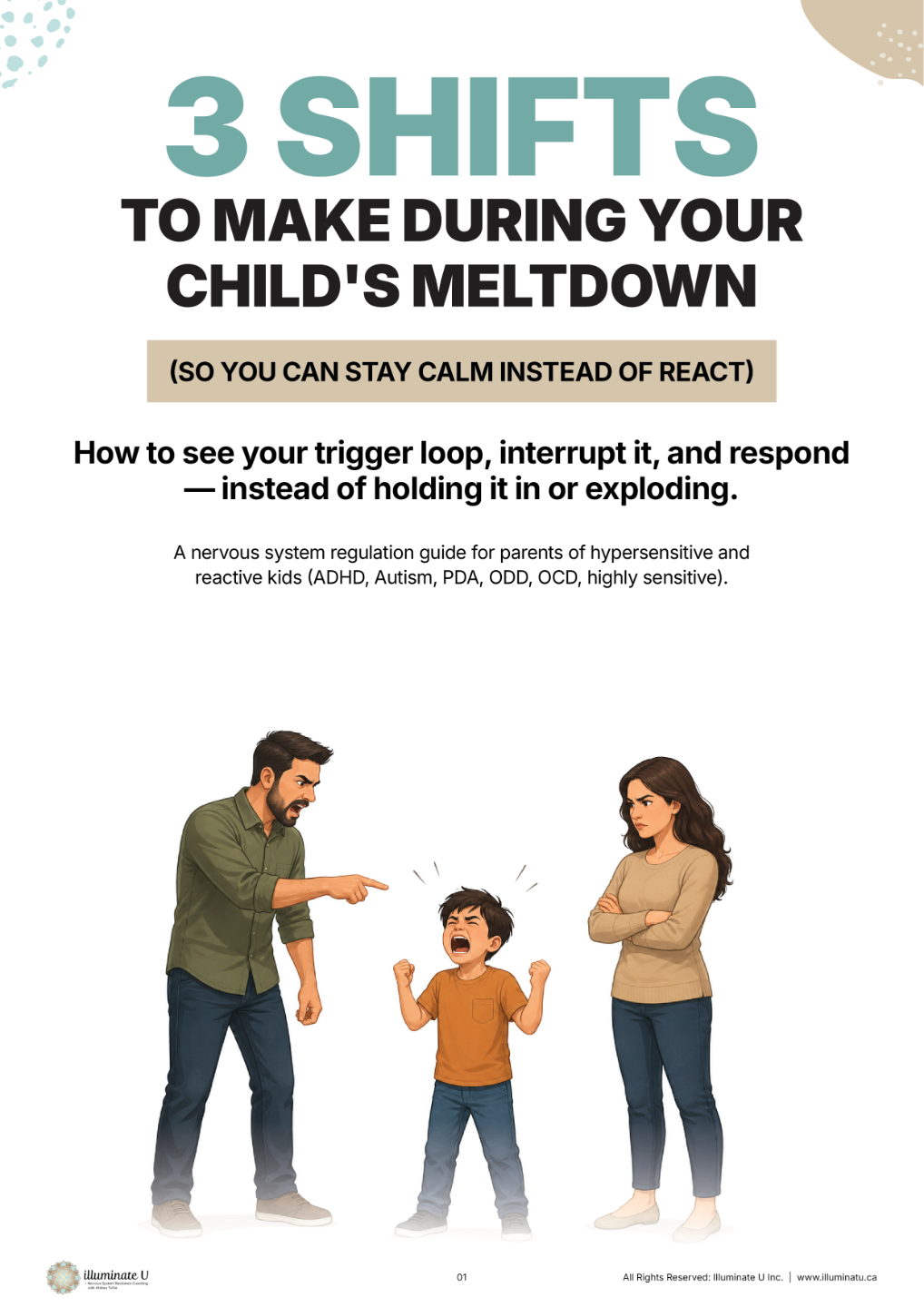
Free: The 3 Shifts Guide
The trigger loop and 3 patterns you get stuck in during meltdowns — and how to shift them so you can stay calm instead of react.
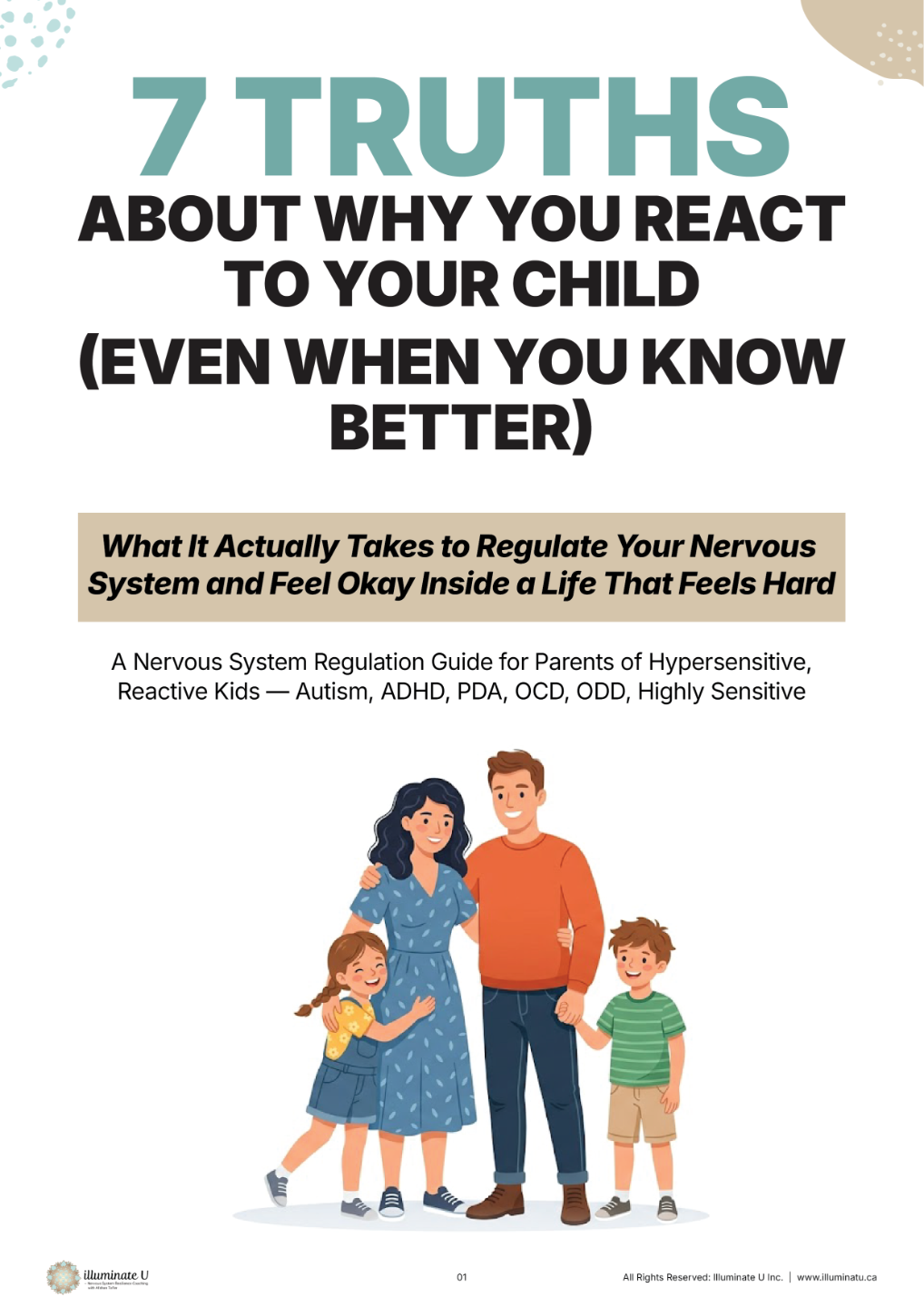
Free: 7 Truths About Why You React to Your Child Guide
Why you react even when you know better — the conditioning, nervous system states, hidden beliefs and patterns, and buried emotions running the show.

