
When Mother’s Day Feels Hard: How to Feel Seen and Valued While Parenting a PDA, Autistic or High-Needs Child

**You can also listen to this in audio format only on The Regulated Mother Podcast on Apple or Spotify. Look for Episode #45
If Mother’s Day Feels Heavy Instead of Celebratory
Have you ever gone into Mother’s Day hoping… maybe this year will feel different…
And instead, it ends up feeling heavy… disappointing… or even painful?
Maybe your child refuses to participate.
Maybe there’s no card, no “thank you,” no moment where you feel seen.
Maybe there’s a meltdown… cancelled plans… or you’re just trying to hold it together while everyone else seems to be celebrating.
And then on top of all of that…
There’s this pressure to feel grateful.
To see the good.
To shift your perspective.
To appreciate it all.
But what if you can’t?
What if, instead of gratitude, what you’re actually feeling is grief… or loneliness… or the painful gap between what you hoped for and what you’re living?
What if nothing is wrong with you… and you don’t actually have to feel grateful right now?
In this episode, I’m going to walk you through what’s really happening underneath that pressure…
and show you a different way to move through this day—
one where you can feel more seen, more validated, and less alone…
without forcing yourself to feel something you don’t.
When Mother’s Day Slowly Became Something I Dreaded
For years, I hated Mother’s Day because of everything the day came to represent.
The expectation of celebrations that were never met because it was too much for my son.
The grief of feeling like I would never be acknowledged—by others, or by my own child—in the way I longed for.
The reality of not even being able to take a break on this one day.
The pressure to feel gratitude for it all.
And the guilt for not being able to show up for my own mother and celebrate her.
Mother’s Day wasn’t just a day.
It became something loaded.
What It Used to Be — And What Changed
There were years when my son could handle family gatherings.
I would host. I would have the grandmothers over, make the food, order the cake.
My son would enjoy it.
Back then, he was going to school, so I would get a handmade card or a piece of art.
There were small, simple moments where I could feel appreciation. Where I could feel connection.
But when things shifted—when my son became more extroverted in his PDA, when OCD emerged, when the rages intensified, and when he stopped going to school—those moments slowly disappeared.
The celebrations fell away.
And Mother’s Day became something else entirely.
It became a quiet reminder of the kind of Mother’s Day I might never have.
The kind where your child runs up to you with a card.
The kind where you feel seen, appreciated, and reflected back to.
The kind where something inside you can finally relax and say, “I’m happy to be a mother.”
When the Day Starts to Carry More Than It Should
Over time, it became just another hard day on the calendar.
A day where my son’s needs still came first.
A day where I still had to keep going—without pause, without relief.
A day where, somehow, I was still expected to feel grateful and appreciative for being a mother.
And even as I say this, I know this can feel uncomfortable for some of you to hear.
How can a mother not feel grateful for being a mom? After all, there are women who desperately want to be mothers and cannot conceive. I thought those same thoughts. And because of that, I felt awful.
Awful for feeling grief.
Awful for feeling alone.
Awful for not being able to access gratitude in the way I thought I should.
There was so much pressure—not just from the outside, but from within.
What I Wish More Mothers Could Say Out Loud
But I also know this:
Some of you will feel relief hearing this. Because you’ve felt it too. You’ve just never said it out loud.
And what I’ve come to understand—both through my own experience and through the work I do—is that what doesn’t get named doesn’t go away. It doesn’t just disappear. It stays in the body. It builds in the nervous system. It keeps us stuck in cycles of shame, pressure, and internal conflict.
But when something gets acknowledged honestly, without trying to fix it right away, it creates space. Space for choice. Space to find ways to support yourself. Space for things to move forward and shift.
The Reality So Many Mothers Are Living
So I want to take a moment to really validate this experience.
The reality of parenting a high-needs child—where so much of your energy, your attention, your resources go into your child or your children.
And then there is this one day—Mother’s Day—where society tells you that you should be appreciated, celebrated, and cared for.
And instead…
It becomes a day that highlights everything you don’t have.
A day that carries the weight of your daily reality— plus the grief of comparison.
Watching other mothers receive what your system deeply longs for:
To feel special.
To feel valued.
To feel like a good-enough mother.
And inside, it can feel like you are holding all of that… alone.
Why Gratitude Wasn’t the Starting Point for Me
For years, I thought about Mother’s Day.
I wanted to get to a place where I could feel genuine gratitude for the journey.
For what I was learning.
For how I was growing.
For the ways my child was shaping me into the person I wanted to become.
And I do believe that is possible for you…because it was for me eventually.
But there were so many Mother’s Days where it didn’t feel real.
Where it felt like I was faking it.
Like I was gaslighting myself.
Overriding the grief.
Criticizing myself for not being able to feel differently.
And underneath all of that… was something deeper.
A longing.
I wanted my son to show me—through his connection, through his growth—that I was doing it right.
That he loved me.
That he appreciated me.
That all of this effort meant something and was making a positive impact on his life.
But I didn’t receive that in the way I needed for years.
The Shift That Changed Everything
And this is where something began to change for me.
I realized that if I wanted to eventually feel real gratitude— not forced, not performative, but something that felt true in my body— I couldn’t bypass where I actually was.
I had to start with allowing my experience.
With validating what was real.
Because that is what actually gets us unstuck.
That is what allows movement.
And over time, that is what creates the conditions for something deeper to emerge—
meaning, growth, even gratitude— but from the heart, not from the head or from pressure.
Naming the Unspoken Experience of Mother’s Day
And this is not just my story.
This is something I now see in so many mothers. I also see this in Father’s too.
Mother’s Day (or even your birthday) is supposed to be a day where you feel celebrated, seen, and appreciated—especially by your child.
But when you’re parenting a PDA, autistic, or high-needs child… that appreciation often doesn’t come. At least not in the ways you’ve been taught to expect.
Often there are no handmade cards.
No “I love you, Mom.”
Sometimes no hug.
Sometimes active rejection.
Sometimes a meltdown and cancelled plans—because the day itself feels like too much.
And underneath all of that is a grief most people don’t talk about:
Does my child even know how much I love them?
Does any of this matter?
Will they ever appreciate what I’m doing?
Am I a good enough mother if my child has all these challenges?
If this is what Mother’s Day feels like for you— you are not alone. And you are not a bad mom.
The Grief No One Talks About
Let’s just name the reality of how much grief this parenting experience can bring, especially on these special days.
We crave this validation from others, the outside world and from our child or children. But we don’t often get it. That can feel like a loss.
We want our child to know how much we love them… how much we do for them… how hard we’re trying – moving heaven and earth to help them. And even deeper than that, we want to feel that our love is actually landing.
That it’s being felt.
That it matters.
That it’s being received in some way.
And often… we don’t get that feedback.
And this can feel like a huge loss in our system – which is totally natural as we are designed to want that feedback from our child, and that feedback then nourishes us to keep going and keep doing all the hard things for them.
In real life, many of our kids are so chronically stressed that they can’t even think to make a card, or say thank you, or even say “I love you”. Real life is a lot of meltdowns, pushing you away, or seeming completely indifferent to everything you do.
And on a day that is supposed to be about appreciation, you can end up feeling more rejected than celebrated.
When that happens, there are questions that naturally begin to surface—questions that can feel incredibly painful to even admit to yourself.
Does my child even know I love them?
Does any of this matter?
Am I pouring into someone who will never appreciate it?
And maybe the hardest one of all:
What if they never show me that they feel loved?
Of course this hurts.
Because this isn’t just about appreciation.
It’s about connection.
It’s about being seen.
It’s about wanting some reflection—some sign—that what you are giving is being received.
That is not selfish. That is human.
And what makes this even more painful is that you’re not just grieving what is happening today.
You’re grieving the version of motherhood you imagined.
The ease.
The mutual connection.
The natural back-and-forth.
The feedback loop where your child reflects your love back to you in a way your system can recognize and settle into.
And when that isn’t there—or isn’t there consistently—it creates a kind of grief that is rarely named.
But it is real.
And it deserves to be felt… not bypassed.
Feeling and processing grief can be immensely helpful to getting the nervous system unstuck and moving forward towards greater regulation.
For a long time I did what I call weekly grief dumps for all the losses I was experiencing and this helped me immensely to be able to stay present and regulated for my son.
The Pressure to Be Grateful (And Why It Doesn’t Work)
The other thing that happens on Mother’s day or special days is we often feel like we “should” feel gratitude.
Everywhere you look, Mother’s day is loaded with messages of gratitude and pride in the kids doing something for their mother.
And Mother’s Day becomes this one day where you’re supposed to feel it more than ever.
To see the gift.
To see the growth.
To shift your perspective.
To be thankful for it all.
And sometimes… yes, you can.
There are moments where you can genuinely feel appreciation for your child, for what you’re learning, for how this journey is shaping you.
But when you’re in survival mode…
when your child just melted down and plans got cancelled…
when you’re sitting alone, overwhelmed, maybe even hiding in the bathroom trying to hold it together…
Gratitude doesn’t feel grounding.
It feels like pressure.
Because real gratitude cannot be forced.
And when you try to force it—especially when your system is overwhelmed—it doesn’t land as something supportive. It often lands as something else entirely.
It becomes another layer.
Now you’re not only struggling with what’s happening…you’re also judging yourself for struggling.
You start to think:
I should be grateful.
Other moms can feel this—why can’t I?
What’s wrong with me that I can’t shift my perspective right now?
And without even realizing it, the focus moves away from the reality of what you’re carrying, and onto what you think you should be feeling instead.
That’s where gratitude can start to feel like gaslighting.
Not because gratitude itself is wrong—but because it’s being asked of you at a time when your system doesn’t have the capacity to access it.
So instead of supporting you, it disconnects you further from what is actually true.
And this is where I want to offer you something different.
You don’t have to feel grateful right now.
You don’t have to find the silver lining.
You don’t have to turn this moment into something meaningful.
You don’t have to prove that you’re growing through this.
You can just be in the hard.
You can just feel what you feel—without needing to change it, fix it, or reframe it.
And that… is more than enough.
Because being able to be in the hard, being with whatever state your nervous system is in, is actually the first step in becoming a more regulated human who can eventually feel more gratitude down the road.
What You Can Focus On Instead of Gratitude
If gratitude doesn’t feel accessible right now, I want to offer you some other places you can land.
Not as a way to bypass what you’re feeling, but as a way to meet yourself in a way that feels more honest, more grounded, and more supportive to your nervous system.
Because when you’re in survival mode—when you’re overwhelmed, grieving, or feeling unseen—gratitude can feel too far away.
So instead of trying to leap to something that doesn’t feel real, you can begin somewhere closer to the truth of your experience.
1. Acknowledgment (instead of gratitude)
You don’t have to feel grateful.
You can just acknowledge what is.
You might say to yourself:
- “This is hard.”
- “I showed up today.”
- “I kept going even when I didn’t want to.”
- “I’m doing something most people will never understand.”
Acknowledgment is powerful because it is neutral.
It doesn’t ask you to reframe the experience.
It doesn’t ask you to find the good in it.
It doesn’t ask you to override what you’re feeling.
It simply asks you to see what is true.
And sometimes, just naming the truth—without trying to fix it, change it, or make it more acceptable—is one of the most regulating things you can do.
Because in that moment, you are no longer abandoning yourself or resisting what you feel.
You are saying:
This is what I’m carrying.
And I’m willing to see it.
2. Self-Appreciation (instead of gratitude for your child or the journey)
Instead of trying to feel grateful for what this experience is teaching you, you can gently shift the focus back to yourself.
Not in a self-centered way—but in a self-honoring way.
You might say:
“I appreciate myself for how I’m showing up.”
And then name it more specifically:
- “I appreciate that I didn’t give up today.”
- “I appreciate that I’m learning how to support my nervous system.”
- “I appreciate that I kept trying even when nothing worked.”
- “I appreciate that I repaired after I snapped.”
- “I appreciate that I’m here, doing this, even on the days I don’t want to be.”
What this does is shift your focus away from trying to find gratitude for the struggle…
and instead toward recognizing who you are within the struggle.
Your effort.
Your persistence.
Your willingness to keep showing up.
And that matters.
Even if no one else sees it.
3. Presence (instead of gratitude)
Sometimes you don’t need to feel better.
You just need to come back to where you are, in the now, in the present moment.
You don’t need to be grateful.
You just need to be here and present, because being in your body in the present is a safety cue and can bring you back to your more grounded and centered place.
You might:
- Notice one thing in the room that feels neutral or safe
- Feel your feet on the ground
- Take one breath with a longer exhale and stay with it
- Let yourself be exactly as you are—without needing to change anything - even saying to yourself with a hand on your heart “this too belongs”
Presence doesn’t ask you to perform.
It doesn’t ask you to become a different version of yourself.
It simply invites you to stay with yourself in the moment.
And for a nervous system that is used to pushing through, fixing, or escaping, this can be a profound shift.
Because instead of leaving yourself in the hard moment…
You stay.
This is deeply repairing for the nervous system.
4. Meaning (instead of gratitude)
This one is more subtle.
Because sometimes the idea of gratitude feels like too much—but meaning can still feel accessible.
Instead of saying:
“I’m grateful for this pain because it’s teaching me”
—which can sometimes feel like spiritual bypassing for some because you’re not ready for it yet—
You might say, with a curious “What if” in front of it:
“What if this pain has meaning?”
“What if I am growing through this?”
“What if I am breaking cycles?”
“What if I am becoming more of who I truly am?”
You might reflect on:
- “I am learning how to support my nervous system—and that will stay with me for life.”
- “I am breaking patterns of control, shame, and suppression.”
- “I am raising a child who gets to be fully themselves—and that matters.”
- “This is hard—and it has purpose.”
Meaning allows two things to be true at the same time:
This is painful.
And this is meaningful.
It doesn’t force you to feel good about the struggle.
It simply allows you to see that what you are doing—and who you are becoming—has depth and purpose and even some gain (instead of all loss).
And if you’re not ready for Meaning yet, let that be ok too.
5. Compassion (instead of gratitude)
If gratitude feels out of reach, compassion is often the place to begin.
Not fixing.
Not reframing.
Not improving.
Just meeting yourself with kindness.
You might say:
- “Of course I feel this way.”
- “Of course this is hard.”
- “I’m doing the best I can.”
- “I deserve kindness—especially from myself.”
Compassion doesn’t require anything from you.
It doesn’t ask you to change your emotions.
It simply asks you to be with yourself differently.
And for many parents, that shift—from self-judgment to self-compassion—is where healing begins.
6. Letting It Be Hard (without needing to fix it or find the lesson)
Sometimes, the most honest and supportive thing you can say is:
“This is hard.”
“I don’t have to make it mean something right now.”
“I don’t have to find the gift in this moment.”
You can just let it be hard.
Without rushing to change it.
Without turning it into growth.
Without trying to make it more acceptable.
Because not every moment needs to become something else.
Some moments just need to be felt.
And when you allow that…
You remove the pressure to perform healing.
And that, in itself, creates space.
How to Validate Yourself (When Your Child Can’t)
The Shift You’re Being Invited Into
The deeper shift here is to begin moving away from needing your child or others to show appreciation in order to feel like a good mom or parent.
And I want to say this clearly—that doesn’t mean your longing is wrong. It doesn’t mean you shouldn’t want appreciation. It doesn’t mean it wouldn’t feel good to be seen and get that reciprocal feedback from your child who you pour your heart and soul and all your energy into.
Of course it would. That kind of feedback is so nourishing for a nervous system that works so hard to co-regulate and help your child.
But the reality is your child may not be able to show appreciation in the ways you’ve been taught to expect. At least not consistently and not in those specific forms.
And that doesn’t mean your love isn’t landing. It doesn’t mean your presence doesn’t matter.
It just means you may need to learn how to see it differently.
Practice 1: Widening Your Lens to See the Glimmer Moments
This is about learning to notice the quiet, invisible moments, called Glimmers, where your child does take in your love — even if it doesn't look like a card or a hug, and let that experience nourish you and validate your worth as a parent.
Helping your brain orient to a glimmer is a fundamental practice I teach all my clients and students. It’s so easy for the brain to get stuck in a negativity bias when under chronic stress, and noticing glimmers, which are tiny little moments of goodness, can help immensely to bring the brain out of negativity bias and begin noticing very small things that signal safety and goodness.
Noticing the good builds a brain that can also see safety and goodness instead of just challenge and danger, which creates a more flexible nervous system.
A glimmer moment might be noticing the littlest of ways your child shows you that you are affecting them in positive ways:
- A moment of calm after you stayed regulated
- Your child leaning into you, a small smile, a softening
- Choosing to be near you, even if they don’t say why
- Watching them access a skill they couldn’t access before
- A moment of joy, laughter, or ease—even if brief
- Feeling safe enough to unmask around you
- The gradual, subtle shifts in their regulation over time
These moments are easy to miss when you’re stuck in chronic stress because they don’t look like the version of appreciation we’ve been conditioned to expect.
But they are real signs.
Signs that your child is taking in your presence.
Signs that your nervous system is impacting theirs.
Signs that your love is landing—just not in a loud or obvious way.
The foundational support we are giving our children now often don’t show bigger results until many years later and if we don’t notice the smallest bits of goodness, our nervous systems will get stuck feeling like nothing works and you’re failing, which is simply not the truth.
Help your brain notice the truth.
Practice 2: The Deeper Validation
And here's the other piece:
You can validate yourself.
You can say to yourself (or the part of you that does so much) what you've been waiting for your child or spouse or grandparents to say:
"I see how hard you're working."
"I see how much love you always give."
"I see everything you do — and it matters."
When you do this — when you stop abandoning yourself while waiting for external validation — something shifts.
You stop needing your child, spouse or others to show appreciation for you to feel like a good mom or parent.
You start to trust that your love is enough — even when the feedback doesn't come.
And you give yourself the gift of being seen — by you. And that is deeply nourishing.
Practice 3: A quick nervous system reset for when Mother's Day feels too hard
If you're feeling activated, shutdown, grief, or overwhelm on Mother's Day — here's a 60-second tool to help your nervous system settle:
- Find your feet — press them into the ground, feel the support underneath you. Notice the sensations and temperature in your feet.
- Place one hand on your heart, one on your belly — take 3 slow breaths, feeling your hands rise and fall
- Say to yourself: "I'm safe right now. This is hard, and I'm here with myself."
- Orient to something safe in the room — a plant, a window, a photo — let your eyes rest there for a few breaths.
Using this tool can help you come back to the present moment and release some stress and meet yourself where you are.
Today, Let Yourself Be Enough As You Are
When you begin to shift out of waiting for appreciation… and into seeing and validating yourself… something starts to change.
Not all at once.
Not perfectly.
But slowly, and in ways that begin to matter.
You stop feeling like a failure when your child can’t show gratitude.
You stop measuring your worth as a mother or parent by whether or not the day goes “right.”
You begin to notice the quieter, more subtle ways your child is taking in your love—ways that may not look like appreciation, but are still real.
And maybe most importantly…
You begin to give yourself the compassion and acknowledgment you’ve been waiting for from others.
And you start to feel less alone.
Not because everything around you has changed—but because you are no longer leaving yourself in it.
You are with yourself. And that changes something deep inside.
Because the deeper truth is this:
You don’t need your child or anyone else to show appreciation or acknowledge you to be a good mom or parent.
You don’t need to feel grateful for the struggle in order to honor your strength.
You just need to see yourself.
To recognize what you are carrying.
To acknowledge how much you are giving.
To be with yourself exactly as you are.
And that… is enough.
So if today feels heavy…
If it doesn’t look like what you hoped…
If you feel unseen, unappreciated, or alone…
I want you to hear this clearly:
You are not failing.
You are parenting in a way most people will never fully understand.
And that kind of love—
the kind that keeps showing up, even when it isn’t reflected back—
still matters.
It counts.
Even here.
And if all you do today is stay with yourself…
If you breathe…
If you allow what is…
If you meet yourself with even a small amount of compassion…
That is enough.
Happy Mothers Day to you my friend. Thank you for being on this journey with me.
The Regulation Rebuild course
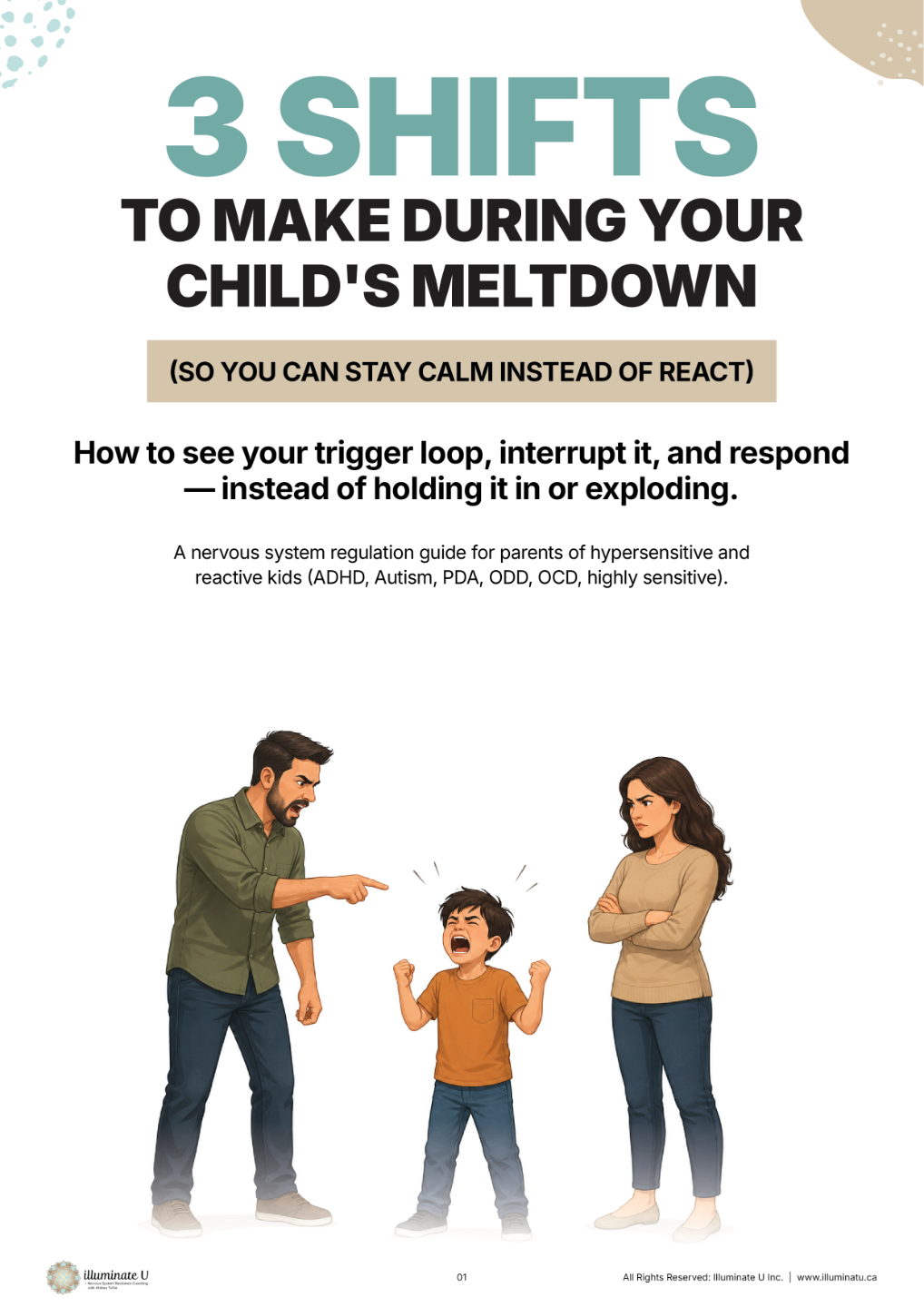
Free: The 3 Shifts Guide
The trigger loop and 3 patterns you get stuck in during meltdowns — and how to shift them so you can stay calm instead of react.
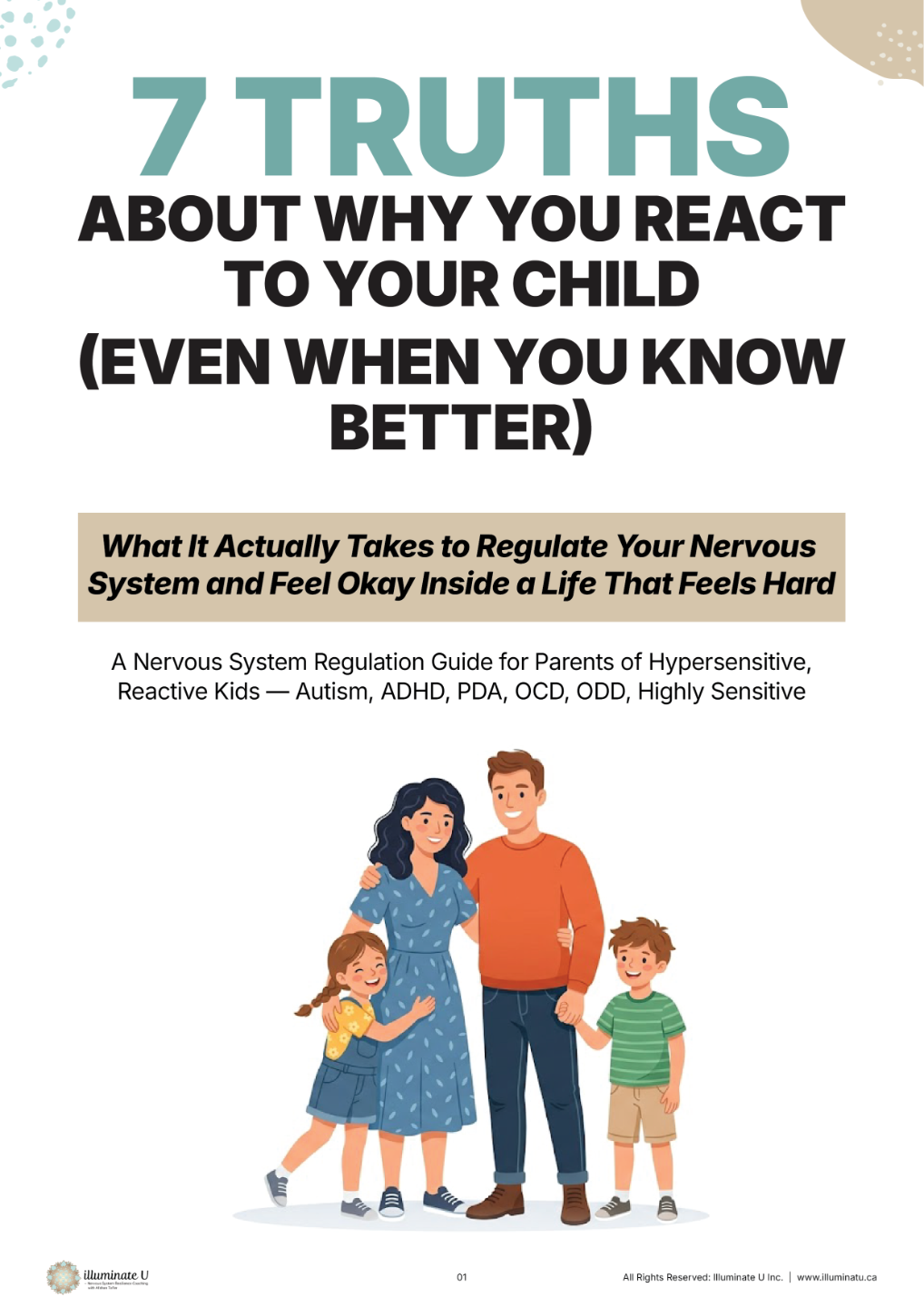
Free: 7 Truths About Why You React to Your Child Guide
Why you react even when you know better — the conditioning, nervous system states, hidden beliefs and patterns, and buried emotions running the show.

