
Reclaiming Your Joy and Aliveness — Even When Your Autistic Child Is Still Struggling

**You can also listen to this in audio format only on The Regulated Mother Podcast on Apple or Spotify. Look for Episode #50
If You've Forgotten What It Feels Like to Feel Like Yourself
If you are parenting a PDA, autistic, or high-needs child — and somewhere along the way you stopped feeling like yourself — I want you to stay with me today.
I'm not talking about the version of you that's exhausted. Or the version that's stressed or reactive or just getting through. I'm talking about the version that has lost its aliveness and joy for life.
The you that used to laugh and actually feel it. Who felt lightness. Who felt ease — not relief that a hard moment ended, but genuine ease, like life could hold you for a moment instead of you always holding it.
Maybe that version of you feels like a distant memory. Maybe you get time to yourself now and you don't even know what to do with it — you sit down, and instead of resting, you just feel blank or worried. Maybe your child has a genuinely good day and instead of joy, you feel worried this won't last, or you feel strangely far away from it, like the moment is happening somewhere you can't quite reach.
Maybe you've noticed that you can still feel the hard things — fear, anxiety, frustration, the low hum of dread — but the good things don't land the same way anymore. Joy feels thin. Ease feels like it belongs to someone else's life.
If any of this sounds familiar, I want to say something to you clearly: nothing is permanently wrong with you. This is not who you've become. It's what happens when a nervous system has been living in survival mode for a very long time.
Today I want to help you understand why your joy, aliveness, and ease — the parts of you that are most truly you — get covered over, and more importantly, whether you can find your way back to them. Not when life gets easier. Not when your child is doing better. Now.
Let me start with the moment I realized I had completely lost myself.
The Day I Realized I Had Lost Myself
A few years into the most intense period of my son's burnout, he had a good day.
Not a miraculous turnaround. Not a sign that things were finally changing. Just a genuinely good day — the kind that used to feel normal and now felt like something borrowed or fleeting.
He was smiling. Laughing, even. His face looked lighter in a way I hadn't seen in so long that I'd almost forgotten it was possible for his face to look that way.
And I remember standing there watching him, and feeling this desperate, almost physical longing rise up inside me.
I wanted so badly to feel what he was feeling.
After everything we had been through — the years of daily meltdowns, the house destruction, the throwing and hitting and swearing, the basic needs that had become battlegrounds, school stopping, our world shrinking, becoming housebound — after all of that, I wanted this. I needed this. I needed to let this moment in and actually feel it.
But I couldn't.
I felt nothing.
Not relief. Not joy. Not even the beginnings of gratitude. Just flatness. Just this strange, hollow void where feeling was supposed to be.
And the thing that confused me most — the thing that actually frightened me — was that I wanted to feel it. I was desperately reaching for it. I wanted joy. I wanted the aliveness. And still, nothing came.
I remember thinking: What is wrong with me? My child is smiling. This is the moment I have been hoping for. Why can I not feel it? Why can't I take this in?
At the time, I made the only meaning I could make of it. I must be too far gone. I must be too exhausted, too depleted, too damaged by everything we'd been through. Something in me had broken, and now even the good things couldn't reach it.
I felt broken.
It took me a long time to understand that this wasn't what had happened.
My nervous system hadn't broken. It had done exactly what it was designed to do. It had learned, over years of chronic stress and unpredictability, to stay in survival mode — braced for the next crisis, scanning for the next threat — and in doing so, it had narrowed my access to the very experiences that make life feel worth living.
I hadn't lost joy.
I had lost access to joy.
And that distinction, when I finally understood it, changed everything.
The Loss Nobody Names
Here is what I think most people don't talk about when they talk about parenting a child with intense needs.
Yes, we talk about the exhaustion. The isolation — feeling like we're all alone, like we don't belong anywhere. The grief of the life we imagined. The impact on our relationships and our careers and our sense of what's possible.
But there's another loss — quieter, more invisible — that I see in almost every parent I work with.
We lose ourselves.
Not suddenly. Not in a way that announces itself. Gradually, almost imperceptibly, the parts of us that made us feel alive start going dark.
The things we used to love — the hobbies, the interests, the moments of spontaneity — stop fitting into the space we have left. We tell ourselves we'll get back to them when things settle down. But things don't settle down. And slowly, we stop even reaching for them.
And then something more subtle happens. Even when we do get time — a rare afternoon off, a night away, an hour while our child is calm — we find we can't use it. We sit down to watch something and don't take any of it in. We go for a walk and spend the whole time mentally rehearsing future conversations, future crises, future decisions. We have the break, but we're not there for it.
I hear this all the time from parents. You finally get a night away and spend it checking your phone. Your child has a calm day and you can't take it in and are already bracing for tomorrow. Someone asks you what you do for fun and you realize, with a start, that you genuinely don't know anymore.
Fun feels like something from another lifetime.
I know you're feeling me here — because I have heard so many parents say this.
And somewhere in all of this, we arrive at one of two conclusions. Either something is wrong with us. Or we've lost ourselves. I'm gone. Where am I? I don't even know who I am anymore. I'm this shell of a human being.
But here's what I want you to understand — and this is the heart of everything I'm going to share today. What's happening here is not actually losing ourselves. Who we truly are — with all of our aliveness, our zest for life, our capacity for gratitude and joy and fun — is still there. It's just covered over by a nervous system stuck in survival mode. And once you understand that, everything begins to look different.
Why Good Things Stop Registering
When you can't feel your aliveness or your joy — even when there are moments right in front of you that would have moved you before — it isn't because you're damaged. It isn't because something is permanently wrong with you.
It's because under chronic stress, the nervous system does two things. First, it develops a negativity bias — it learns to scan for threat and danger far more readily than it can take in the goodness of life. And we are all wired for this negativity bias — everybody has it. But it becomes the dominant way of being when we are under chronic stress. And second, it numbs us. Because when you are living through the volume of pain that comes with this kind of parenting — the daily meltdowns, the aggression, the fear, the grief, the shame — the nervous system eventually has to find a way to keep you functional. And the way it does that is by turning down the dial on feeling — imagine that dial being turned all the way down. All feeling.
The problem is that when it numbs you from the painful emotions, it also numbs you from the nourishing ones.
This is what I lived for years. My son would have a moment of genuine connection with me — a real moment, the kind I had been longing for — and I would go through the motions of responding as if I felt it, but inside I was still numb. Still scanning. A friend would say something kind and I'd say thank you, but it wouldn't land in my body. A therapist would finally understand what we were dealing with, and I'd feel it for maybe thirty seconds before my nervous system moved right back to bracing.
For a while I thought this was a problem with me specifically. That I wasn't grateful enough. Present enough. Mindful enough.
What I came to understand is that this is what the nervous system does. Researchers call it negativity bias — the brain's tendency to weight threats more heavily than positive experiences. Under chronic stress, that bias becomes extreme. A moment of connection with your child lands for thirty seconds. But a difficult exchange from three days ago? That's still alive. That's still taking up space.
This isn't a character flaw. It's a nervous system that has learned, very efficiently, to prioritize survival over nourishment.
And the cost is that life starts to feel like something you're enduring rather than something you're living.
There's something even harder beneath this though. When the hypervigilance — that anxious, braced, always-scanning state — goes on long enough, many parents eventually tip into the other survival state: shutdown. Freeze. Flat. Emotionally absent. Not distressed exactly, just not really there. Going through the motions of a life without fully inhabiting it.
And that's when even the things you desperately want to feel — joy, ease, love — even love, in the open-hearted way you used to feel it — become completely inaccessible.
Not because they're gone. Because your nervous system has covered them over completely in its effort to protect you.
And here's what made it worse — I kept waiting for things to change before I allowed myself to feel better.
The Trap of Waiting
For years, I ran a quiet bargain in the back of my mind.
I don't think I ever said it out loud. But it was running constantly, like a background process I couldn't see.
Once my son is better, I'll be okay. Once school and learning is figured out, I'll relax. Once the hard part is over, I'll feel like myself again.
I see this in almost every parent I work with. And it makes complete sense. When you're managing daily crises, of course you're looking toward some future point where things are easier. Of course you're hoping for relief.
But the problem is that this bargain quietly postpones your life and keeps your nervous system stuck in this holding pattern. You never get to replenish and nourish yourself and you often end up burning out.
Not intentionally. Not because you're doing anything wrong. But because everything — your attention, your energy, your capacity for joy — gets organized entirely around managing the next thing. The next appointment, the next accommodation, the next school meeting, the next hard morning.
And before you know it, years have passed and you're still waiting.
Here's the truth I had to sit with: for many of us, parenting a PDA, autistic, or high-needs child is not a problem that eventually gets resolved. There may be progress, and there may be seasons of real relief. But the nature of this parenting journey means there will always be something that needs navigating.
If your access to joy, or peace, or feeling like yourself depends entirely on circumstances becoming perfect first — you may spend a very long time waiting for a day that never fully arrives.
For years I lived as though my capacity for joy was contingent on my circumstances first cooperating. As though I had to get my son's wellbeing secured, get the future settled, get the external chaos to quiet — and then, finally, I could feel okay.
What I eventually learned is that it was never out there waiting for me.
It was always here. Covered over, yes. But here. Waiting for me to notice it.
I don't say that to take away hope. I say it because it was the question that cracked something open for me. And I want to say — when you are deep in the survival system, it feels like this is the only true reality. Because story follows state. The story your mind tells you about your life follows whatever state your nervous system is in. But that story is not the whole truth. Waiting within us is this feeling. It's just covered over.
What if I don't have to wait? And, what if I can't afford to wait if I really want to be a more regulated person and parent and want to feel better about my life? What if my child can still struggle — and I can still reconnect with myself and feel who I truly am, which is that person who has a zest for life, feels aliveness, feels well-being and ease? What if both things can be true?
Your Inner Resource Is Waiting For You
For a long time, I assumed that what I had lost — the aliveness, ease, zest for life, joy — was actually gone.
The groundedness, the sense of being able to handle life, the feeling of being at home inside myself — I assumed these were casualties of everything we'd been through. Things that existed in a former version of me that chronic stress had simply used up.
But over time, through the work I began doing on my own nervous system, I started to understand something that shifted everything.
Those qualities weren't gone.
I had lost access to them.
And that is a completely different problem.
Because if something is gone, there is nothing you can do. You grieve it and you move on.
But if something is covered over — buried underneath layers of survival activation, fear, grief, and years of narrowed attention — it can be rediscovered. Because it has been there all along, and is not dependent on any circumstances outside of you. All you need to do is tune into it. It's been waiting for you to discover it again.
And this is what I teach as the Inner Resource.
This concept isn't mine originally. Richard Miller, who developed iRest meditation, describes the Inner Resource as an unshakable ground of well-being that remains present even in the middle of trauma, grief, chronic stress, or pain. His work has been particularly powerful for people with PTSD, and it's become foundational to how I understand nervous system healing.
Internal Family Systems therapy talks about something similar — what it calls the Self, with a capital S. The calm, clear, compassionate, curious part of us that exists underneath our survival parts. Not something we have to create. Something we reconnect with.
And across contemplative traditions for centuries, there's been a version of the same understanding: that beneath your thoughts, your fears, your emotions, and your reactive survival states, there is an awareness that hasn't been damaged by any of it. A deeper ground of well-being that simply gets obscured when survival becomes all-consuming.
Here is what I want you to understand. This isn't abstract.
You have already felt your Inner Resource. You just didn't have a name for it.
You've felt it in a moment in nature where something in you suddenly softened — standing beside the ocean, or walking in a forest, or noticing sunlight coming through leaves. Something shifted. You dropped out of your head, out of the scanning and the bracing, and you were just there. Present. And for a moment, something that felt like okayness was available.
You've felt it holding your sleeping child and, despite everything — despite the hard days and the fear about the future — feeling, just for a moment, completely present with them. A tenderness that cut through the survival.
You've felt it in a rare morning alone with your coffee, before anyone else was awake, and feeling for a few minutes like yourself. Not performing, not managing, not bracing. Just here.
What those moments have in common is that your survival system became quieter. And in that quiet, something underneath it became available.
That's what I mean by the Inner Resource. Not a spiritual concept you have to adopt. An experience you've already had, that your nervous system already knows how to access, that chronic stress has simply been drowning out.
And I love this name — Inner Resource — because in my work I teach parents to connect to both their external resources and their inner resources. Your external resources are the things outside of you that help you feel safer and more regulated — nature, a loving person, a pet, something in your environment that brings you ease or appreciation. When you feel those things in your body, they nourish you. But you also have this inner resource that is always available, even when no external resource is present. And that inner resource is what you access when you truly connect — not just think about, but feel — those external resources too.
Think about the sun behind the clouds on an overcast day. The clouds are real. The storm is real. But the sun hasn't disappeared. It's still there. The conditions simply make it temporarily inaccessible.
Your Inner Resource is exactly the same. It hasn't been destroyed by what you've been through. It's been covered. And what I love about this is that it's not dependent on the circumstances outside of you going well. This innate aspect of you — who you truly are — is always there, always available, just waiting for you to tune into it.
Finding Your Way Back Through the Body
One of the most helpful things I discovered when I began this work is that you don't have to generate joy from scratch.
But I also want to offer you something even more immediate than that — because for many parents, the body itself is the doorway. And it was for me.
The first time I actually touched my Inner Resource, it wasn't through a memory or a beautiful moment in nature.
It was through sensation.
I had been so far into my head for so long — thinking, analyzing, planning, ruminating, worrying, bracing — that I had almost completely lost the felt sense of living in a body. I was like a walking head, cut off from the body. And one of my teachers guided me to do something deceptively simple: stop trying to think my way into well-being, and start sensing.
Not searching for anything big. Not trying to feel joyful or peaceful or okay. Just noticing — what is actually happening inside my body right now?
And when I dropped out of my thoughts and into sensation, something surprised me.
And I want to say — when you first drop into sensation, you will notice the sensations of the survival system too. Tension. Maybe a speeding up somewhere. Whatever your survival system holds. Notice those. That's okay. But then, as you allow yourself to open up and look a little deeper — there is more that is there.
There was aliveness already there.
A subtle tingling in my hands. A very faint pulsing or vibration — something that felt like energy moving, quietly, underneath all the noise and all the tension. Not dramatic. Not what I would have called joy or peace. But unmistakably alive. And I remember thinking — oh my goodness, that's aliveness. It's there. It's still there.
And the more I stayed with it — without trying to change it or analyze it or make it mean something — the more it expanded.
What started as a faint tingling began to feel like warmth. The warmth began to feel like something I can only describe as being at ease inside my own skin — not because anything around me had changed, but because I had stopped fighting the moment I was in.
And underneath that ease, something even quieter: a kind of groundedness. A sense that even with everything uncertain, even with everything hard, there was something in me that was okay. Not performing okayness. Just... okay.
This is what Richard Miller calls the unshakable ground of well-being. And the reason I love that phrase is that it captures something important — it isn't a feeling that comes and goes based on what's happening around you. It's more like a foundation. Something that was there before the hard years, that stayed there during them, and that I had simply lost the ability to sense.
As I kept practising — returning to sensation, noticing the aliveness in my body, staying with it instead of moving away from it — other qualities began to surface. Ease. Equanimity. A spaciousness around my thoughts that I hadn't felt in years. And eventually, on some days, something that genuinely felt like joy.
Not forced joy. Not gratitude I was performing. Just a quiet, unmistakable sense of being glad to be here. Just the joy of being here and this okayness with everything as it is.
What I want you to know is that the Inner Resource shows up differently for everyone. For you it might not start with tingling. It might be warmth. Or a sense of weight dropping from your shoulders. Or a subtle brightening somewhere in your chest. Or simply a moment where your breath comes a little easier.
But the doorway, for most of us, is the same: stop thinking. Start sensing. And look for any quality of aliveness — however small — that's already here. And if aliveness isn't available yet, look for something quieter — even just a little ease, a slight relaxation response, a softening somewhere. Start there and let it lead you toward aliveness.
Breath is another doorway in. As you focus on your breathing — breathing slowly and deeply into the belly, feeling the ease of each breath coming in — that itself can be a way back to your Inner Resource.
And If Your Body Feels Too Shut Down to Sense Much
For some parents, especially those deep in freeze or shutdown, even dropping into sensation can feel like trying to tune into a signal that's barely coming through. The body feels numb. Flat. Like there's nothing there to sense.
If that's where you are, there's another way in — and I call it borrowing.
The brain, in many ways, can't distinguish between a vivid memory of joy and joy happening right now. When you bring a memory into your body — not just think about it, but actually feel into it — your nervous system begins to register what that state feels like again.
So find a moment — even two minutes — and just arrive. Feet on the floor, eyes softening, one slow breath. Just land.
Then let a memory surface. Something that once carried warmth. Not forcing anything, not searching hard. A moment in nature where something in you softened. Your child at a younger age, laughing. A memory of connection with someone you love. A place that always made you feel more like yourself. Even a vacation you went on before you had kids. And if none of those come easily, it can even be a person you admire, or a character from a show or film who embodies a quality you want to feel — your nervous system can borrow from that too.
And then light up the senses — notice what you see, textures you feel, what you hear, what you smell and taste. Let the memory become embodied rather than just pictured. Notice what it does in your body: maybe a small softening in the chest, your shoulders dropping slightly, a faint vibrating or pulsing or tingling that feels like aliveness, a sense of ease or openness or spaciousness. Find your own words for what you feel and where you feel it. Remember those words — they're your way back in.
The practice is simply staying with that a little longer than you normally would. Letting the nervous system register it before moving back into scanning.
Most of us have become extraordinarily practised at staying with fear. This is the practice of becoming equally practised at staying with nourishment — with your Inner Resource — however brief, however small, so the nervous system begins to remember that it exists. It doesn't have to be all pain. It can be nourishment too.
Then, throughout your day, ask yourself one simple question: What quality of my Inner Resource is available right now?
A moment of connection with your child — pause, let it land, and notice what sensations it brings up in your body.
Something beautiful in passing — stay with it for ten seconds instead of moving through it.
A sip of coffee that actually tasted good — feel it.
Not adding anything to your day. Just stopping the habit of passing through the good things without letting them register.
This is how the nervous system slowly gets reoriented — away from exclusive survival scanning and back toward noticing what is already here. The nourishment that exists alongside the stress, not instead of it. It's been here all along, and it's here to support you. You just need to tune into it.
What Changes — and What Doesn't
I want to be honest with you about what this work does and doesn't change.
It doesn't change your child. It doesn't make the hard moments disappear. There will still be grief. There will still be days that break you open. There will still be uncertainty you can't resolve and challenges you didn't sign up for.
But something else begins to shift.
You stop meeting every difficult moment from the floor of your survival system. You begin to have, as I think of it, a little more room. A little more space between what is happening and how completely it takes you over.
You find yourself recovering from hard moments a little faster. You notice that you're no longer spending the entirety of your child's good moments braced for them to end. You begin to trust yourself a little more — your instincts, your judgment, your capacity to handle what comes.
And perhaps most meaningfully, you stop postponing your own aliveness.
You begin to understand, in your body not just your mind, that both things can be true. Your child can struggle — and you can have activation inside — and you can still feel moments of peace. This is what nervous system flexibility actually looks like. Not the absence of hard feelings, but the ability to feel the challenge and also feel the goodness, the aliveness, the ease, at the same time or right alongside it.
And when you've practiced connecting to your Inner Resource and a hard moment arises with your child, you can pause, bring forth that Inner Resource, and let it be here alongside the activation. That Inner Resource stimulates your ventral vagal system — your calm, connected, alert state — to come online and help you regulate, rather than being swept away by the survival response.
Life can be hard — and you can feel moments of joy. There can be grief and love in the same afternoon. Fear and courage in the same hour.
These are not contradictions. This is just what a full life actually feels like.
And I want to say — a full life is not about things being great all the time, or happy all the time, or you being calm all the time. A full life is being able to feel all ends of the spectrum — not only the hard, but at the same time feel the nourishing and the goodness that is there to support you along the way. And feel the aliveness and joy in the moments that are right in front of you, that can bring it out in you.
Coming Home
I want to come back to that moment I started with.
My son laughing. Me standing behind glass, feeling nothing, wanting so badly to feel his joy.
I used to think that moment was a sign of how far gone I was.
What I understand now is that it was a nervous system in survival doing its job — protecting me from feeling too much by not letting me feel much at all. And while that protection had kept me functional through some genuinely unbearable years, it had cost me access to the very things that make life feel like life.
That wasn't permanent — and that's the good news. That was the beginning of something I didn't know I needed to learn.
Today, my son still struggles. He's doing much better overall, but there are still challenges. There is still grief and fear and uncertainty that I live with every day.
But now, when he laughs — I can feel the laughter rise within me.
When he overcomes another obstacle, I can feel joy and gratitude instead of immediately worrying that he may fall into the pits of despair and regress, and we'll be back to where we were before. I can let that joy and gratitude in and let it nourish me.
When I feel so exhausted and tired and spent from co-regulating all day, I can lie down at night before sleep and just tune into the aliveness that is there underneath, and the ease that is here now in the comfort of my bed.
I can recognize in daily moments that I am here too. That I haven't disappeared. That underneath everything we've been through, I can still tune into who I truly am underneath all the stress — and feel the unshakable ground of well-being and aliveness that I never truly lost. I just lost my way to sense it.
And I believe the same is true for you, my friends.
Not because your circumstances are going to change first.
But because what you're looking for was never actually gone.
It's still there. Waiting for you to find your way back to it.
One small moment at a time.
A Way Back In — Your Practice This Week
Before you move on from this episode, I want to offer you something specific.
Find a moment today — even just a few minutes. Arrive in your body. Feel your seat in the chair and your feet on the floor. Slow your breathing down. Soften your eyes, your jaw, your neck and shoulders — all the areas where we hold tension. Let everything just drop.
Then let a memory surface — anything that once carried warmth, ease, or joy. It can be as simple as walking in nature, petting your dog, or a vacation you were on. Now light up the senses — notice what you see, what you hear, what you feel, what you smell, and even what you taste. Notice how your body feels. Now let go of the thinking and drop into the sensing — feel the experience in your body. Notice where it lands. Describe the sensations of what you're feeling in your body, and stay with that felt sense just a little longer than you normally would.
That's your Inner Resource. See if you can name the qualities you feel when those sensations are available to you. Remember those qualities — they're your way back in.
And then throughout your week, practice the question: What quality of my Inner Resource is available right now? Catch the micro-moments. The warmth of the sun. The connection in a small exchange. The brief sense of okayness after a hard thing passes — don't bypass that. Stay with it. Let it nourish your nervous system and remind it that you are okay, that you are safe right now.
You're not adding joy to your life. You're practising noticing the joy that is already here, that survival has been filtering out.
Little and often. Again and again.
That's how we come home to who we truly are, my friends.
If this spoke to you, if this helped you in any way, I invite you to leave a comment and please share it with other parents who may need this too.
The Regulation Rebuild course
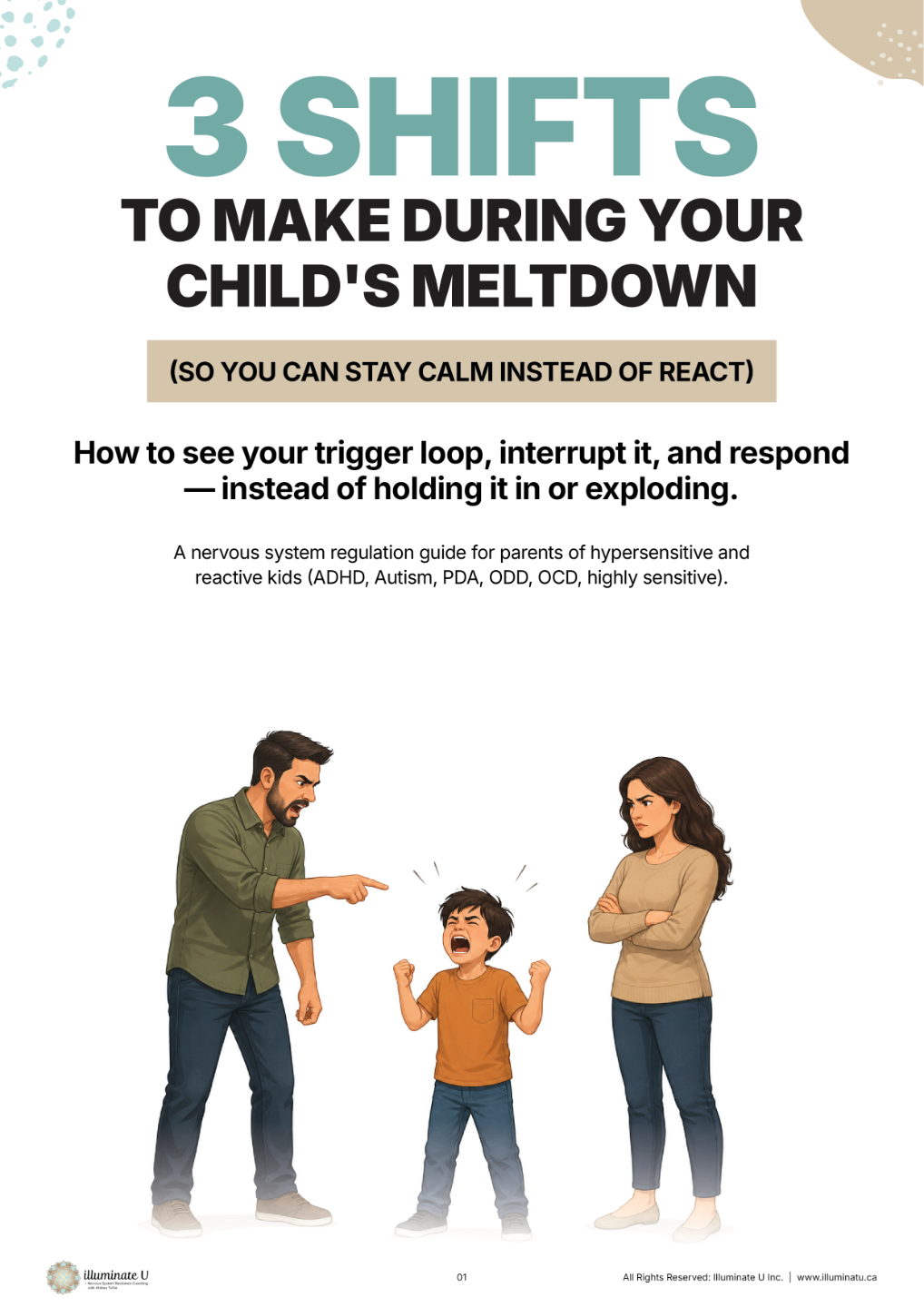
Free: The 3 Shifts Guide
The trigger loop and 3 patterns you get stuck in during meltdowns — and how to shift them so you can stay calm instead of react.
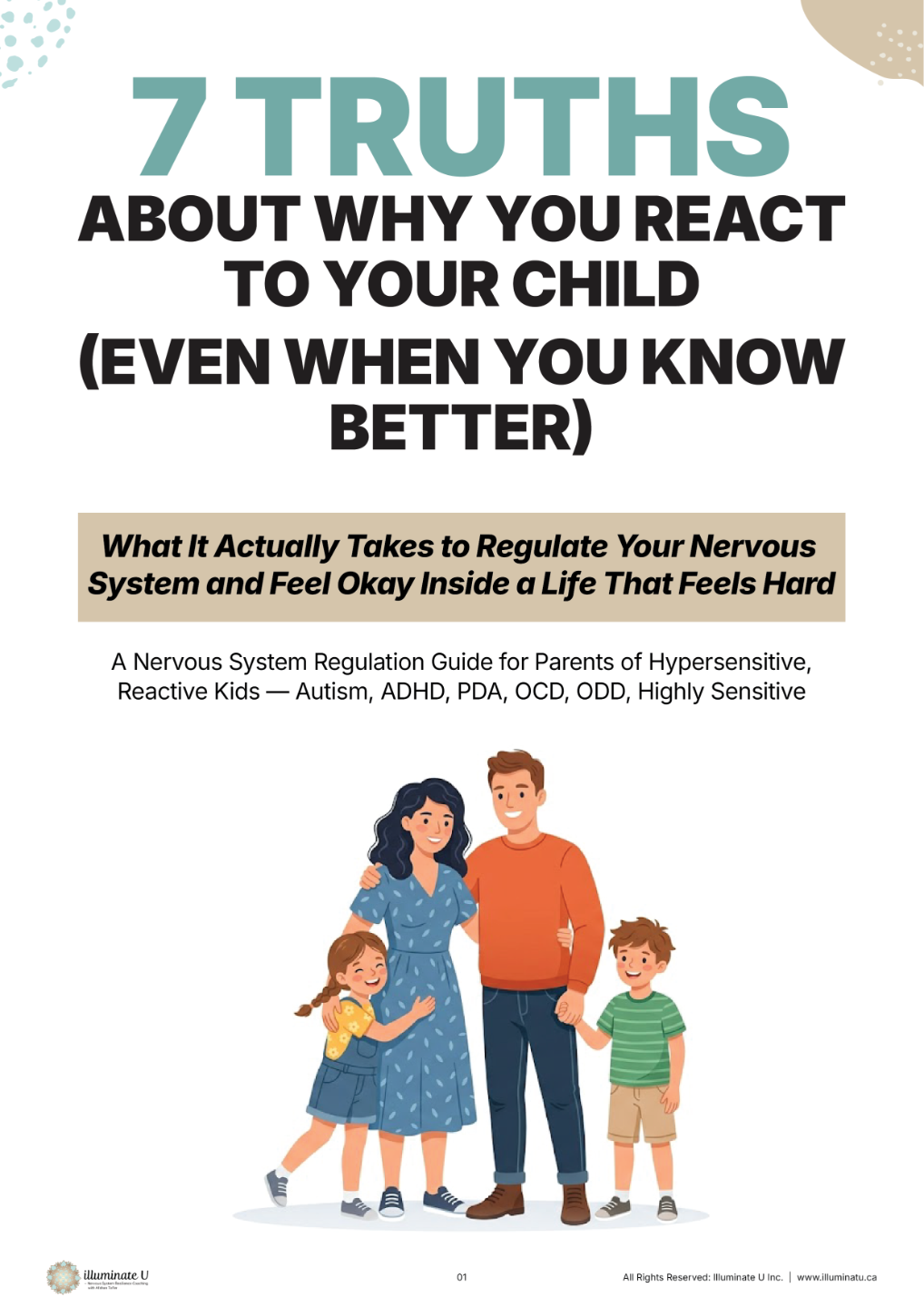
Free: 7 Truths About Why You React to Your Child Guide
Why you react even when you know better — the conditioning, nervous system states, hidden beliefs and patterns, and buried emotions running the show.

