
Am I Damaging My Child? The 3 Shame Spirals That Keep Parents of PDA, Autistic, ADHD Kids Stuck

**You can also listen to this in audio format only on The Regulated Mother Podcast on Apple or Spotify. Look for Episode #51
The 3 Thoughts That Keep Parents of PDA and Autistic Kids Stuck
"I lost it on my child again. I am damaging them."
"My child is still struggling. I must not be doing enough."
"We can't go anywhere. We don't fit in. Something must be fundamentally wrong with us."
If you've said any of those things to yourself — or felt them in your body even when you couldn't find the words — this post is for you.
These are the three most common things I hear from parents of PDA, autistic, ADHD and high-needs kids. And what they all have in common is this: they are shame spirals.
Shame doesn't just hurt. It keeps your nervous system stuck. It builds stress load in your body instead of letting you regulate and recover. Which means the very thing you most want — to show up better for your child — becomes harder and harder the longer you stay in it.
Today I want to show you what's actually driving these loops, what's underneath them, and how to start breaking free. Not when life gets easier. Now.
Three Shame Spirals in a Single Day
A few years ago, we were in the thick of my son's burnout.
He was in a phase of breaking glass whenever he got activated. I could handle a lot of his outbursts — the hitting, the throwing, the spitting. But the glass breaking wore on me in a way I can't fully explain. The sound of it. The danger of it. The exhaustion of cleaning it up while he was still raging, trying to keep him safe while also defending myself.
One morning he woke up really agitated. And he interrupted my morning regulation routine — the one thing that was holding me together in those years. He could sense my agitation. He ran downstairs, took a glass from the cupboard, and threw it on the floor.
The sound jolted my whole body. I ran down and just stood there for a moment. Frozen. I watched him start to step toward the broken glass, screamed at him to step back, and started furiously cleaning it up with rage on my face I wasn't even trying to hide.
Then he ran to grab a glass vitamin dropper bottle — an expensive one he had broken many times before — and held it up, threatening to smash it against the glass dining table. Glass on glass.
Everything I had been holding down came exploding out of me. I ran toward him like an unleashed animal. He bolted. I reached him, grabbed the hand holding the bottle, and said through gritted teeth: "Don't you dare ever break my vitamin bottles."
He froze. And started to cry.
In that moment I came out of the trance I was in. I let go. I went back to clean up the glass on the floor and sat in my pile of shame.
My inner critic was screaming: "You're damaging him. You will never change. Nothing will ever change."
That was Loop 1.
Later that day, after we had repaired, I watched my son online trying to connect with another child. The other child started saying mean things — couldn't understand why my son needed to repeat messages, why he communicated the way he did. Part of his OCD.
My heart broke for him. He wanted friends so badly and couldn't find anyone who had patience for him or understood him. Not even cousins — those relationships had quietly fallen away too.
And I heard the voice start: "I need to do more. I need to find a way to help him connect. I'm not doing enough to get him out into the world."
That was Loop 2.
That evening, I found out we hadn't been invited to an extended family event — one we used to always be included in. I knew why. We'd said no so many times because of my son's challenges, and people had stopped asking. I understood it. And it still hit me like a wave.
That old feeling rose up — one I'd felt so many times before. The shame and grief of: "Something is wrong with us. We don't belong. Not even in our own family anymore."
That was Loop 3.
By the end of that day, I was spent. Not just from the parenting — from carrying all three shame spirals on top of everything else.
And this wasn't a bad day. This was a regular day. This happened on repeat, for many days, for many years.
The 3 Shame Spirals — And Why They Feel Like Truth
If you resonate with that story, I want you to know: this is not just you. These three loops show up in almost every parent I work with.
Loop 1: The Post-Outburst Loop
Your child has been in a threat state for hours. You've held it together — until you snap. You yell, slam something, say something you regret. And immediately the voice comes: "I'm damaging my child. I am the problem. What kind of parent does that to a child who can't help it?"
Loop 2: The Not-Enough Loop
You watch your child suffer through a meltdown, through isolation, through another impossible day. And the weight of not being able to fix it becomes: "I am failing them. If I were a better parent, I would figure this out."
Loop 3: The Isolation Loop
You can't go to the birthday party. You leave the grocery store halfway through. Your family doesn't understand. And slowly, that becomes: "Something is fundamentally wrong with us. We don't belong anywhere."
Each one feels like truth. Each one feels like a verdict on who you are and who your child is.
None of them are. Here's why.
What's Actually Happening: 3 Layers You Need to Understand
Layer 1: We Are All Wired for Shame
Shame is not a personal flaw. It's ancient survival biology.
We are social creatures. For thousands of years, being cast out of the tribe meant death. So the brain evolved to use shame to keep us acceptable, to keep us in the group. When we violate what we believe a "good parent" or "good human" looks like, the nervous system fires shame automatically.
This is not weakness. This is wiring. It's normal. It's expected.
Layer 2: What Happens in Your Nervous System When Shame Gets Triggered
When your child has been in a threat state for hours, you feel it. You absorb their activation in your body — that's part of the design of co-regulation. And as a parent trying to hold it together, you hold all of that in. You hold and hold and hold.
But here's something important: that holding in is not regulation. It's functional freeze.
Until your alarm system snaps. Fight takes over. You lose it.
That explosion might feel like a release. But it isn't. It didn't resolve the activation or bring you back to safety — it came out sideways, at your child. Your nervous system knows it wasn't a clean discharge. That activation stays in your body, incomplete.
And immediately, a voice fires: "You're a monster. You damaged them."
That's the inner critic — a protective part that learned long ago that shaming you back into line would stop things from getting worse. It's trying to help. But it's an old, painful strategy. And that voice triggers shame as a physiological event — not just a feeling.
Your nervous system shifts from high-activation fight into dorsal vagal shutdown. The freeze. The collapse. Chest tight. Throat clamped. Shoulders forward. Heavy. Numb. Small.
Shame is an inhibitory emotion. It's the nervous system slamming the brakes. And in a strange way, it is protective — it's trying to stop you from being overwhelmed by what's underneath. But here's the trap: shame doesn't discharge the stress. It builds a wall around it.
Underneath the shame, the rage and terror are still there. And underneath those — even deeper — are the most vulnerable emotions: grief, helplessness, loneliness. Those emotions never got to move through. They stay frozen. And your nervous system stays stuck.
Layer 3: The Shame Wound That Was Already There
For most of us, this shame pathway was worn into us long before our child arrived.
We learned early — from a parent, a teacher, a system — that when things go wrong, we are what's wrong. We took on beliefs like: "I'm bad. I'm wrong. I'm not enough. I'm to blame."
That belief didn't start in this parenting experience. It started in childhood. This parenting just keeps triggering those old wounds. Which is why the shame hits so hard, why it feels like truth, and why it stays stuck in a patterned loop.
The Shift: Shame Is Not the Truth About Who You Are
Shame is not the truth about who you are. It's a protection pattern that developed by taking on the voices and programming of those around you — trying to make you do better and be better, but in a way that isn't working and is keeping you stuck. And it's protecting something even more vulnerable underneath.
If those vulnerable emotions are never processed, you stay stuck in shame.
Underneath the “I lost it– post-outburst shame” — when you feel like you're a horrible parent damaging your child — there is terror. The raw fear that you've hurt someone you love. There is also grief and pain for how hard this parenting experience is, and how out of control you feel.
Underneath the “I’m not doing enough for my child” shame — there is grief and helplessness. The unbearable weight of loving a child you can't protect from their own nervous system, and from how that nervous system gets received in the world.
Underneath the “something is wrong with us, we don’t belong isolation shame” — there is sadness. And longing. For belonging. For an easier life for your child. For an easier life for yourself.
And when you touch into those vulnerable emotions, you're usually touching into something older — from your own childhood. The meaning-making you took on about not being enough. As a child, you didn't believe your caregivers were wrong. You took the blame. You made it mean something about yourself: "Something must be wrong with me."
The shame you're feeling today didn't start with your child. It started long before.
When you understand that, you stop fighting the shame. You get curious about what it's carrying. And this is where it becomes important to get comfortable supporting the more vulnerable emotions that shame is inadvertently protecting you from feeling.
Why This Work Is Also for Your Child
When I started to see my inner critic as a protector — not as truth — something really shifted. When I got comfortable sitting with shame instead of fighting it, and feeling what was underneath — the grief, the fear, the helplessness — that helped me. And when I started to see that so many of those feelings and beliefs weren't even about today, that they came from childhood, from learning I had to be a certain way to be safe, to be loved, to belong — that's when something really changed.
I finally felt like I was enough. Even on the days I lost it. Even when my son struggled. Even when we didn't fit in. What was happening in my life with my son was no longer defining whether I was enough or not.
That is life-changing work. And it's not just for you — it's for your child too.
When you're frozen in a shame loop, your body is collapsed, numb, distant. And your child's nervous system reads that as threat. Even when you're trying to look calm on the outside. Our children are exquisitely attuned to our nervous system cues — through our eyes, the tension in our bodies, our energy, our overall presence.
This is what I call the double threat cycle. They're already dysregulated. And now they sense you collapsing inside too. Their internal logic registers: "Not only is this situation dangerous — my parent is breaking. The person who is supposed to be my safe harbour is gone." That adds a whole second layer of unsafety on top of what they're already carrying.
I want to be clear: I'm not saying this to shame you. Your nervous system is going to do what it does — it's automatic. But I want to motivate you to understand that staying stuck in these shame loops isn't helping you, and it isn't helping your child.
When you begin to unthaw from shame — when you come back into your body and start to regulate — they can begin to co-regulate off you. Your regulation is their regulation. That's not a metaphor. That's biology.
And when you can approach repair from a grounded place — not drowning in shame, not needing their forgiveness to feel okay about yourself — you model something powerful: I made a mistake, I take responsibility, and I am still okay. For a child who already carries so much shame about their own nervous system, watching you do that is one of the most healing things they can witness. They learn it for themselves.
I used to end days like the one I described completely hollow — not just tired from parenting, but crushed under the weight of all three loops. That changed when I stopped fighting the shame and got curious about what I was carrying. And it can change for you too.
Two Practices for Breaking Free
Practice 1: Working with the Inner Critic
Get to know your inner critic well — because it's always going to be there. It learned a long time ago that shaming you into doing better would keep you safe and acceptable. It's not going away. But you can change your relationship with it.
When a shame loop hits, you'll often notice the inner critic voice first — "You're damaging them," "You're not enough," "Nothing will ever change." When you hear it, don't argue with it and don't try to silence it. It will just grow louder. Instead, become the curious observer.
Say to it — out loud or internally — "Thank you for trying to protect me." Allow it to be here. Then get curious and ask: "Where did you learn to speak to me this way? What are you afraid will happen if you stop?"
Just wait and hear the response. You'll begin to understand the fear underneath — what this inner critic has been trying to protect you from all along.
This voice is not you. It's a part of you that took on the critical voices of caregivers, teachers, and systems from long ago. It learned that shaming you into compliance would keep you safe. It was trying to help then. It's not helping now. When you can see it as a protective part rather than the truth, it begins to loosen its grip. You step back into the truth of who you are, and your system starts to regulate.
Practice 2: Working with Shame and the Vulnerable Emotions Underneath — Kristin Neff's 3 Steps of Self-Compassion
For working with shame itself — and the vulnerable emotions underneath it — I turn to the work of Dr. Kristin Neff, a leading researcher on self-compassion who has spent decades studying its effects. Her three-step framework is one of the most powerful tools I know for this work. It's also deeply regulating for the nervous system. When you practice this, you are literally reparenting yourself — teaching your nervous system a new, safer way of being with yourself that you may never have received growing up.
Step 1 — Mindfulness: Notice What's Here Without Judgment
Feel where the shame lives in your body. The tight chest, the heavy stomach, the collapsed shoulders — or perhaps in your face. Put your hand there and say: "I feel you. It's okay that you're here."
Don't try to fix it or push it away. If there's resistance, allow that too. Build tolerance for being with it. Then go a little deeper and ask: "What else are you holding? What else do you want me to know? What are you believing?"
Wait. Let whatever is underneath begin to surface — the terror, the grief, the helplessness, the old belief of "I'm not enough." Don't try to resolve it. Witness it. Let it unthaw slowly.
Step 2 — Common Humanity: You Are Not Alone
Place a hand on your heart — or wherever you feel the shame most — and say: "I am not alone in this. Every parent doing this work knows these loops. Struggling, making mistakes, feeling like I'm not enough — this is part of being human. It doesn't mean something is wrong with me."
I do this myself. I feel the shame spiral coming and I put one hand on my chest, one on my solar plexus, and I speak to it this way. I imagine all the parents of high-needs kids feeling shame just like me in this moment. And something about feeling that shared humanity — not being alone in it — genuinely shifts something.
Step 3 — Self-Kindness: Speak to Yourself the Way You'd Speak to a Friend
This isn't about toxic positivity. It's about saying something honest — the kind of thing you'd say to someone you love who was utterly exhausted and doing the hardest thing: "This is genuinely one of the hardest things a parent can go through. Of course I'm struggling. Of course I've hit my limit. I am a human being — not a regulation machine."
“It’s ok that I feel this way. This makes sense. I’m here with you. You’re enough as you are.”
Let that land in your body. Not just your mind. Let it feel true.
That's the full movement: see the inner critic for what it is → feel the shame and what's underneath → meet all of it with self-compassion. Not once. Again and again. This is what rewires the nervous system — not a quick fix, but a new pattern to return to, so that you stop cycling between shame and losing it, shame and losing it, shame and losing it.
You Don't Have to Keep Living Inside This
Those three statements we started with — "I'm damaging them," "I'm not doing enough," "something is wrong with us" — they are not the truth about you.
They are the voices of a nervous system that learned, a long time ago, that shame would keep you safe.
You have been carrying these loops — some of them for decades — on top of one of the hardest parenting journeys that exists. That is not failure. That is a human being at their limit, doing their best with what they were given.
The shame makes sense. And you don't have to keep living inside it.
Start with one loop. One moment. One breath of self-compassion. That's where it begins to change.
This is deep and meaningful work — not just for yourself or your child, but for the world around you. Because each person who does this work creates a ripple effect. In their child. In their family. In the generations that follow.
This is generational healing. And it starts here, with you.
If this resonated with you, please share it with another parent who needs to hear it. And leave a comment — I love to read them.
The Regulation Rebuild course
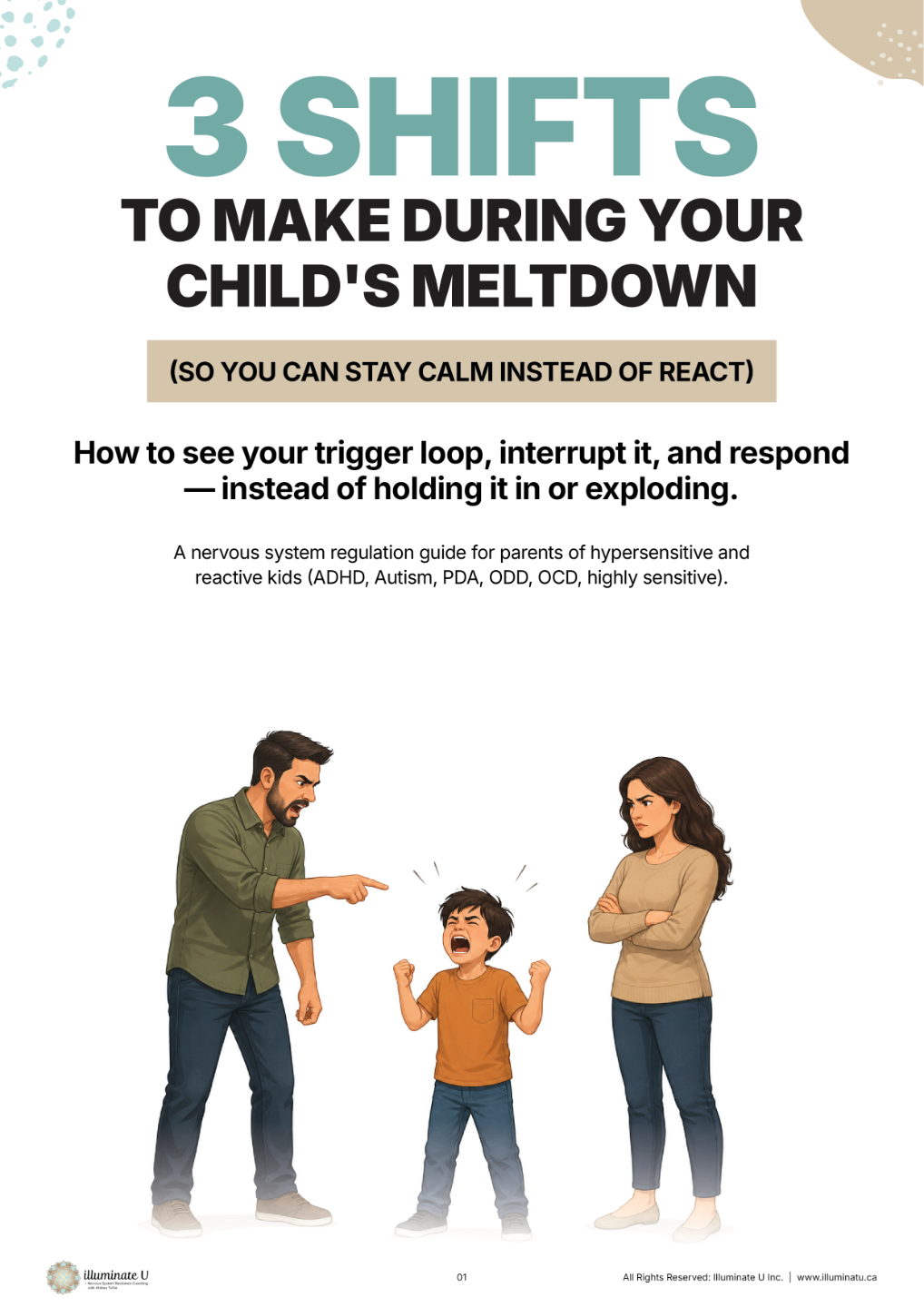
Free: The 3 Shifts Guide
The trigger loop and 3 patterns you get stuck in during meltdowns — and how to shift them so you can stay calm instead of react.
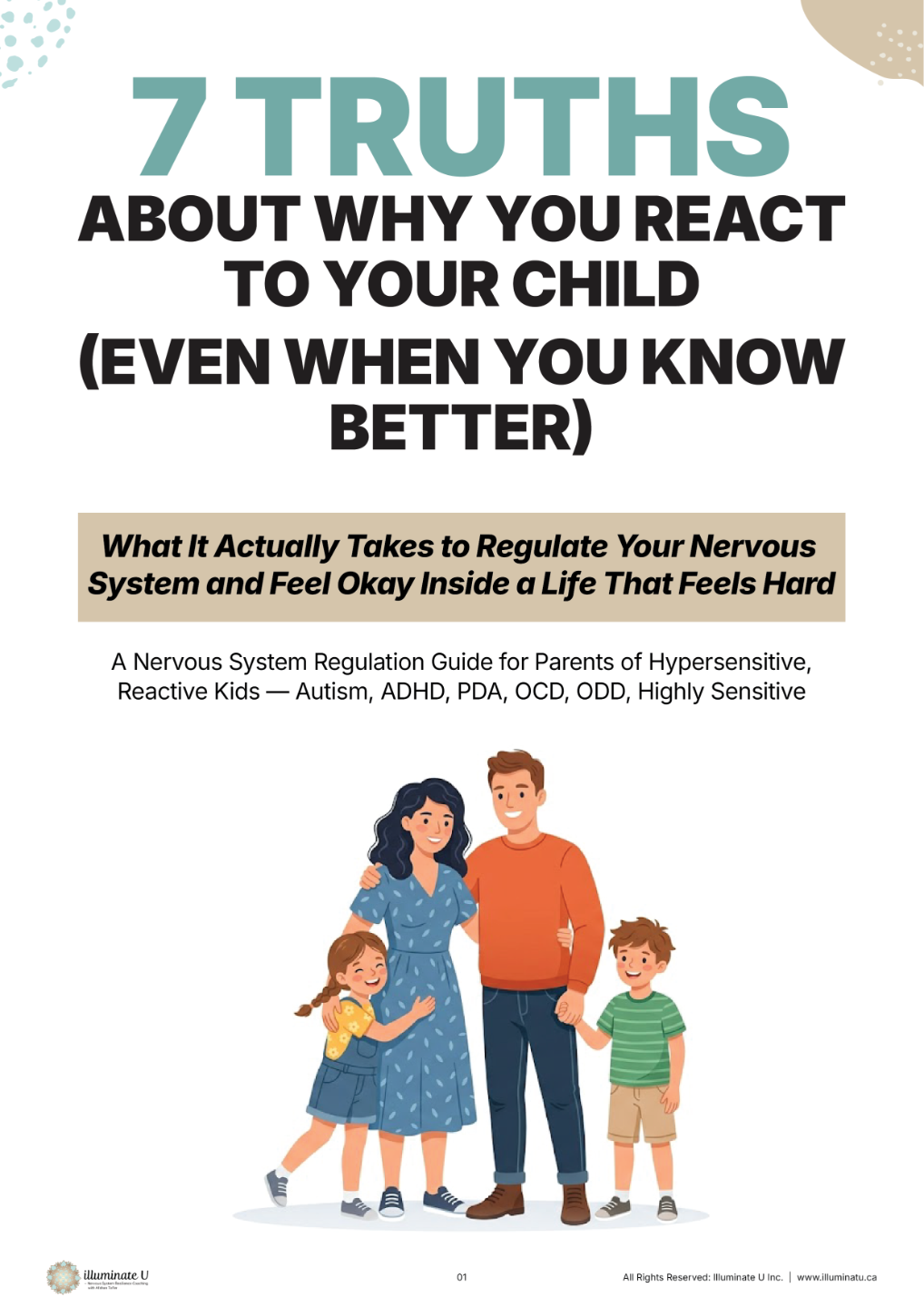
Free: 7 Truths About Why You React to Your Child Guide
Why you react even when you know better — the conditioning, nervous system states, hidden beliefs and patterns, and buried emotions running the show.

