
7 Ways to Support Your Nervous System When You’re With Your PDA Child All Day

**You can also listen to this in audio format only on The Regulated Mother Podcast on Apple or Spotify. Look for Episode #28
**Below is the blog article for easy reading.
The Invisible Load of Being With Your PDA Child All Day
If you spend the entire day with your PDA or high-needs child, you might notice that it’s not just the behaviors and the triggering that exhaust you—it’s how much of yourself you have to hold together internally just to keep going.
By the end of the day, you may feel wiped out, resentful, or completely empty, without fully understanding why. Not because you did something wrong—but because your system has been working hard in ways that are mostly invisible.
In this episode, I want to slow that experience down and help you understand what’s actually happening inside you when you’re with your child all day—and how small, realistic ways of supporting yourself can completely change you from feeling completely depleted to feeling more fulfilled.
When Parenting Becomes an All-Day Nervous-System Experience
If you’re exhausted after spending the whole day with your child, you are not doing anything wrong.
This is especially true if you’re parenting a PDA or high-needs child—a child who needs a lot of autonomy, control, flexibility, and nervous system support. Our PDA kids often require a level of attunement and co-regulation that is intense, sustained, and deeply personal.
This can be especially noticeable during the holidays, when routines change and school is out. And for many parents, this is also the daily reality when their child doesn’t attend school at all.
Feeling drained, overwhelmed, or wiped out by the end of the day isn’t a sign that you’re failing. It’s a nervous system response to sustained demand, responsibility, and stress.
Let’s name why this can feel so hard—and then talk about how to support yourself in ways that actually help.
Why Being With Your Child All Day Can Feel So Exhausting
1. You Activate When Your Child Activates
Parents are biologically wired to attune to their children.
So when your child becomes anxious, dysregulated, controlling, or overwhelmed, your nervous system reacts too. This isn’t a lack of resilience—it’s how we’re designed. We are meant to feel our children, mirror their internal state, and then blend our regulated energy with theirs to help guide their nervous systems back toward regulation.
The challenge is that over the course of a full day, this cycle of your child activating and your body mounting a stress response can happen again and again.
Each time your child activates, your nervous system responds. And because you still need to function, support your child, and keep things moving, you often hold your own reactions inside rather than letting them fully complete.
With little opportunity to recover between these moments, stress load begins to accumulate in the body. Much of this activation gets held in rather than released. By the end of the day, this can register as bone-deep exhaustion, irritability, emotional numbness, or the sense that you have nothing left to give.
2. You’re Constantly Co-Regulating
Co-regulation takes energy.
In theory, when we co-regulate, there is meant to be some sense of return on the energy we give. Our nervous system offers steadiness, presence, and regulation, and over time we usually receive feedback that our presence is helping. That feedback—seeing or feeling another nervous system settle—supports our own system and helps replenish the energy we’re using.
But for many parents of PDA children, this reciprocity is delayed, inconsistent, or often absent.
Instead, parents frequently find themselves over-efforting to keep their child regulated—tracking cues, staying calm at all costs, adjusting tone, anticipating triggers, offering reassurance, preventing escalation. This is all nervous-system labor. Even when nothing dramatic is happening, your system may be working very hard in the background to maintain stability.
This level of sustained attunement is taxing, especially without breaks.
The nervous system is designed to socially engage and then step out of engagement to recover. It is also designed to regulate more easily when we receive feedback that our regulation is landing. When that feedback isn’t there—as is often the case with PDA children—parents end up working much harder to keep things steady while not receiving the small hits of oxytocin and dopamine that normally signal connection, nourishment, and relief.
Over time, this can leave parents feeling depleted and exhausted—not because they’re doing co-regulation wrong, but because your nervous system is giving far more than it has the opportunity to recover from.
3. Your Nervous System Loses a Sense of Choice or Escape
When you’re with your child all day—especially during the holidays or when school isn’t an option—your nervous system can begin to feel trapped.
There may be no clear breaks, no handoff, no place to step away. Even when you love your child deeply, your body can still experience this as choicelessness.
For the nervous system, lack of choice is a cue of danger.
When choice goes offline, the body often shifts into a protective state. You may notice yourself bracing, holding it together, or pushing through. Irritability or emotional numbness can creep in. Many parents enter a kind of functional freeze—continuing to show up and do what’s needed, but at a significant internal cost.
By the end of the day, this often registers as a deep, hard-to-explain exhaustion that isn’t relieved by rest alone.
This isn’t about wanting to escape your child. It’s about your nervous system needing to know that it still has options, agency, and support—even when circumstances are genuinely limiting.
4. Your Own Needs Get Pushed Aside
When your child needs you throughout the day, it becomes easy—almost automatic—to override your own body’s signals.
You may ignore hunger, delay going to the bathroom, push past fatigue, or stay in your head to keep functioning rather than dropping into your body. In the moment, this can feel necessary. Over time, though, it creates a quiet depletion that builds beneath the surface.
Because these needs are small and constant, the cost often isn’t obvious right away. But hour by hour, your nervous system learns that your signals don’t matter as much as everyone else’s—and that ongoing self-override contributes significantly to the exhaustion you feel by the end of the day.
5. Your Nervous System Shifts Into Functional Freeze to Keep You Going
When the demands don’t let up and your needs and choices keep getting pushed aside, many parents’ nervous systems adapt by shifting into functional freeze.
Functional freeze can look like calm on the outside, but it isn’t true calm. It’s more like activation being clamped down on. Beneath the surface, your nervous system is still highly activated, but that energy is being held in so you can keep functioning, stay composed, and meet everyone else’s needs.
This takes a tremendous amount of energy.
In this state, stress doesn’t move through the body—it gets trapped. You may notice jaw clenching, tightness in the shoulders or chest, shallow breathing, or the familiar feeling of being wired and exhausted at the same time.
Functional freeze isn’t a failure or a coping flaw. It’s a survival strategy that allows you to keep showing up when rest, relief, or support aren’t available. The cost is that your system is working overtime to hold everything together, which contributes to the deep exhaustion many parents feel by the end of the day.
6. Negativity Bias Creeps In
When the nervous system is under strain, the brain naturally shifts into problem-scanning mode. This is known as negativity bias, and it’s a survival response—not a personality flaw.
Around a child who activates frequently, your brain may stay focused on what could go wrong, what needs managing next, or what isn’t working. In this state, it becomes much harder to notice moments of ease, neutrality, or connection, even when they are present.
This doesn’t mean you’re negative or ungrateful. It means your nervous system is prioritizing safety and predictability, and your perception narrows as a result.
7. Expectations Add Another Layer of Stress
On top of all of this, expectations often add a quieter but significant layer of pressure.
Holding onto how the day should go—what you hoped for, what you planned, how things used to be, or how you think it’s supposed to look—creates internal friction when reality doesn’t match. That ongoing mismatch asks your nervous system to hold disappointment, frustration, and self-judgment alongside everything else it’s already managing.
When expectations remain rigid, the system stays in a state of resistance. When they soften, the nervous system often does too.
When you understand what your nervous system is carrying all day, the question naturally becomes: how do you support yourself within this reality, rather than pushing through it?
How to Support Yourself So the Day Feels More Fulfilled and Less Depleting
This isn’t about fixing the day or making things easy.
It’s about working with your nervous system instead of overriding it.
1. Let Go of Expectations and Practice Allowing What Is
Letting go of expectations isn’t giving up—it’s regulating.
When you soften your attachment to how the day should look and meet what is, your nervous system receives the message: I don’t have to fight reality.
That alone can reduce internal resistance, lower stress hormones, and create more flexibility and presence.
2. Keep Choice Online—Including the Choice to Support Yourself With Compassion
When you can’t physically leave or take a full break, the goal becomes keeping choice online in your nervous system. Choice helps the nervous system feel safe because you feel you have some agency and control.
Choice doesn’t have to be big to matter.
It can look like choosing to sit instead of stand, choosing to close your eyes for 30 seconds, choosing when and how you respond, or choosing a regulating movement.
And sometimes, the most powerful choice is choosing self-compassion.
Offering yourself kindness—rather than judgment—creates a felt sense of support in the body. This might sound like:
- “This is really hard, and I’m doing my best.”
- “Of course I’m tired—this is a lot.”
When self-compassion is present, the nervous system no longer feels alone inside the stress. That felt sense of being supported—by yourself—can shift the body out of freeze and reduce the depletion that comes from feeling trapped.
Sometimes it can help to name the choice directly:
“I’m choosing to be here right now, and I’m also choosing to support myself while I do.”
3. Notice When You’re Mounting Stress Load—and Help It Release
When your child activates, notice what happens in your body.
Do you brace? Tighten your jaw? Hold your breath?
These are signs stress load is building.
Can you interrupt that pattern by:
- Shaking out your body
- Rolling your shoulders
- Stretching
- Sitting or lying down for a few minutes to let your body feel safe again
When you come into the body and help it feel safe, then stress load naturally gets released instead of carried all day.
4. After Meltdowns, Let Your Body Fully Come Back Down
After a meltdown or intense moment, it’s tempting to scroll, distract yourself, or jump straight into tasks.
But your nervous system needs completion.
Giving yourself five quiet minutes to breathe, soften, and let your body settle teaches your system: The danger has passed. It’s safe to rest now.
This is when stress naturally discharges, helping you regenerate for the next challenge.
5. Practice Dual Awareness While Co-Regulating
When co-regulating, many parents lose themselves entirely in their child.
Dual awareness means holding awareness of your child’s nervous system and your own.
This allows you to meet your needs in small but meaningful ways—taking a sip of water, eating when hungry, going to the bathroom when you notice the urge, or resting your eyes for a minute.
Even tiny moments of self-support can prevent resentment and burnout.
For rest, ask:
Can I take two minutes to drop into my body instead of staying in my head?
I like using the practices of grounding (feeling your feet on the floor or seat in your chair, orienting or looking around the room and noticing and naming 5-10 things to help your brain see the present moment is safe, giving myself some sort of felt sense of comfort or support, like wrapping myself in a blanket or giving myself a self-hug to create the felt sense of being supported—even in the middle of a busy day.
6. Let Moments of Connection Nourish You
When you’re stressed, it’s easy to miss moments of genuine connection. It’s important to take those moments in and let them land for at least 30 seconds as they can nourish your nervous system so much.
When you notice and really take in moments of shared calm, laughter, or closeness, your body releases oxytocin and dopamine—chemicals that reduce stress and restore motivation and meaning.
Let yourself feel these moments and let yourself linger in them. They matter.
7. Intentionally Notice Glimmers
Glimmers are the small, positive, comforting, or nourishing moments that help your nervous system feel safe, supported, and at ease. They are often subtle, but they matter deeply.
When you’re under chronic stress, however, these moments are easy to miss. Stress causes the brain’s negativity bias to take over. Negativity bias isn’t a flaw—it’s a survival response. But when it runs unchecked, it can narrow your focus so that all you can see are the challenges and difficulties in your day.
You can gently counter this by intentionally noticing glimmers throughout the day. This might be sunlight through a window, a tree outside, the feeling of a warm blanket, the softness of your child’s hand, or a small sign of ease in your child.
Let your eyes rest there for a few seconds. Let your body register it.
Doing this helps your nervous system experience safety alongside challenge. It reminds your system that even though parts of the day are hard, there is also goodness, comfort, and support present. Over time, this helps your nervous system stay more flexible and better able to meet the challenges of the day with greater ease.
You Are Doing Something Very Demanding—and Very Meaningful
Spending the day supporting a PDA or high-needs child asks a lot of you, often in ways that aren’t immediately visible. Much of that effort we put into our days mounts a lot of quiet stress load in the body.
Becoming aware of what’s happening inside you—and learning small, realistic ways to support yourself within these demanding circumstances—can change how the day is experienced. You’re not changing your child or the reality you’re in; you’re changing how you meet yourself inside it, restoring a sense of control and agency where it’s been missing.
The goal isn’t a perfect day or an easy one. It’s the difference between ending the day feeling exhausted, depleted, and resentful—or ending it feeling more fulfilled, more resourced, and more connected to yourself, even after a hard day.
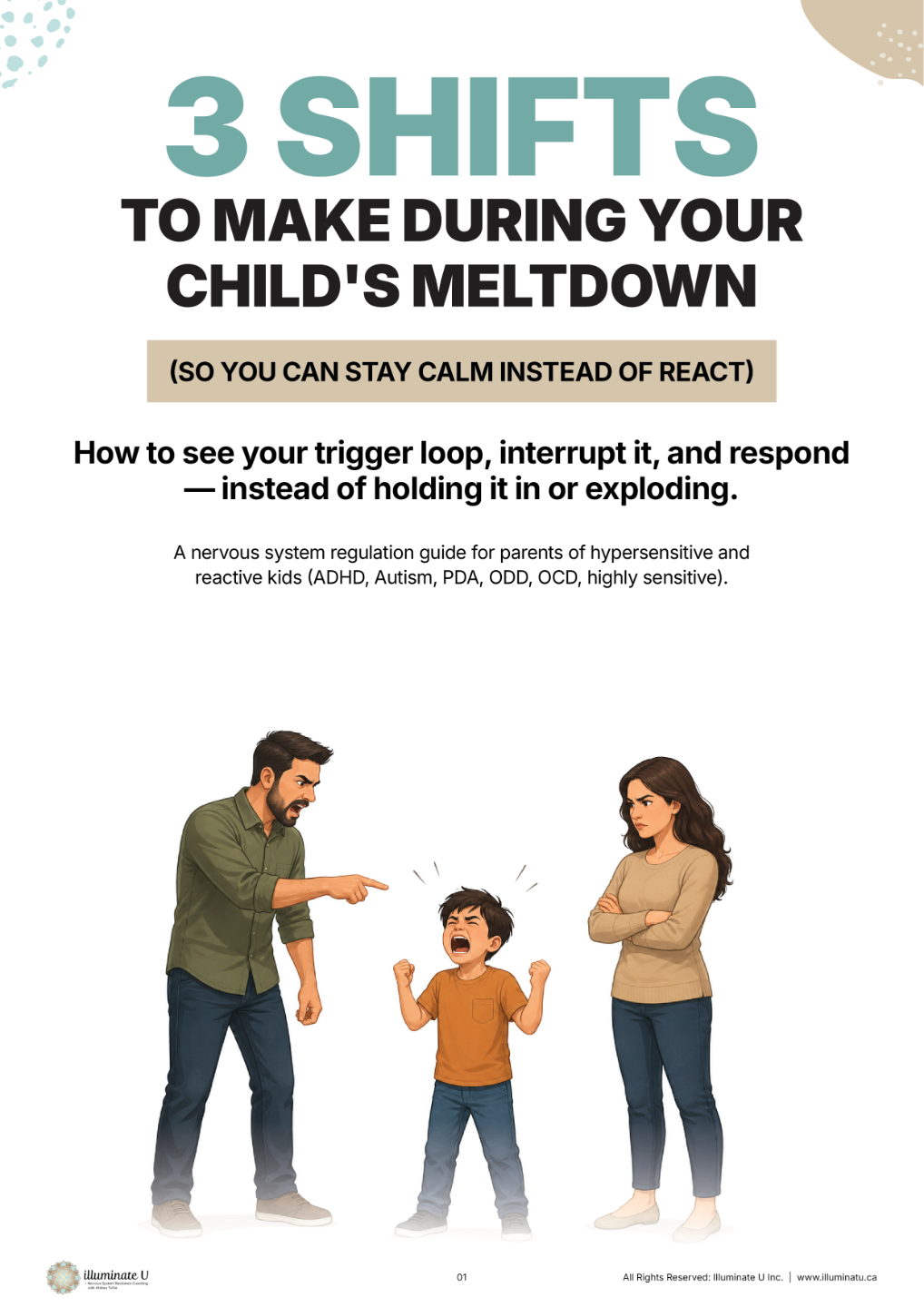
Free: The 3 Shifts Guide
The trigger loop and 3 patterns you get stuck in during meltdowns — and how to shift them so you can stay calm instead of react.
Free: 7 Truths About Why You React to Your Child Guide
Why you react even when you know better — the conditioning, nervous system states, hidden beliefs and patterns, and buried emotions running the show.

